
Cisco 300-620 Practice Exams
Last updated on Nov 16,2026- Exam Code: 300-620
- Exam Name: Implementing Cisco Application Centric Infrastructure (DCACI)
- Certification Provider: Cisco
- Latest update: Nov 16,2026
An engineer is implementing a connection that represents an external bridged network.
Which two configurations are used? (Choose two.)
- A . Layer 2 remote fabric
- B . Layer 2 outside
- C . Layers 2 internal
- D . Static path binding
- E . VXLAN outside
B, D
Explanation:
When implementing a connection that represents an external bridged network, the configurations used are Layer 2 outside (Option B) and Static path binding (Option D)12. Layer 2 outside is typically used to connect a bridged external network trunk switch to a leaf switch in the ACI fabric, while static path binding is used to assign specific ports on a leaf switch to an external bridged network12.
Refer to the exhibit.
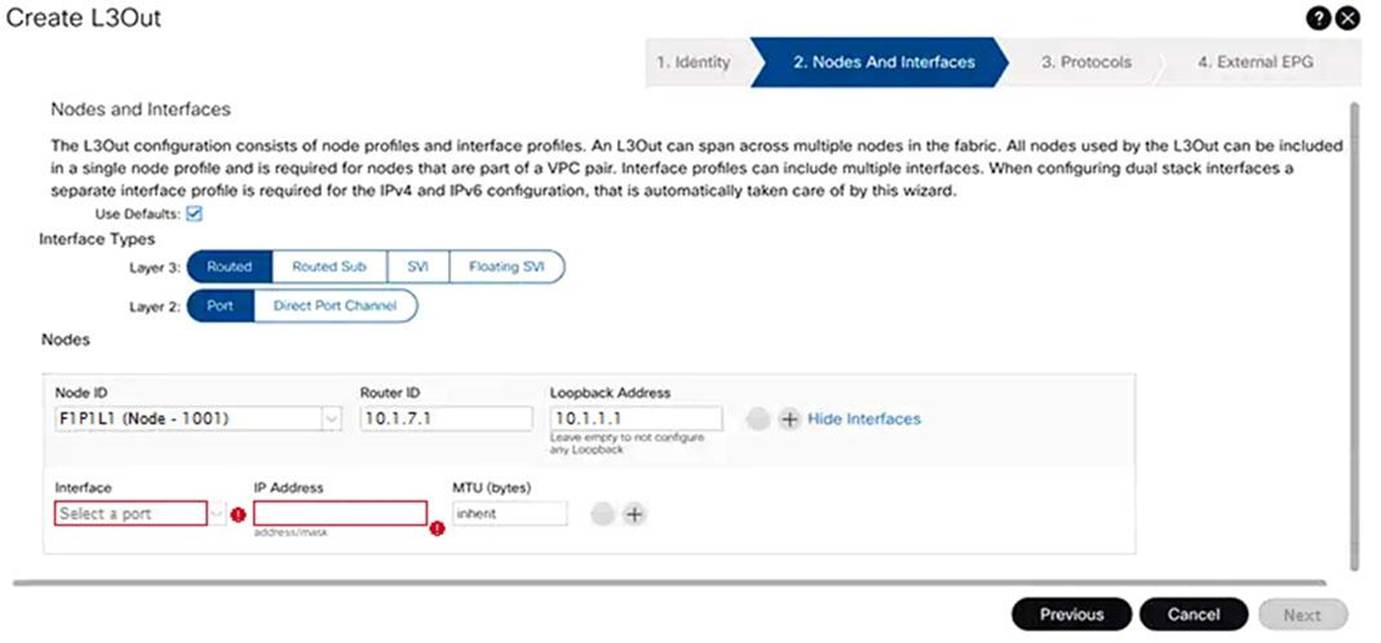
An engineer must configure an L3Out peering with the backbone network. The L3Out must forward unicast and multicast traffic over the link.
Which two methods should be used to configure L3Out to meet these requirements? (Choose two.)
- A . Layer 3 routed port
- B . VPC with SVI
- C . port channel with SVI
- D . Layer 3 routed subinterface
- E . Layer 3 floating SVI
A, D
Explanation:
To configure an L3Out peering with the backbone network that must forward both unicast and multicast traffic, the two methods that should be used are:
Layer 3 routed port (Option A): This method involves configuring a physical port on the Cisco ACI leaf switch as a Layer 3 interface, which is suitable for routing unicast and multicast traffic.
Layer 3 routed subinterface (Option D): This method involves configuring a subinterface under a physical port, which allows for traffic segregation and routing over the same physical link, supporting both unicast and multicast traffic.
These methods ensure that the L3Out can handle the required traffic types and maintain proper routing with the backbone network.
https://www.cisco.com/c/en/us/solutions/collateral/data-center-virtualization/application-centricinfrastructure/guide-c07-743150.html#_L3Out_sStatic_rRoutes
https://www.cisco.com/c/en/us/td/docs/switches/datacenter/aci/apic/sw/4-x/L3-configuration/Cisco-APIC-Layer-3-Networking-Configuration-Guide-401/Cisco-APIC-Layer-3-Networking-Configuration-Guide-401_chapter_010010.html

An engineer must deploy Cisco ACI across 10 geographically separated data centers.
Which ACI site deployment feature enables the engineer to control which bridge domains contain Layer 2 flooding?
- A . GOLF
- B . Multi-Site
- C . Multi-Pod
- D . Stretched Fabric
B
Explanation:
The Cisco ACI site deployment feature that enables an engineer to control which bridge domains contain Layer 2 flooding across geographically separated data centers is Multi-Site. This feature allows for the extension of Layer 2 and Layer 3 connectivity between different locations with consistent policy enforcement5.
https://www.cisco.com/c/en/us/td/docs/switches/datacenter/aci/aci_multi-site/sw/2x/fundamentals/Cisco-ACI-Multi-Site-Fundamentals-Guide-211/Cisco-ACI-Multi-Site-Fundamentals-Guide-211_chapter_011.html#id_51188
Refer to the exhibit.
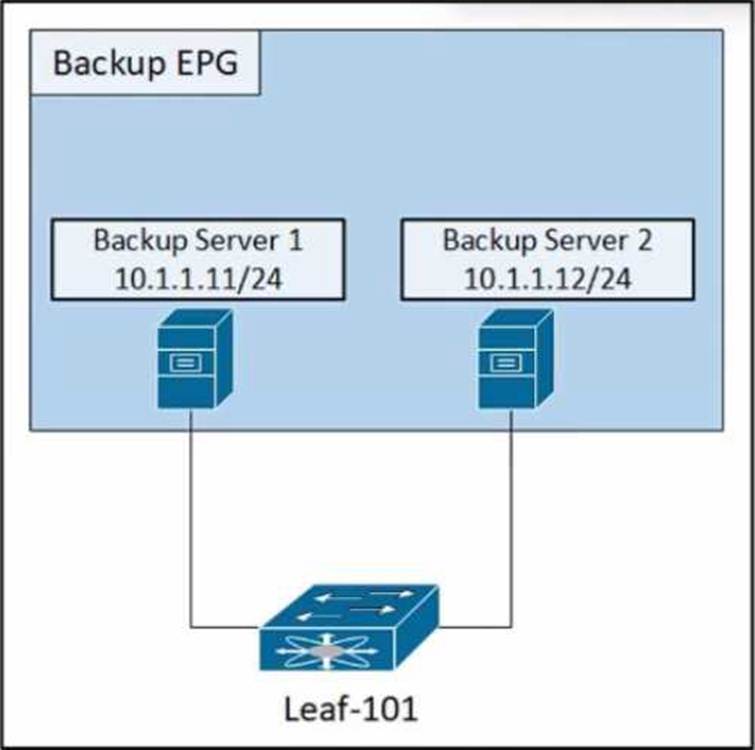
An engineer must disable the communication between the two backup servers in the backup EPG.
Which action accomplishes this goal?
- A . Set Preferred Group Member to Excluded.
- B . Set the physical domain to None.
- C . Set a different static binding for the encap VLAN.
- D . Set Intra EPG Isolation to Enforced.
D
Explanation:
In Cisco ACI, Intra-EPG Isolation is a feature that prevents communication between endpoints within the same EPG. By default, endpoints in the same EPG can communicate freely without requiring contracts. To disable communication between two backup servers within the same EPG (e.g., in the "Backup EPG"), you need to enforce Intra-EPG Isolation.
Which type of policy configures the suppression of faults that are generated from a port being down?
- A . fault lifecycle assignment
- B . event lifecycle assignment
- C . fault severity assignment
- D . event severity assignment
C
Explanation:
The type of policy that configures the suppression of faults generated from a port being down is the ‘fault severity assignment’ policy. This policy allows administrators to change the severity of a fault
or suppress it altogether, which can be useful for managing expected faults and reducing noise from non-critical events
Reference: https://www.cisco.com/c/en/us/td/docs/switches/datacenter/aci/apic/sw/all/faults/guide/b_APIC_Faults_Errors/b_IFC_Faults_Errors_chapter_01.html
Which two hardware models are supported as fixed spine in Cisco ACI fabrics? (Choose two.)
- A . Cisco Nexus 9508
- B . Cisco Nexus 9236C
- C . Cisco Nexus 9364C
- D . Cisco Nexus 9336C-FX2
- E . Cisco Nexus 9332C
Cisco ACI fabric is integrated with VMware VDS. The fabric must apply a security policy to check the integrity of traffic out of the network adapter.
Which action must be taken to drop the .. when the ESXi host discovers a mismatch between the actual source MAC address transmitted by the guest operating system and the effective MAC address of the virtual machine ….?
- A . Reject MAC changes.
- B . Accept forged transmits.
- C . Accept MAC changes.
- D . Reject forged transmits.
B
Explanation:
https://docs.vmware.com/en/VMware-vSphere/7.0/com.vmware.vsphere.security.doc/GUID-7DC6486F-5400-44DF-8A62-6273798A2F80.html
An engineer configures a Cisco ACI Multi-Pod for disaster recovery.
Which action should be taken for
the new nodes to be discoverable by the existing Cisco APICs?
- A . Configure IGMPv3 on the interfaces of IPN routers that face the Cisco ACI spine.
- B . Enable subinterfaces with dot1q tagging on all links between the IPN routers.
- C . Enable DHCP relay on all links that are connected to Cisco ACI spines on IPN devices.
- D . Configure BGP as the underlay protocol in IPN.
C
Explanation:
For the new nodes in a Cisco ACI Multi-Pod deployment to be discoverable by the existing Cisco APICs, DHCP relay should be enabled on all links that are connected to Cisco ACI spines on Inter-Pod Network (IPN) devices. This allows the APICs to dynamically assign IP addresses to the new nodes, facilitating their discovery and integration into the fabric.
Reference: Cisco ACI Multi-Pod Configuration Guide
Cisco ACI Best Practices Guide
Refer to the exhibit.
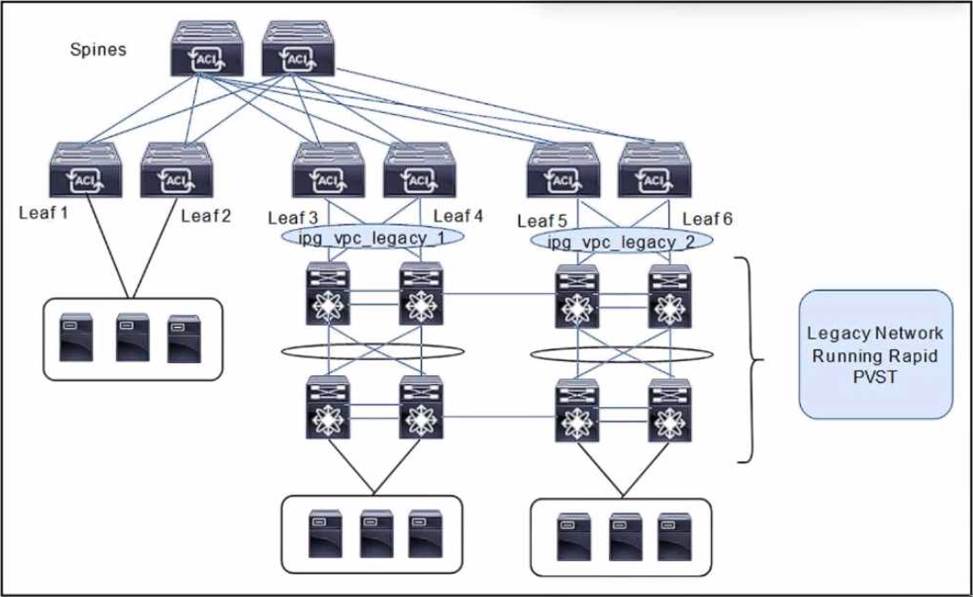
A client is configuring a new Cisco ACI fabric. All VLANs will be extended during the migration phase using the VPC connections on leaf switches 3. 4 and leaf switches toward the legacy network.
The migration phase has these requirements;
* If The legacy switches must be able to transfer BPDUs through the ACI fabric.
* If the legacy switches fail to break a loop. Cisco ACI must break the loop.
Which group settings must be configured on VPC interface policy groups ipg_vpc-legacy_1 and ipg_vpc-legacy_2 to meet these requirements?
- A . MCP: enabled
BPDU Guard: enabled
BPDU Filter: disabled - B . MCP: enabled
BPDU Guard: disabled
BPDU Filter: disabled - C . MCP: disabled
BPDU Guard: disabled
BPDU Filter: enabled - D . MCP: disabled
BPDU Guard: enabled
BPDU Filter enable
Refer to the exhibit.
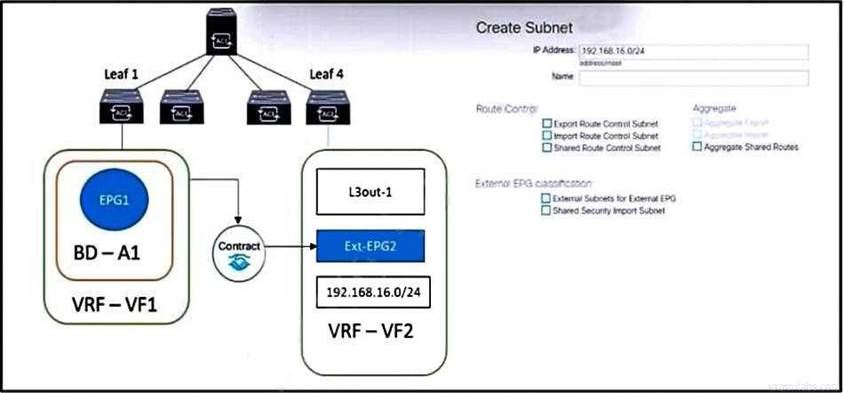
The external subnet and internal EPG1 must communicate with each other, and the L3Out traffic must leak into the VRF named "VF1".
Which configuration set accomplishes these goals?
- A . Export Route Control Subnet
Import Route Control Subnet
Aggregate Shared Routes - B . External Subnets for External EPG
Shared Route Control Subnet
Shared Security Import Subnet - C . External Subnets for External EPG
Import Route Control Subnet
Shared Route Control Subnet - D . Export Route Control Subnet
Shared Security Import Subnet
Aggregate Shared Routes
B
Explanation:
To enable communication between the external subnet and internal EPG1, and to allow L3Out traffic to leak into the VRF named “VF1”, the following configuration set should be used:
External Subnets for External EPG: This configuration defines the subnets that are external to the ACI fabric but need to be reachable from within the fabric. It is necessary to specify which subnets are to be considered part of the L3Out1.
Shared Route Control Subnet: This setting allows the subnets to be shared across different VRFs, enabling communication between EPGs that are in different tenants but within the same VRF1.
Shared Security Import Subnet: This configuration ensures that the security policies (contracts) associated with the shared subnets are also imported, allowing for the necessary traffic to flow between the internal and external endpoints1.
By applying this configuration set, the external subnet and internal EPG1 will be able to communicate, and the L3Out traffic will be properly leaked into the designated VRF, meeting the specified goals.
Reference: ACI Inter VRF/Tenant Route Leaking Configuration Example1