
Cisco 300-620 Practice Exams
Last updated on Nov 16,2026- Exam Code: 300-620
- Exam Name: Implementing Cisco Application Centric Infrastructure (DCACI)
- Certification Provider: Cisco
- Latest update: Nov 16,2026
Cisco ACI fabric must send a packet between two pods in a Cisco AC1 Multi-Pod topology where ARP flooding is disabled within the bridge domain.
How does a Cisco ACI spine switch .. ARP messages from a leaf switch in POD1 to POD2?
- A . The ARP message is dropped and connectivity is lost between the endpoints.
- B . ARP optimization is applied and sends ARP to remote anycast.
- C . A proxy ARP message is sent to destination group 225.224.0.0.
- D . An ARP Glean message is sent to multicast address 239.255.255.240.
Refer to the exhibit.
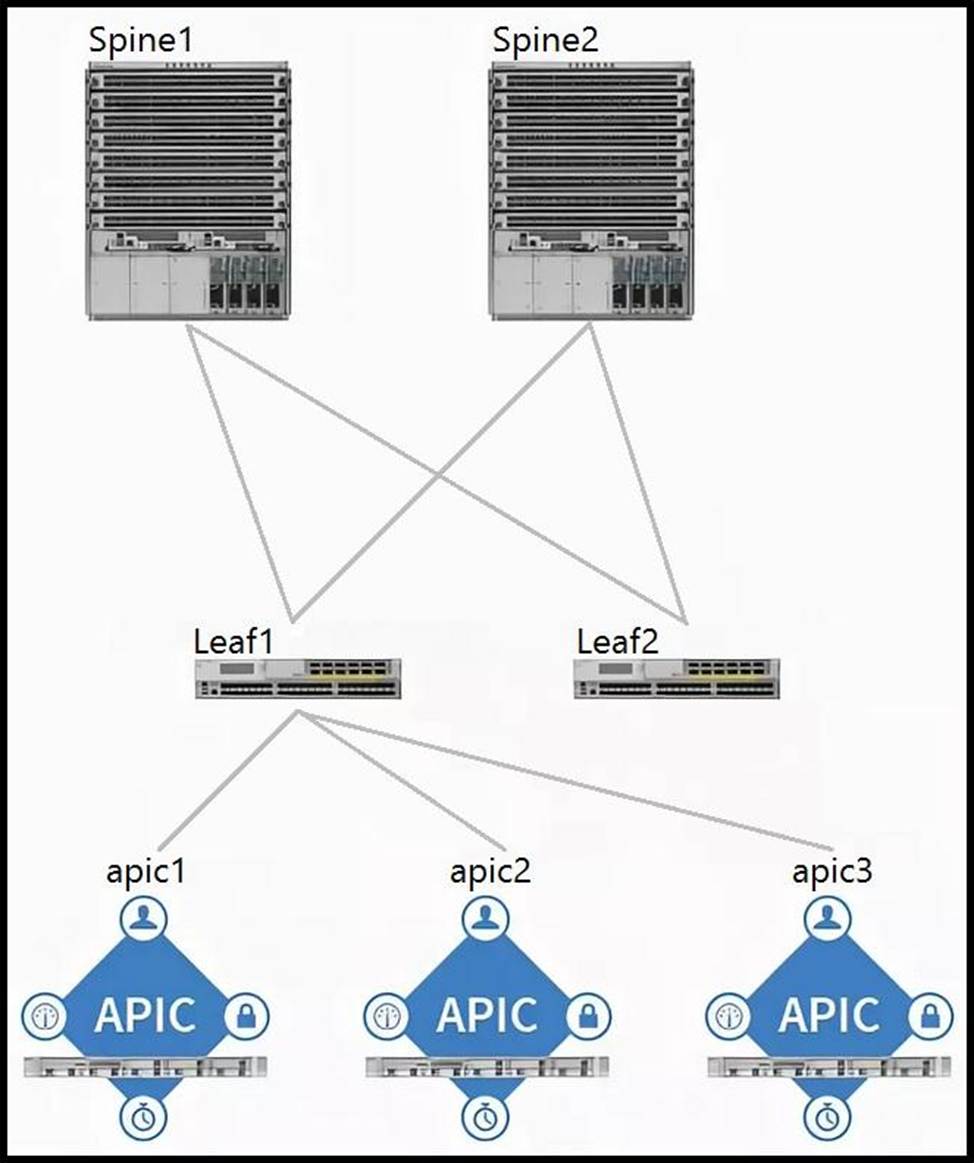
Which two components should be configured as route reflectors in the ACI fabric? (Choose two.)
- A . Spine1
- B . apic1
- C . Spine2
- D . Leaf1
- E . Leaf2
- F . apic2
A, C
Explanation:
In a Cisco ACI fabric, the spine switches are typically configured as route reflectors. This is because spine switches are central to the fabric’s architecture and are responsible for interconnecting all the leaf switches, making them ideal for reflecting BGP routes within the fabric.
Therefore, the components that should be configured as route reflectors are:
Spine1 (Option A)
Spine2 (Option C)
An engineer configures a one-armed policy-based redirect service Insertion for an unmanaged firewall.
The engineer configures these Cisco ACI objects:
• a contract named All_Tra c_Allowed
• a Layer 4 to Layer 7 device named FW-Device
• a policy-based redirect policy named FW-1Arm-Policy-Based RedirectPolicy
Which configuration set redirects the traffic to the firewall?
- A . Configure a policy-based redirect subject.
Associate the policy-based redirect subject with All_Tra c_Allowed. - B . Configure a firewall bridge domain.
Associate the bridge domain with FW-Device. - C . Configure a device interface policy.
Associate the device interface policy with FW-Device. - D . Configure a service graph.
Associate the service graph with All_Tra c_Allowed.
D
Explanation:
To redirect traffic to the firewall using a one-armed policy-based redirect service insertion, the following configuration set should be used:
Configure a service graph: This involves defining the service graph template that represents the logical flow of traffic through network services.
Associate the service graph with All_Traffic_Allowed: By associating the service graph with the contract named All_Traffic_Allowed, traffic that matches the contract will be redirected through the service graph to the firewall device.
Reference: Cisco ACI Fabric Administration Guide, Release 4.2(1)
Cisco ACI Virtualization Guide, Release 4.2(1)
Which description regarding the initial APIC cluster discovery process is true?
- A . The APIC uses an internal IP address from a pool to communicate with the nodes.
- B . Every switch is assigned a unique AV by the APIC.
- C . The APIC discovers the IP address of the other APIC controllers by using Cisco Discovery Protocol.
- D . The ACI fabric is discovered starting with the spine switches.
A
Explanation:
The initial APIC cluster discovery process involves each APIC using an internal private IP address from a pool to communicate with the nodes and other APICs in the cluster. The APICs discover the IP addresses of other APIC controllers through an LLDP-based discovery process
Reference: https://www.cisco.com/c/en/us/td/docs/switches/datacenter/aci/apic/sw/1-x/aci-fundamentals/b_ACI-Fundamentals/b_ACI-Fundamentals_chapter_010011.html
Which type of profile needs to be created to deploy an access port policy group?
- A . attachable entity
- B . Pod
- C . module
- D . leaf interface
A
Explanation:
To deploy an access port policy group within Cisco ACI, an attachable entity profile (AEP) needs to be created. An AEP is a policy construct that groups together various domains and allows them to be attached to the fabric access layer
Reference: https://www.cisco.com/c/en/us/td/docs/switches/datacenter/aci/apic/sw/1-x/Operating_ACI/guide/b_Cisco_Operating_ACI/b_Cisco_Operating_ACI_chapter_0110.html
An engineer must configure a group of servers with a contract that uses TCP port 80. The EGP that contains the web servers requires an external Layer 3 cloud to initiate communication.
Which action must be taken to meet these requirements?
- A . Configure the EGP as a provider and L3 out as consumer of the contract.
- B . Configure OSPF to exchange routes between the L3 out and EGP.
- C . Configure a taboo contract and apply it to the EPG.
- D . Configure the EPG as a consumer and L3 out as a provider of the contract.
D
Explanation:
To configure a group of servers with a contract that uses TCP port 80 and requires an external Layer 3 cloud to initiate communication, the EPG that contains the web servers should be configured as a consumer of the contract, and the Layer 3 Out (L3Out) should be configured as the provider of the contract. This configuration establishes the direction of the contract and allows the external Layer 3 cloud to initiate communication with the web servers within the EPG.
An engineer must add a group of 70 bare-metal ESXi servers to the Cisco ACI fabric, which is
integrated with vCenter.
These configuration steps are complete:
The configured pool of ESXi hosts is configured with an Attachable Access Entity Profile (AAEP) called AEP_VMM.
The new group uses the AAEP called AEP_BAREMETAL.
Which action extends functional VMM integration to the new nodes?
- A . Update AAEP to AEP_VMM on all policy groups that are used toward bare-metal servers.
- B . Create a new AAEP container object for policy groups for AEP_VMM.
- C . Implement a separate VMM domain for the bare-metal servers by using AEP_VMM.
- D . Add the VMM domain under the AEP_BAREMETAL AAEP object.
C
Explanation:
To extend functional VMM integration to the new group of 70 bare-metal ESXi servers, a separate VMM domain should be implemented using the AEP_VMM. This allows for the management and automation of network policies for the bare-metal servers in a manner similar to the virtualized environment managed by vCenter1.
On which two interface types should a user configure storm control to protect against broadcast traffic? (Choose two.)
- A . APIC facing interfaces
- B . port channel on a single leaf switch
- C . all interfaces on the leaf switches in the fabric
- D . endpoint-facing trunk interface
- E . fabric uplink interfaces on the leaf switches
B, D
Explanation:
Storm control should be configured on port channel on a single leaf switch (Option B) and endpoint-facing trunk interface (Option D) to protect against broadcast traffic6. These interfaces are where storm control policies are typically applied to prevent disruptions caused by traffic storms6.
Reference: https://www.cisco.com/c/en/us/td/docs/switches/datacenter/aci/apic/sw/2-x/L2_config/b_Cisco_APIC_Layer_2_Configuration_Guide/b_Cisco_APIC_Layer_2_Configuration_Guide_chapter_01010.html
An engineer is implementing an out-of-band (OOB) management access for the Cisco ACI fabric.
The secure access must meet these requirements:
• Only GUI and secure shell must be allowed to access the management interfaces of the ACIs.
• The only IP ranges that must be permitted to connect the fabric will be 10.10.10.0724 and 192.168.15.0/24.
Which configuration set meets these requirements?
- A . Implement HTTPS and SSH protocol filters in the OOB contract. Add the required subnets to the external network instance profile.
- B . Create an out-of-band EPG in the external management entity. Associate the management profile with the OOB contract.
- C . Set up static IPs on the management interfaces from the required IP range. Add the required subnets to the external network instance profile.
- D . Create an out-of-band EPG in the common tenant. Associate the external network instance profile with the OOB contract.
A
Explanation:
The engineer is implementing out-of-band (OOB) management access for the Cisco ACI fabric with the following requirements:
Only GUI (HTTPS) and Secure Shell (SSH) must be allowed to access the management interfaces.
Only IP ranges 10.10.10.0/24 and 192.168.15.0/24 must be permitted to connect.
This requires configuring access control and restricting IP ranges for OOB management.
Requirement Analysis
OOB management in ACI is typically handled via the Management Tenant (mgmt) and an OOB contract to define allowed protocols and sources.
The external network instance profile defines the permitted IP ranges for external access.
Option Evaluation
An engineer must ensure that Cisco ACI flushes the appropriate endpoints when a topology change notification message is received in an MST domain.
Which three steps are required to accomplish this goal? (Choose three.)
- A . Enable the BPDU interface controls under the spanning tree interface policy.
- B . Configure a new STP interface policy.
- C . Bind the spanning tree policy to the switch policy group.
- D . Associate the STP interface policy to the appropriate interface policy group.
- E . Create a new region policy under the spanning tree policy.
- F . Map VLAN range to MAT instance number.
A, C, D
Explanation:
To ensure that Cisco ACI flushes the appropriate endpoints when a topology change notification message is received in an MST domain, the three steps required are:
Enable the BPDU interface controls under the spanning tree interface policy (Option A)2.
Bind the spanning tree policy to the switch policy group (Option C)3.
Associate the STP interface policy to the appropriate interface policy group (Option D)3. These steps ensure that the ACI fabric responds correctly to STP events, such as topology changes, by flushing the MAC address table and the Local Station Table for the affected VLAN on the leaf switch4.