
Cisco 300-620 Practice Exams
Last updated on Nov 16,2026- Exam Code: 300-620
- Exam Name: Implementing Cisco Application Centric Infrastructure (DCACI)
- Certification Provider: Cisco
- Latest update: Nov 16,2026
Refer to the exhibit.
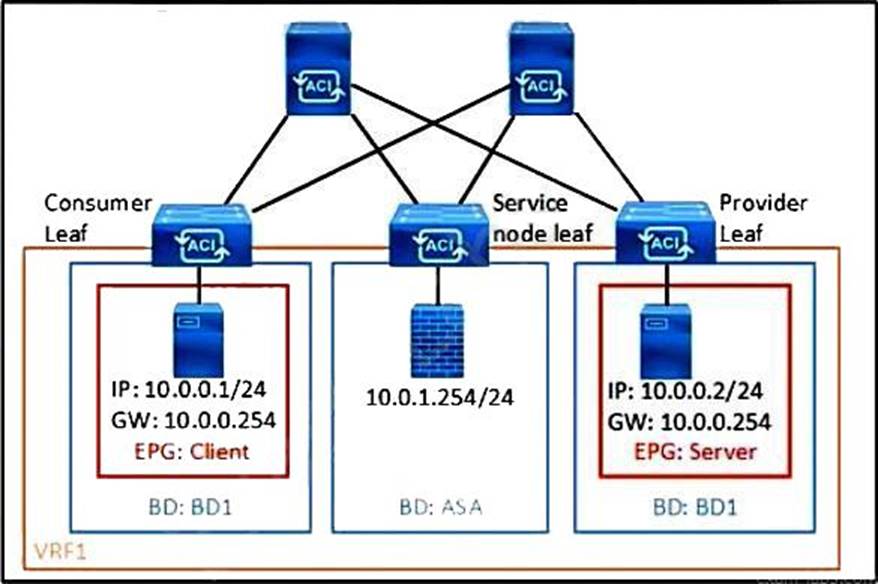
What must be configured in the service graph to redirect HTTP traffic between the EPG client and EPG server to go through the Cisco ASA firewall?
- A . precise filter to allow only HTTP traffic
- B . permit-all contract filter
- C . contract with no filter
- D . contract filter to allow ARP and HTTP.
A
Explanation:
To redirect HTTP traffic between the EPG client and EPG server through the Cisco ASA firewall using a service graph in Cisco ACI, a precise filter must be configured to allow only HTTP traffic. This filter will specify the protocol (HTTP) and the Layer 4 port (typically port 80 for HTTP) to ensure that only HTTP traffic is redirected to the firewall for inspection or processing. The service graph can then be associated with the relevant EPGs to enforce the redirection1.
Reference: Service Graph Design with Cisco ACI (Updated to Cisco APIC Release 5.2) White Paper
Which attribute should be configured for each user to enable RADIUS for external authentication in Cisco ACI?
- A . cisco-security domain
- B . cisco-auth-features
- C . cisco-aci-role
- D . cisco-av-pair
D
Explanation:
The attribute that should be configured for each user to enable RADIUS for external authentication in Cisco ACI is cisco-av-pair. This attribute allows for the assignment of roles and permissions to users authenticated via RADIUS.
Reference: https://www.cisco.com/c/en/us/td/docs/switches/datacenter/aci/apic/sw/2-0x/Security_config/
b_Cisco_APIC_Security_Configuration_Guide/b_Cisco_APIC_Security_Guide_chapter_01011.html
A customer is deploying a new application across two ACI pods that is sensitive to latency and jitter. The application sets the DSCP values of packets to AF31 and CS6, respectively.
Which configuration changes must be made on the APIC to support the new application and prevent packets from being delayed or dropped between pods?
- A . disable DSCP mapping on the IPN devices
- B . disable DSCP translation policy
- C . align the ACI QoS levels and IPN QoS policies
- D . align the custom QoS policy on the EPG site in the customer tenant
C
Explanation:
To support a new application that is sensitive to latency and jitter and sets the DSCP values of packets to AF31 and CS6, it is necessary to align the ACI Quality of Service (QoS) levels and Inter-Pod Network (IPN) QoS policies. This alignment ensures that the DSCP values are preserved and respected across the ACI fabric and the IPN, preventing packets from being delayed or dropped between pods.
Reference: Cisco ACI Multi-Site Architecture White Paper
Cisco ACI Best Practices Guide
Cisco ACI Quality of Service Configuration Guide
Refer to the exhibit.
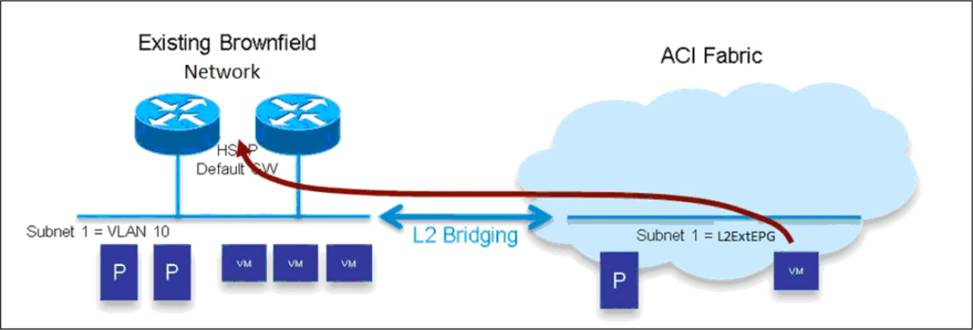
An engineer must migrate workloads from the brownfield network to the Cisco ACI fabric. The VLAN 10 default gateway remains in the router located in the brownfield Network. The bridge domain has already been associated with L20ut.
Which two actions must be taken to migrate the workloads? (Choose two.)
- A . Select Limit IP Learning to Subnet.
- B . Configure Multi-Destination Flooding Flood in Encapsulation.
- C . Set L2 Unknown Unicast Flood.
- D . Map the MAC address of the default gateway to the bridge domain
- E . Enable ARP Flooding
Refer to the exhibit.
An engineer must migrate workloads from the brownfield network to the Cisco ACI fabric. The VLAN 10 default gateway remains in the router located in the brownfield Network. The bridge domain has already been associated with L20ut.
Which two actions must be taken to migrate the workloads? (Choose two.)
- A . Select Limit IP Learning to Subnet.
- B . Configure Multi-Destination Flooding Flood in Encapsulation.
- C . Set L2 Unknown Unicast Flood.
- D . Map the MAC address of the default gateway to the bridge domain
- E . Enable ARP Flooding
An engineer is extending an EPG out of the ACI fabric using static path binding.
Which statement about the endpoints is true?
- A . Endpoints must connect directly to the ACI leaf port.
- B . External endpoints are in a different bridge domain than the endpoints in the fabric.
- C . Endpoint learning encompasses the MAC address only.
- D . External endpoints are in the same EPG as the directly attached endpoints.
D
Explanation:
When extending an EPG out of the ACI fabric using static path binding, it is true that external endpoints are in the same EPG as the directly attached endpoints8. This means that traffic received on a statically bound leaf port with a specific VLAN ID is mapped to the EPG, and the same policies applied to directly attached endpoints are enforced on the external endpoints8.
Cisco ACI fabric has three different endpoints S1, S2. and S3. These endpoints must communicate with each other without contracts.
These objects have been created in APIC:
• Two EPGs named DNS_EPG and Database_EPG
• Two application profiles. PROD_App and Data_App
• Two bridge domains DNS_BD and Database_BD
• PROD_APP and Database_BD mapped to Tenant PROD
• Data_App and DNS_BD mapped to Tenant Data
Which set of actions completes the fabric configuration?
- A . Add S1, S2, S3 under Database_EPG. MAP Database_EPG under PROD_ App. Associate Datbase_EPG with DNS_BD.
- B . Add S1, S2, S3, under DNS_EPG. MAP DNS_EPG to Data_App. Associate DNS_EPG with Dns_BD.
- C . Add S1, S2, S3 under DNS_EPG. MAP DNS_EPG to Data_App. Associate DNS_EPG with Database_BD.
- D . Add S1, S2, S3 under Database_EPG. MAP Database_EPG under Data_App. Associate Datbase_EPG with Database_BD.
Refer to the exhibit.
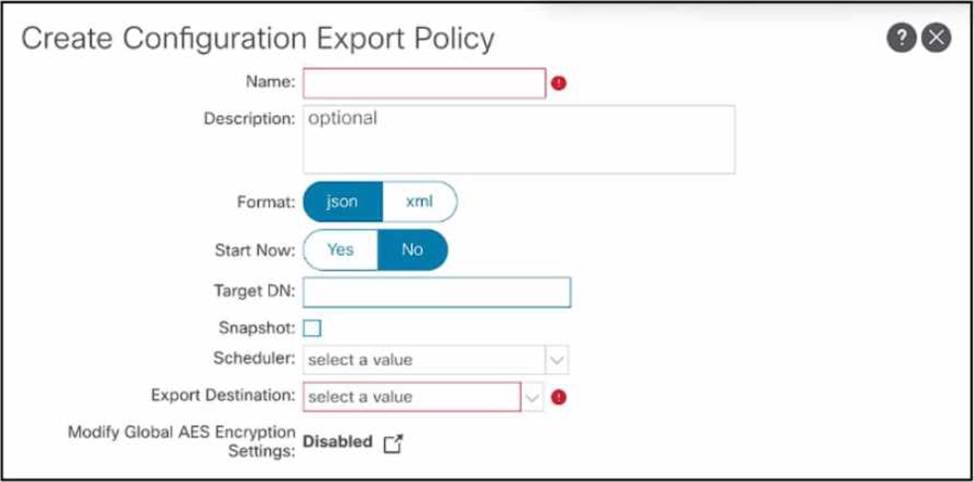
A network engineer must improve the configuration backup process and the configuration restore process. The current ACI solution is integrated with VMMs and third-y.. L4-L7 devices. The process requires that no additional information be re-entered when importing the configuration for a fully-functional state.
Which configuration configures the port policy?
- A . Enable the Global AES Encryption Setting.
- B . Select the JSON data format to be used when exporting
- C . Create target DNs for all tenants.
- D . Configure a local snapshot.
A
Explanation:
Enabling AES encryption ensures that sensitive data, such as credentials for VMMs and third-party integrations, is securely encrypted in the backup file. This is essential for a fully functional restore without requiring re-entry of sensitive details.
In the context of ACI Multi-Site, when is the information of an endpoint (MAC/IP) that belongs to site 1 advertised to site 2 using the EVPN control plane?
- A . Endpoint information is not exchanged across sites unless COOP protocol is used.
- B . Endpoint information is not exchanged across sites unless a policy is configured to allow communication across sites.
- C . Endpoint information is exchanged across sites as soon as the endpoint is discovered in one site.
- D . Endpoint information is exchanged across sites when the endpoints are discovered in both sites.
C
Explanation:
In the context of ACI Multi-Site, the information of an endpoint (MAC/IP) that belongs to site 1 is advertised to site 2 using the EVPN control plane as soon as the endpoint is discovered in one site. This allows for immediate visibility of the endpoint across sites.
Reference: https://www.cisco.com/c/en/us/solutions/collateral/data-center-virtualization/application-centric-infrastructure/white-paper-c11-739609.html#CiscoACIMultiSiteoverlaydataplane
Cisco ACI fabric must send a packet between two pods in a Cisco AC1 Multi-Pod topology where ARP flooding is disabled within the bridge domain.
How does a Cisco ACI spine switch .. ARP messages from a leaf switch in POD1 to POD2?
- A . The ARP message is dropped and connectivity is lost between the endpoints.
- B . ARP optimization is applied and sends ARP to remote anycast.
- C . A proxy ARP message is sent to destination group 225.224.0.0.
- D . An ARP Glean message is sent to multicast address 239.255.255.240.