
Cisco 300-620 Practice Exams
Last updated on Nov 16,2026- Exam Code: 300-620
- Exam Name: Implementing Cisco Application Centric Infrastructure (DCACI)
- Certification Provider: Cisco
- Latest update: Nov 16,2026
An engineer is in the process of discovering a new Cisco ACI fabric consisting of two spines and four leaf switches. The discovery of leaf 1 has just been completed.
Which two nodes are expected to be discovered next? (Choose two.)
- A . spine 1
- B . leaf 4
- C . spine 2
- D . leaf 3
- E . leaf 2
A, C
Explanation:
In the process of discovering a new Cisco ACI fabric, after the discovery of leaf 1 has been completed, the next nodes expected to be discovered are the spine switches. This is because the spines are typically connected to the leaf switches and play a central role in the fabric’s topology6.
Reference: https://www.cisco.com/c/en/us/td/docs/switches/datacenter/aci/apic/sw/2-x/GSG/b_APIC_Getting_Started_Guide_Rel_2_x/b_APIC_Getting_Started_Guide_Rel_2_x_chapter_0 100.pdf
Which action sets Layer 2 loop migration in an ACI Fabric with a Layer 2 Out configured?
- A . Enable MCP on the ACI fabric.
- B . Disable STP in the external network.
- C . Disable STP on the ACI fabric.
- D . Enable STP on the ACI fabric.
A
Explanation:
To set Layer 2 loop migration in an ACI Fabric with a Layer 2 Out configured, MCP (Misconfiguration Protocol) must be enabled on the ACI fabric56. MCP helps to prevent Layer 2 loops by detecting misconfigurations that could potentially cause loops56.
Which feature is used to program policy CAM on a leaf switch without sending traffic from VM to the leaf?
- A . immediate resolution immediacy
- B . immediate deployment immediacy
- C . on-demand deployment immediacy
- D . on-demand resolution immediacy
Which feature is used to program policy CAM on a leaf switch without sending traffic from VM to the leaf?
- A . immediate resolution immediacy
- B . immediate deployment immediacy
- C . on-demand deployment immediacy
- D . on-demand resolution immediacy
All workloads in VLAN 1001 have been migrated into EPG-1001. The requirement is to move the gateway address for VLAN 1001 from the core outside the Cisco ACI fabric into the Cisco ACI fabric. The endpoints in EPG-1001 must route traffic to endpoints in other EPGs and minimize flooded traffic in the fabric.
Which configuration set is needed on the bridge domain to meet these requirements?
- A . Disable ARP Flood
Disable Limn Endpoint Learning - B . Enable Hardware Proxy Enable Unicast Routing
- C . Disable Local IP Learning Limit Disable Unicast Routing
- D . Enable Flood
Enable Unicast Routing
B
Explanation:
To move the gateway address for VLAN 1001 from the core outside the Cisco ACI fabric into the Cisco ACI fabric and ensure that endpoints in EPG-1001 route traffic to endpoints in other EPGs while minimizing flooded traffic in the fabric, the following configuration set is needed on the bridge domain:
Enable Hardware Proxy: This step involves enabling the hardware proxy feature, which allows the fabric to learn and maintain endpoint information more efficiently7.
Enable Unicast Routing: This step involves enabling unicast routing within the bridge domain, which allows for the routing of traffic between different EPGs and minimizes flooded traffic
Which protocol is used in a Multi-Pod topology to synchronize reachability information across pods?
- A . IS-IS
- B . MP-BGP EVPN
- C . OSPF
- D . COOP
B
Explanation:
https://learnduty.com/cisco-aci/aci-multi-pod-overview-and-basics/
Refer to the exhibit.
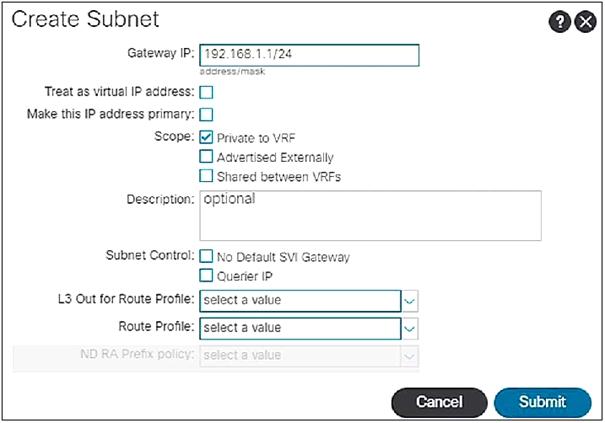
When the subnet is configured on a bridge domain, on which physical devices is the gateway IP address configured?
- A . all leaf switches and all spine nodes
- B . only spine switches where the bridge domain of the tenant is present
- C . only leaf switches where the bridge domain of the tenant is present
- D . all border leaf nodes where the bridge domain of the tenant is present
C
Explanation:
In Cisco Application Centric Infrastructure (ACI), when a subnet is configured on a bridge domain, the gateway IP address is configured on the leaf switches where the bridge domain of the tenant is present. This configuration allows for localized routing within the fabric, providing efficient east-west traffic handling without requiring traffic to traverse up to the spine nodes unless necessary for north-south routing or policy enforcement.
Reference: http://www.netdesignarena.com/index.php/2016/06/16/aci-tenant-building-blocks-forwarding-logic/
https://www.cisco.com/c/en/us/td/docs/switches/datacenter/aci/apic/sw/1-x/Operating_ACI/guide/b_Cisco_Operating_ACI/b_Cisco_Operating_ACI_chapter_0111.html

Refer to the exhibit.
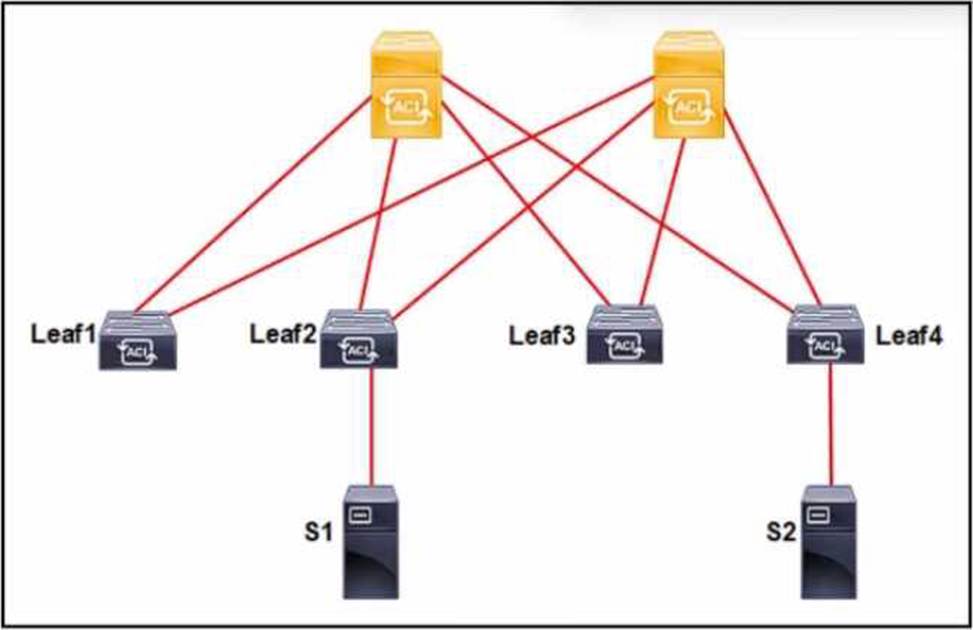
An application called App_1 is hosted on the server called S1. A silent host application. App_2. is hosted on S2.
Both applications use the same VLAN encapsulation, which action forces Cisco ACI fabric to learn App_2 on ACI leaf 2?
- A . Set Multi-Destination Flooding to Drop.
- B . Set Unicast Routing to Hardware Proxy.
- C . Set L2 Unknown Unicast to Flood.
- D . Set L3 Unknown Multicast to Optimized flood.
C
Explanation:
The scenario involves an application (App_1) on server S1 and a silent host application (App_2) on S2, both using the same VLAN encapsulation. The task is to force the ACI fabric to learn App_2 on Leaf-2. A silent host does not generate traffic, so special handling is needed.
Requirement Analysis
A silent host requires flooding (e.g., ARP or unknown unicast) to be learned by the fabric when it moves or is detected.
The goal is to ensure Leaf-2 learns App_2’s endpoint.
Option Evaluation
In a Cisco ACI Multi-Site fabric, the Inter-Site BUM Traffic Allow option is enabled in a specific stretched bridge domain.
What is used to forward BUM traffic to all endpoints in the same broadcast domain?
- A . ingress replication on the spines in the source site
- B . egress replication on the destination leaf switches
- C . egress replication on the source leaf switches
- D . ingress replication on the spines in the destination site
A
Explanation:
In a Cisco ACI Multi-Site fabric, when the Inter-Site BUM Traffic Allow option is enabled for a stretched bridge domain, ingress replication on the spines in the source site is used to forward Broadcast, Unknown unicast, and Multicast (BUM) traffic to all endpoints in the same broadcast domain. This method ensures that BUM traffic is replicated and sent out through the spines to the destination sites.
Which Cisco APIC configuration prevents a remote network that is not configured on the bridge domain from being learned by the fabric?
- A . enable Limit IP Learning to Subnet
- B . enable Unicast Routing
- C . enable IP Data-plane Learning
- D . enable ARP Flooding to BD
A
Explanation:
The Cisco APIC configuration that prevents a remote network that is not configured on the bridge domain from being learned by the fabric is to enable Limit IP Learning to Subnet2. This setting restricts IP address learning to only those subnets that are defined on the bridge domain2.
Reference: https://www.cisco.com/c/en/us/solutions/collateral/data-center-virtualization/application-centric-infrastructure/white-paper-c11-739989.html