
Cisco 300-620 Practice Exams
Last updated on Nov 16,2026- Exam Code: 300-620
- Exam Name: Implementing Cisco Application Centric Infrastructure (DCACI)
- Certification Provider: Cisco
- Latest update: Nov 16,2026
Refer to the exhibit.

A Cisco ACI fabric displays this fault.
Which set of actions modifies the event to be displayed as a warning in the future?
- A . Navigate to the ACI Events tab.
Create a new record. - B . Navigate to the ACI Fault tab.
Create a new record. - C . Navigate to the ACI Events tab.
Change the severity level. - D . Navigate to the ACI Fault tab.
Change the severity level.
D
Explanation:
To modify the event to be displayed as a warning in the future, you need to navigate to the ACI Fault tab and change the severity level of the fault. This involves selecting the monitoring object that corresponds to the class of the Managed Object (MO) that generated the fault, then choosing the fault code you want to modify and setting an initial severity value1.
Reference: Cisco APIC Faults, Events, and System Messages Management Guide2 How ACI Faults Are Generated and How to Selectively Prevent … – Cisco1
Refer to the exhibit.
A Cisco ACI fabric displays this fault.
Which set of actions modifies the event to be displayed as a warning in the future?
- A . Navigate to the ACI Events tab.
Create a new record. - B . Navigate to the ACI Fault tab.
Create a new record. - C . Navigate to the ACI Events tab.
Change the severity level. - D . Navigate to the ACI Fault tab.
Change the severity level.
D
Explanation:
To modify the event to be displayed as a warning in the future, you need to navigate to the ACI Fault tab and change the severity level of the fault. This involves selecting the monitoring object that corresponds to the class of the Managed Object (MO) that generated the fault, then choosing the fault code you want to modify and setting an initial severity value1.
Reference: Cisco APIC Faults, Events, and System Messages Management Guide2 How ACI Faults Are Generated and How to Selectively Prevent … – Cisco1
Refer to the exhibit.
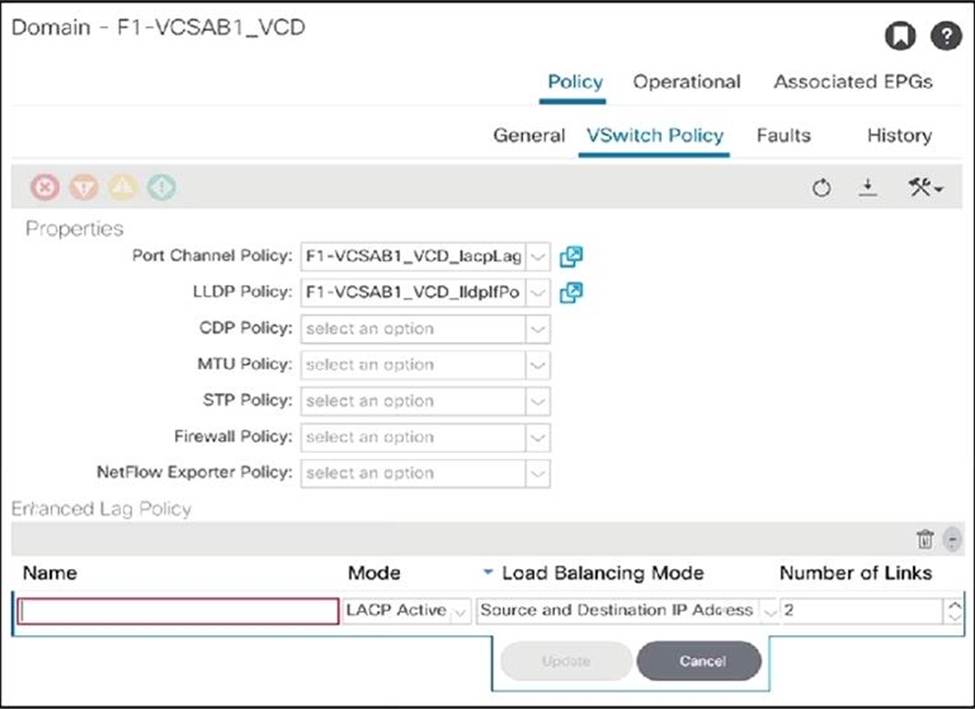
An engineer configures the Cisco ACI fabric for VMM integration with ESXi servers that are to be connected to the ACI leaves. The server team requires the network switches to initiate the LACP negotiation as opposed to the servers. The LAG group consists of two 10 Gigabit Ethernet links. The server learn also wants to evenly distribute traffic across all available links.
Which two enhanced LAG policies meet these requirements? (Choose two.)
- A . LACP Mode: LACP Standby
- B . LB Mode: Destination IP Address and TCP/UDP Port
- C . LB Mode: Source and Destination MAC Address
- D . LB Mode: Source IP Address and TCP/UDP Port
- E . LACP Mode: LACP Active
B, E
Explanation:
To meet the server team’s requirements for VMM integration with ESXi servers, the two enhanced LAG policies that should be configured are:
LB Mode: Destination IP Address and TCP/UDP Port (Option B): This load balancing mode ensures that traffic is evenly distributed across all available links based on the destination IP address and the TCP/UDP port numbers, which can provide a balanced traffic flow for different sessions.
LACP Mode: LACP Active (Option E): Setting the LACP mode to active allows the network switches to initiate the LACP negotiation, which is necessary when the servers are not configured to initiate the LACP process.
These settings ensure that the LAG group consisting of two 10 Gigabit Ethernet links will have traffic evenly distributed across them and that the network switches will initiate the LACP negotiation as required by the server team.
Reference: https://www.cisco.com/c/en/us/td/docs/switches/datacenter/aci/aci_virtual_edge/configuration/2-x/Cisco-ACIVirtual-Edge-Configuration-Guide-202/Cisco-ACI-Virtual-Edge-Configuration-Guide-202_chapter_0100.html
Refer to the exhibit.
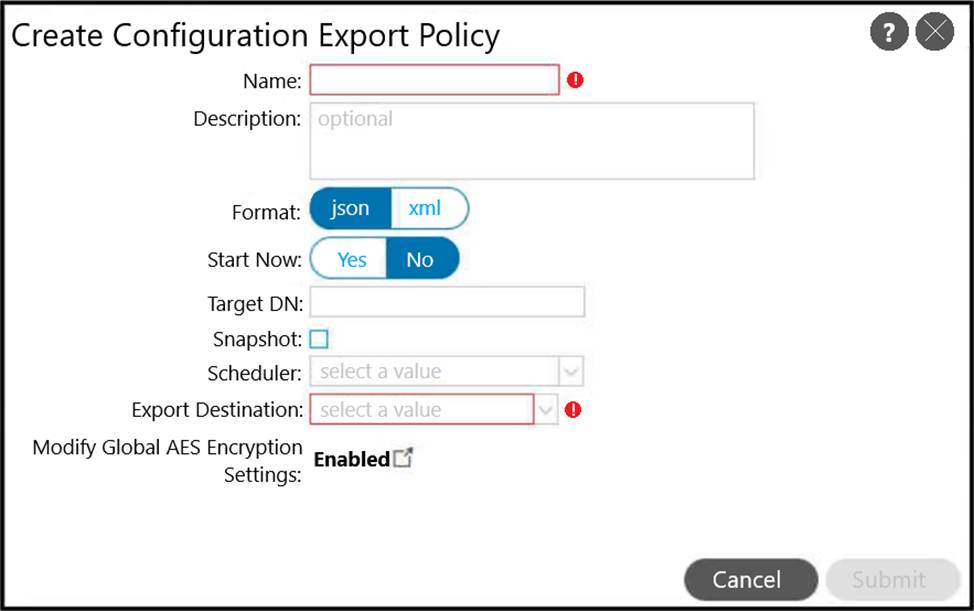
A customer must back up the current Cisco ACI configuration securely to the remote location using encryption and authentication. The backup job must run once per day The customer s security policy mandates that any sensitive information including passwords, must not be exported from the device.
Which set of steps meets these requirements?
- A . Export destination using FTP protocol.
Use XML format. - B . Export destination using FTP protocol.
Disable Global AES Encryption. - C . Export destination using SCP protocol.
Use XML format. - D . Export destination using SCP protocol.
Disable Global AES Encryption.
B
Explanation:
To securely back up the current Cisco ACI configuration to a remote location with encryption and authentication, and ensure that sensitive information is not exported, the following steps should be taken:
Create a Remote Location: Define a remote location where the backup will be stored. This involves specifying the hostname or IP address of the remote server and selecting the protocol (SCP/FTP/SFTP) to be used1.
Create a Configuration Export Policy: Set up an export policy that defines the format (XML/JSON) and the destination for the backup. This policy will also include the schedule for the backup to run once per day1.
Configure Global AES Encryption: To ensure that the backup is encrypted, configure the Global AES Encryption setting. This will allow for hashed secure properties, such as passwords and certificates, to be exported in an encrypted form. It’s important to configure a passphrase that is at least 16 characters long for the encryption1.
Schedule the Backup Job: Use the scheduler to set up the backup job to run once per day. This ensures that the backup process is automated and adheres to the customer’s security policy1.
Exclude Sensitive Information: To comply with the security policy that mandates sensitive information not be exported, ensure that the configuration export policy is set to exclude secure fields unless encryption is enabled1.
Reference: Cisco Guide on Creating a Backup for Your APIC Cluster1
Cisco Community Discussion on Backing Up ACI Configuration2
A network engineer is integrating a new Hyperflex storage duster into an existing Cisco ACI fabric The Hyperflex cluster must be managed by vCenter so a new vSphere Distributed switch must be created In addition the hardware discovery must be performed by a vendor-neutral discovery protocol
Which set of steps meets these requirements?
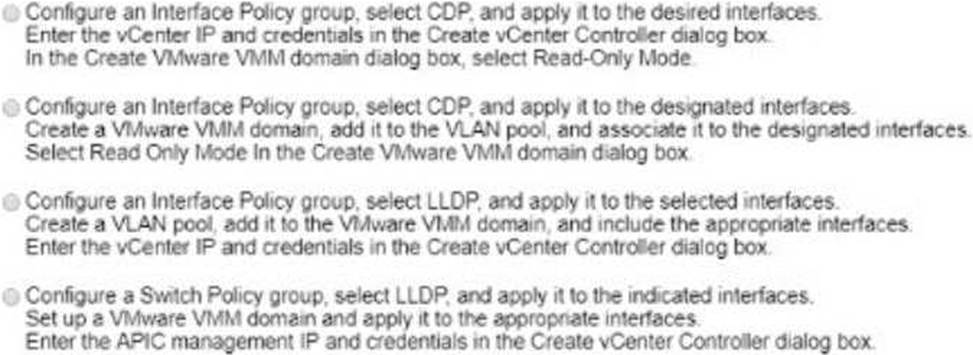
- A . Option A
- B . Option B
- C . Option C
- D . Option D
B
Explanation:
To integrate a new Hyperflex storage cluster into an existing Cisco ACI fabric and manage it with vCenter, the following steps should be taken:
Create a new vSphere Distributed Switch (vDS): This is done within the vCenter interface. The vDS acts as a single virtual switch across all associated hosts in the data center, providing centralized management and monitoring of the network configuration1.
Configure the vDS for the Hyperflex cluster: This involves setting up the correct port groups, VLANs, and uplink profiles to ensure proper network segmentation and performance2.
Enable hardware discovery using a vendor-neutral protocol: This could involve using protocols like LLDP (Link Layer Discovery Protocol) or CDP (Cisco Discovery Protocol), which are supported by vCenter and can help in identifying and managing physical network devices3.
Integrate the Hyperflex cluster with ACI using the Application Policy Infrastructure Controller (APIC): This involves creating the necessary policies and profiles in ACI to manage the Hyperflex storage traffic effectively4.
Reference: Cisco HyperFlex Systems Installation Guide for VMware ESXi1
Cisco HyperFlex Virtual Server Infrastructure 3.0 with Cisco ACI 3.2 and VMware vSphere 6.52
How to Set Up Networking with vSphere Distributed Switches – VMware Docs3
Tutorial: How to integrate HyperFlex and ACI with VMM (VMware) and UCSM4
A network engineer is implementing a Layer 3 Out in the Cisco ACI fabric. The data center core switches must connect to a pair of leaf switches and exchange routes via a routing protocol.
In addition, the implementation must meet these criteria;
• The external switch interface must use 802.1Q tagging.
• Access to the internet for the ACI fabric must be the L30ut.
• The L30ut must use a routing protocol that has rapid convergence time and low CPU usage.
Which configuration set meets these requirements?
- A . Configure the OSPF Protocol policy with an area of 0.
Set up the Routed External Network object and Node Profile and select OSPF. Create the Switch profile and select VPC with the appropriate interfaces. Create the default network and associate it with the Routed Outside object. - B . Configure the BGP Protocol policy with the appropriate Autonomous System number. Configure an Interface policy and an External Bridged Domain. Create an External Bridged Network and use the configured VLAN pool. Build the Leaf profile and select the Routed sub-interface with the appropriate VLAN.
- C . Implement the IS-IS Protocol policy with the selected Autonomous System number. Create the Routed Outside object and Node Profile and select IS-IS. Configure the Interface profile and select the Routed Interface with the appropriate interfaces. Create the External Network object.
- D . Implement the EIGRP Protocol policy with the selected Autonomous System number. Create Routed Outside object and Node Profile and select EIGRP as the routing protocol. Build the Interface profile and select SVI and the appropriate VPC. Configure the External Network object with a network of 0.0.0.070.
Refer to the exhibit.
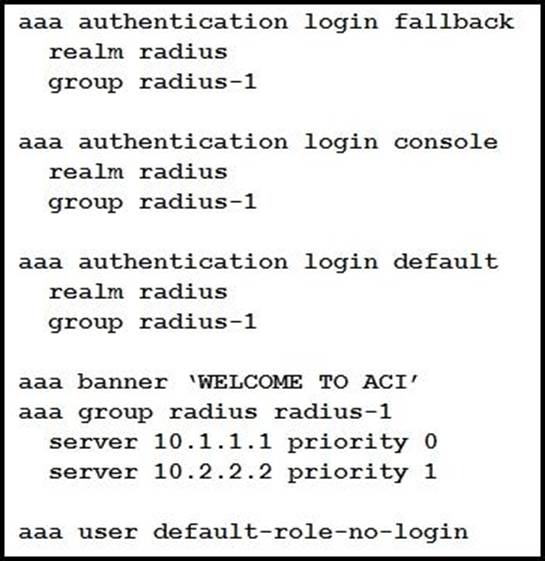
Which action should be taken to ensure authentication if the RADIUS servers are unavailable?
- A . Adjust the priority of server 10.1.1.1 to 1.
- B . Set the fallback login to local.
- C . Assign the user to the default role.
- D . Set the default login realm to LDAP
B
Explanation:
To ensure authentication if the RADIUS servers are unavailable, the action that should be taken is to set the fallback login to local. This setting allows users to authenticate using the local database on the Cisco APIC when external RADIUS servers cannot be reached.
What are two requirements for the IPN network when implementing a Multi-Pod ACI fabric? (Choose two.)
- A . EIGRP routing
- B . PIM ASM multicast routing
- C . BGP routing
- D . VLAN ID 4
- E . OSPF routing
B, E
Explanation:
The two requirements for the IPN network when implementing a Multi-Pod ACI fabric are:
PIM ASM multicast routing2.
OSPF routing3.
When Layer 3 routed traffic is destined to a Cisco ACI fabric, which mechanism does ACI use to detect silent hosts?
- A . gratuitous ARP
- B . inverse ARP
- C . ARP gleaning
- D . proxy ARP
C
Explanation:
The question asks about the mechanism Cisco ACI uses to detect silent hosts when Layer 3 routed traffic is destined to the ACI fabric. A "silent host" refers to an endpoint that does not initiate traffic or send ARP requests, making detection challenging without specific mechanisms. Let’s evaluate the options based on Cisco ACI documentation and best practices.
Requirement Analysis
Layer 3 routed traffic implies that the ACI fabric is handling IP routing, and the detection mechanism must work within the context of the bridge domain and endpoint learning.
Silent hosts require passive detection methods since they do not generate active traffic (e.g., ARP requests).
The solution must align with ACI’s endpoint learning and proxy mechanisms.
Option Evaluation
Refer to the exhibit.
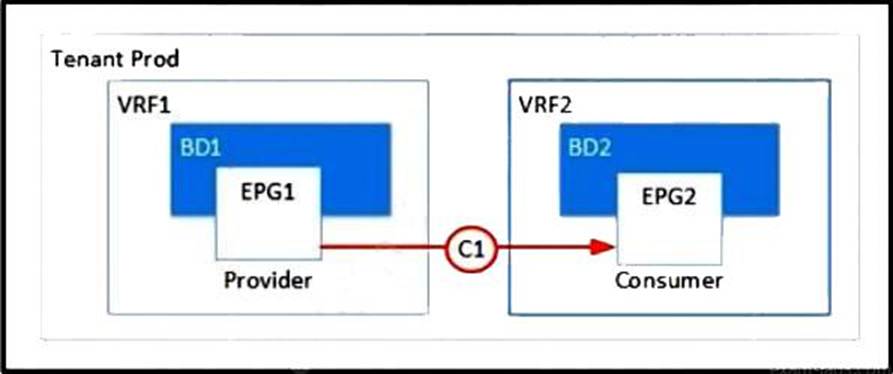
Which two configurations enable inter-VRF communication? (Choose two.)
- A . Set the subnet scope to Shared Between VRFs.
- B . Enable Advertise Externally under the subnet scope.
- C . Export the contract and import as a contract interface.
- D . Change the contract scope to Tenant.
- E . Change the subject scope to VRF.
A, C
Explanation:
To enable inter-VRF communication, the following configurations are necessary:
Set the subnet scope to Shared Between VRFs: This allows the subnets to be shared across different VRFs within the same tenant or across tenants, enabling communication between EPGs that are in different VRFs1.
Export the contract and import as a contract interface: By exporting a contract from the provider tenant and importing it as a contract interface in the consumer tenant, you establish a relationship that allows for controlled communication between EPGs in separate VRFs or tenants1.
Reference: ACI Inter VRF/Tenant Route Leaking Configuration Example1