
Cisco 300-620 Practice Exams
Last updated on Nov 16,2026- Exam Code: 300-620
- Exam Name: Implementing Cisco Application Centric Infrastructure (DCACI)
- Certification Provider: Cisco
- Latest update: Nov 16,2026
A Cisco ACI environment consists of multiple silent hosts that are often relocated between leaf switches. When the host is relocated, the bridge domain takes more than a few seconds to relearn the host’s new location. The requirement is to minimize the relocation impact and make the ACI fabric relearn the new location of the host faster.
Which action must be taken to meet these requirements?
- A . Set Unicast Routing to Enabled.
- B . Configure ARP Flooding to Enabled.
- C . Set L2 Unknown Unicast to Hardware Proxy.
- D . Configure IP Data-Plane Learning to No.
D
Explanation:
In a Cisco ACI environment with multiple silent hosts that are often relocated between leaf switches, configuring IP Data-Plane Learning to ‘No’ will minimize the relocation impact and make the ACI fabric relearn the new location of the host faster. Disabling IP Data-Plane Learning prevents the fabric from learning IP addresses from the data plane, which can speed up the process of relearning host locations when they move3.
An engineer deploys a two-pod Cisco ACI Multi-Pod environment.
Why should no more than two Cisco APIC controllers be deployed in the same pod?
- A . to enable equal capacity to scale in each pod
- B . to avoid losing all replicas of a shard if a pod fails
- C . to avoid hair-pinning traffic that is destined for the primary APIC controller between pods
- D . to ensure that all nodes in all pods have local access to a controller
B
Explanation:
In a two-pod Cisco ACI Multi-Pod environment, it is recommended to deploy no more than two Cisco APIC controllers in the same pod to avoid losing all replicas of a shard if a pod fails. The APIC cluster is a distributed system where each APIC contains a replica of the configuration database, referred to as a shard. If all replicas of a shard were located in the same pod and that pod were to fail, it would result in the loss of the shard and potentially impact the entire fabric’s operation. By distributing the APIC controllers across pods, the risk of losing all replicas due to a single point of failure is mitigated, enhancing the overall resiliency of the system1.
Reference: ACI Multi-Pod White Paper – Cisco1
What is the result of selecting the On Demand attribute in the Deploy Immediacy feature during VMM domain association to an EPG?
- A . The EPG policy is downloaded to the leaf when a hypervisor is connected, and a VM is placed in a port group.
- B . The EPG policy is programmed in the hardware policy CAM only when the first packet is received through the data path.
- C . The EPG policy is programmed in the hardware policy CAM as soon as the policy is downloaded in the leaf software.
- D . The EPG policy is downloaded to the leaf when a hypervisor is attached to a DVS. and CDP or LLDP adjacency is formed.
What must be configured to redistribute externally learned OSPF routes within the ACI fabric?
- A . Route Control Profile
- B . BGP Route Reflector
- C . BGP Inter-leak Route Map
- D . PIM Sparse Mode
A
Explanation:
To redistribute externally learned OSPF routes within the ACI fabric, a Route Control Profile must be configured1. This profile allows for the control of route redistribution and the application of route maps to influence routing decisions within the fabric1.
Reference: https://www.cisco.com/c/en/us/td/docs/switches/datacenter/aci/apic/sw/1-x/ACI_Best_Practices/b_ACI_Best_Practices/b_ACI_Best_Practices_chapter_010010.html
Cisco ACI fabric must detect all silent endpoints for the Layer 3 bridge domain.
Which actions accomplish this goal?
- A . Disable Unicast Routing.
Enable L2 Unknown Unicast Hardware Proxy. - B . Disable Unicast Routing.
Enable L2 Unknown Unicast Flood. - C . Enable Unicast Routing. Disable ARP Flooding.
- D . Enable Unicast Routing. Enable ARP Flooding.
An organization deploys active-active data centers and active-standby firewalls in each data center.
Which action should be taken in a Cisco ACI Multi-Pod to maintain traffic symmetry through the firewalls?
- A . Disable Resilient Hashing.
- B . Disable service node Health Tracking.
- C . Enable Pod ID Aware Redirection.
- D . Enable Endpoint Dataplane Learning.
C
Explanation:
In a Cisco ACI Multi-Pod environment with active-active data centers and active-standby firewalls in each data center, enabling Pod ID Aware Redirection is the action that should be taken to maintain traffic symmetry through the firewalls. This feature ensures that traffic is consistently directed through the active firewall based on the pod identifier, thus maintaining the desired traffic flow and symmetry2.
Reference: Cisco ACI Multi-Pod and Service Node Integration White Paper
Refer to the exhibit.
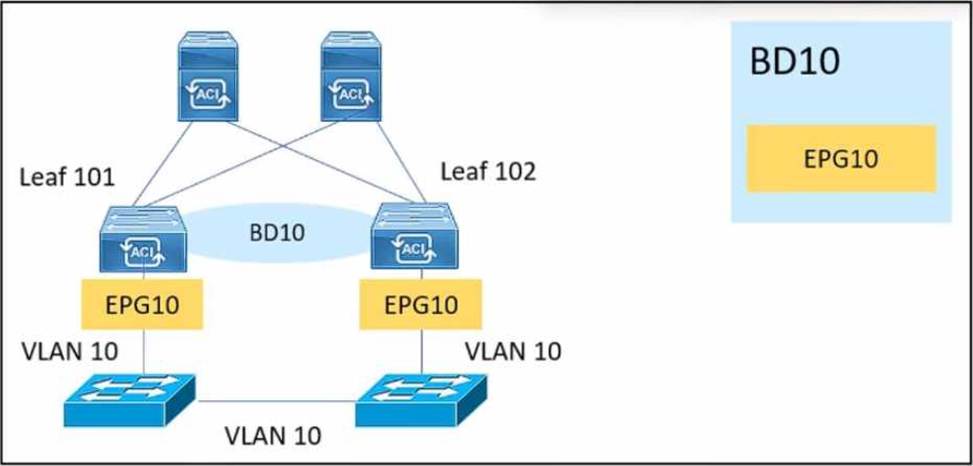
An engineer is implementing a BPDU filter on external switch interfaces That face the Cisco ACI fabric to prevent excessive TCNs from impacting the fabric.
Which Configuration must be applied on Cisco ACI to avoid a Layer 2 loop?
- A . Apply an MSTP instance on Cisco ACI.
- B . Configure MCP globally
- C . implement BPDU Guard.
- D . Enable STP on downlinks.
Refer to the exhibit.
An engineer is implementing a BPDU filter on external switch interfaces That face the Cisco ACI fabric to prevent excessive TCNs from impacting the fabric.
Which Configuration must be applied on Cisco ACI to avoid a Layer 2 loop?
- A . Apply an MSTP instance on Cisco ACI.
- B . Configure MCP globally
- C . implement BPDU Guard.
- D . Enable STP on downlinks.
An application team tells the Cisco ACI network administrator that it wants to monitor the statistics of the unicast and BUM traffic that are seen in a certain EPG.
Which statement describes the collection statistics?
- A . All EPGs in the Cisco ACI tenant object must be enabled for statistics to be collected.
- B . Cisco ACI does not capture statistics at the EPG level. Only statistics that pass through ACI contracts can be monitored.
- C . EPG statistics can be collected only for VMM domains. If a physical domain exists, statistics are not collected.
- D . The collection of statistics is enabled on the EPG level by enabling the statistics for unicast and BUM traffic.
D
Explanation:
To monitor the statistics of unicast and BUM traffic seen in a certain EPG, the collection of statistics must be enabled at the EPG level. This is done by enabling the statistics specifically for unicast and BUM traffic within the EPG settings3.
https://www.cisco.com/c/en/us/td/docs/switches/datacenter/aci/apic/sw/1-x/Operating_ACI/guide/b_Cisco_Operating_ACI/b_Cisco_Operating_ACI_chapter_01011.html

An organization has encountered many STP-related issues in the past due to failed hardware components. They are in the process of long-term migration to a newly deployed ACI fabric. Senior engineers are worried that spanning-tree loops in the existing network may be extended to the ACI fabric.
Which feature must be enabled on the ACI leaf ports to protect the fabric from spanning-tree loops?
- A . BPDU Guard
- B . per-VLANMCP
- C . Storm Control
- D . BPDU Filter
A
Explanation:
o protect the ACI fabric from spanning-tree loops, the feature that must be enabled on the ACI leaf ports is BPDU Guard
Reference: https://www.cisco.com/c/en/us/td/docs/switches/datacenter/aci/apic/sw/4-x/aci-fundamentals/Cisco-ACI-Fundamentals-401/Cisco-ACI-Fundamentals-401_chapter_0101.html