
Cisco 300-620 Practice Exams
Last updated on Oct 01,2026- Exam Code: 300-620
- Exam Name: Implementing Cisco Application Centric Infrastructure (DCACI)
- Certification Provider: Cisco
- Latest update: Oct 01,2026
Logging with syslog is important for:
- A . Enhancing user experience
- B . Network performance tuning
- C . Collecting and analyzing system events
- D . Direct packet routing
What is the maximum number of sites connected using spine back-to-back with a direct link in a Cisco ACI Multi-Site fabric?
- A . 2
- B . 3
- C . 4
- D . 5
A
Explanation:
In a Cisco ACI Multi-Site setup, back-to-back spine connectivity is limited to a direct connection between two sites. This design simplifies inter-site communication by avoiding the need for an intermediate Inter-Pod Network (IPN) or Multi-Site Orchestrator.
An engineer created a monitoring policy called Test in a Cisco ACI fabric and had to change the severity level of the monitored object Call home source.
Which set of actions prevent the event from appearing in event reports?
- A . Select Event Severity Assignment Policies. Set severity level to cleared.
- B . Select Faults Severity Assignment Policies. Set severity level to cleared.
- C . Select Event Severity Assignment Policies. Set severity level to squelched.
- D . Select Faults Severity Assignment Policies. Set severity level to squelched.
An engineer created a monitoring policy called Test in a Cisco ACI fabric and had to change the severity level of the monitored object Call home source.
Which set of actions prevent the event from appearing in event reports?
- A . Select Event Severity Assignment Policies. Set severity level to cleared.
- B . Select Faults Severity Assignment Policies. Set severity level to cleared.
- C . Select Event Severity Assignment Policies. Set severity level to squelched.
- D . Select Faults Severity Assignment Policies. Set severity level to squelched.
Refer to the exhibit.
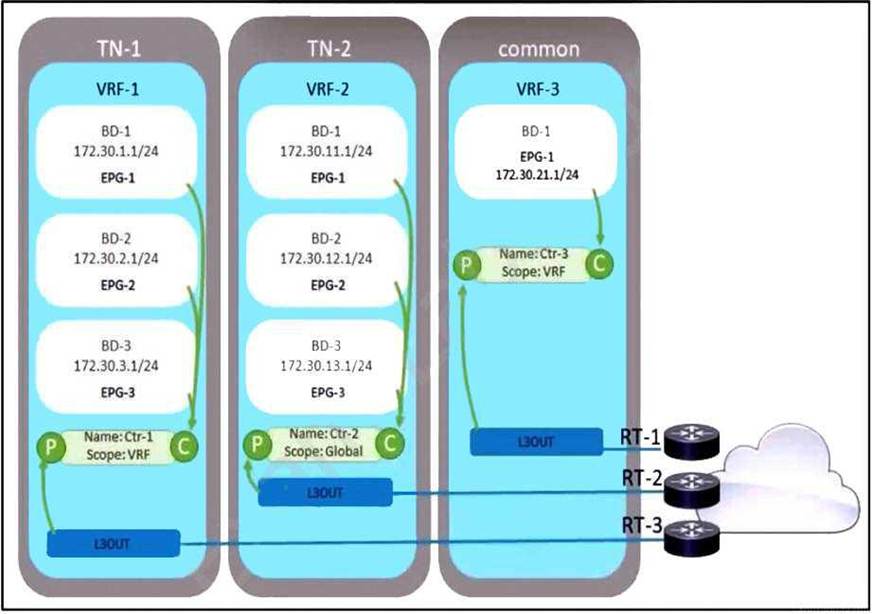
A company decided to decrease its routing footprint and remove RT-2 and RT-3 devices from its data center. Because of that, the exit point must be created from all the tenants by using the common tenant.
Which two configuration tasks must be completed to meet these requirements? (Choose two.)
- A . Move subnets from all the bridge domains to the EPG level and mark them with flag Shared between VRFs.
- B . Update the L3Out ExtEPG subnet in the common tenant with flag Shared Route Control Subnet and Aggregate Shared Routes.
- C . Mark all subnets with flag Shared between VRFs and attach contract Ctr-3 as a provider to all the EPGs.
- D . Change contract Ctr-3 scope to Global, consume it by all EPGs, and flag all subnets with flag Shared between VRFs.
- E . Export contract Ctr-2 into the tenant TN-1 and attach it as a consumer to all the EPGs in the tenant TN-1.
B, D
Explanation:
To create an exit point from all tenants using the common tenant and decrease the routing footprint, the following configuration tasks must be completed:
Update the L3Out ExtEPG subnet in the common tenant with flag Shared Route Control Subnet and Aggregate Shared Routes: This configuration allows the subnets to be shared across different VRFs within the common tenant, enabling communication between EPGs that are in different tenants1.
Change contract Ctr-3 scope to Global, consume it by all EPGs, and flag all subnets with flag Shared between VRFs: By changing the scope of contract Ctr-3 to Global, it can be consumed by all EPGs across the fabric. Additionally, flagging all subnets with Shared between VRFs ensures that the subnets can be used by multiple tenants1.
Reference: Cisco Community Discussion on Common Tenant1
Cisco ACI Basic Configuration Guide2
Cisco ACI Configuring Shared L3Outs Documentation
An ACI administrator notices a change in the behavior of the fabric.
Which action must be taken to determine if a human intervention introduced the change?
- A . Inspect event records in the APIC UI to see all actions performed by users.
- B . Inspect /var/log/audit_messages on the APIC to see a record of all user actions.
- C . Inspect audit logs in the APIC UI to see all user events.
- D . Inspect the output of show command history in the APIC CLI.
C
Explanation:
To determine if a change in the behavior of the ACI fabric was due to human intervention, an ACI administrator should inspect the audit logs in the APIC UI. The audit logs provide a record of all user events, which includes actions performed by users, making it possible to trace any changes back to specific human activities1.
A situation causes a fault to be raised on the APIC. The ACI administrator does not want that fault to be raised because it is not directly relevant to the environment.
Which action should the administrator take to prevent the fault from appearing?
- A . Under System -> Faults, right-click on the fault and select Acknowledge Fault so that acknowledged faults will immediately disappear.
- B . Create a stats threshold policy with both rising and falling thresholds defined so that the critical severity threshold matches the squelched threshold.
- C . Under System -> Faults, right-click on the fault and select Ignore Fault to create a fault severity assignment policy that hides the fault.
- D . Create a new global health score policy that ignores specific faults as identified by their unique fault code.
C
Explanation:
To prevent a fault from appearing that is not directly relevant to the environment, the ACI administrator should create a fault severity assignment policy that hides the fault. This can be done by selecting “Ignore Fault” under System -> Faults in the APIC UI2
Which protocol does ACI use to securely sane the configuration in a remote location?
- A . SCP
- B . HTTPS
- C . TFTP
- D . FTP
A
Explanation:
ACI uses the SCP (Secure Copy Protocol) to securely save the configuration in a remote location. SCP is a network protocol that supports file transfers and relies on the Secure Shell (SSH) protocol to provide security for the transferred data.
Reference: https://www.cisco.com/c/en/us/td/docs/switches/datacenter/aci/apic/sw/kb/b_KB_Using_Import_Export_to_Recover_Config_States.html
An engineer must advertise a selection of external networks learned from a BGP neighbor into the ACI fabric.
Which L3Out subnet configuration option creates an inbound route map for route filtering?
- A . External Subnets for the External EPG
- B . Shared Route Control Subnet
- C . Import Route Control Subnet
- D . Shared Security Import Subnet
C
Explanation:
The L3Out subnet configuration option that creates an inbound route map for route filtering is Import Route Control Subnet3. This option allows for the application of route maps to incoming routes from external networks, providing granular control over which routes are allowed into the ACI fabric3.
What is the effect of enabling the disable Remote EP learn feature?
- A . It disables remote IP endpoint learning on all leaf nodes in the fabric.
- B . It disables remote IP endpoint learning on leaf switches that do not have L3Outs.
- C . It limits learning of compute leaf endpoints on border leaves.
- D . It prevents border leaf switches from receiving routes through peering with external routers.
D
Explanation:
Enabling the “disable Remote EP learn” feature in Cisco ACI has the effect of preventing border leaf switches from receiving routes through peering with external routers. This feature is particularly useful when there is a mix of Gen1 and Gen2 hardware in the fabric, as it clears all the remote endpoints from the border leaf only. Traffic will still use hardware proxy if the endpoint is not learned on the border leaf, ensuring no operational impact12.
Reference: ACI Fabric Endpoint Learning White Paper2
Cisco Community Discussion on Disable Remote EP Learn
https://unofficialaciguide.com/2018/11/29/aci-best-practice-configurations/