
Cisco 300-620 Practice Exams
Last updated on Nov 16,2026- Exam Code: 300-620
- Exam Name: Implementing Cisco Application Centric Infrastructure (DCACI)
- Certification Provider: Cisco
- Latest update: Nov 16,2026
A network engineer must backup the PRODUCTION tenant. The configuration backup should be stored on the APIC using a markup language and contain all secure information.
Which export policy must be used to meet these requirement?
A)
B)
C)
D)
- A . Option A
- B . Option B
- C . Option D
- D . Option D
A
Explanation:
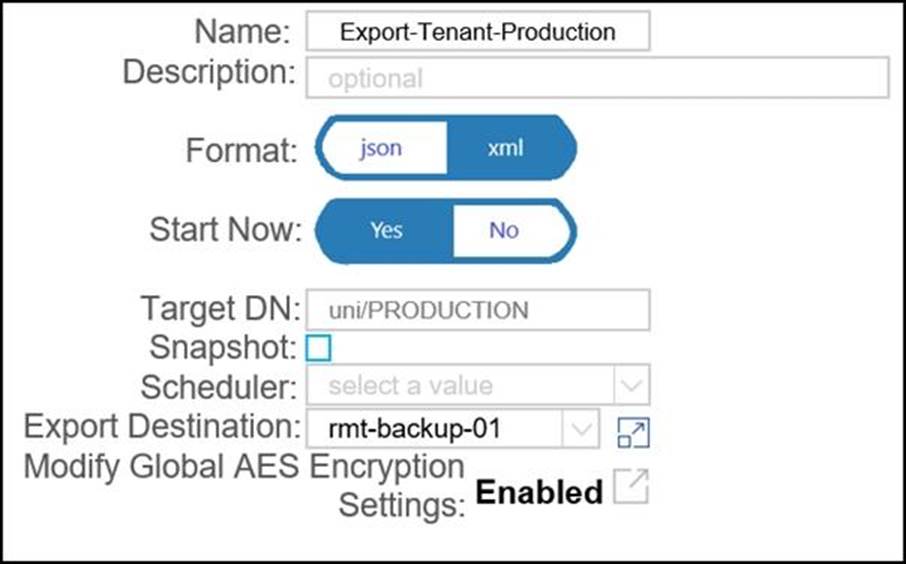
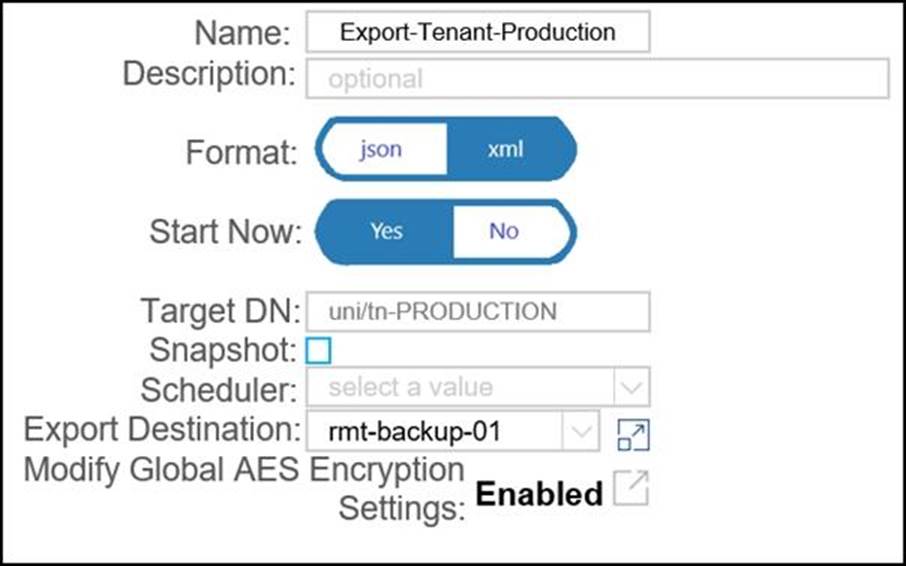
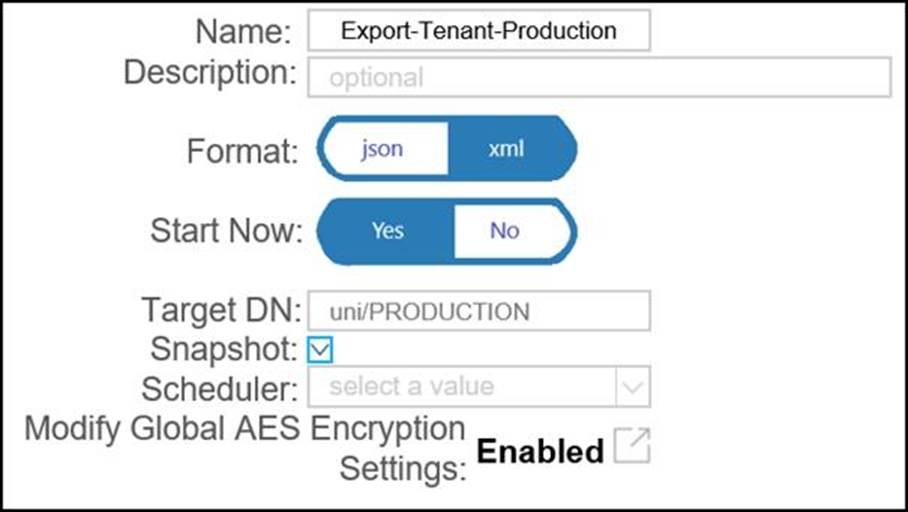
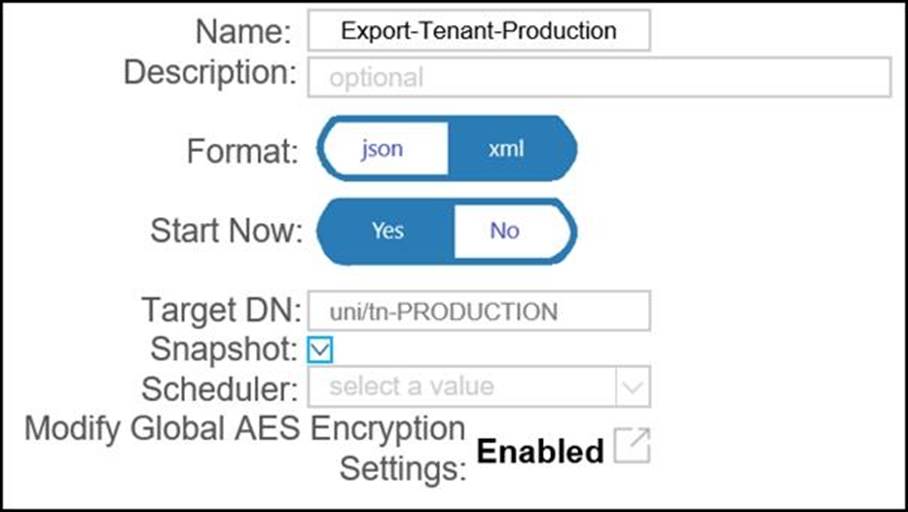
To backup the PRODUCTION tenant configuration on the APIC using a markup language and include all secure information, the network engineer must use an export policy that allows for exporting in a markup language format such as XML or JSON and includes secure attributes. In this case, the correct export policy is Option A, which shows an interface with “Export-Tenant-Production” where the format can be selected as ‘xml’ or ‘json’, and there is an option to modify global AES encryption settings, indicating that secure information can be included in the backup.
Reference: Cisco Application Policy Infrastructure Controller (APIC) – Cisco APIC
Cisco Application Centric Infrastructure Best Practices Guide – Cisco ACI Design Guide
The image shows a graphical user interface for an export policy named “Export-Tenant-Production.” The interface provides options to select the format of the backup (either ‘json’ or ‘xml’), whether to start now with options ‘Yes’ or ‘No’, a field for Target DN with ‘/tn-PRODUCTION’ filled in, a scheduler dropdown menu, and a checkbox for modifying global AES encryption settings which is enabled. This image is relevant because it depicts how to configure an export policy on Cisco’s APIC to backup tenant configurations securely.
What is a requirement for Cisco ACI IPN to manage multidestination traffic?
- A . pervasive gateway
- B . unicast routing
- C . anycast gateway
- D . multicast routing
D
Explanation:
For Cisco ACI IPN (Inter-Pod Network) to manage multidestination traffic, multicast routing is a requirement. This is because multidestination traffic includes broadcast, unknown unicast, and multicast (BUM) traffic, which needs to be efficiently transported across different pods in a Cisco ACI Multi-Pod environment. Multicast routing protocols like Bidirectional Protocol-Independent Multicast (Bidir PIM) are used to handle this type of traffic1.
Reference: Cisco Application Centric Infrastructure Multi-Pod Configuration White Paper1
An engineer associates EPG-A with a VMM domain and sets the Deployment and Resolution preferences to Immediate. The host that will generate endpoints for EPG-A is attached to Leaf-and Leaf-102 using etht1/1. However, no configuration for EPG-A appears to have been pushed to the leaf switches.
Which action must be taken for the configuration to be pushed to f-101 and Leaf-102?
- A . Enable CDP or LLDP on the host.
- B . Configure both ports for trunking.
- C . Enable LACP on the leaf switch ports.
- D . Disable and enable eth1/1 on both leaf switches
A
Explanation:
The scenario involves associating EPG-A with a Virtual Machine Manager (VMM) domain, setting the
Deployment and Resolution preferences to Immediate, and attaching the host (generating endpoints for EPG-A) to Leaf-101 and Leaf-102 via eth1/1. However, no configuration for EPG-A is pushed to the leaf switches. This suggests an issue with the discovery or communication between the ACI fabric and the host. Let’s analyze the options based on Cisco ACI documentation.
Requirement Analysis
The VMM domain integration (e.g., VMware vCenter) relies on protocols like Cisco Discovery Protocol (CDP) or Link Layer Discovery Protocol (LLDP) to detect and map virtualized endpoints to the correct EPG.
The "Immediate" preference ensures that policies are applied as soon as endpoints are detected, but this requires proper protocol support for host discovery.
No configuration on the leaf switches indicates a failure in endpoint detection or policy application.
Option Evaluation
The unicast routing feature is enabled on the bridge domain.
Which two conditions enable the Cisco ACI leaf to learn a source IP as a local endpoint? (Choose two.)
- A . Through Ethernet traffic received in a bridge domain.
- B . IP traffic routed through an SVI.
- C . Through VXLAN traffic received on the uplink.
- D . IP traffic routed through a Layer 3 Out.
- E . Through ARP received on an SVI.
A, E
Explanation:
With unicast routing enabled on the bridge domain, the two conditions that enable the Cisco ACI leaf to learn a source IP as a local endpoint are:
Through Ethernet traffic received in a bridge domain (Option A): The leaf switch learns the source IP address as a local endpoint when it receives Ethernet traffic within the bridge domain.
Through ARP received on an SVI (Option E): The leaf switch also learns the source IP address as a local endpoint when it receives an ARP request or reply on a Switched Virtual Interface (SVI) associated with the bridge domain.
These conditions allow the ACI fabric to maintain an accurate endpoint database for efficient routing and forwarding of traffic within the fabric.
https://www.cisco.com/c/en/us/solutions/collateral/data-center-virtualization/application-centric-infrastructure/white-paper-c11-739989.html


Refer to the exhibit.
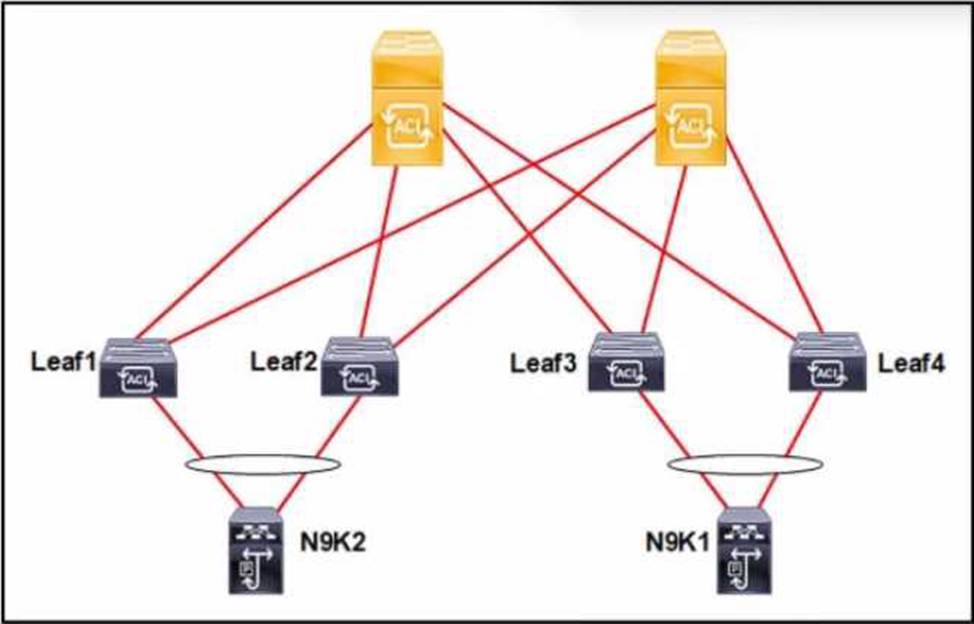
The Cisco ACI fabric is built with L20ut to the N9K1 and N9K2 switches. The switches run the RSTP protocol. The requirement is for the Cisco ACI fabric to detect 5 from the N9K and for the fabric to be protected against loops.
Which set of actions must be taken to meet the requirements?
- A . Configure the N9K STP link type as point-to-point link. Enable MCP on ACI globally.
- B . Configure the N9K STP link type as a point-to-point Enable MCP on the ACI leaf interfaces.
- C . Configure the N9K STP link type as a shared link. Enable MCP on the ACI leaf interfaces.
- D . Configure the N9K STP link type as a shared link. Enable MCP on ACI globally.
An administrator must migrate the vSphere Management VMkernel of all ESXi hosts in the production cluster from the standard default virtual switch to a VDS that is integrated with APIC in a VMM domain.
Which action must be completed in this scenario?
- A . The Management VMkernel EPG resolution must be set to Pre-Provosion.
- B . The administrator must create an in-band VMM Management EPG before performing the migration.
- C . The administrator must set the Management VMkernel BD resolution immediacy to On-Demand.
- D . The VMkernel Management BD must be located under the Management Tenant.
A
Explanation:
When migrating the vSphere Management VMkernel of all ESXi hosts from the standard default virtual switch to a Virtual Distributed Switch (VDS) that is integrated with APIC in a VMM domain, it is essential to set the Management VMkernel EPG resolution to Pre-Provision. This action ensures that the necessary policies are in place on the ACI fabric before the migration occurs, allowing for a seamless transition and continuous management connectivity.
DRAG DROP
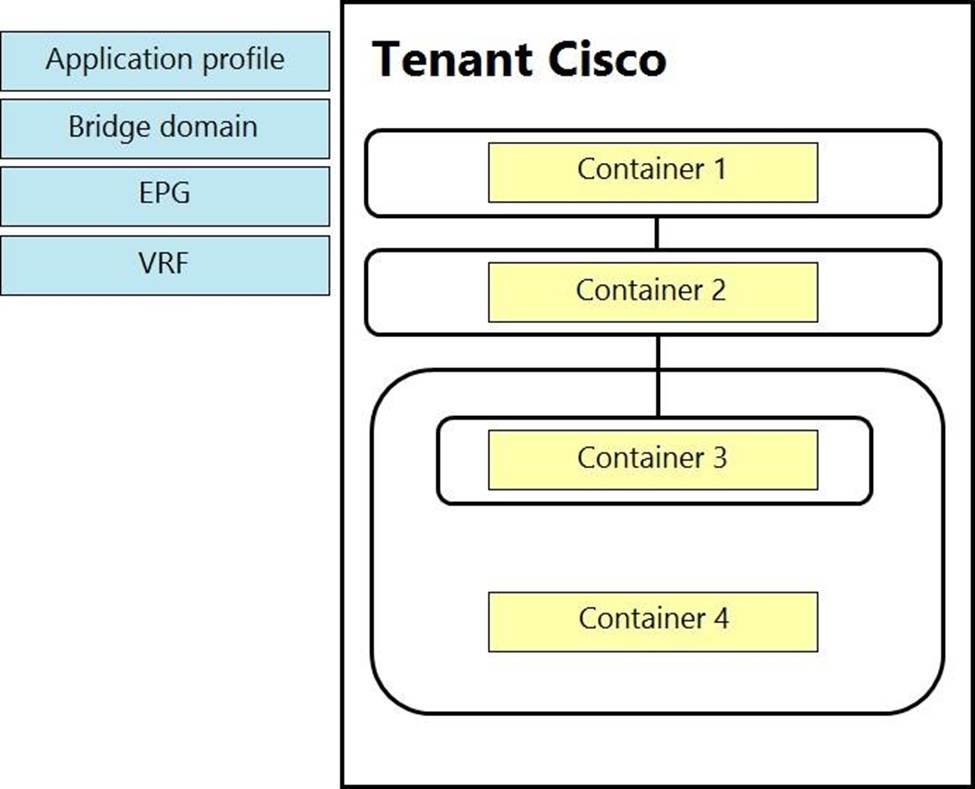
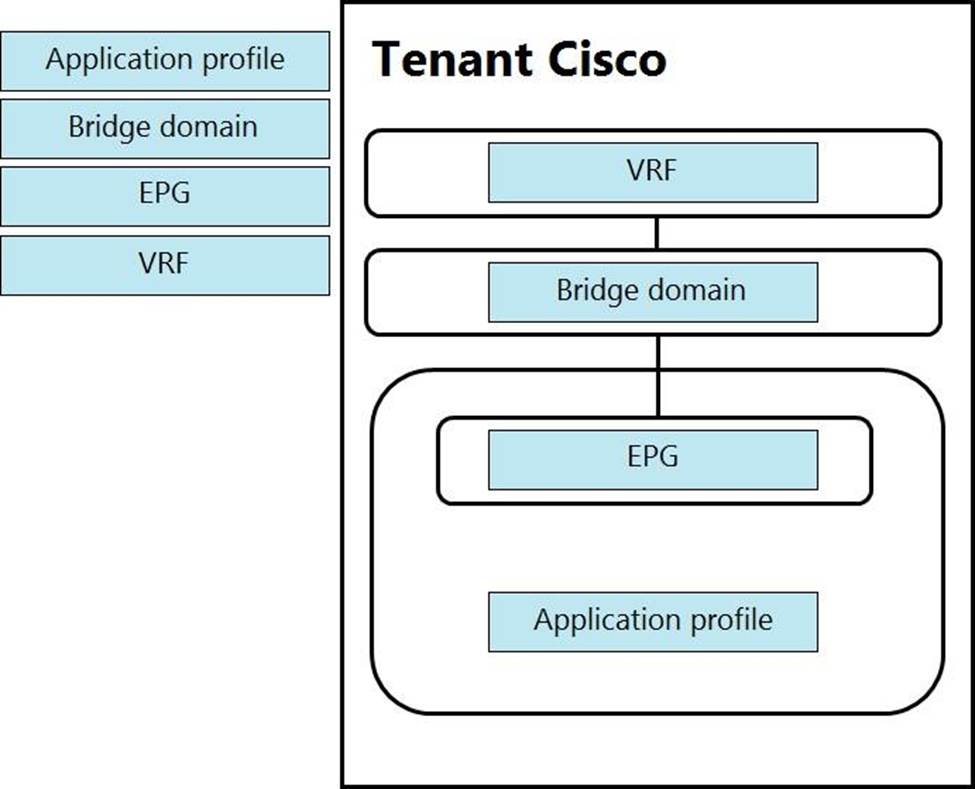
An engineer is configuring a VRF for a tenant named Cisco. Drag and drop the child objects on the left onto the correct containers on the right for this configuration.
Which switch type is discovered first in the Cisco ACI fabric discovery process?
- A . leaf
- B . access
- C . distribution
- D . spine
A
Explanation:
The question asks which switch type is discovered first in the Cisco ACI fabric discovery process. The ACI fabric consists of spine and leaf switches, and the discovery process is a critical initial step to establish the fabric topology. Let’s analyze this based on Cisco ACI documentation.
Requirement Analysis
The ACI fabric discovery process involves the Application Policy Infrastructure Controller (APIC) identifying and registering switches to form the network topology.
The process relies on protocols like Link Layer Discovery Protocol (LLDP) and Cisco Discovery Protocol (CDP) to detect connected devices.
The sequence of discovery is determined by the physical connectivity and the role of switches in the fabric.
Option Evaluation