
Cisco 300-620 Practice Exams
Last updated on Nov 16,2026- Exam Code: 300-620
- Exam Name: Implementing Cisco Application Centric Infrastructure (DCACI)
- Certification Provider: Cisco
- Latest update: Nov 16,2026
An engineer must configure a service graph for the policy-based redirect to redirect traffic to a transparent firewall. The policy must be vendor-agnostic to support any firewall appliance.
Which two actions accomplish these goals? (Choose two.)
- A . Set the Service Type to Other.
- B . Set Promiscuous Mode to True.
- C . Set Function Type to L2.
- D . Set Managed to True.
- E . Set Context Aware to Single.
A network engineer must allow secure access to the Cisco ACI out-of-band (OOB) management only from external subnets 10 0 0024 and 192.168 20 G’25.
Which configuration set accomplishes this goal?
- A . Create a L3Out in the MGMT tenant in OOB VRF.
Set External Management Network Instance Pro le as a consumer of the OOB contract.
Create an External EPG with two subnet entries with the external subnets. - B . Create a PBR service graph in the MGMT tenant.
Create a management Pro le with the required OOB EPG.
Redirect all traffic going into ACI management to the external firewall.
Create two subnet entries under the OOB Bridge domain with the required subnets. - C . Create an OOB contract that allows the required ports.
Provide the contract from the OOB EPG.
Consume the contract by the OOB External Management Network Instance Profile.
Create two subnet entries in the External Management Network Pro le with the required subnets. - D . Create an EPG and BD in the MGMT tenant in OOB VRF.
Set OOB VRF to provide the contract.
Set a new EPG to consume the OOB contract.
C
Explanation:
To enable the APIC in a Cisco ACI fabric using out-of-band management connectivity to access a routable host with an IP address of 192.168.11.2, you need to add a Fabric Access Policy that allows management connections. This involves configuring a contract that will be consumed and provided to your OOB devices. The contract will let the system know what traffic is allowed. In this case, you will use the default/common contract to permit any traffic. This is necessary because the APIC needs
to be able to send traffic to and receive traffic from the management network1.
Reference: ACI: Configuring Out-of-Band (OOB) Access for Your Fabric – Cisco1
Troubleshoot ACI Management and Core Services – In-band and Out-of-band Management – Cisco2
A network engineer demonstrates Cisco ACI to a customer. One of the test cases is to validate a disaster recovery event by resetting the ACI fabric to factory and then restoring the fabric to the state it was in before the event.
Which setting must be enabled on ACI to export all configuration parameters that are necessary to meet these requirements?
- A . enabled AES encryption
- B . generated a tech-support file
- C . encrypted export destination
- D . enabled JSON format export
D
Explanation:
To export all configuration parameters necessary for disaster recovery in Cisco ACI, the setting that
must be enabled is enabled JSON format export1. This format allows for a complete and structured export of the configuration that can be used for recovery purposes1.
https://www.cisco.com/c/en/us/td/docs/switches/datacenter/aci/apic/sw/kb/b_KB_Using_Import_Export_to_Recover_Config_States.html
The company’s Cisco ACI fabric hosts multiple customer tenants. To meet a service level agreement, the company is constantly monitoring the Cisco ACI environment. Syslog is one of the methods used for monitoring. Only events related to leaf and spine environmental information without specific customer data should be logged.
To which ACI object must the configuration be applied to meet these requirements?
- A . access policy
- B . infra tenant
- C . switch profile
- D . fabric policy
D
Explanation:
To ensure that only events related to leaf and spine environmental information are logged without including specific customer data, the configuration should be applied to the fabric policy. The fabric policy in Cisco ACI is used to define global settings that apply to the entire fabric, such as syslog settings, which can be configured to filter and forward only the desired types of system messages12.
Refer to the exhibit.
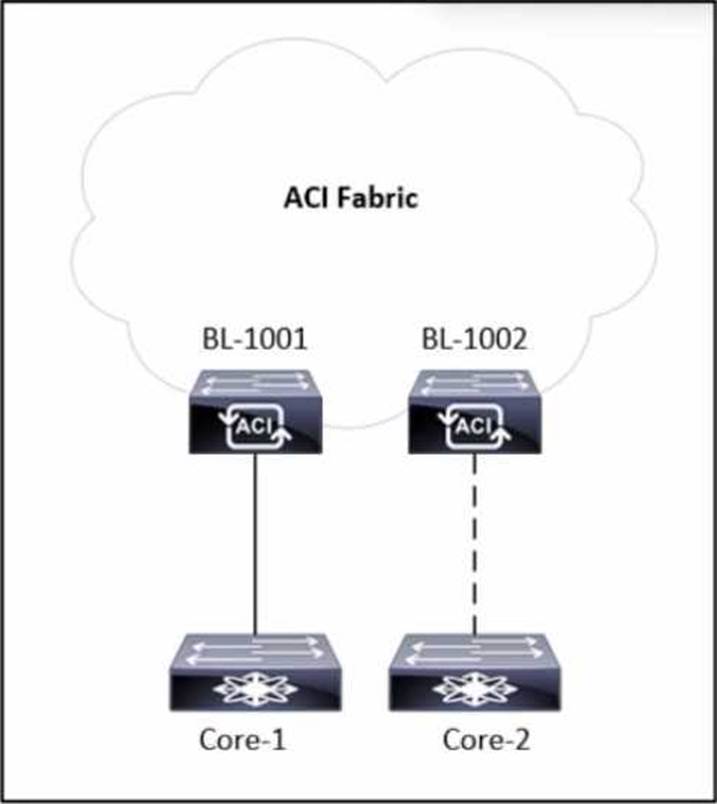
A tenant is configured with a single L30ut and a single-homed link to the core router called Core-1. An engineer must add a second link to the L30ut that connects to Core-2 router.
Which action allows the traffic from Core-2 to BL-1002 to have the same connectivity as the traffic from Core-1 to BL-1001?
- A . Add a second path to the logical interface profile of the existing L30ut
- B . Add a second subnet to the external EPG to the existing L30ut.
- C . Add a second OSPF interface profile to the logical interface profile.
- D . Add a second interface to the external domain to the existing L30ut.
A
Explanation:
The scenario involves a tenant configured with a single L3Out and a single-homed link from the ACI fabric (via border leaf BL-1001) to a core router (Core-1). The engineer must add a second link to the L3Out, connecting to Core-2 via BL-1002, ensuring that traffic from Core-2 to BL-1002 has the same connectivity as traffic from Core-1 to BL-1001. The exhibit shows a single-homed setup with BL-1001 and BL-1002 as potential border leaves, with a dashed line indicating a planned second link.
Requirement Analysis
The existing L3Out is single-homed to Core-1 via BL-1001, and the goal is to extend it to a multi-homed configuration with Core-2 via BL-1002.
"Same connectivity" implies that the second link must be integrated into the existing L3Out configuration, sharing the same routing policies, external EPG, and subnet reachability.
The solution must leverage ACI’s L3Out framework to add the new path without creating a separate L3Out or altering the current routing setup unnecessarily.
Option Evaluation
A Cisco APIC is configured with RADIUS authentication as the default The network administrator must ensure that users can access the APIC GUI with a local account if the RADIUS server is unreachable.
Which action must be taken to accomplish this goal?
- A . Create an additional login domain that references local accounts
- B . Enable the fallback check with the default authentication domain
- C . Associate console authentication with the "RADIUS" realm.
- D . Reference the local realm in the fallback domain
B
Explanation:
To ensure that users can access the Cisco APIC GUI with a local account if the RADIUS server is unreachable, the network administrator must enable the fallback check with the default authentication domain. This allows for local authentication as a backup method when RADIUS is not available. The fallback mechanism is crucial for maintaining access to the APIC GUI in case of RADIUS server issues1.
Reference: Cisco Community Discussion on Auth Radius fallback to Local1 Cisco APIC Security Configuration Guide
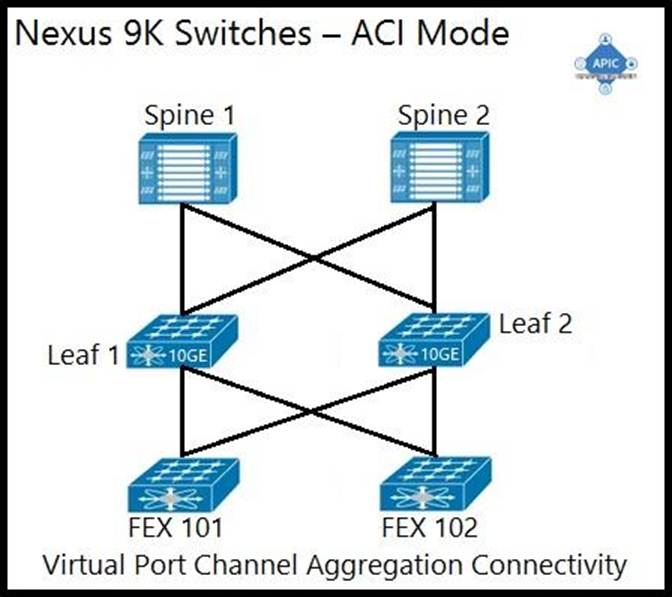
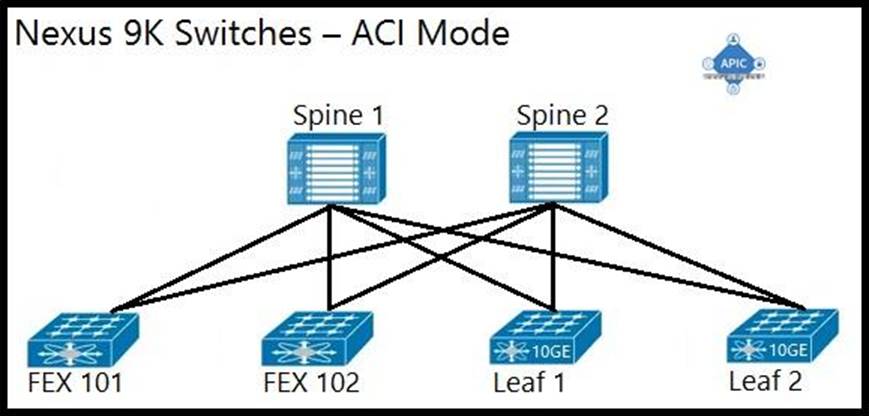
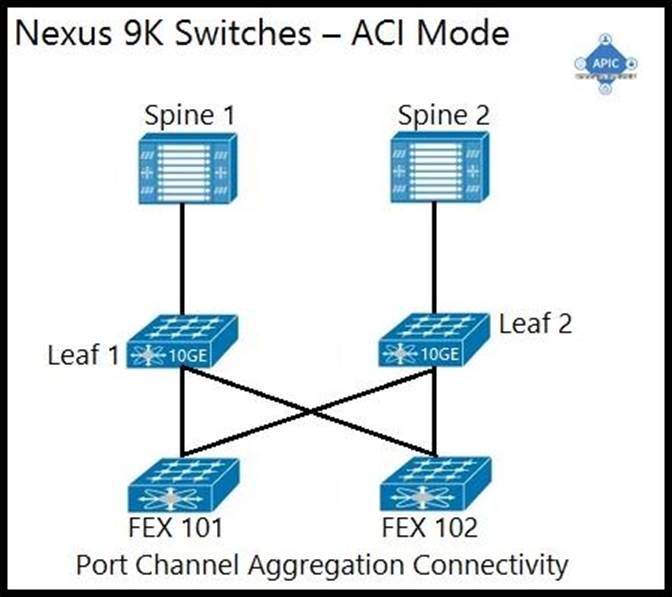
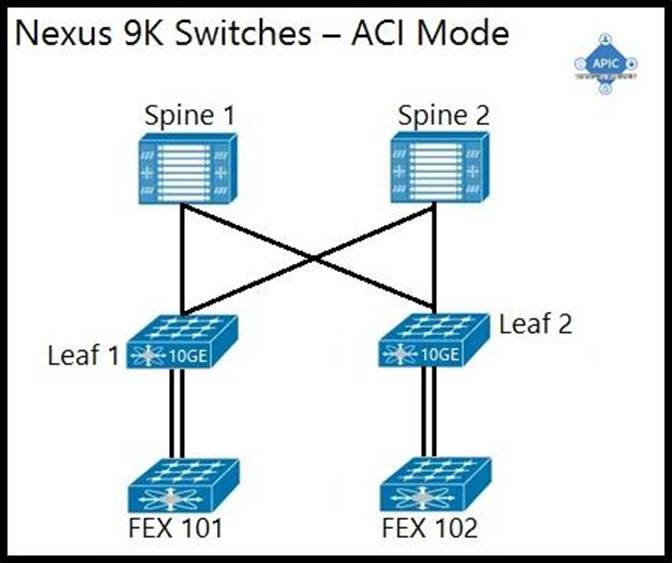
An engineer is implementing a Cisco ACI data center network that includes Cisco Nexus 2000 Series 10G fabric extenders.
Which physical topology is supported?
A)
B)
C)
D)
- A . Option A
- B . Option B
- C . Option C
- D . Option D
A
Explanation:
The supported physical topology for a Cisco ACI data center network that includes Cisco Nexus 2000 Series 10G fabric extenders is depicted in Option A. This topology illustrates a pair of spine switches connected to leaf switches, which are then connected to the fabric extenders. The Cisco Nexus 2000 Series Fabric Extenders act as remote line cards for a parent Cisco Nexus switch, extending the network fabric. The topology shown is a spine-leaf architecture, which is a scalable, high-bandwidth framework that is typical in ACI deployments.
Reference: For a detailed understanding of the ACI fabric and supported topologies, you can refer to the Cisco Application Centric Infrastructure Design Guide, which provides comprehensive information on design recommendations and deployment models: Cisco ACI Design Guide.
To learn more about the role of fabric extenders in the ACI architecture, the following resource offers insights into how they integrate with the ACI fabric: Understanding the ACI Fabric.
An engineer created two interface protocol policies called Pol_CDP40275332 and Pol_LLDP46783451. The policies must be used together in a single policy.
Which ACI object must be used?
- A . interface policy group
- B . switch policy group
- C . switch profile
- D . interface profile
A
Explanation:
When two interface protocol policies need to be used together in a single policy, the ACI object that must be used is an interface policy group
Refer to the exhibit.
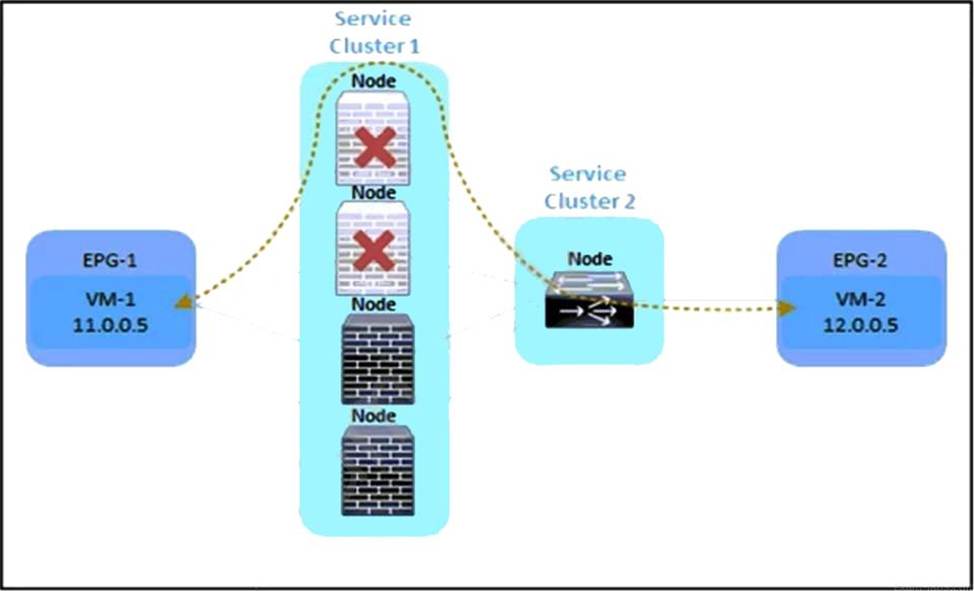
An engineer must divert the traffic between VM-1 and VM-2 by using a Multi-Node service graph. The solution should prevent an insufficient number of available Layer 4 to Layer 7 devices in the first cluster.
Which configuration set accomplishes this goal?
- A . • PBR node tracking
• tracking threshold with action bypass
• symmetric PBR
• resilient hashing - B . • PBR node tracking
• tracking threshold with action permit
• unidirectional PBR
• resilient hashing - C . • PBR node tracking
• tracking threshold with action permit
• symmetric PBR
• resilient hashing - D . • PBR node tracking
• tracking threshold with action deny
• symmetric PBR
• unidirectional PBR
A
Explanation:
To divert traffic between VM-1 and VM-2 using a Multi-Node service graph while preventing an insufficient number of available Layer 4 to Layer 7 devices in the first cluster, the following configuration set should be used:
PBR node tracking: This feature monitors the health of the nodes (Layer 4 to Layer 7 devices) in the service graph. If a node becomes unavailable, the system can take action based on the tracking threshold1.
Tracking threshold with action bypass: When the number of healthy nodes falls below the tracking threshold, the action ‘bypass’ ensures that traffic is not sent to the unhealthy nodes, thus preventing service disruption1.
Symmetric PBR: This ensures that return traffic follows the same path as the original traffic, maintaining session consistency and avoiding asymmetric routing issues1.
Resilient hashing: This hashing mechanism provides a consistent and optimal distribution of traffic across the available Layer 4 to Layer 7 devices, even when the number of nodes changes due to a failure or maintenance1.
Reference: Cisco APIC Layer 4 to Layer 7 Services Deployment Guide, Release 5.2(x)
Refer to the exhibit.
An engineer must divert the traffic between VM-1 and VM-2 by using a Multi-Node service graph. The solution should prevent an insufficient number of available Layer 4 to Layer 7 devices in the first cluster.
Which configuration set accomplishes this goal?
- A . • PBR node tracking
• tracking threshold with action bypass
• symmetric PBR
• resilient hashing - B . • PBR node tracking
• tracking threshold with action permit
• unidirectional PBR
• resilient hashing - C . • PBR node tracking
• tracking threshold with action permit
• symmetric PBR
• resilient hashing - D . • PBR node tracking
• tracking threshold with action deny
• symmetric PBR
• unidirectional PBR
A
Explanation:
To divert traffic between VM-1 and VM-2 using a Multi-Node service graph while preventing an insufficient number of available Layer 4 to Layer 7 devices in the first cluster, the following configuration set should be used:
PBR node tracking: This feature monitors the health of the nodes (Layer 4 to Layer 7 devices) in the service graph. If a node becomes unavailable, the system can take action based on the tracking threshold1.
Tracking threshold with action bypass: When the number of healthy nodes falls below the tracking threshold, the action ‘bypass’ ensures that traffic is not sent to the unhealthy nodes, thus preventing service disruption1.
Symmetric PBR: This ensures that return traffic follows the same path as the original traffic, maintaining session consistency and avoiding asymmetric routing issues1.
Resilient hashing: This hashing mechanism provides a consistent and optimal distribution of traffic across the available Layer 4 to Layer 7 devices, even when the number of nodes changes due to a failure or maintenance1.
Reference: Cisco APIC Layer 4 to Layer 7 Services Deployment Guide, Release 5.2(x)