
Cisco 300-620 Practice Exams
Last updated on Nov 16,2026- Exam Code: 300-620
- Exam Name: Implementing Cisco Application Centric Infrastructure (DCACI)
- Certification Provider: Cisco
- Latest update: Nov 16,2026
What is the purpose of the Overlay Multicast TEP in a Cisco ACI Multi-Site deployment?
- A . to source and receive unicast VXLAN data plane traffic
- B . to establish MP-BGP EVPN adjacencies with the spine nodes in remote sites
- C . to encapsulate multicast traffic in a common multicast group
- D . to perform head-end replication for BUM traffic
D
Explanation:
The purpose of the Overlay Multicast TEP (O-MTEP) in a Cisco ACI Multi-Site deployment is to perform head-end replication for BUM (Broadcast, Unknown unicast, Multicast) traffic. This common anycast address is shared by all the spine nodes in the same site and is used to replicate BUM traffic across the sites4.
An engineer is implementing Cisco ACI at a large platform-as-a-service provider using APIC controllers, 9396PX leaf switches, and 9336PQ spine switches. The leaf switch ports are configured as IEEE 802.1p ports.
Where does the traffic exit from the EPG in IEEE 802.1p mode in this configuration?
- A . from leaf ports tagged as VLAN 0
- B . from leaf ports untagged
- C . from leaf ports tagged as VLAN 4094
- D . from leaf ports tagged as VLAN 1
B
Explanation:
In a Cisco ACI configuration with IEEE 802.1p ports, the traffic exits from the EPG untagged from leaf ports. This means that when the port is configured in Access (802.1p) mode and the access VLAN is the only VLAN deployed on the port, then traffic will be untagged on egress56.
Refer to the exhibit.
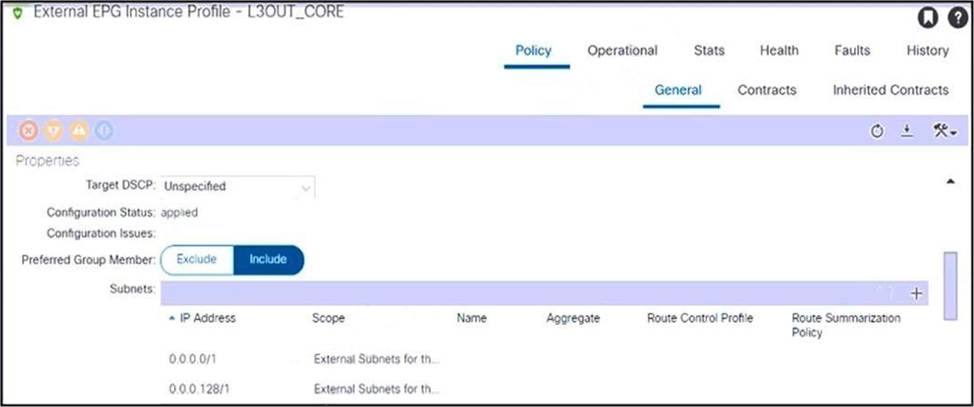
An engineer configured subnets on the external EPG called L3OUT_CORE. The external endpoints in the 10.1.0.0/24 subnet can reach internal endpoints, but the external endpoints in the 172.16.1.0/24 subnet are unreachable.
Which set of actions enables the connectivity?
- A . Delete both external EPG subnets.
Create the 0.0.0.0/1 subnet. - B . Delete the external EPG subnet 0.0.0.128/1.
Create the 128.0.0.0/1 subnet. - C . Delete both external EPG subnets.
Create the 0.0.0.0/0 subnet. - D . Delete the external EPG subnet 0.0.0.0/0.
Create the 0.0.0.0/128 subnet.
C
Explanation:
To enable connectivity for the external endpoints in the 172.16.1.0/24 subnet, the following actions should be taken:
Delete both external EPG subnets: This action removes any specific subnet configurations that might be causing routing issues or conflicts within the external EPG1.
Create the 0.0.0.0/0 subnet: By configuring a 0.0.0.0/0 subnet, you are effectively creating a default route that allows all traffic to be routed, ensuring that endpoints in any subnet, including the 172.16.1.0/24 subnet, can reach internal endpoints1.
This configuration change addresses the issue where traffic from the 172.16.1.0/24 subnet is not reaching the internal endpoints, likely due to a lack of a default route or misconfigured subnets within the external EPG
A bridge domain for a new endpoint group in the Cisco ACI fabric must meet these requirements:
• The bridge domain must function as the default gateway for the subnet so that routing remains within the Cisco ACI fabric.
• ARP requests must be managed via Layer 3 unicast packets or be dropped to reduce excessive broadcast traffic.
• The impact of misconfigured virtual machines must be kept to a minimum by preventing IP addresses outside of the configured subnet from being routed.
Which set of actions must be taken?
- A . Disable ARP Flooding.
Enable Limit IP Learning to Subnet.
Enable Unicast Routing on the bridge domain and configure a subnet. - B . Enable Limit IP Learning to Subnet.
Enable Unicast Routing on the bridge domain and configure a subnet.
Set Multi-Destination Flooding to Flood in BD. - C . Set Endpoint Retention Policy to default.
Enable ARP Flooding.
Enable Unicast Routing on the bridge domain and configure a subnet. - D . Enable Unicast Routing on the bridge domain and configure a subnet.
Set L2 Unknown Unicast to Flood.
Disable Endpoint Retention Policy.
A
Explanation:
To meet the requirements for the new endpoint group’s bridge domain in the Cisco ACI fabric, the following actions must be taken:
Disable ARP Flooding: This action prevents ARP requests from being broadcast across the entire bridge domain, which reduces excessive broadcast traffic.
Enable Limit IP Learning to Subnet: This setting restricts IP address learning to only those IPs within the configured subnet, minimizing the impact of misconfigured virtual machines.
Enable Unicast Routing on the bridge domain and configure a subnet: Enabling unicast routing allows the bridge domain to function as the default gateway for the subnet, ensuring that routing remains within the Cisco ACI fabric.
Which new construct must a user create when configuring in-band management?
- A . VLAN pool
- B . management contract
- C . management tenant
- D . bridge domain
D
Explanation:
When configuring in-band management, the new construct that must be created is a bridge domain1.
Reference: https://www.cisco.com/c/en/us/td/docs/switches/datacenter/aci/apic/sw/kb/b_KB_Configuring_Static_Management_Access.html
DRAG DROP
Drag and drop the Cisco ACI filter entry options from the left onto the correct categories on the right indicating what are required or optional parameters.
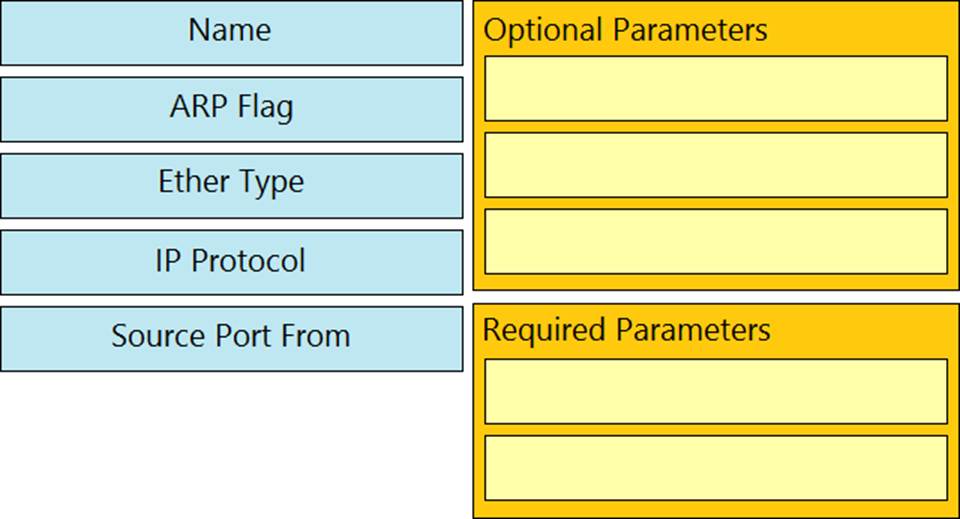
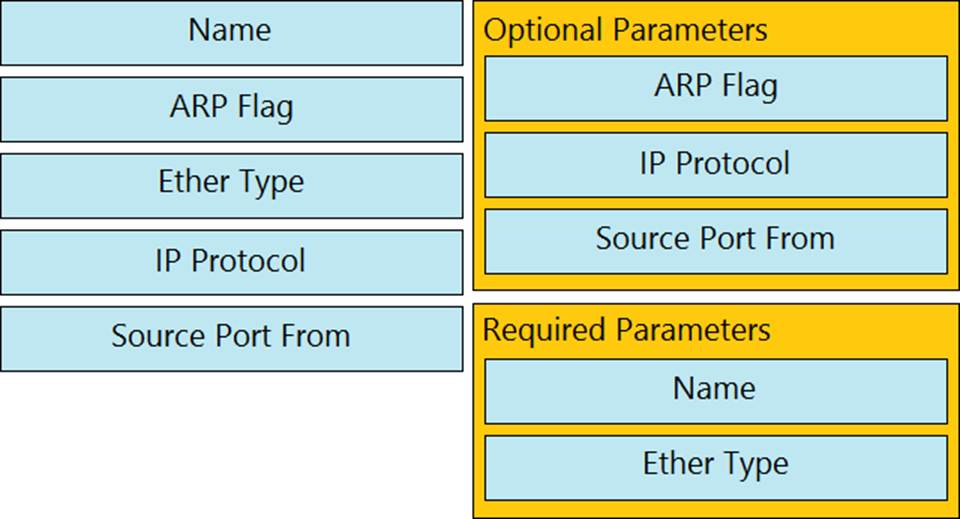
Explanation:
Reference: https://www.cisco.com/c/en/us/td/docs/switches/datacenter/aci/apic/sw/1-x/Operating_ACI/guide/b_Cisco_Operating_ACI/b_Cisco_Operating_ACI_chapter_01000.html
An engineer must allow multiple external networks to communicate with internal ACI subnets.
Which action should the engineer take to assign the prefix to the class ID of the external Endpoint Group?
- A . Enable the Export Route Control Subnet for the External Endpoint Group flag.
- B . Enable an L30ut with Shared Route Control Subnet.
- C . Configure subnets with the External Subnets for External EPG flag enabled.
- D . Configure subnets with the Import Route Control Subnet flag enabled.
C
Explanation:
To allow multiple external networks to communicate with internal ACI subnets and assign the prefix to the class ID of the external Endpoint Group, the engineer should configure subnets with the External Subnets for External EPG flag enabled1. This configuration allows the specified subnets to be associated with an external EPG, which facilitates communication between internal tenants and external routed networks via L3Outs1.
https://www.cisco.com/c/en/us/td/docs/switches/datacenter/aci/apic/sw/1-x/ACI_Best_Practices/b_ACI_Best_Practices/b_ACI_Best_Practices_chapter_01001.html

An engineer must allow multiple external networks to communicate with internal ACI subnets.
Which action should the engineer take to assign the prefix to the class ID of the external Endpoint Group?
- A . Enable the Export Route Control Subnet for the External Endpoint Group flag.
- B . Enable an L30ut with Shared Route Control Subnet.
- C . Configure subnets with the External Subnets for External EPG flag enabled.
- D . Configure subnets with the Import Route Control Subnet flag enabled.
C
Explanation:
To allow multiple external networks to communicate with internal ACI subnets and assign the prefix to the class ID of the external Endpoint Group, the engineer should configure subnets with the External Subnets for External EPG flag enabled1. This configuration allows the specified subnets to be associated with an external EPG, which facilitates communication between internal tenants and external routed networks via L3Outs1.
https://www.cisco.com/c/en/us/td/docs/switches/datacenter/aci/apic/sw/1-x/ACI_Best_Practices/b_ACI_Best_Practices/b_ACI_Best_Practices_chapter_01001.html
In the context of VMM, which protocol between ACI leaf and compute hosts ensures that the policies are pushed to the leaf switches for immediate and on demand resolution immediacy?
- A . VXLAN
- B . LLDP
- C . ISIS
- D . STP
B
Explanation:
In the context of VMM, the protocol between ACI leaf and compute hosts that ensures that the policies are pushed to the leaf switches for immediate and on-demand resolution immediacy is LLDP (Link Layer Discovery Protocol)2. LLDP is used for discovery and to ensure that the policies are applied as needed for the virtual machines2.
https://www.cisco.com/c/en/us/td/docs/switches/datacenter/aci/apic/sw/1-x/aci-fundamentals/b_ACI-Fundamentals/b_ACI-Fundamentals_chapter_01011.html