
Cisco 300-620 Practice Exams
Last updated on Nov 16,2026- Exam Code: 300-620
- Exam Name: Implementing Cisco Application Centric Infrastructure (DCACI)
- Certification Provider: Cisco
- Latest update: Nov 16,2026
An engineer configured Layer 2 extension from the ACI fabric and changed the Layer 2 unknown
unicast policy from Flood to Hardware Proxy.
How does this change affect the flooding of the L2 unknown unicast traffic?
- A . It is forwarded to one of the spines to perform as a spine proxy.
- B . It is flooded within the whole fabric.
- C . It is dropped by the leaf when the destination endpoint is not present in the endpoint table.
- D . It is forwarded to one of the APICs to perform as a proxy.
A
Explanation:
Changing the Layer 2 unknown unicast policy from Flood to Hardware Proxy results in the traffic being forwarded to one of the spines to perform as a spine proxy4. If the spine proxy also does not know the address, the packet is discarded4.
Reference: https://www.cisco.com/c/en/us/td/docs/switches/datacenter/aci/apic/sw/2-x/L2_config/b_Cisco_APIC_Layer_2_Configuration_Guide/b_Cisco_APIC_Layer_2_Configuration_Guide_chapter_010.html
What is the minimum number of APICs does Cisco recommend to deploy in a production cluster?
- A . 1
- B . 3
- C . 4
- D . 5
B
Explanation:
The minimum number of APICs that Cisco recommends to deploy in a production cluster is 3 (Option B). This recommendation is based on the need for high availability and redundancy in a production
environment.
An engineer is configuring ACI VMM domain integration with Cisco UCS-B Series.
Which type of port channel policy must be configured in the vSwitch policy?
- A . LACP Active
- B . MAC Pinning
- C . LACP Passive
- D . MAC Pinning-Physical-NIC-load
D
Explanation:
When configuring ACI VMM domain integration with Cisco UCS-B Series, the type of port channel policy that must be configured in the vSwitch policy is MAC Pinning-Physical-NIC-load. This policy type allows for the distribution of traffic across physical NICs based on MAC address hashing, which is suitable for environments where dynamic port channels (LACP) are not used.
Reference: https://www.cisco.com/c/en/us/support/docs/cloud-systems-management/application-policy-infrastructure-controller-apic/118965-config-vmm-aci-ucs-00.html
Refer to the exhibit.
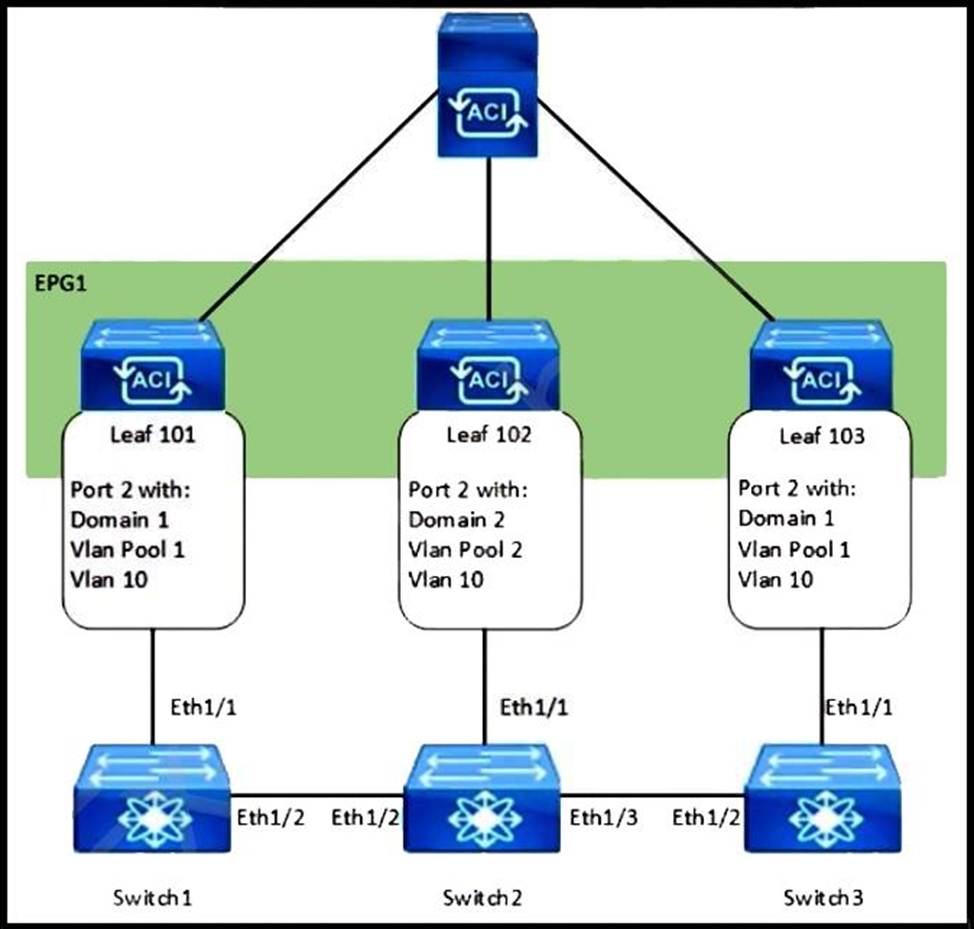
How are the STP BPDUs forwarded over Cisco ACI fabric?
- A . Cisco ACI acts as the STP root for all three external switches.
- B . STP BPDUs that are generated by Switch2 are received by Switch1 and Switch3
- C . STP BPDUs that are generated by Switch1 are received only by Switch3.
- D . Cisco ACI fabric drops all STP BPDUs that are generated by the external switches.
B
Explanation:
In a Cisco ACI fabric, Spanning Tree Protocol (STP) Bridge Protocol Data Units (BPDUs) that are generated by an external switch, such as Switch2 in this scenario, are indeed forwarded across the fabric. This allows externally connected switches to maintain a loop-free topology. While Cisco ACI does not participate in STP as it uses its own protocols and mechanisms for loop prevention within the fabric, it will forward STP BPDUs across End Point Groups (EPGs) on which they are received1. This ensures that the connected external switches can still use STP for their loop prevention mechanisms.
Reference: Cisco Community Discussion on STP BPDUs in ACI1
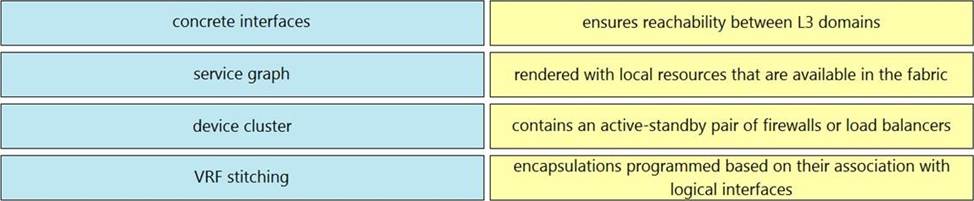
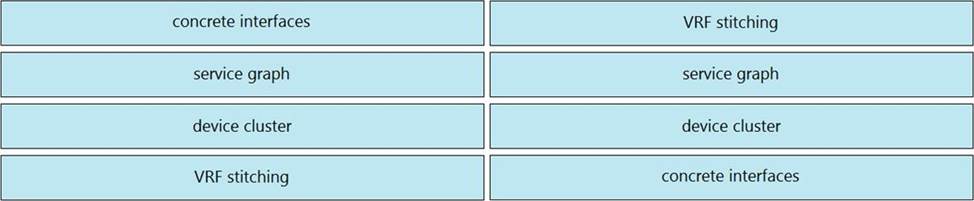
DRAG DROP
Drag and drop the Cisco ACI Layer 4 to Layer 7 service insertion terms on the left to the correct descriptions on the right.
How does Cisco ACI detect the IP address of a silent host that moved from one location to another without notifying a Cisco ACI leaf?
- A . ARP requests are flooded in the bridge domain.
- B . Bounce entries are installed on the leaf switch.
- C . Endpoint announce messages are sent to COOP.
- D . Silent hosts are detected by the ACI fabric.
A
Explanation:
In a Cisco ACI fabric, when a silent host moves from one location to another without notifying the ACI leaf switch (e.g., via Gratuitous ARP), the detection mechanism depends on how the bridge domain is configured. Specifically, ARP flooding can help detect such silent hosts.
An engineer wants to monitor all configuration changes, threshold crossing, and link-state transitions in a Cisco ACI fabric.
Which action must be taken to receive the required messages?
- A . Add Faults and Events to the monitor policy.
- B . Add Session Logs and Audit Logs to the monitor policy.
- C . Include Audit Logs and Events in the Syslog source policy.
- D . Include Events and Session Logs in the Syslog source policy.
C
Explanation:
To monitor all configuration changes, threshold crossing, and link-state transitions in a Cisco ACI fabric, the action that must be taken is to Include Audit Logs and Events in the Syslog source policy
https://community.cisco.com/legacyfs/online/attachments/blog/technote-aci-syslog_external-latest.pdf
https://www.cisco.com/c/en/us/td/docs/switches/datacenter/aci/apic/sw/all/faults/guide/b_APIC_Faults_Errors/b_IFC_Faults_Errors_chapter_010.html
What do Pods use to allow Pod-to-Pod communication in a Cisco ACI Multi-Pod environment?
- A . over Layer 3 directly connected back-to-back spines
- B . over Layer 3 Out connectivity via border leafs
- C . over Layer 3 IPN connectivity via spines
- D . over Layer 3 IPN connectivity via border leafs
C
Explanation:
In a Cisco ACI Multi-Pod environment, Pods use over Layer 3 IPN connectivity via spines to allow Pod-to-Pod communication6.
https://www.cisco.com/c/en/us/solutions/collateral/data-center-virtualization/application-centric-infrastructure/white-paper-c11-737855.html
Refer to the exhibit.
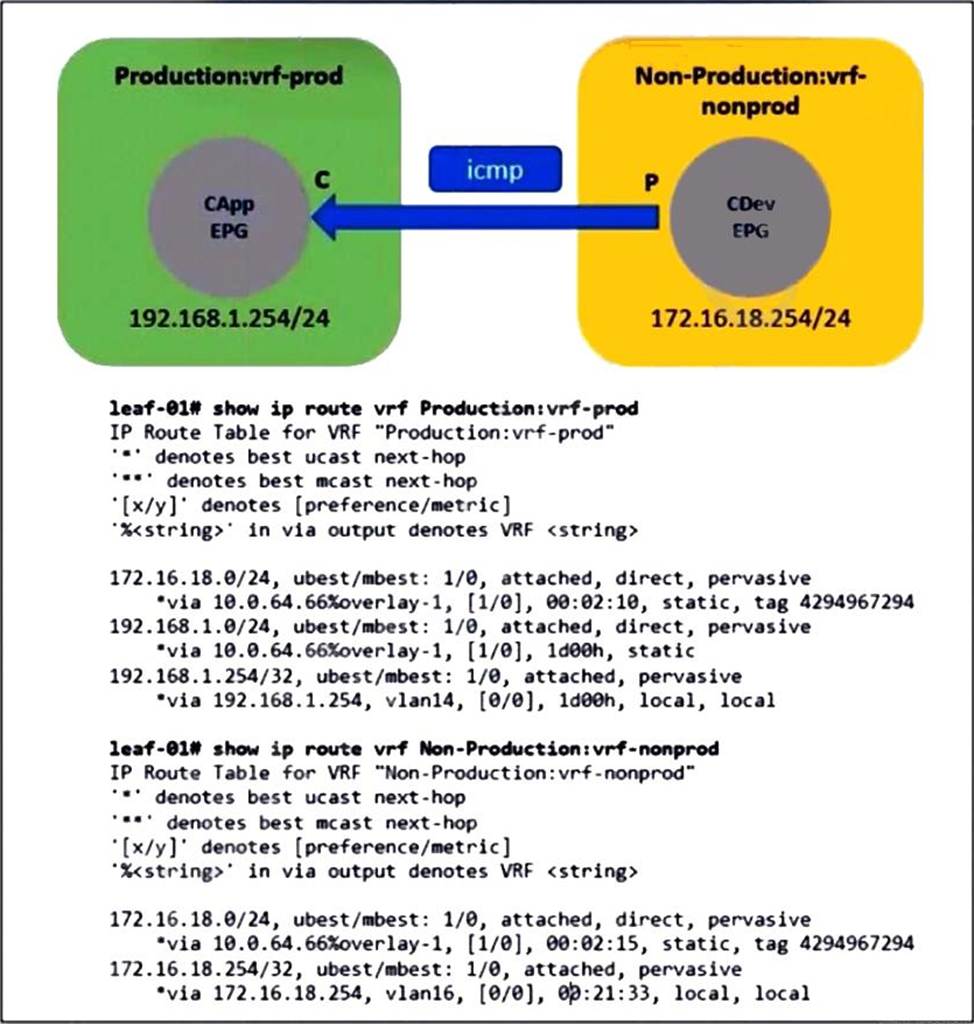
An administrator configures inter-VRF route leaking between Production:vrf-prod and Non-Production:vrf-nonprod. However, the route in the Non-Production:vrf-nonprod VRF to the production tenant is missing.
Which action resolves the VRF route leaking issue?
- A . Change the contract scope to Global.
- B . Enable the Shared between VRFs option for the BD subnet in the production VRF.
- C . Enable the Shared between VRFs option for the EPG subnet in the non-production VRF.
- D . Export the contract from provider to consumer tenant.
B
Explanation:
To resolve the VRF route leaking issue and ensure that the route in the Non-Production:vrf-nonprod VRF to the production tenant is present, the action that should be taken is to enable the “Shared between VRFs” option for the bridge domain (BD) subnet in the production VRF. This setting allows the subnet to be shared across different VRFs within the same tenant or across tenants, enabling communication between EPGs that are in different VRFs1.
Reference: ACI Inter VRF/Tenant Route Leaking Configuration Example
Which components must be configured for the BGP Route Reflector policy to take effect?
- A . spine fabric interface overrides and profiles
- B . access policies and profiles
- C . pod policy groups and profiles
- D . leaf fabric interface overrides and profiles
D
Explanation:
For the BGP Route Reflector policy to take effect, the components that must be configured are the leaf fabric interface overrides and profiles. These configurations are necessary to establish the route reflector relationships within the BGP protocol on the leaf switches
Reference: https://www.cisco.com/c/en/us/td/docs/switches/datacenter/aci/apic/sw/4-x/L3-configuration/Cisco-APIC-Layer-3-Networking-Configuration-Guide-401/Cisco-APIC-Layer-3-Networking-Configuration-Guide- 401_chapter_01.html