
Cisco 300-620 Practice Exams
Last updated on Nov 16,2026- Exam Code: 300-620
- Exam Name: Implementing Cisco Application Centric Infrastructure (DCACI)
- Certification Provider: Cisco
- Latest update: Nov 16,2026
Which switch type is discovered first in the Cisco ACI fabric discovery process?
- A . leaf
- B . access
- C . distribution
- D . spine
A
Explanation:
The question asks which switch type is discovered first in the Cisco ACI fabric discovery process. The ACI fabric consists of spine and leaf switches, and the discovery process is a critical initial step to establish the fabric topology. Let’s analyze this based on Cisco ACI documentation.
Requirement Analysis
The ACI fabric discovery process involves the Application Policy Infrastructure Controller (APIC) identifying and registering switches to form the network topology.
The process relies on protocols like Link Layer Discovery Protocol (LLDP) and Cisco Discovery Protocol (CDP) to detect connected devices.
The sequence of discovery is determined by the physical connectivity and the role of switches in the fabric.
Option Evaluation
What are two PBR characteristics of the Cisco ACI Active-Active Across Pods deployment mode in Cisco ACI Multi-Pod design? (Choose two.)
- A . Traffic is dynamically redirected to the firewall that owns the connection.
- B . Deployment occurs in transparent mode.
- C . The connection state is unsynchronized.
- D . Deployment occurs in go-to mode only.
- E . This mode causes the traffic to flow asymmetrically.
A, D
Explanation:
In the Cisco ACI Active-Active Across Pods deployment mode, one of the key characteristics of Policy-Based Redirect (PBR) is that traffic is dynamically redirected to the firewall that owns the connection. This allows for load distribution across multiple Layer 4 to Layer 7 devices, also known as symmetric PBR. Additionally, deployment in this mode occurs in go-to mode only, which means that traffic is explicitly directed to a service node or firewall for processing
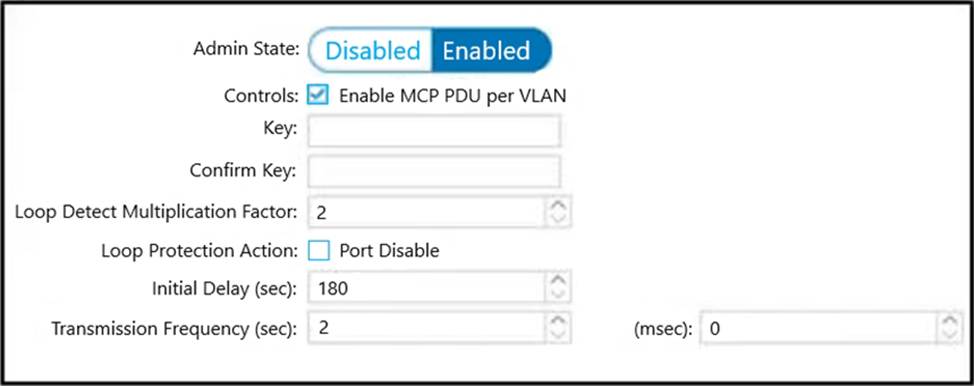
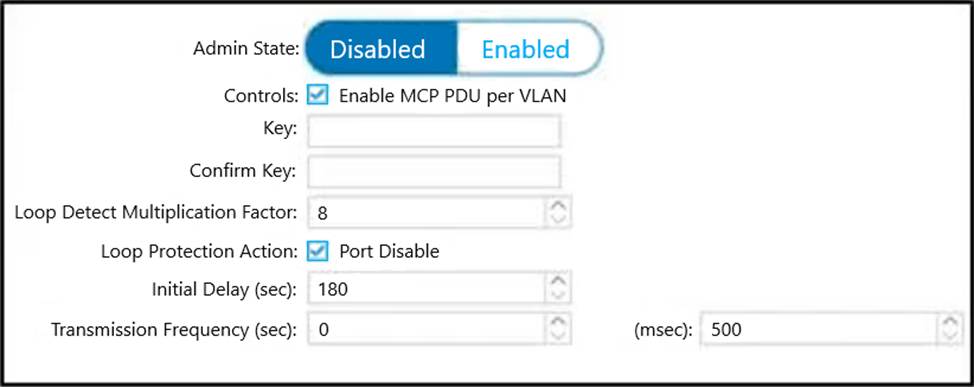
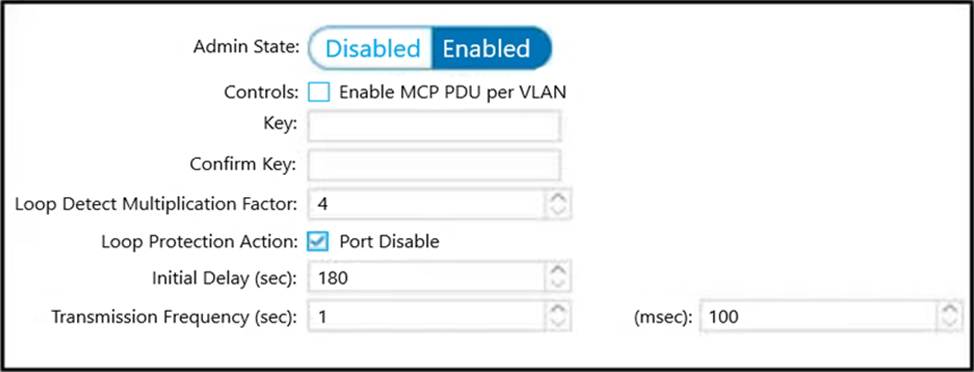
A network engineer must configure a Cisco ACI system to detect network loops for untagged and tagged traffic The loop must be detected and slopped by disabling an interface within 4 seconds.
Which configuration must be used?
A)
B)
C)
- A . Option A
- B . Option B
- C . Option C
B
Explanation:
To configure a Cisco ACI system to detect network loops for both untagged and tagged traffic and to stop the loop by disabling an interface within 4 seconds, the following configuration must be used:
Enable Mis-Cabling Protocol (MCP): MCP detects loops from external sources and will err-disable the interface on which Cisco ACI receives its own packet. This is crucial for preventing loops in the network1.
Configure MCP Transmit Frequency: Set the MCP transmit frequency to a value that allows for quick loop detection. The Cisco ACI fabric provides faster loop detection with transmit frequencies from 100 milliseconds to 300 seconds. To meet the requirement of detecting and stopping a loop within 4 seconds, you would set the transmit frequency to a value less than 4 seconds2.
Set Action on Loop Detection: Configure the MCP policies to identify loops and decide how to act upon them. You can set the policy to generate a syslog message or disable the port upon loop detection2.
Implement Error Disabled Recovery Policy: Configure an error disabled recovery policy to automatically re-enable ports that were disabled due to loop detection after a configurable interval2.
By implementing these configurations, the Cisco ACI system will be able to detect and stop network loops quickly and efficiently, ensuring network stability and preventing potential disruptions.
Reference: Cisco APIC Online Help – Loop Detection2
Cisco ACI Best Practices Quick Summary
Which tenant is used when configuring in-band management IP addresses for Cisco APICs, leaf nodes, and spine nodes?
- A . default
- B . infra
- C . common
- D . mgmt
D
Explanation:
When configuring in-band management IP addresses for Cisco APICs, leaf nodes, and spine nodes, the tenant used is the mgmt tenant1.
Reference: https://www.cisco.com/c/en/us/td/docs/switches/datacenter/aci/apic/sw/kb/b_KB_Configuring_Static_Management_Access.html#concept_CFF63FEBE947424291B0F10E6F23DA7D
Refer to exhibit.
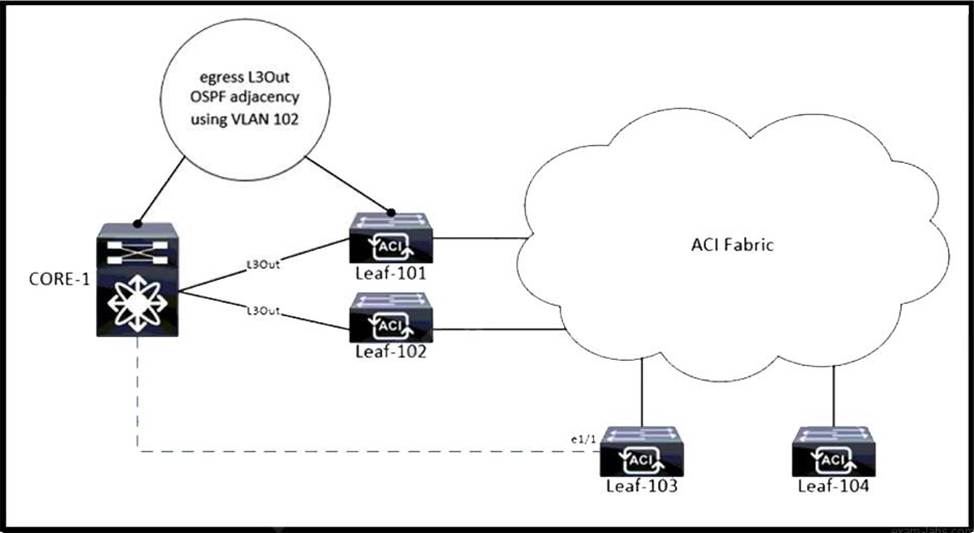
The Cisco ACI fabric has an egress L3Out from Leaf-101 and Leaf-102 to CORE-1. VLAN 102 is used to form the OSPF adjacency. The workloads must be migrated into EPG-101, and the static port binding is configured to Leaf-103 e1/1 with encap VLAN 101. An engineer completes the port binding and receives an MCP fault.
Which action clears the fault?
- A . Use VLAN 101 for OSPF adjacency on the egress L3Out.
- B . Use VLAN 102 as the encap VLAN on the EPG-101 static port binding.
- C . Add VLAN 102 to the VLAN pool that is used by the static port binding.
- D . Prune VLAN 101 from the VLAN pool that is used by the egress L3Out.
B
Explanation:
To clear the MCP (Mis-Cabling Protocol) fault in a Cisco ACI fabric when an egress L3Out is configured from Leaf-101 and Leaf-102 to CORE-1, and VLAN 102 is used for OSPF adjacency, the encapsulation VLAN on the EPG-101 static port binding should match the VLAN used for OSPF adjacency. This means that VLAN 102 should be used as the encapsulation VLAN for the static port binding on Leaf-103 e1/1. Using the same VLAN for both OSPF adjacency and the static port binding ensures consistency and prevents misconfiguration that could lead to MCP faults1.
Reference: ACI Fabric L3Out White Paper – Cisco1
Engineer resolves an underlying condition of a fault but notices that the fault was not deleted from the Faults view.
Which two actions must be taken to remove the fault? (Choose two.)
- A . The fault is deleted after the retention interval.
- B . Acknowledge the fault as an administrator.
- C . The raised condition ceases.
- D . The soaking timer expires.
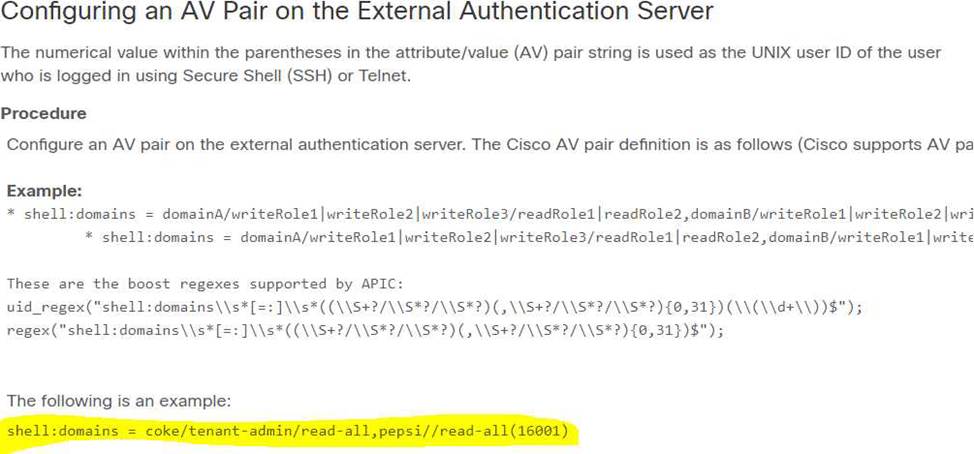
A customer implements RBAC on a Cisco APIC using a Windows RADIUS server that is configured with network control policies.
The APIC is as follows:
Tenant = TenantX
Security Domain = Tenantx-SD
User = X
The customer requires User X to have access to TenantX only, without any extra privilege in the Cisco ACI fabric domain.
Which Cisco AV pair must be implemented on the RADIUS server to meet these requirement?
- A . shell:domains = TenantX-SD/fabric-admin/,common//read-all
- B . shell:domains = TenantX-SD/tenant-admin
- C . shell:domains = TenantX-SD/tenant-ext-admin/,common//read-all
- D . shell:domains = TenantX-SD/tenant-admin/,common//read-all
B
Explanation:
To restrict User X to have access only to TenantX without any extra privileges in the Cisco ACI fabric domain, the Cisco AV pair that must be implemented on the RADIUS server is shell: domains = TenantX-SD/tenant-admin. This AV pair assigns User X the role of tenant admin within the security domain of TenantX, ensuring that the user has the necessary permissions to manage resources within TenantX and no additional privileges outside of this scope.
https://www.cisco.com/c/en/us/td/docs/switches/datacenter/aci/apic/sw/2-x/Security_config/b_Cisco_APIC_Security_Guide/b_Cisco_APIC_Security_Guide_chapter_0100.html
A packet is routed between two endpoints on different Cisco ACI leaf switches.
Which VXLAN VNID is applied to the packet?
- A . FD
- B . EPG
- C . VRF
- D . BD
D
Explanation:
In Cisco ACI, when a packet is routed between two endpoints on different leaf switches, the VXLAN VNID that is applied to the packet corresponds to the Bridge Domain (BD). The BD VNID is used to encapsulate the packet for Layer 2 transport across the fabric. This VNID ensures that the packet is delivered to the correct bridge domain, maintaining the segmentation and policy enforcement required by the ACI fabric.
Reference: Cisco ACI Fabric Forwarding White Paper
Cisco ACI Basic Configuration Guide
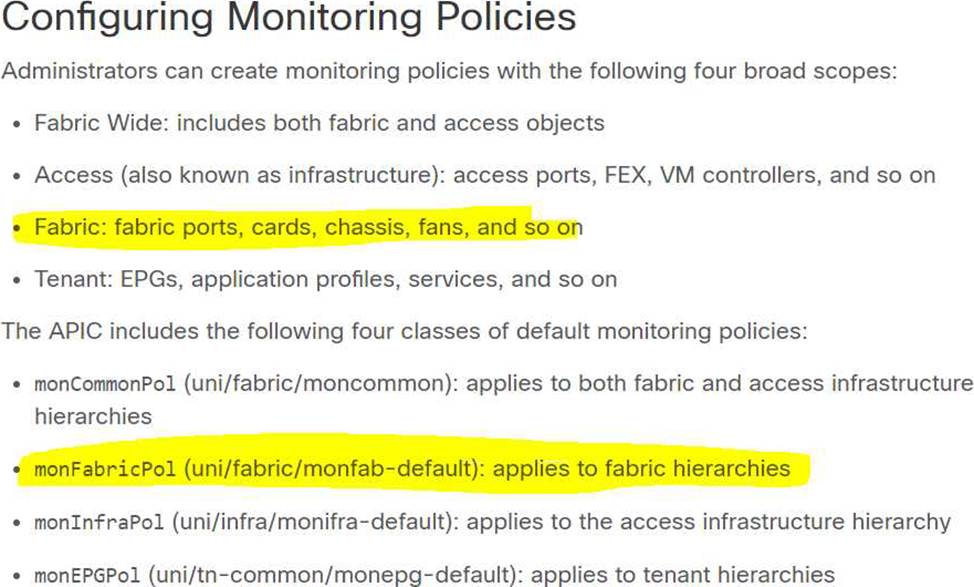
An engineer must set up a Cisco ACI fabric to send Syslog messages related to hardware events, such as chassis line card failures. The messages should be sent to a dedicated Syslog server.
Where in the Cisco APIC should the policy be configured to meet this requirement?
- A . uni/tn-common/monepg-default
- B . uni/infra/monifra-default
- C . uni/fabric/monfab-default
- D . uni/fabric/moncommon
C
Explanation:
To set up a Cisco ACI fabric to send Syslog messages related to hardware events to a dedicated Syslog server, the policy should be configured at uni/fabric/monfab-default4. This location in the Cisco APIC allows for the configuration of Syslog policies that can be applied to the entire fabric4.
https://www.cisco.com/c/en/us/td/docs/switches/datacenter/aci/apic/sw/4-x/aci-fundamentals/Cisco-ACI-Fundamentals-401/Cisco-ACI-Fundamentals-401_chapter_01100.html
An engineer plans a Cisco ACI firmware upgrade. The ACI fabric consists of three Cisco APIC controllers, two spine switches, and four leaf switches. Two leaf switches have 1-Gb copper s for bare metal servers, and the other two leaf switches have 10-Gb SFP ports to connect storage.
Which set of actions accomplishes an upgrade with minimal disruptions?
- A . Upgrade the APIC controllers by selecting the desired firmware and choosing Upgrade Now.
Divide the switches into two upgrade groups: spines and leaves.
Start the firmware upgrade on the spine upgrade group and then proceed with the leaf upgrade group. - B . Upgrade the APIC controllers by initiating the upgrade process that uses the most recent uploaded firmware.
Divide the switches into three upgrade groups: spines, 1-Gb switches, and 10-Gb switches.
Start the firmware upgrade on the spine upgrade group and then proceed with the other two groups. - C . Upgrade the APIC controllers by selecting the desired firmware and choosing Upgrade Now.
Divide the switches into two upgrade groups with one spine, one 1-Gb switch, and one 10-Gb switch per group.
Start the firmware upgrade on the first upgrade group and when it finishes, start the second upgrade group. - D . Upgrade the APIC controllers as a single group by selecting the firmware and choosing Upgrade Now.
Divide the switches into four upgrade groups with one switch per group.
Start the firmware upgrade on each upgrade group in succession until all four are complete.