
Cisco 300-620 Practice Exams
Last updated on Nov 16,2026- Exam Code: 300-620
- Exam Name: Implementing Cisco Application Centric Infrastructure (DCACI)
- Certification Provider: Cisco
- Latest update: Nov 16,2026
An engineer must securely export Cisco APIC configuration snapshots to a secure, offsite location The exported configuration must be transferred using an encrypted tunnel and encoded with a platform-agnostic data format that provides namespace support.
Which configuration set must be used?
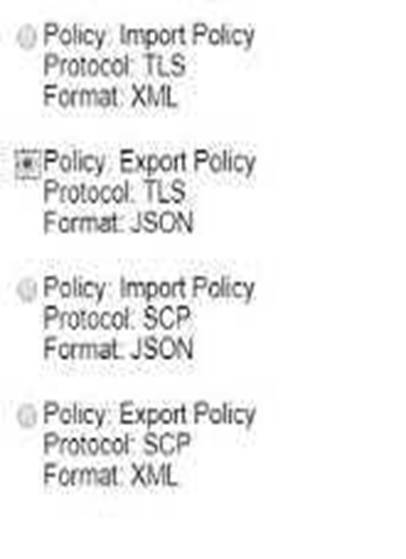
- A . Policy: Import Policy
Protocol: TLS
Format: XML - B . Policy: Export Policy
Protocol: TLS
Format: JSON - C . Policy: Import Policy
Protocol: SCP
Format: JSON - D . Policy: Export Policy
Protocol: SCP
Format: XML
B
Explanation:
To securely export Cisco APIC configuration snapshots to a secure, offsite location using an encrypted tunnel and a platform-agnostic data format that provides namespace support, the following configuration set must be used:
Choose a Platform-Agnostic Data Format: Export the configuration in a data format like JSON or XML, which are platform-agnostic and support namespaces1.
Use an Encrypted Tunnel: Transfer the configuration snapshot over a secure protocol such as SFTP or SCP, which provides an encrypted tunnel for the data transfer1.
Schedule the Export: Set up a scheduled export of the configuration in the Cisco APIC to occur at regular intervals, ensuring the process is automated1.
Enable Encryption: Make sure the configuration export policy includes encryption settings. Cisco APIC supports AES-256 encryption for securing exported configuration files2.
Verify Namespace Support: Ensure that the chosen data format and the method of export support the use of namespaces, which are essential for organizing elements and attributes in XML documents1.
By following these steps and choosing Option B, the engineer can meet the requirements for securely exporting Cisco APIC configuration snapshots to an offsite location.
A customer migrates a legacy environment to Cisco ACI. A Layer 2 trunk is configured to interconnect the two environments. The customer also builds ACI fabric in an application-centric mode.
Which feature should be enabled in the bridge domain to reduce instability during the migration?
- A . Set Multi-Destination Flooding to Flood in BD.
- B . Enable Flood in Encapsulation.
- C . Set Multi-Destination Flooding to Flood in Encapsulation.
- D . Disable Endpoint Dataplane Learning
A
Explanation:
To reduce instability during the migration of a legacy environment to Cisco ACI, the feature that should be enabled in the bridge domain is to Set Multi-Destination Flooding to Flood in BD (Option A). This setting allows unknown multicast, broadcast, and unknown unicast traffic to be flooded within the bridge domain, which can help prevent traffic loss during the migration process.
Refer to the exhibit.
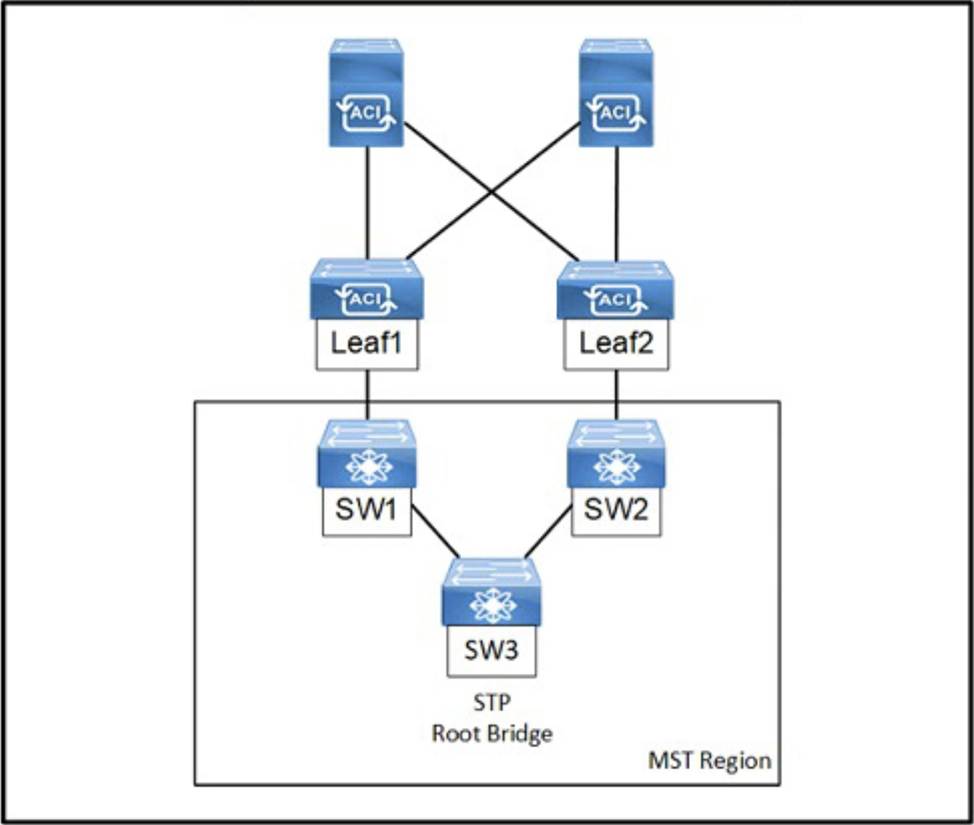
An engineer is deploying a Cisco ACI environment but experiences a STP loop between switch1 and switch2.
Which configuration step is needed to break the STP loop?
- A . Configure the STP instance to VLAN mapping under the switch STP policy.
- B . Configure a Layer 2 external bridged network on the interfaces facing the MST switches.
- C . Enable the native VLAN on the interfaces facing the MST switches using static pons in a dedicated EPG.
- D . Enable BPDU filter under the STP interface policy on the Interfaces lacing the MST switches.
D
Explanation:
To break the STP loop between switch1 and switch2 in a Cisco ACI environment, enabling BPDU filtering on the interfaces facing the MST (Multiple Spanning Tree) switches is the necessary step. BPDU filtering prevents BPDUs from being sent or received through a port, which effectively stops the STP process on those ports and breaks the loop1.
When BPDU filtering is enabled on an interface, the switch does not send any BPDUs and ignores any BPDUs it receives on that interface. This can be used to prevent unwanted STP negotiations on ports where loops are not expected to happen or where STP is not desired1.
Reference: Use of ACI Operation with L2 Switches and Spanning Tree Link Types – Cisco1
What must be enabled in the bridge domain to have the endpoint table learn the IP addresses of endpoints?
- A . L2 unknown unicast: flood
- B . GARP based detection
- C . unicast routing
- D . subnet scope
C
Explanation:
To have the endpoint table learn the IP addresses of endpoints in a bridge domain, unicast routing must be enabled1. This allows the bridge domain to learn the IP addresses of endpoints through the data plane1.
Refer to the exhibit.
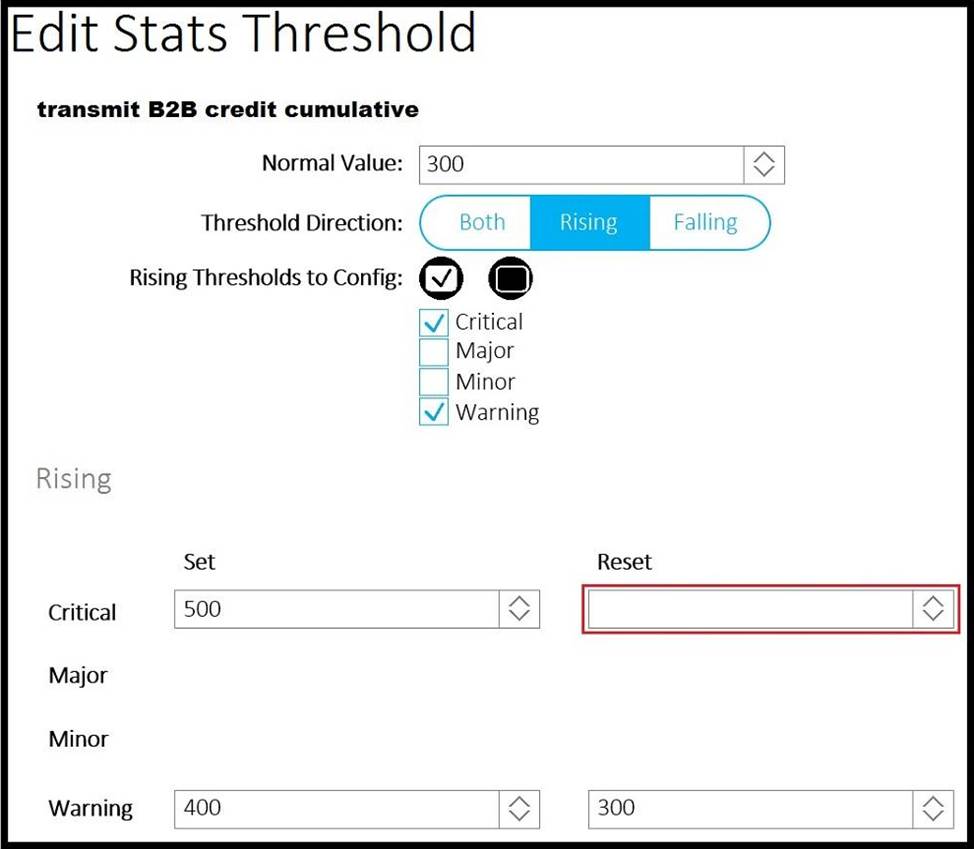
A client reports that the ACI domain connectivity to the fiber channel storage is experiencing a B2B credit oversubscription. The environment has a SYSLOG server for state collection messages.
Which value should be chosen to clear the critical fault?
- A . 300
- B . 410
- C . 350
- D . 510
D
Explanation:
To clear the critical fault related to B2B credit oversubscription in the ACI domain connectivity to the fiber channel storage, the value that should be chosen is 5101. This value is set to address the issue of B2B credit oversubscription and clear the critical fault as reported by the client1.
Network engineer configured a Cisco ACI fabric as follows:
• An EPG called EPG-A is created and associated with a VMM domain called North.
• The EPG-A is associated with BD-A and is in an application profile called Apps-A.
• The BD-A is associated with VRF-1 in the Prod tenant.
Which port group must be selected to place VMs in EPG-A?
- A . Prod|VRF-1 |Apps-A|EPG-A
- B . Prod|Business_Apps|BD-A|EPG-A
- C . Prod|Apps-A|North|EPG-A
- D . Prod|Apps-A|EPG-A
Network engineer configured a Cisco ACI fabric as follows:
• An EPG called EPG-A is created and associated with a VMM domain called North.
• The EPG-A is associated with BD-A and is in an application profile called Apps-A.
• The BD-A is associated with VRF-1 in the Prod tenant.
Which port group must be selected to place VMs in EPG-A?
- A . Prod|VRF-1 |Apps-A|EPG-A
- B . Prod|Business_Apps|BD-A|EPG-A
- C . Prod|Apps-A|North|EPG-A
- D . Prod|Apps-A|EPG-A
When Cisco ACI connects to an outside Layers 2 network, where does the ACI fabric flood the STP BPDU frame?
- A . within the bridge domain
- B . within the APIC
- C . within the access encap VLAN
- D . between all the spine and leaf switches
A
Explanation:
When Cisco ACI connects to an outside Layer 2 network, the ACI fabric floods the STP BPDU frame within the bridge domain (Option A)5. This ensures that BPDUs are properly propagated within the relevant VLAN encapsulation associated with the bridge domain5.
Reference: https://www.cisco.com/c/en/us/solutions/collateral/data-center-virtualization/application-centric- infrastructure/white-paper-c07-732033.html#_Toc395143571
Which table holds IP address, MAC address and VXLAN/VLAN information on a Cisco ACI leaf?
- A . endpoint
- B . adjacency
- C . RIB
- D . ARP
A
Explanation:
The table that holds IP address, MAC address, and VXLAN/VLAN information on a Cisco ACI leaf is the endpoint table6. This table is essential for the ACI fabric’s ability to track and apply policies to endpoints.
Refer to the exhibit.
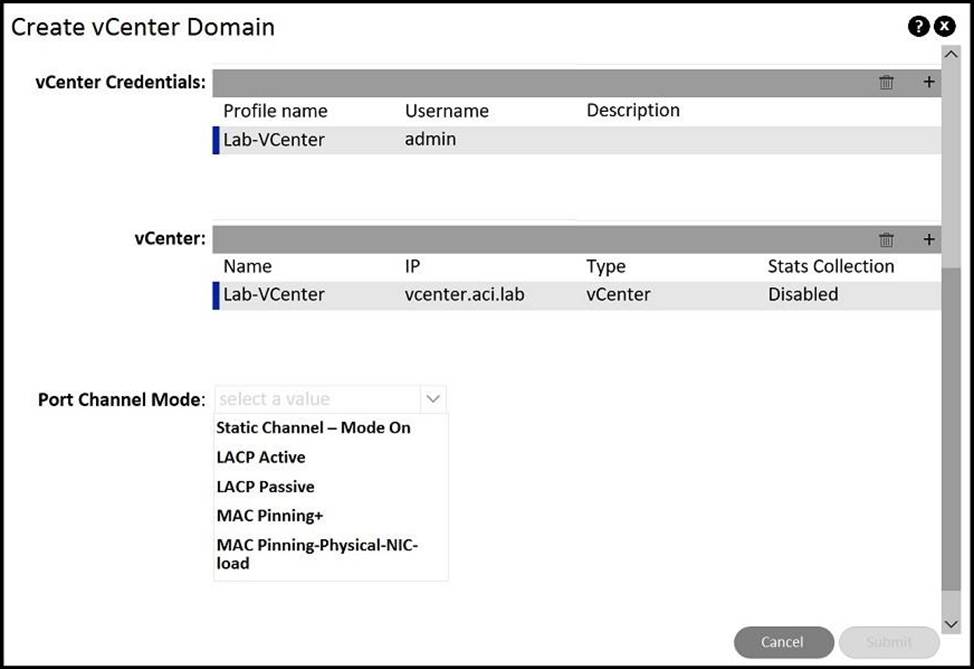
An engineer is implementing Cisco ACI C VMware vCenter integration for a blade server that lacks support of bonding.
Which port channel mode results in “route based on originating virtual port” on the VMware VDS?
- A . Static Channel C Mode On
- B . MAC Pinning-Physical-NIC-load
- C . LACP Passive
- D . MAC Pinning+
- E . LACP Active
B
Explanation:
For a blade server that lacks support of bonding, the port channel mode that results in “route based on originating virtual port” on the VMware VDS is MAC Pinning-Physical-NIC-load (Option B). This mode ensures that the virtual machine traffic is distributed across the available uplinks based on the MAC address of the originating virtual port1.
https://www.cisco.com/c/en/us/td/docs/dcn/aci/apic/6x/virtualization/cisco-aci-virtualization-guide-60x/ACI-Virtualization-Guide-60x-aci-with-vmware-vds.pdf