
Cisco 300-620 Practice Exams
Last updated on Nov 16,2026- Exam Code: 300-620
- Exam Name: Implementing Cisco Application Centric Infrastructure (DCACI)
- Certification Provider: Cisco
- Latest update: Nov 16,2026
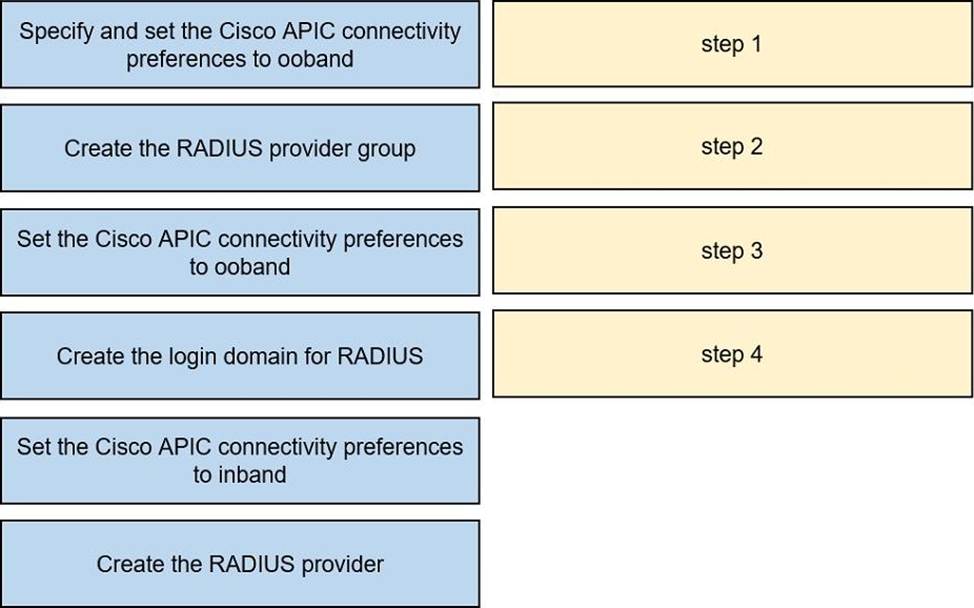
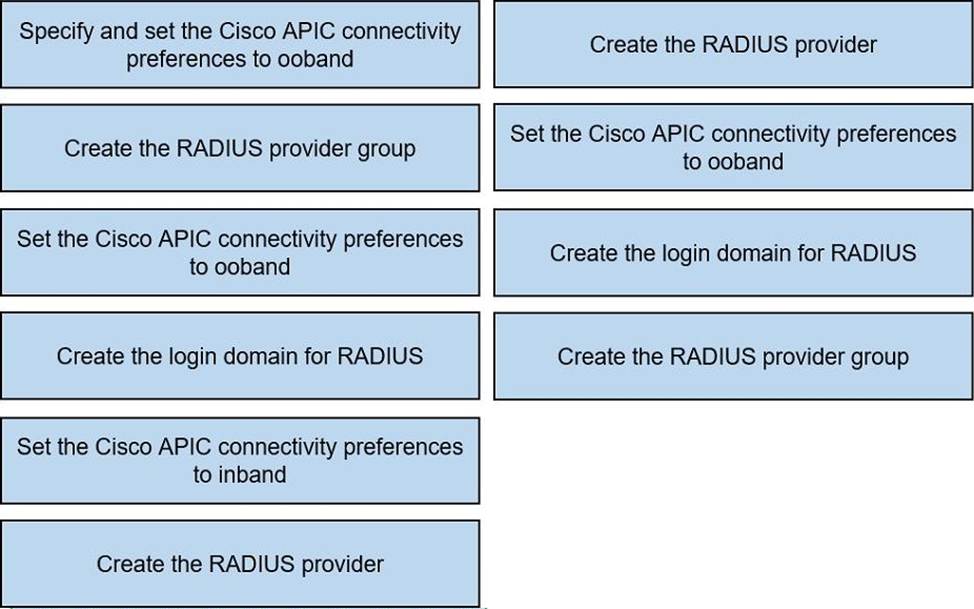
DRAG DROP
An engineer must configure RADIUS authentication with Cisco ACI for remote authentication with out-of-band management access.
Drag and drop the RADIUS configuration steps from the left into the required implementation order on the right. Not all steps are used.
The engineer notices frequent MAC and IP address moves between different leaf switch ports.
Which action prevents this problem from occurring?
- A . Disable enforce subnet check.
- B . Enable endpoint loop protection.
- C . Enable rogue endpoint control.
- D . Disable IP bridge domain enforcement.
C
Explanation:
To prevent frequent MAC and IP address moves between different leaf switch ports, enabling rogue endpoint control is the recommended action. This feature helps in identifying and mitigating the movement of endpoints that could potentially cause loops or other issues within the network.
Refer to the exhibit.
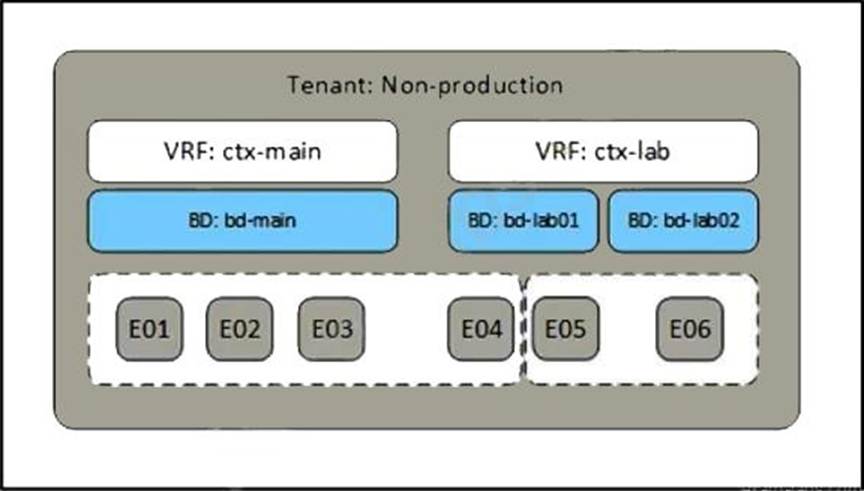
A network engineer must complete the Cisco ACI implementation based on the logical system design created by the systems architect.
Which Cisco ACI object is required where the dotted line indicates to complete the task?
- A . contract
- B . application profile
- C . context
- D . attachable Access Entity Profile
A
Explanation:
In Cisco ACI, a contract is used to define the communication policy between EPGs (Endpoint Groups). It specifies which types of traffic are allowed to pass between EPGs and can include filters for protocols, ports, and other attributes. In the context of the logical system design, the contract would be the object that completes the communication requirements as indicated by the dotted line in the exhibit12.
Reference: Cisco Application Centric Infrastructure (ACI) Design Guide1 Cisco ACI Policy Model Guide2
Which two external entities are referenced by an AEP? (Choose two.)
- A . VMware vCenter server
- B . VMM domain
- C . Layer 3 domain
- D . Hypervisor
- E . Fibre Channel switch
How many ARP requests are sent from leaf switches to perform host tracking for local endpoints?
- A . 1
- B . 2
- C . 3
- D . 4
Upgrade the APIC controllers.
Explanation:
To minimize possible traffic impact during the upgrade of an ACI fabric with 3 APIC controllers and servers dual-homed to pairs of leaf switches configured in VPC mode, the fabric should be upgraded following Option A2. This option involves creating two maintenance groups for the APIC controllers, upgrading one group at a time, and then proceeding with the leaf switches2. This staged approach helps ensure that not all paths are affected simultaneously, thereby reducing the potential for traffic disruption2.
Upgrade the APIC controllers.
Explanation:
To minimize possible traffic impact during the upgrade of an ACI fabric with 3 APIC controllers and servers dual-homed to pairs of leaf switches configured in VPC mode, the fabric should be upgraded following Option A2. This option involves creating two maintenance groups for the APIC controllers, upgrading one group at a time, and then proceeding with the leaf switches2. This staged approach helps ensure that not all paths are affected simultaneously, thereby reducing the potential for traffic disruption2.
What is the advantage of implementing an active-active firewall cluster that is stretched across separate pods when anycast services are configured?
- A . A cluster is capable to be deployed in transparent mode across pods.
- B . A different MAC/IP configuration combination is configurable for the firewall in each pod.
- C . Local traffic in a pod is load-balanced between the clustered firewalls.
- D . The local pod anycast node is preferred by the local spines.
C
Explanation:
The advantage of implementing an active-active firewall cluster that is stretched across separate pods when anycast services are configured is that local traffic within a pod is load-balanced between the clustered firewalls. This means that traffic destined for the anycast IP address of the service node (firewall) will preferentially be directed to the local node within the same pod, thus optimizing traffic flows and reducing latency by avoiding unnecessary traffic tromboning to a remote pod1.
A network engineer must configure a new SNMP configuration and syslog servers. The requirement is for all faults and events related to endpoint groups, bridge domains, and VRFs to be sent to it.
Which action must be taken to meet the requirements?
- A . Enable access monitoring policies on the required endpoint groups, bridge domains, and VRFs.
- B . Utilize common tenant monitoring policies in the Cisco APIC.
- C . Configure fabric monitoring policies and attach to the spine switch in the fabric.
- D . Implement fabric-wide monitoring policies on all nodes.
B
Explanation:
To meet the requirement of sending all faults and events related to endpoint groups, bridge domains, and VRFs to the new SNMP configuration and syslog servers, the network engineer should utilize common tenant monitoring policies in the Cisco APIC. The common tenant is used for global configurations that apply across the entire fabric, including monitoring policies.
Refer to the exhibit.
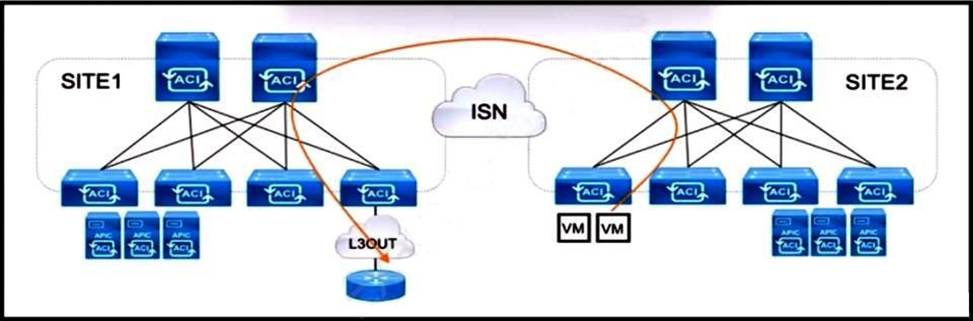
An engineer is configuring a production Multi-Site solution to provide connectivity from EPGs from a specific site to networks reachable through a remote site L3OUT. All required schema and template objects are already defined.
Which additional configuration must be implemented in the Multi-Site Orchestrator to support the cross-site connectivity?
- A . Configure a routable TEP pool for SITE1.
- B . Enable CloudSec for intersite traffic encryption.
- C . Add a new stretched external EPG to the existing L3OUT.
- D . Implement a policy-based redirect using a service graph.
C
Explanation:
To support cross-site connectivity in a production Multi-Site solution, where connectivity from EPGs from a specific site to networks reachable through a remote site L3OUT is required, the additional configuration that must be implemented in the Multi-Site Orchestrator is to add a new stretched external EPG to the existing L3OUT1. This allows the EPGs from one site to communicate with the networks defined in the L3OUT at the remote site, facilitating the required connectivity across sites.
Reference: Cisco ACI Multi-Site Configuration Guide1