
Cisco 300-620 Practice Exams
Last updated on Nov 16,2026- Exam Code: 300-620
- Exam Name: Implementing Cisco Application Centric Infrastructure (DCACI)
- Certification Provider: Cisco
- Latest update: Nov 16,2026
What are two descriptions of ACI multi-site? (Choose two.)
- A . The Inter-Site network routers should run OSPF to establish peering with the spines.
- B . The Multi-Site orchestrator must be directly attached to one ACI leaf.
- C . Routers in the inter-Site network must run OSPF. DHCP relay, and MP-BGP
- D . ACI Multi-Site is a solution that allows one APIC cluster to manage multiple ACI sites
- E . ACI Multi-Site is a solution that supports a dedicated APIC cluster per site
D, E
Explanation:
ACI Multi-Site architecture is designed to interconnect geographically dispersed data centers and
extend Layer 2 and Layer 3 connectivity between those locations with consistent policy enforcement. It allows for either a single APIC cluster to manage multiple ACI sites or supports a dedicated APIC cluster per site. This architecture ensures a scalable and flexible approach to managing multiple data center sites, providing a unified policy framework and operational model across the sites34.
Reference: Cisco Multi-Site Deployment Guide for ACI Fabrics3
Cisco ACI Multi-Site Architecture White Paper4
Where are STP BPDUSs flooded in Cisco ACI fabric?
- A . in the access encapsulation VLAN part of different VLAN pools
- B . in the bridge domain VLAN
- C . in the native VLAN ID
- D . in the VNID that is assigned to the FD VLAN
B
Explanation:
In the Cisco ACI fabric, Spanning Tree Protocol (STP) Bridge Protocol Data Units (BPDUs) are flooded within the bridge domain VLAN. This allows the BPDUs to be propagated throughout the bridge domain, enabling STP to function correctly for the associated VLAN.
Where are STP BPDUSs flooded in Cisco ACI fabric?
- A . in the access encapsulation VLAN part of different VLAN pools
- B . in the bridge domain VLAN
- C . in the native VLAN ID
- D . in the VNID that is assigned to the FD VLAN
B
Explanation:
In the Cisco ACI fabric, Spanning Tree Protocol (STP) Bridge Protocol Data Units (BPDUs) are flooded within the bridge domain VLAN. This allows the BPDUs to be propagated throughout the bridge domain, enabling STP to function correctly for the associated VLAN.
Refer to the exhibit.
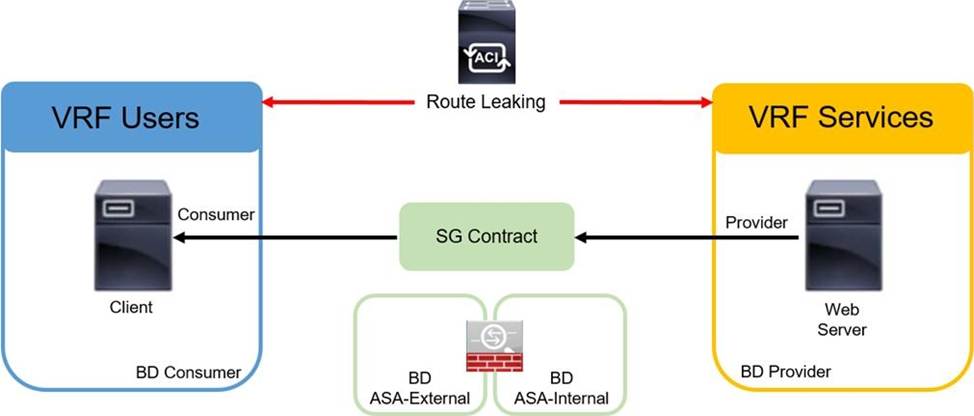
An engineer must implement the inter-tenant service graph.
Which set of actions must be taken to accomplish this goal?
- A . • Define the contract in the provider tenant and export it to the consumer tenant.
• Define the L4-L7 device, service graph template, and ASA bridge domains in the provider tenant. - B . • Define the contract in the provider tenant and export it to the consumer tenant.
• Define the L4-L7 device and service graph template in the provider tenant and the ASA bridge domains in the consumer tenant. - C . • Define the contract in the provider tenant and export it to the provider tenant.
• Define the L4-L7 device and service graph template in the provider tenant and the ASA bridge domains in the consumer tenant. - D . • Define the contract in the provider tenant and export it to the provider tenant.
• Define the L4-L7 device, service graph template, and ASA bridge domains in the consumer tenant.
B
Explanation:
To implement the inter-tenant service graph, the set of actions that must be taken are:
Define the contract in the provider tenant and export it to the consumer tenant (Option B).
Define the L4-L7 device and service graph template in the provider tenant and the ASA bridge domains in the consumer tenant (Option B).
This approach allows for the proper configuration and association of the service graph between the provider and consumer tenants, ensuring that the services are correctly applied to the traffic flowing between them.
A customer must deploy three Cisco ACI based data centers. Each site must be separated from the others.
Which characteristic of Cisco ACI Multi-Pod makes it unsuitable for this deployment?
- A . creates a virtual pod in the remote location
- B . requires all pods to share the same Cisco APIC cluster
- C . has distance and scale limitations
- D . places leaf switches in the remote site that belong to the same fabric as at the headquarters site
B
Explanation:
The characteristic of Cisco ACI Multi-Pod that makes it unsuitable for deploying three separate data centers is that it requires all pods to share the same Cisco APIC cluster. In a Multi-Pod deployment, all the pods are part of the same fabric and are managed by a single APIC cluster, which means that they are not completely isolated from each other.
An engineer is implementing a Cisco ACI environment that consists of more than 20 servers. Two of the servers support only Cisco Discovery Protocol with no order link discovery protocol. The engineer wants the servers to be discovered automatically by the Cisco ACI fabric when connected.
Which action must be taken to meet this requirement?
- A . Create an override policy that enables Cisco Discovery Protocol after LLDP is enabled in the default policy group.
- B . Configure a higher order interface policy that enables Cisco Discovery Protocol for the interface on the desired leaf switch.
- C . Configure a lower order policy group that enables Cisco Discovery Protocol for the interface on the desired leaf switch.
- D . Create an interface profile for the interface that disables LLDP on the desired switch that is referenced by the interface policy group.
A
Explanation:
To ensure that servers supporting only Cisco Discovery Protocol are discovered automatically by the Cisco ACI fabric when connected, the action that must be taken is to Create an override policy that enables Cisco Discovery Protocol after LLDP is enabled in the default policy group
An engineer must implement management policy and data plane separation in the Cisco ACI fabric.
Which ACI object must be created in Cisco APIC to accomplish this goal?
- A . Application profile
- B . Tenant
- C . Contract
- D . Bridge domain
D
Explanation:
To implement management policy and data plane separation in the Cisco ACI fabric, the ACI object that must be created in Cisco APIC is a Bridge domain
An engineer must connect Cisco ACI fabric using Layer 2 with external third-party switches. The third-party switches are configured using 802.1s protocol.
Which two constructs are required to complete the task? (Choose two.)
- A . spanning tree policy for mapping MST Instances to VLANs
- B . MCP policy with PDU per VLAN enabled
- C . MCP instance policy with administrative slate disabled
- D . dedicated EPG for native VLAN
- E . static binding of native VLAN in all existing EPGs
A, E
Explanation:
To connect Cisco ACI fabric using Layer 2 with external third-party switches configured using 802.1s protocol, the two constructs required are:
Spanning tree policy for mapping MST Instances to VLANs (Option A): This policy will ensure that the Multiple Spanning Tree (MST) instances on the third-party switches are correctly mapped to the VLANs in the ACI fabric.
Static binding of native VLAN in all existing EPGs (Option E): This construct is necessary to maintain the native VLAN across all EPGs when integrating with third-party switches that use 802.1s protocol.
https://www.ciscolive.com/c/dam/r/ciscolive/emea/docs/2019/pdf/BRKACI-3101.pdf
https://www.cisco.com/c/en/us/solutions/collateral/data-center-virtualization/application-centric-infrastructure/white-paper-c07-732033.html
Refer to the exhibit.
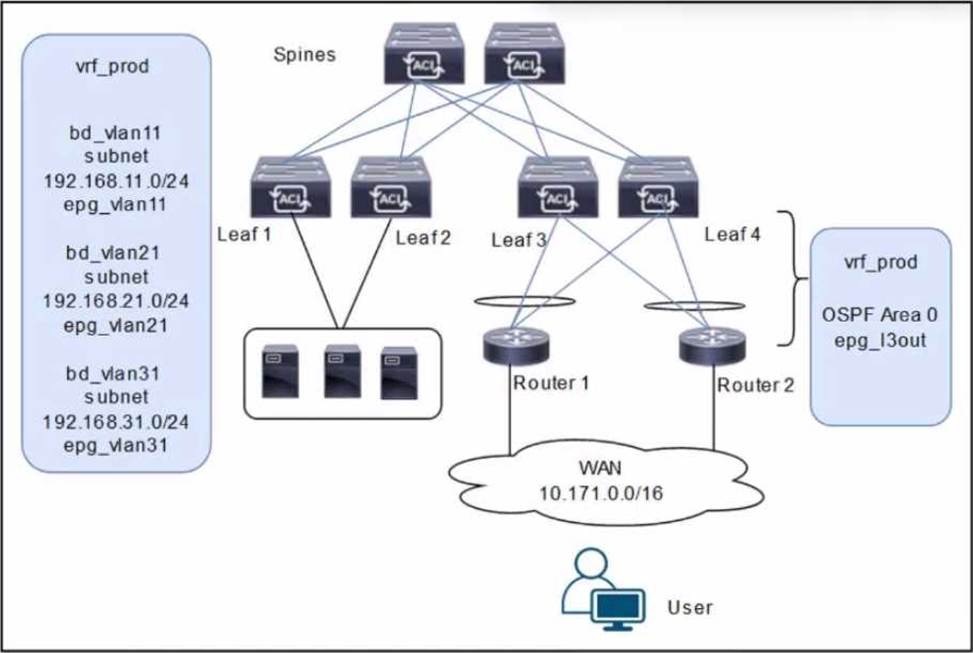
A customer is deploying a WAN with these requirements: •Routers 1 and 2 must receive only routes 192.168.11.0/24 and 192.168.21.0724 from the Cisco ACI fabric •Reachability to the WAN users must be permitted only for the servers that are located in vrf_prod.
Which settings must be configured to meet these objectives?
- A . Configure the subnets 192.168.11.0/24 and 192.168.21.0/24 as Private to VRF
Configure the subnet 192.168.31.0/24 as Advertised Externally.
Configure an EPG subnet 0.0.0.0/0 as External Subnets for External EPG. - B . Configure the subnets 192.168.11.0/24 and 192.168.21.0/24 as Private to VRF.
Configure the subnet 192.168.31.0/24 as Advertised Externally.
Configure an EPG subnet 0.0.0.0/0 as Shared Route Control Subnet. - C . Configure the subnets 192.168.11.0/24 and 192.168.21.0/24 as Advertised Externally.
Configure the subnet 192.168.31.0/24 as Private to VRF.
Configure an EPG subnet 0.0.0.0/0 as Shared Route Control Subnet. - D . Configure the subnets 192.168.11.0/24 and 192.168.21.0/24 as Advertised Externally.
Configure the subnet 192.168.31.0/24 as Private to VRF.
Configure an EPG subnet 0.0.0.0/0 as External Subnets for External EPG.
D
Explanation:
The scenario involves deploying a WAN with Cisco ACI, where Routers 1 and 2 (connected via an L3Out with OSPF Area 0) must receive specific routes (192.168.11.0/24 and 192.168.21.0/24) from the ACI fabric, and reachability to WAN users must be permitted only for servers in vrf_prod. The diagram shows three bridge domains (bd_vlan11, bd_vlan21, bd_vlan31) with their respective subnets and EPGs, all under vrf_prod, along with an L3Out (epg_l3out) for WAN connectivity.
Requirement Analysis
Routers 1 and 2 must receive only routes 192.168.11.0/24 and 192.168.21.0/24:
These subnets belong to bd_vlan11 and bd_vlan21, respectively. To advertise these routes to Routers 1 and 2 via the L3Out, they must be marked with the appropriate scope in the bridge domain configuration.
In ACI, the "Advertised Externally" scope on a subnet ensures that it is advertised to external routers via the L3Out routing protocol (OSPF in this case).
Reachability to WAN users must be permitted only for servers in vrf_prod:
This implies that only the subnets in vrf_prod (192.168.11.0/24, 192.168.21.0/24, and 192.168.31.0/24) should be accessible, but WAN users should only reach specific subnets based on policy.
The external EPG (epg_l3out) represents the WAN users (10.171.0.0/16), and its subnet scope must control inbound reachability.
The subnet 192.168.31.0/24 (bd_vlan31) should not be advertised to the WAN, as it is not listed in the routes Routers 1 and 2 should receive.
Option Evaluation
Refer to the exhibit.
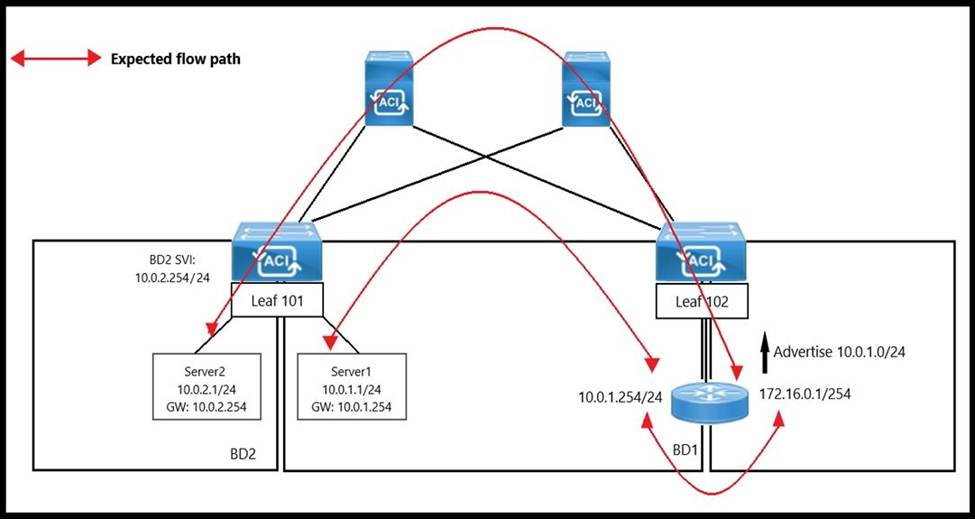
An engineer wants to initiate an ICMP ping from Server1 to Server2. The requirement is for the BD1 to enforce ICMP replies that follow the expected path. The packets must be prevented from taking the direct path from Leaf1 to Server1.
Which action must be taken on BD1 to meet these requirements?
- A . Set L2 Unknown Unicast to Flood.
- B . Set L2 Unknown Unicast to Hardware Proxy.
- C . Disable Unicast Routing.
- D . Enable ARP Flooding.
B
Explanation:
In the Cisco ACI environment, when an engineer wants to enforce a specific path for ICMP replies and prevent packets from taking a direct path, setting Layer 2 Unknown Unicast to Hardware Proxy on the bridge domain (BD1) is the appropriate action. This setting ensures that the unknown unicast traffic, which includes ICMP packets destined for an unknown MAC address, is forwarded to the spine proxy. The spine proxy then forwards the packets based on the endpoint table information, ensuring that the packets follow the expected path through the fabric and do not take any shortcuts or direct paths that bypass the intended routing.