
Cisco 300-620 Practice Exams
Last updated on Nov 16,2026- Exam Code: 300-620
- Exam Name: Implementing Cisco Application Centric Infrastructure (DCACI)
- Certification Provider: Cisco
- Latest update: Nov 16,2026
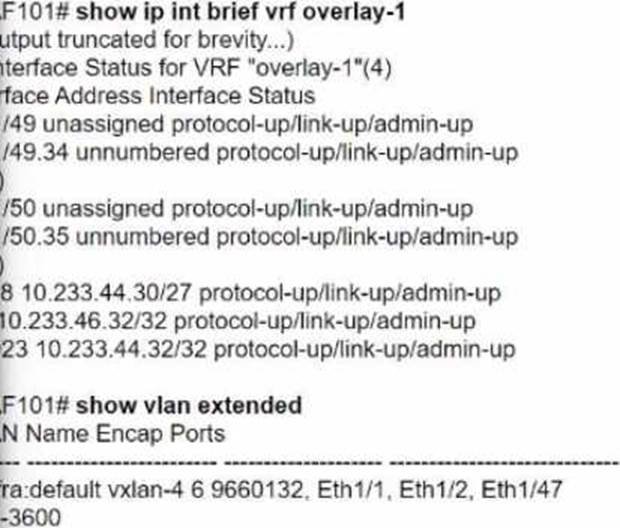
What is the name of the automatically configured VLAN 3600 presented during Cisco ACI fabric discovery?
- A . Transit VLAN
- B . Infrastructure VLAN
- C . Loopback VLAN
- D . Fabric VLAN
B
Explanation:
The Infrastructure VLAN is automatically configured during the Cisco ACI fabric discovery process. This VLAN, often referred to as the “infra VLAN,” is used to enable internal communication between the ACI fabric components, such as the leaf and spine nodes. It is vital for the overlay network and the control plane functionality. In the provided output, VLAN 3600 represents the Infrastructure VLAN, which is configured for inter-node communication.
The Application team reports that a previously existing port group has disappeared from vCenter. An engineer confirms that the VM domain association for the EPG is no longer present.
Which action determines which user is responsible for the change?
- A . Check the EPG audit logs for the ‘deletion’ action and compare the affected object and user.
- B . Evaluate the potential faults that are raised for that EPG.
- C . Examine the health score and drill down to an object that affects the EPG combined score.
- D . Inspect the server logs to see who was logging in to the APIC during the last few hours.
A
Explanation:
To determine which user is responsible for the disappearance of a previously existing port group from vCenter, the engineer should check the EPG audit logs for any ‘deletion’ actions. By comparing the affected object and the user who performed the action, the engineer can identify the responsible individual2.
An Cisco ACI leaf switch learns the source IP address of a packet that enters the front panel port of the switch.
Which bridge domain setting is used?
- A . Unicast Routing
- B . L3 Unknown Multicast Flooding – Flood
- C . ARP Flooding
- D . Unknown Unicast – Hardware proxy
A
Explanation:
The question asks which bridge domain setting is used when a Cisco ACI leaf switch learns the source IP address of a packet entering the front panel port. This involves understanding how ACI handles endpoint learning and IP address association within a bridge domain.
Requirement Analysis
When a packet enters a leaf switch’s front panel port, ACI learns the source IP and MAC address of the endpoint to populate its endpoint table.
The bridge domain settings control how IP addresses are learned and routed, especially for Layer 3 traffic.
The correct setting must enable the leaf switch to associate the source IP with the endpoint.
Option Evaluation
Which endpoint learning operation is completed on the egress leaf switch when traffic is received from an L3Out?
- A . The source MAC and IP address of the traffic is learned as a local endpoint.
- B . The source MAC address of the traffic is learned as a remote endpoint.
- C . No source MAC or IP address of the traffic is learned as a remote endpoint.
- D . The source IP address of the traffic is learned as a remote endpoint.
C
Explanation:
On the egress leaf switch, when traffic is received from an L3Out, no source MAC or IP address of the traffic is learned as a remote endpoint1. The Cisco ACI fabric does not learn the IP addresses from the data plane in an L3Out domain; instead, it uses ARP to resolve next-hop IP and MAC relationships to reach the prefixes behind external routers1.
An engineer needs to avoid loops in the ACI network and needs an ACI leaf switch to error-disable an interface if the interface receives an ACI-generated packet.
Which action meets these requirements?
- A . Enable the Loop Indication by MCP event in the Error Disabled Recovery Policy.
- B . Set Rogue EP Control in the Endpoint Controls Policy.
- C . Uncheck the Loop Protection Action check box in MCP Instance Policy.
- D . Change the default administrative state of the global MCP Instance Policy.
D
Explanation:
MisCabling Protocol (MCP) detects loops from external sources (i.e., misbehaving servers, external networking equipment running STP, etc.) and will err-disable the interface on which ACI receives its own packet. Enabling this feature is a best practice, and it should be enabled globally and on all interfaces, regardless of the end device. For MCP to be enabled, you need to have it enabled globally and on a per-interface basis. While MCP is enabled on all interfaces by default, it is not turned “on” until you also enable it globally. The global configuration knob for MCP can be enabled by configuring the global settings here: Fabric > Access Policies > Global Policies > MCP Instance Policy default.
https://www.cisco.com/c/dam/en/us/solutions/collateral/data-center-virtualization/application-centric-infrastructure/aci-guide-using-mcp-mis-cabling-protocol.pdf
Refer to the exhibit.
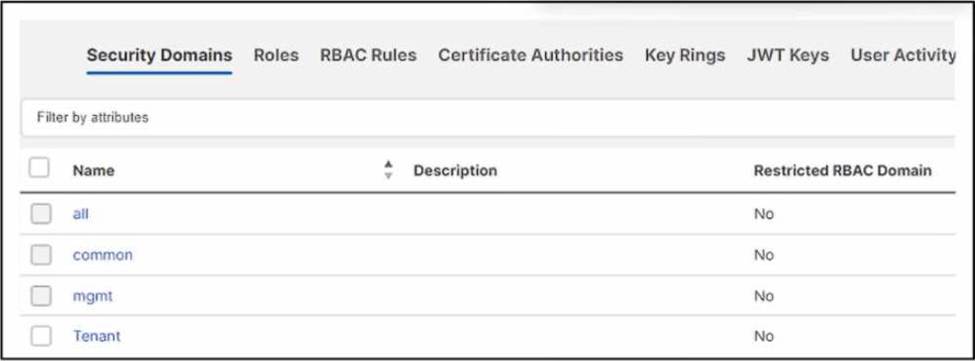
An engineer created a local user named User on Cisco ACI.
The engineer must configure the fabric so that the User can access only common and PROD tenants, ch set of actions accomplishes the goal?
- A . Add security domain "all" to User.
Associate security domain "all" under PROD tenant. - B . Add security domain ‘Tenant" to User.
Associate security domain "Tenant" under PROD tenant. - C . Add security domain "common" to User.
Associate security domain "common" under PROD tenant. - D . Add security domain "mgmt" to User
Associate security domain "mgmt" under PROD tenant.
Which two types of interfaces are supported on border leaf switches to connect to an external router? (Choose two.)
- A . subinterface with VXLAN tagging
- B . subinterface with 802.1Q tagging
- C . FEX host interface
- D . out of band interface
- E . Switch Virtual Interface
B, E
Explanation:
On border leaf switches in Cisco ACI, the two types of interfaces supported to connect to an external router are subinterface with 802.1Q tagging and Switch Virtual Interface (SVI)7. These interfaces allow for the segmentation of traffic and the extension of Layer 2 and Layer 3 services to external networks7.
Which two types of interfaces are supported on border leaf switches to connect to an external router? (Choose two.)
- A . subinterface with VXLAN tagging
- B . subinterface with 802.1Q tagging
- C . FEX host interface
- D . out of band interface
- E . Switch Virtual Interface
B, E
Explanation:
On border leaf switches in Cisco ACI, the two types of interfaces supported to connect to an external router are subinterface with 802.1Q tagging and Switch Virtual Interface (SVI)7. These interfaces allow for the segmentation of traffic and the extension of Layer 2 and Layer 3 services to external networks7.
What controls communication between EPGs?
- A . Inter-EPG communication is controlled by BGP.
- B . Inter-EPG communication is controlled by contracts.
- C . Inter-EPG communication is controlled by IS-IS.
- D . Inter-EPG communication is controlled by VXLAN.
B
Explanation:
In Cisco ACI, communication between Endpoint Groups (EPGs) is controlled by contracts. Contracts define the types of traffic and the rules that govern how EPGs can communicate with each other. They act as a policy framework that enforces security and segmentation within the ACI fabric.
An engineer must create a backup of the Cisco ACI fabric for disaster recovery purposes. The backup must be transferred over a secure and encrypted transport. The backup file must contain all user and password related information. The engineer also wants to process and confirm the backup file validity by using a Python script. This requires the data structure to have a format similar to a Python dictionary.
Which configuration set must be used to meet these requirements?
- A . Under the Create Remote location settings, select Protocol: FTP Under the Export policy, select
– Format: XML
– Modify Global AES Encryption Settings: Enabled - B . Under the Create Remote location settings, select Protocol: FTP Under the Export policy, select
– Format: XML
– Modify Global AES Encryption Settings: Disabled - C . Under the Create Remote location settings, select Protocol: SCP Under the Export policy, select
– Format: JSON
– Modify Global AES Encryption Settings: Disabled - D . Under the Create Remote location settings, select Protocol: SCP Under the Export policy, select
– Format: JSON
– Modify Global AES Encryption Settings: Enabled
D
Explanation:
To create a backup of the Cisco ACI fabric for disaster recovery that is secure, encrypted, and in a format conducive to processing with a Python script, the engineer must select Secure Copy Protocol (SCP) for secure and encrypted transport. The backup file should be in JSON format, which is similar to a Python dictionary and can be easily processed by a Python script. Additionally, enabling Global AES Encryption ensures that all user and password-related information is included securely in the backup1.