
Cisco 300-620 Practice Exams
Last updated on Nov 16,2026- Exam Code: 300-620
- Exam Name: Implementing Cisco Application Centric Infrastructure (DCACI)
- Certification Provider: Cisco
- Latest update: Nov 16,2026
As part of a migration, legacy non-ACI switches must be connected to the Cisco ACI fabric. All non-ACI switches run per-VLAN RSTP. After the non-ACI switches are connected to Cisco ACI, the STP convergence caused a microloop and significant CPU spike on all switches.
Which configuration on
the interfaces of the external switches that face the Cisco ACI fabric resolves the problem?
- A . BPDU guard
- B . aggressive STP timers
- C . BPDU filtering
- D . STP type link shared
C
Explanation:
To resolve the issue of STP convergence causing a microloop and significant CPU spike on all switches after connecting legacy non-ACI switches to the Cisco ACI fabric, BPDU filtering should be configured on the interfaces of the external switches that face the Cisco ACI fabric. BPDU filtering prevents Bridge Protocol Data Units (BPDUs) from being sent or received on those interfaces, which stops the STP process and eliminates the possibility of microloops.
An engineer configures port-12 on Leaf-101 and Leaf-102 to connect to a new server, SVR-12. The new server will belong to EPG-12 and use encap VLAN-1212. The engineer configured SVR-12 as a VPC member port and statically bound the VPC member port to EPG-12.
Which additional step must the engineer take to configure connectivity?
- A . Create a VPC Explicit Protection Group for EPG-12 and VLAN-1212.
- B . Associate a domain with EPG-12 that is associated with VLAN-1212.
- C . Select VLAN-1212 on the EPG-12 Interface Policy Group.
- D . Configure an LACP Interface Policy and apply it to EPG-12.
B
Explanation:
The engineer configures port 1/2 on Leaf-101 and Leaf-102 to connect to a new server (SVR-12),
which belongs to EPG-12 using VLAN-1212 encapsulation. The server is configured as a vPC member port and statically bound to EPG-12. The task is to ensure connectivity, indicating a missing configuration step.
Requirement Analysis
Static binding of a vPC member port to an EPG requires proper VLAN association and domain mapping.
vPC ensures redundancy, and the VLAN (1212) must be allocated and associated with the EPG via a domain (e.g., VMM or physical domain).
Option Evaluation
An ACI engineer is implementing a Layer 3 out inside the Cisco ACI fabric that must meet these requirements:
• The data center core switch must be connected to one of the leaf switches with a single 1G link.
• The routes must be exchanged using a link-state routing protocol that supports hierarchical network design.
• The data center core switch interface must be using 802.1Q tagging, and each VLAN will be configured with a dedicated IP address.
Which set of steps accomplishes this goals?
- A . Set up the EIGRP Protocol policy with the selected Autonomous System number.
Create the Routed Outside object and Node Pro le, selecting EIGRP.
Configure the Interface pro le, selecting Routed Interface and the appropriate interfaces.
Create the External Network object with a network of 0.0.0 0/0. - B . Set up the EIGRP Protocol policy with the selected Autonomous System number.
Set up the Routed External Network object and Node Pro le, selecting EIGRP.
Create the Switch pro le, selecting Port-channel and the appropriate interfaces.
Create the default network and associate it with the Routed Outside object. - C . Set up the BGP Protocol policy with the Autonomous System number of 0.
Configure an Interface policy and an External Bridged Domain.
Create an External Bridged Network using the configured VLAN pool.
Build the Leaf pro le, selecting Routed sub-interface and the appropriate VLAN. - D . Configure the OSPF Protocol policy with an area of 0.
Create Routed Outside object and Node Pro le, selecting OSPF as the routing protocol.
Build the Interface pro le, selecting Routed Sub-interface and the appropriate VLAN.
Configure the External Network object with a network of 0 0.0 0/0.
C
Explanation:
To implement a Layer 3 out (L3Out) inside the Cisco ACI fabric that meets the specified requirements, the following steps should be taken:
Configure the OSPF Protocol policy with an area of 0: This step involves setting up OSPF, a link-state routing protocol that supports hierarchical network design, as the routing protocol for the L3Out1.
Create Routed Outside object and Node Profile, selecting OSPF: This step involves creating a Routed Outside object and associating it with a Node Profile that specifies OSPF as the routing protocol1.
Build the Interface profile, selecting Routed Sub-interface and the appropriate VLAN: This step involves creating an Interface profile for the connection to the data center core switch, using 802.1Q tagging for VLAN separation2.
Configure the External Network object with a network of 0.0.0.0/0: This step involves setting up the External Network object to advertise routes to the rest of the network1.
When configuring Cisco ACI VMM domain integration with VMware vCenter, which object is created in vCenter?
- A . datacenter
- B . VMware vSphere Standard vSwitch
- C . VMware vSphere Distributed Switch
- D . cluster
C
Explanation:
When configuring Cisco ACI VMM domain integration with VMware vCenter, the object that is created in vCenter is a VMware vSphere Distributed Switch (VDS)12. The VDS is a virtual switch that extends across all esxi hosts in the cluster and provides a centralized interface from which network configurations can be managed12. This switch allows network administrators to manage networking for multiple hosts and virtual machines from a single interface within vCenter12.
Which statement regarding ACI Multi-Pod and TEP pool is true?
- A . The IP addresses used in the IPN network can overlap TEP pool of the APIC.
- B . A different TEP pool must be assigned to each Pod.
- C . The Pod1 TEP pool must be split and a portion of the TEP pool allocated to each Pod.
- D . The same TEP pool is used in all Pods.
D
Explanation:
The true statement regarding ACI Multi-Pod and TEP pool is that the same TEP pool is used in all Pods. This shared TEP pool ensures consistent addressing and simplifies the management of the overlay network across multiple Pods.
Reference: https://www.cisco.com/c/en/us/solutions/collateral/data-center-virtualization/application-centric-infrastructure/white-paper-c11-739714.html
An engineer implements a configuration backup on the Cisco APIC.
The backup job must meet these requirements:
• The backup must transfer the encrypted data to the remote server.
• The transfer must be resumed if the connection is interrupted.
Which configuration set meets these requirements?
- A . Select protocol HTTP in Create Remote Location. Choose JSON format in Configuration Export Policy.
- B . Select protocol TFTP in Create Remote Location. Choose JSON format in Configuration Export Policy
- C . Select protocol FTP in Create Remote Location. Choose XML format in Configuration Export Policy.
- D . Select protocol SFTP in Create Remote Location. Choose XML format in Configuration Export Policy.
A network engineer must design a method to allow the Cisco ACI to redirect traffic to the firewalls. Only traffic that matches specific L4-L7 policy rules should be redirected. The load must be distributed across multiple firewalls to scale the performance horizontally.
Which action must be taken to meet these requirements?
- A . Configure ACI Service Graph with Unidirectional PBR.
- B . Implement ACI Service Graph with GIPo.
- C . Implement ACI Service Graph Two Nodes with GIPo.
- D . Configure ACI Service Graph with Symmetric PBR.
A
Explanation:
To design a method that allows the Cisco ACI to redirect traffic to the firewalls based on specific L4-L7 policy rules and distribute the load across multiple firewalls, the action that must be taken is to Configure ACI Service Graph with Unidirectional PBR (
https://www.cisco.com/c/en/us/solutions/collateral/data-center-virtualization/application-centric-infrastructure/white-paper-c11-739971.html
Refer to the exhibit.
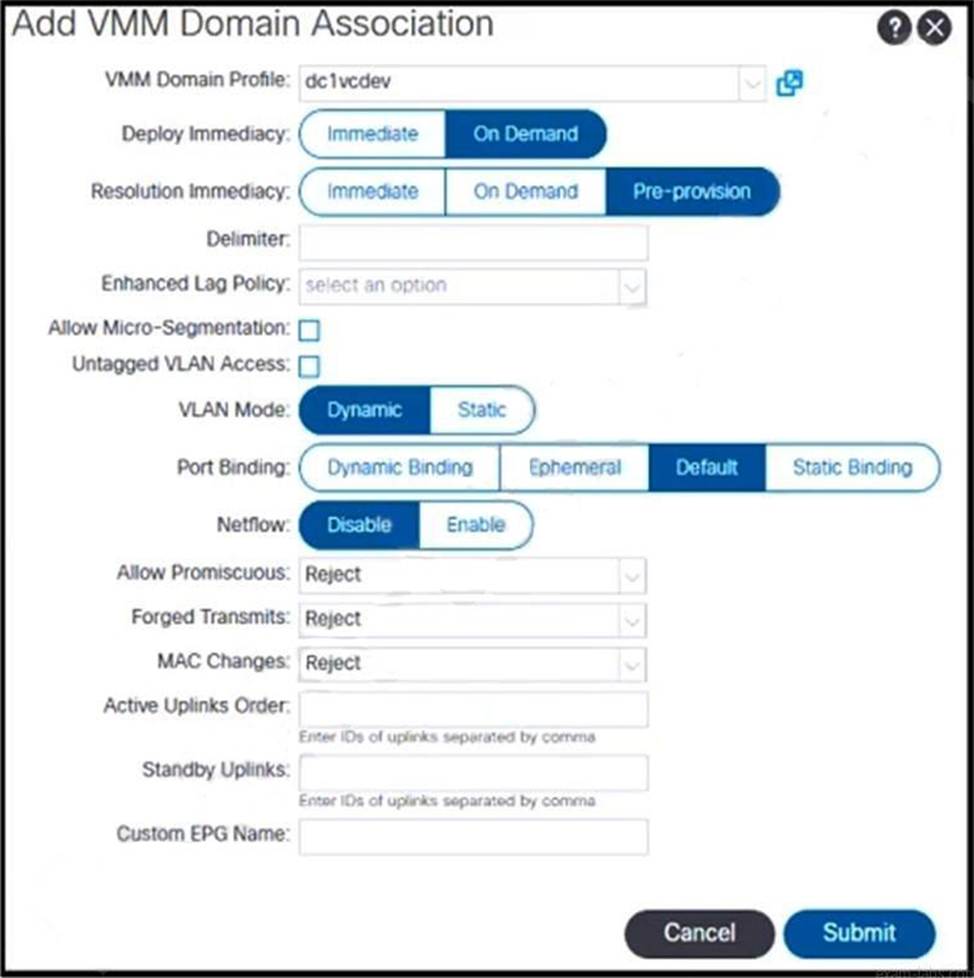
The EPG-100 must be extended to the vCenter as a port group with a tagged VLAN ID of 100.
Which set of actions accomplishes this goal?
- A . Define a static VLAN range (from 100-200) under a VLAN pool that is associated with the dc1vcdev domain.
Associate the dc1vcdev domain with EPG and select these settings:
Untagged VLAN Access: unselected
VLAN Mode: Static with Encap: 100 - B . Define a static VLAN range (from 100-200) under a VLAN pool that is associated with the dc1vcdev domain.
Associate the dc2vcdev domain with EPG and select these settings:
Untagged VLAN Access: selected
VLAN Mode: Static with Encap: 100 - C . Define a dynamic VLAN range (from 100-200) under a VLAN pool that is associated with the del vdev domain.
Associate the dc1vcdev domain with EPG and select these settings:
Untagged VLAN Access: unselected
VLAN Mode: Static with Encap: 100 - D . Define a dynamic VLAN range (from 100-200) under a VLAN pool that is associated with the dc1vdev domain.
Associate the dc2vcdev domain with EPG and select these settings:
Untagged VLAN Access: selected
VLAN Mode: Static with Encap: 100
A
Explanation:
To extend the EPG-100 to the vCenter as a port group with a tagged VLAN ID of 100, the following actions should be taken:
Define a static VLAN range (from 100-200) under a VLAN pool: This step involves creating a VLAN pool that includes the desired VLAN range. The VLAN pool is then associated with the VMM domain that corresponds to the vCenter integration1.
Associate the dc1vcdev domain with EPG: The VMM domain named ‘dc1vcdev’ should be associated with the EPG-100. This association allows for the automatic creation of port groups in vCenter when the EPG is associated with a VMM domain1.
Select the appropriate settings for the domain association:
Untagged VLAN Access: This should be unselected because the VLAN ID needs to be tagged.
VLAN Mode: Set to ‘Static’ to specify the encapsulation VLAN ID.
Encap: Set to ‘100’ to define the specific VLAN ID that should be tagged for the port group1.
Reference: Cisco APIC Layer 2 Networking Configuration Guide1
Cisco APIC Layer 2 Networking Configuration Guide1
A Cisco ACI fabric is integrated with a VMware environment. The engineer must back up the current configuration of the fabric and restore the vCenter password when the configuration is imported.
Which action accomplishes this goal?
- A . Select SCP protocol for the remote location.
- B . Create a Configuration Import Policy.
- C . Enable the Global AES Encryption setting.
- D . Set the Authentication type to Use Password.
C
Explanation:
By enabling Global AES Encryption and ensuring secure data inclusion, you can safely back up and restore the Cisco ACI fabric configuration, including the vCenter password.
Refer to the exhibit.
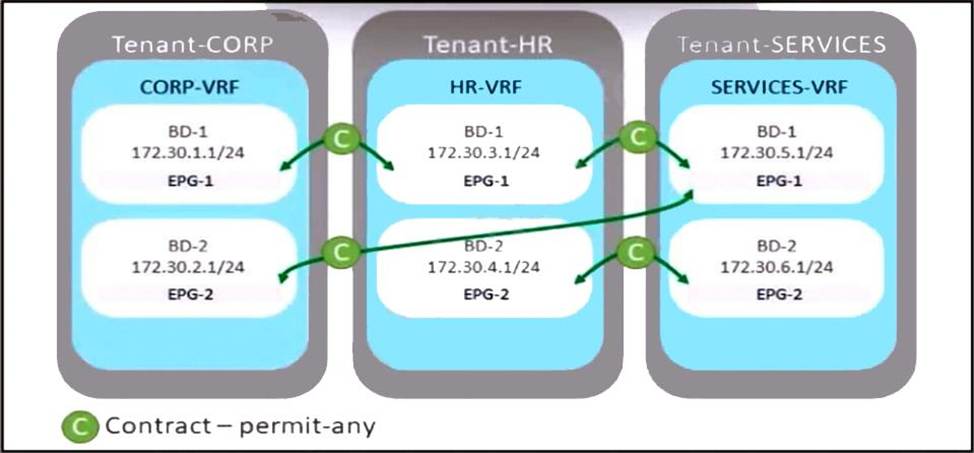
A company merges three of its departments: CORP, HR, and SERVICES, Currently, the connectivity between departments is achieved by using VRF route leaking. The requirement is to redesign the Cisco ACI networking architecture to communicate between EPGs and BDs from any tenant without configuring contracts or VRF route leaking.
Which configuration meets these criteria?
- A . Configure an unenforced VRF in the user tenant and map all required EPGs to it.
- B . Implement an enforced VRF in the common tenant and map all required BDs to it.
- C . Configure an enforced VRF in the user tenant and map all required EPGs to it.
- D . Implement an unenforced VRF in the common tenant and map all required BDs to it.
D
Explanation:
To enable communication between EPGs and BDs from any tenant without the need for contracts or VRF route leaking, the best approach is to implement an unenforced VRF within the common tenant. By doing so, all bridge domains that are associated with this VRF will be able to communicate with each other without additional configurations. This method simplifies the network architecture and reduces the complexity associated with contract management and VRF route leaking1.
Reference: Cisco ACI Contract Guide White Paper1