
Cisco 300-620 Practice Exams
Last updated on Nov 16,2026- Exam Code: 300-620
- Exam Name: Implementing Cisco Application Centric Infrastructure (DCACI)
- Certification Provider: Cisco
- Latest update: Nov 16,2026
An engineer configured a bridge domain with the hardware-proxy option for Layer 2 unknown unicast traffic.
Which statement is true about this configuration?
- A . The leaf switch drops the Layer 2 unknown unicast packet if it is unable to find the MAC address in the local forwarding tables.
- B . The Layer 2 unknown hardware proxy lacks support of the topology change notification.
- C . The leaf switch forwards the Layers 2 unknown unicast packets to all other leaf switches if it is unable to find the MAC address in its local forwarding tables.
- D . The spine switch drops the Layer 2 unknown unicast packet if it is unable to find the MAC address in the proxy database.
D
Explanation:
When a bridge domain is configured with the hardware-proxy option for Layer 2 unknown unicast traffic, if the spine switch is unable to find the MAC address in the proxy database, it will drop the Layer 2 unknown unicast packet4. This behavior is controlled by the hardware proxy option associated with a bridge domain4.
Which two statements regarding ACI Multi-Site are true? (Choose two.)
- A . The Multi-Site orchestrator must be directly attached to one ACI leaf.
- B . Routers in the Inter-Site network must run OSPF, DHCP relay, and MP-BGP.
- C . ACI Multi-Site is a solution that supports a dedicated APIC cluster per site.
- D . ACI Multi-Site is a solution that allows one APIC cluster to manage multiple ACI sites.
- E . The Inter-Site network routers should run OSPF to establish peering with the spines.
C, D
Explanation:
The two true statements regarding ACI Multi-Site are:
ACI Multi-Site is a solution that supports a dedicated APIC cluster per site1.
ACI Multi-Site is a solution that allows one APIC cluster to manage multiple ACI sites1.
An engineer discovered an outage on the mgmt0 port of Leaf113 and Leaf114. Both leaf switches were recently registered in the fabric and have health scores of 100. The engineer overs there is no IP address assigned to the mgmt0 interface of the switches.
Which action resolves the outage?
- A . Statically bind the mgmt0 interface of Leaf113 and Leaf114 to the oob-default EPG.
- B . Enable Leaf 113 and Leaf 114 mgmt0 under the leaf switch.
- C . Associate the oobbrc-default contract to Leaf113 and Leaf114.
- D . Add Leaf113 and Leaf114 to the node management address policy.
D
Explanation:
In Cisco ACI, the mgmt0 interface is used for out-of-band (OOB) management, and its IP address must be explicitly assigned through the Node Management Address Policy under the mgmt tenant. When new leaf switches are registered in the fabric, they do not automatically receive an IP address
for their mgmt0 interfaces unless they are added to this policy.
Refer to the exhibit.
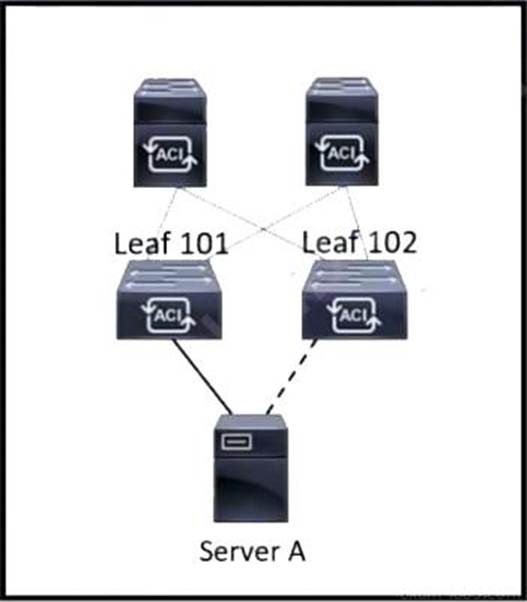
Server A is connected to the Cisco ACI fabric using two teamed interfaces. One interface in a team is configured as active and the other remains in standby mode. When a failover occurs and the standby interface becomes active, it uses its built-in MAC address to send traffic.
Which bridge domain configuration must be applied to resolve the issue?
- A . Configure Hardware proxy.
- B . Set L2 Unknown Unicast to Flood.
- C . Enable ARP flooding.
- D . Activate Limit IP Learning to Subnet.
C
Explanation:
In the scenario where Server A is connected to the Cisco ACI fabric using teamed interfaces with one active and one standby, enabling ARP flooding in the bridge domain configuration is necessary to resolve the issue that occurs when the standby interface becomes active and uses its built-in MAC address to send traffic. Enabling ARP flooding allows the fabric to learn the new MAC address without waiting for the ARP timeout, which helps to ensure that traffic continues to flow to the correct destination after a failover event1.
Reference: Discuss Cisco 300-620 Exam Topic 9 Question 71 | Pass4Success1
When does the Cisco ACI leaf learn a source IP or MAC as a remote endpoint?
- A . When VXLAN traffic arrives on a leaf fabric port from the spine and outer source IP is in the Layer 3 Out EPG subnet range.
- B . When VXLAN traffic arrives on a leaf fabric port from the spine and outer source IP is in the bridge domain subnets range.
- C . When VXLAN traffic arrives on a leaf fabric port from the spine and inner source IP is in the Layer 3 Out EPG subnet range.
- D . When VXLAN traffic arrives on a leaf fabric port from the spine and inner source IP is in the bridge domain subnets range.
D
Explanation:
In Cisco ACI, a leaf switch learns a source IP or MAC as a remote endpoint when VXLAN traffic arrives on a leaf fabric port from the spine, and the inner source IP is within the range of the bridge domain subnets associated with the leaf. This process is part of the ACI’s COOP (Council Of Oracles Protocol),
which ensures that endpoint information is accurately disseminated across the fabric for efficient traffic forwarding.
Refer to the exhibit.
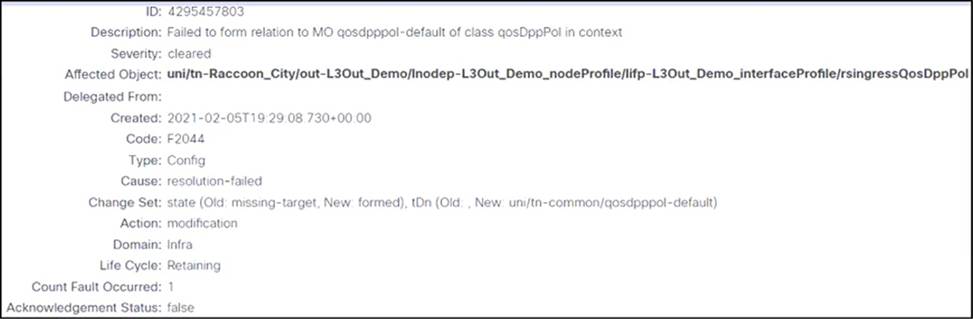
An engineer configures an L3Out but receives the error presented.
Which action clears the fault?
- A . Acknowledge the QoS-related error.
- B . Associate a custom QoS class.
- C . Create a custom QoS policy.
- D . Set the QoS policy to Level 3.
C
Explanation:
When configuring an L3Out in Cisco ACI and encountering a QoS-related error, creating a custom QoS policy is often necessary to clear the fault. This involves defining a QoS policy that meets the specific requirements of the L3Out configuration and applying it to the relevant interfaces or globally within
the fabric. The custom QoS policy should be designed to prioritize traffic appropriately and ensure that the necessary QoS settings are in place for the L3Out connections1.
Reference: Cisco ACI L3Out Configuration Examples1
DRAG DROP
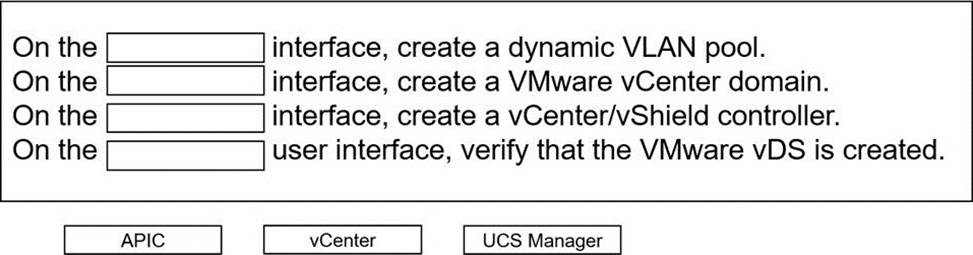
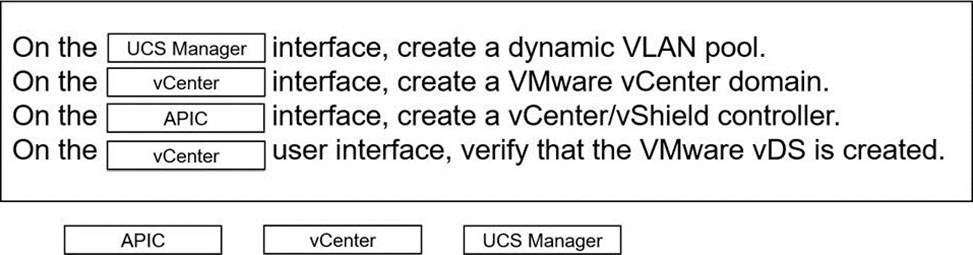
An engineer must configure VMM domain integration on a Cisco UCS B-Series server that is connected to a Cisco ACI fabric.
Drag and drop the products used to create VMM domain from the bottom into the sequence in which they should be implemented at the top. Products are used more than once.
Which feature dynamically assigns or modifies the EPG association of virtual machines based on their attributes?
- A . vzAny contracts
- B . standard contracts
- C . application EPGs
- D . uSeg EPGs
D
Explanation:
The feature that dynamically assigns or modifies the EPG association of virtual machines based on their attributes is uSeg EPGs. uSeg EPGs allow for micro segmentation within the Cisco ACI environment, enabling the dynamic assignment of VMs to EPGs based on attributes such as VM name, tag, or other identifiers
As part of a migration, legacy non-ACI switches must be connected to the Cisco ACI fabric. All non-ACI switches run per-VLAN RSTP. After the non-ACI switches are connected to Cisco ACI, the STP convergence caused a microloop and significant CPU spike on all switches.
Which configuration on
the interfaces of the external switches that face the Cisco ACI fabric resolves the problem?
- A . BPDU guard
- B . aggressive STP timers
- C . BPDU filtering
- D . STP type link shared
C
Explanation:
To resolve the issue of STP convergence causing a microloop and significant CPU spike on all switches after connecting legacy non-ACI switches to the Cisco ACI fabric, BPDU filtering should be configured on the interfaces of the external switches that face the Cisco ACI fabric. BPDU filtering prevents Bridge Protocol Data Units (BPDUs) from being sent or received on those interfaces, which stops the STP process and eliminates the possibility of microloops.