
Cisco 300-620 Practice Exams
Last updated on Nov 16,2026- Exam Code: 300-620
- Exam Name: Implementing Cisco Application Centric Infrastructure (DCACI)
- Certification Provider: Cisco
- Latest update: Nov 16,2026
Refer to the exhibit.
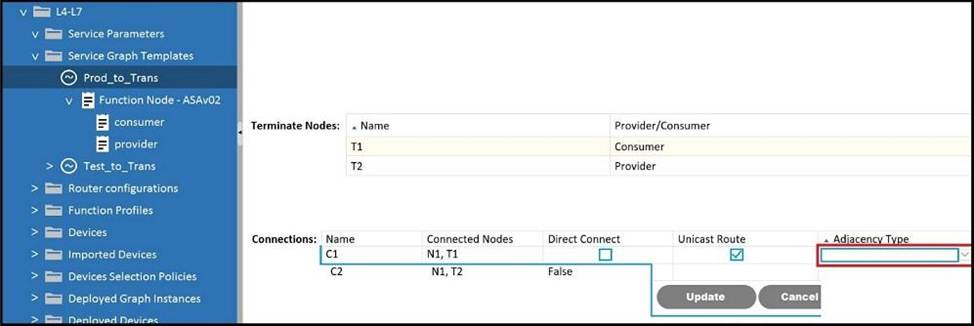
Which Adjacency Type value should be set when the client endpoint and the service node interface are in a different subnet?
- A . Routed
- B . Unicast
- C . L3Out
- D . L3
A
Explanation:
When the client endpoint and the service node interface are in different subnets, the Adjacency Type value should be set to Routed. This setting is used to indicate that routing is required between the client endpoint and the service node interface, as they are not in the same Layer 2 broadcast domain and need Layer 3 routing to communicate.
An engineer is extending EPG connectivity to an external network. The external network houses the Layer 3 gateway and other end hosts.
Which ACI bridge domain configuration should be used?
- A . Forwarding: Custom
L2 Unknown Unicast: Hardware Proxy L3 Unknown Multicast Flooding: Flood Multi Destination
Flooding: Flood in BD ARP Flooding: Enabled - B . Forwarding: Custom
L2 Unknown Unicast: Flood
L3 Unknown Multicast Flooding: Flood Multi Destination Flooding: Flood in BD ARP Flooding:
Enabled - C . Forwarding: Custom
L2 Unknown Unicast: Hardware Proxy L3 Unknown Multicast Flooding: Flood Multi Destination
Flooding: Flood in BD ARP Flooding: Disabled - D . Forwarding: Custom
L2 Unknown Unicast: Flood
L3 Unknown Multicast Flooding: Flood Multi Destination Flooding: Flood in BD ARP Flooding:
Disabled
A
Explanation:
When extending EPG connectivity to an external network that houses the Layer 3 gateway and other end hosts, the ACI bridge domain configuration should use Forwarding: Custom, L2 Unknown
Unicast: Hardware Proxy, L3 Unknown Multicast Flooding: Flood, Multi Destination Flooding: Flood in BD, and ARP Flooding: Enabled23. This configuration ensures that unknown unicast traffic is handled efficiently while still allowing ARP flooding, which is necessary for the ACI fabric to learn about endpoints on the external network23.
What does a bridge domain represent?
- A . Layer 3 cloud
- B . Layer 2 forwarding construct
- C . tenant
- D . physical domain
B
Explanation:
A bridge domain in Cisco ACI represents a Layer 2 forwarding construct345. It defines a unique Layer 2 MAC address space and can include one or more subnets. Bridge domains are associated with a VRF and can contain multiple EPGs345.
Which two actions extend a Layer 2 domain beyond the ACI fabric? (Choose two.)
- A . extending the routed domain out of the ACI fabric
- B . creating a single homed Layer 3 Out
- C . creating an external physical network
- D . extending the bridge domain out of the ACI fabric
- E . extending the EPG out of the ACI fabric
D, E
Explanation:
The two actions that extend a Layer 2 domain beyond the ACI fabric are extending the bridge domain out of the ACI fabric (Option D) and extending the EPG out of the ACI fabric (Option E)34. Extending the bridge domain involves creating a Layer 2 outside connection, while extending the EPG involves statically assigning a port with a VLAN ID to an EPG34.
Refer to the exhibit.
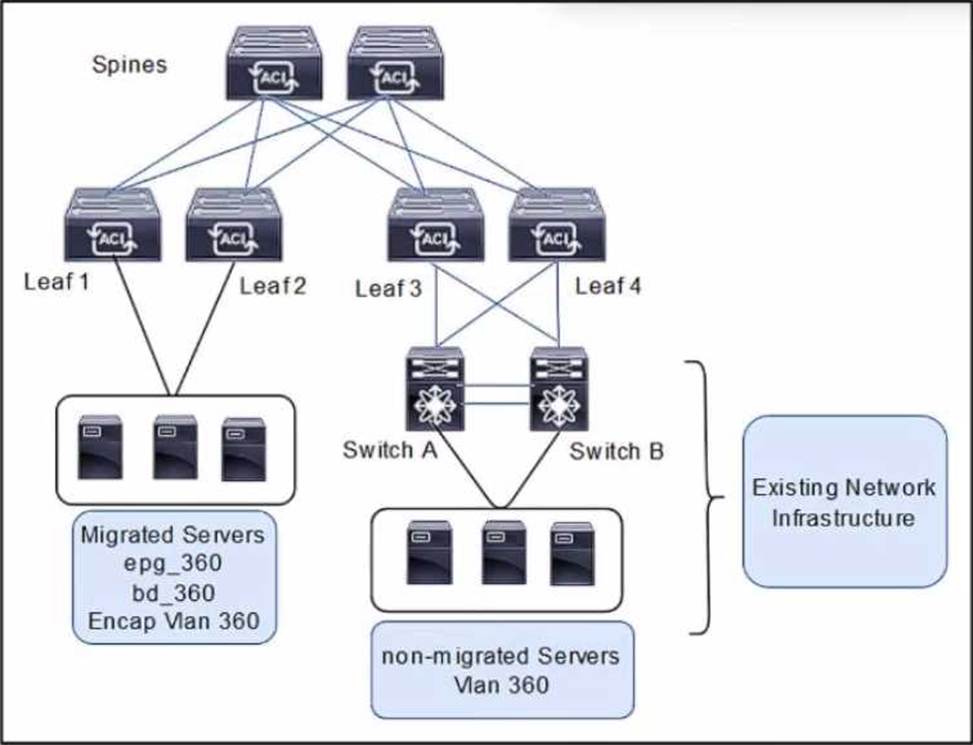
An engineer is migrating legacy servers into the Cisco ACI environment. The requirement is to ensure that all endpoints and MAC addresses are learned properly in legacy and Cisco ACI switches.
Which configuration set must be configured under the bridge domain called bd__360 to accomplish this goal?
- A . L2 Unknown Unicast: Hardware Proxy ARP Flooding: Disabled
- B . L2 Unknown Unicast: Hardware Proxy ARP Flooding: Enabled
- C . L2 Unknown Unicast: Flood ARP Flooding: Disabled
- D . L2 Unknown Unicast: Flood ARP Flooding: Enabled
Which setting prevents the learning of Endpoint IP addresses whose subnet does not match the bridge domain subnet?
- A . “Limit IP learning to network” setting within the bridge domain.
- B . “Limit IP learning to subnet” setting within the EPG.
- C . “Limit IP learning to network” setting within the EPG.
- D . “Limit IP learning to subnet” setting within the bridge domain.
D
Explanation:
The setting that prevents the learning of Endpoint IP addresses whose subnet does not match the bridge domain subnet is the “Limit IP learning to subnet” setting within the bridge domain1. This setting ensures that only IP addresses belonging to the subnets configured on the bridge domain are learned, preventing mis-learning of IP addresses that may not belong to the fabric1.
An engineer must connect a new host to port 1 »’1 on Leaf 101. A Cisco ACI fabric has an MOP policy configured but experience excessive Layer 2 loops. The engineer wants the Cisco ACI fabric to detect and prevent Layer 2 loops m the fabric.
Which set of actions accomplishes these goals’?
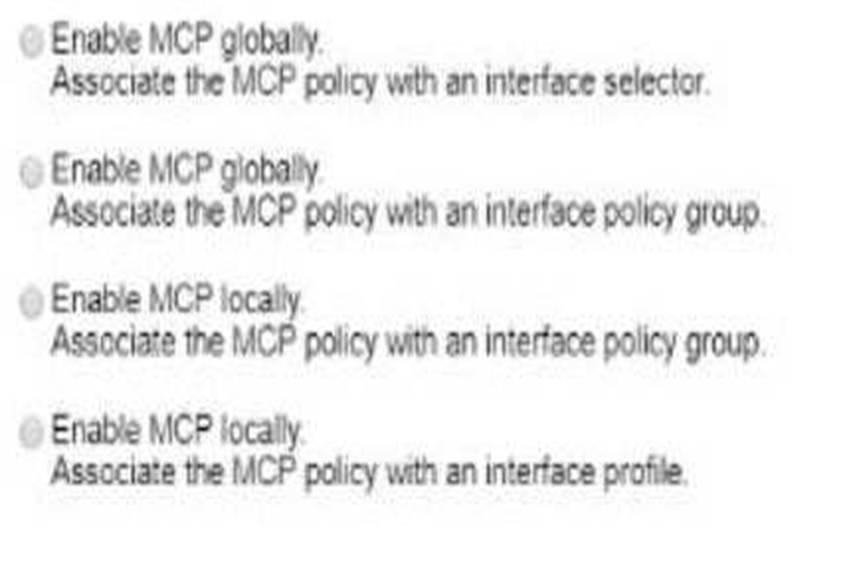
- A . Enable MCP globally.
Associate the MCP policy with an interface selector. - B . Enable MCP globally.
Associate the MCP policy with an interface policy group. - C . Enable MCP locally.
Associate the MCP policy with an interface policy group. - D . Enable MCP locally.
Associate the MCP policy with an interface profile.
B
Explanation:
To detect and prevent Layer 2 loops in a Cisco ACI fabric, the engineer must configure the Mis-Cabling Protocol (MCP) and related policies. MCP is designed to detect loops in Layer 2 network segments connected to ACI access ports and operates in conjunction with Spanning Tree Protocol (STP) running on external Layer 2 networks.
The steps to accomplish these goals include:
Enable MCP Globally: Ensure that MCP is enabled globally on all access ports, virtual ports, and virtual port channels (VPCs) unless they are disabled at the individual port level1.
Configure MCP Transmit Frequency: Set the transmit frequency to a value that allows for quick loop detection. Starting with the 3.2(1) release, the Cisco ACI fabric provides faster loop detection with transmit frequencies from 100 milliseconds to 300 seconds1.
Set Action on Loop Detection: Decide how the MCP policies will act upon loop detection. Options include generating a syslog message or disabling the port upon detection of a loop1.
Implement Error Disabled Recovery Policy: Configure an error disabled recovery policy to automatically re-enable ports that were disabled due to loop detection after a configurable interval1.
By following these steps, the engineer can ensure that the Cisco ACI fabric will detect and prevent Layer 2 loops, thereby maintaining a stable and efficient network environment.
Reference: Cisco APIC Online Help – Loop Detection1
ACI Layer 2 loop detection and Mitigation – Cisco Video Portal2
Cisco ACI fabric contains a tenant called Prod. User_1 must have write access to tenant Prod and full access to the fabric access policy.
Which set of actions must be taken to meet these requirements?
- A . Associate User_1 to the fabric access policy. Associate the security domain to the fabric access policy. Create RBAC for the distinguished name of tenant Prod.
- B . Associate User_1 to tenant Prod.
Associate the security domain to the distinguished name of the fabric access policy.
Create RBAC for the distinguished name of security domain. - C . Associate User_1 to the distinguished name of the fabric access policy.
Associate the security domain to RBAC.
Create RBAC for the distinguished name of User__1. - D . Associate User_1 to the security domain. Associate the security domain to tenant Prod.
Create RBAC for the distinguished name of fabric access policy.