
Cisco 300-620 Practice Exams
Last updated on Nov 16,2026- Exam Code: 300-620
- Exam Name: Implementing Cisco Application Centric Infrastructure (DCACI)
- Certification Provider: Cisco
- Latest update: Nov 16,2026
An engineer is troubleshooting fabric discovery in a newly deployed Cisco ACI fabric and analyzes this output:
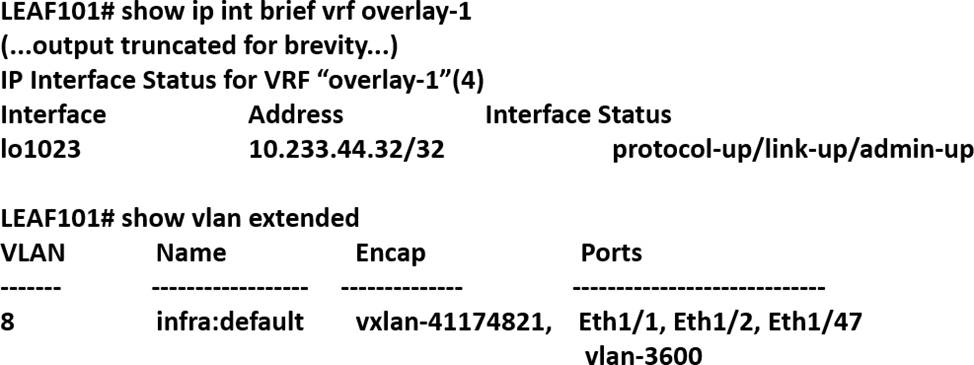
Which ACI fabric address is assigned to interface lo1023?
- A . Dynamic tunnel endpoint
- B . Physical tunnel endpoint
- C . Fabric tunnel endpoint
- D . VXLAN tunnel endpoint
C
Explanation:
In Cisco ACI, the interface lo1023 is assigned as a fabric tunnel endpoint (FTEP). This is a pervasive address found on every leaf and it’s always the same. It is used mostly for AVS (Application Virtual Switch) when the infra VXLAN is extended out of the fabric1. The FTEP is crucial for the internal operation of the fabric, particularly for scenarios where the infrastructure VXLAN needs to be extended outside of the ACI fabric.
Reference: Default IP interfaces on Fabric nodes – Cisco Community1
A company must connect three Cisco ACI data centers by using Cisco ACI Multi-Site. An engineer must configure the Inter-Site Network (ISN) between the existing sites.
Which two configuration steps must be taken to implement the ISN? (Choose two.)
- A . Configure OSPF on subinterfaces on routers that are directly connected with spine nodes.
- B . Configure ISN site extension on Cisco routers in the network.
- C . Configure OSPF on all ISN routers.
- D . Configure BIDIR-PIM on all ISN routers.
- E . Configure encapsulation VLAN-4 between the routers and spine nodes.
C, D
Explanation:
To implement the Inter-Site Network (ISN) for a Cisco ACI Multi-Site deployment, the following configuration steps are essential:
Configure OSPF on all ISN routers: OSPF (Open Shortest Path First) is a routing protocol that is used to ensure that all routers in the ISN have the necessary routing information to forward packets between sites.
Configure BIDIR-PIM on all ISN routers: BIDIR-PIM (Bidirectional Protocol Independent Multicast) is used for efficient multicast traffic forwarding across the ISN. This is particularly important for Cisco ACI Multi-Site deployments as it supports the replication of broadcast, unknown unicast, and multicast (BUM) traffic across sites.
Reference: Cisco ACI Multi-Site Configuration Guide
Cisco ACI Multi-Site Architecture White Paper
When a pre-provision immediacy is used, when is the policy downloaded to the Cisco ACI leaf switch?
- A . The policy is downloaded and programmed in the hardware policy CAM when the change is implemented on the Cisco APIC.
- B . The policy is programmed in the hardware policy CAM when the policy is downloaded in the leaf software.
- C . The policy is programmed in the hardware policy CAM when the first packet is received through the data path.
- D . The policy is downloaded to the associated leaf switch software when the ESXi host is attached to a DVS.
A
Explanation:
When a pre-provision immediacy is used, the policy is downloaded to the Cisco ACI leaf switch and programmed into the hardware policy Content Addressable Memory (CAM) as soon as the change is implemented on the Cisco Application Policy Infrastructure Controller (APIC). This means that the policy is ready on the leaf switch before any endpoints are actually connected.
An engineer must configure a Layer 3 connection to the WAN router. The hosts in production VRF must access WAN subnets. The engineer associates EPGs in the production VRF with the external routed domain.
Which action completes the task?
- A . Configure the Export Route Control Subnet scope for the external EPG.
- B . Configure the External Subnets for the External EPG scope for the external EPG.
- C . Configure the Import Route Control Subnet scope for the external EPG.
- D . Configure the Shared Route Control Subnet scope for the external EPG.
A
Explanation:
To complete the task of configuring a Layer 3 connection to the WAN router and allowing hosts in the production VRF to access WAN subnets, the engineer should configure the Export Route Control Subnet scope for the external EPG. This setting allows the subnets associated with the external EPG to be advertised to external routers, enabling connectivity to the WAN.
A company is implementing a new security policy to track system access, configuration, and changes. The network engineer must enable the log collection to track user login and logout attempts. In addition, any configuration changes such as a fabric node failure must be collected in the logs. The syslog policy is configured to send logs to the company SEIM appliance.
Which two log types must be enabled to meet the security requirements? (Choose two.)
- A . error
- B . audit
- C . event
- D . health
- E . fault
Engineer must configure SNMP inside a Cisco ACI fabric. The engineer has created an SNMP Policy, called SNMP-policy and an SNMP Monitoring Group called SNMP-group1 that Contains five trap receivers.
Which configuration set completes the configuration?
- A . Edit oobbrc to permit traffic using UDP port 16. Associate the client group policy to SNMP-group1.
- B . Permit OOB management traffic using UDP port 161. Associate client group policy with the OOB management EPG.
- C . Allow all OOB management traffic. Configure three trap receivers on SNMP-group1.
- D . Create an OOB management contract. Include the SNMP server in the OOB management EPG.
An engineer configures a Multi-Pod system with the default getaway residing outside of the ACI fabric for a bridge domain.
Which setting should be configured to support this requirement?
- A . disable Limit IP Learning to Subnet
- B . disable IP Data-plane Learning
- C . disable Unicast Routing
- D . disable Advertise Host Routes
A
Explanation:
When configuring a Multi-Pod system with the default gateway residing outside of the ACI fabric for a bridge domain, the setting that should be configured is to disable Limit IP Learning to Subnet (Option A). This allows the ACI fabric to learn IP addresses outside of the defined subnet, which is necessary when the default gateway is external.
Refer to the exhibit.
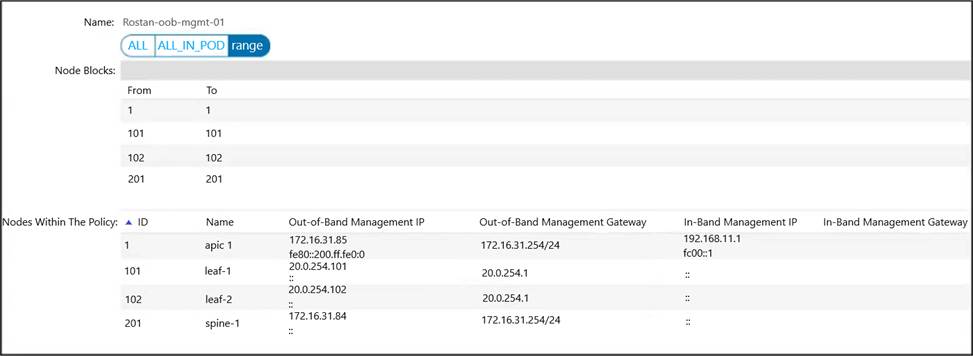
A Cisco ACI fabric is using out-of-band management connectivity The APIC must access a routable host with an IP address of 192 168 11 2.
Which action accomplishes this goal?
- A . Change the switch APIC Connectivity Preference to in-band management
- B . Remove the in-band management address from the APIC.
- C . Add a Fabric Access Policy to allow management connections.
- D . Modify the Pod Profile to use the default Management Access Policy
C
Explanation:
To enable the APIC in a Cisco ACI fabric using out-of-band management connectivity to access a routable host with an IP address of 192.168.11.2, you need to add a Fabric Access Policy that allows management connections. This involves configuring a contract that will be consumed and provided to your OOB devices. The contract will let the system know what traffic is allowed. In this case, you will use the default/common contract to permit any traffic. This is necessary because the APIC needs to be able to send traffic to and receive traffic from the management network1.
Reference: ACI: Configuring Out-of-Band (OOB) Access for Your Fabric – Cisco1
Troubleshoot ACI Management and Core Services – In-band and Out-of-band Management – Cisco2
Refer to the exhibit.
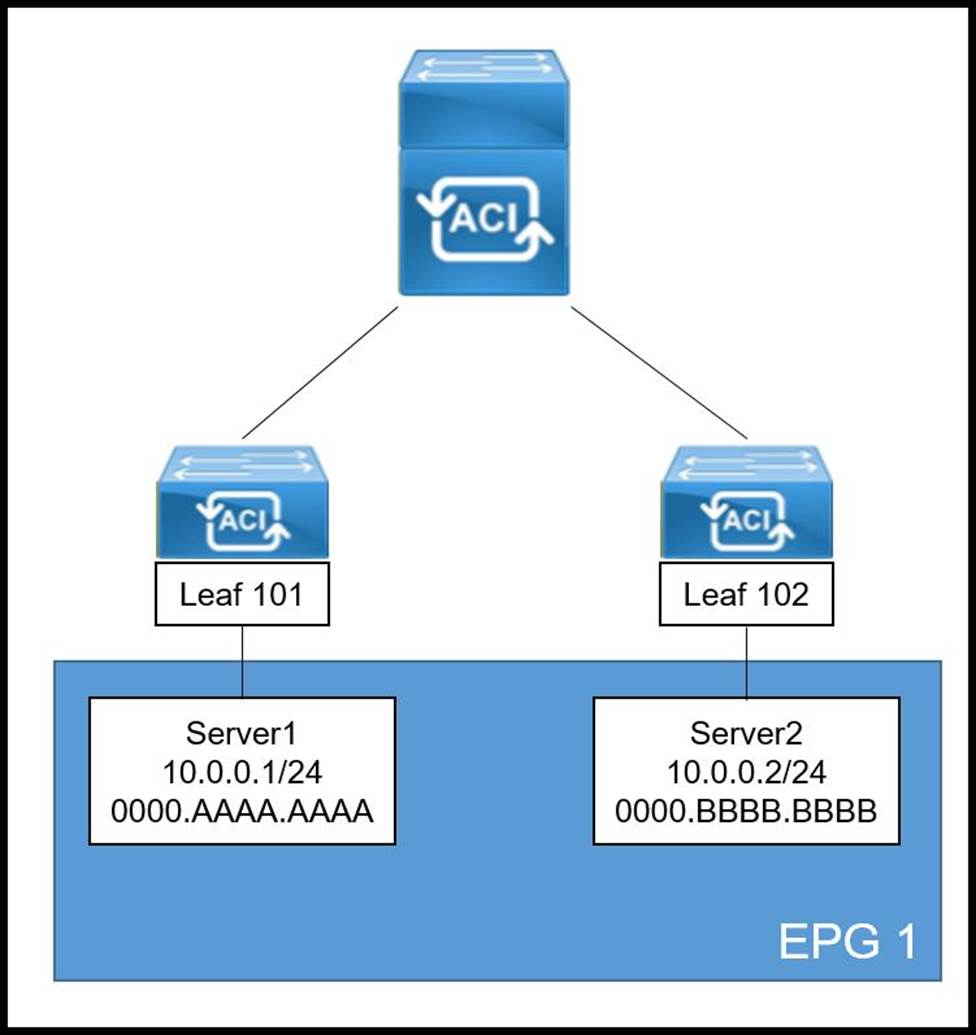
A systems engineer is implementing the Cisco ACI fabric. However, the Server2 information is missing from the Leaf 101 endpoint table and the COOP database of the spine. The requirement is for the bridge domain configuration to enforce the ACI fabric to forward the unicast packets generated by Server1 destined to Server2.
Which action must be taken to meet these requirements?
- A . Enable ARP Flooding
- B . Set L2 Unknown Unicast to Flood
- C . Set IP Data-Plane Learning to No
- D . Enable Unicast Routing
B
Explanation:
In the scenario where Server2 information is missing from the Leaf 101 endpoint table and the COOP database of the spine, setting Layer 2 Unknown Unicast to Flood (Option B) is the correct action to meet the requirements. This setting will cause the ACI fabric to flood unicast packets destined for unknown destinations within the bridge domain. This ensures that packets from Server1 will reach Server2 even though its location isn’t known by Leaf 101 or the spine’s COOP database. https://www.cisco.com/c/en/us/solutions/collateral/data-center-virtualization/application-centric-infrastructure/white-paper-c11-739989.html

Refer to the exhibit.
A systems engineer is implementing the Cisco ACI fabric. However, the Server2 information is missing from the Leaf 101 endpoint table and the COOP database of the spine. The requirement is for the bridge domain configuration to enforce the ACI fabric to forward the unicast packets generated by Server1 destined to Server2.
Which action must be taken to meet these requirements?
- A . Enable ARP Flooding
- B . Set L2 Unknown Unicast to Flood
- C . Set IP Data-Plane Learning to No
- D . Enable Unicast Routing
B
Explanation:
In the scenario where Server2 information is missing from the Leaf 101 endpoint table and the COOP database of the spine, setting Layer 2 Unknown Unicast to Flood (Option B) is the correct action to meet the requirements. This setting will cause the ACI fabric to flood unicast packets destined for unknown destinations within the bridge domain. This ensures that packets from Server1 will reach Server2 even though its location isn’t known by Leaf 101 or the spine’s COOP database. https://www.cisco.com/c/en/us/solutions/collateral/data-center-virtualization/application-centric-infrastructure/white-paper-c11-739989.html