
Cisco 300-620 Practice Exams
Last updated on Nov 16,2026- Exam Code: 300-620
- Exam Name: Implementing Cisco Application Centric Infrastructure (DCACI)
- Certification Provider: Cisco
- Latest update: Nov 16,2026
Which two IP address types are available for transport over the ISN when they are configured from Cisco ACI Multi-Site Orchestrator? (Choose two.)
- A . Management IP of APICs
- B . Management IP of the MSO Node
- C . Anycast Overlay Multicast TEP
- D . MP-BGP EVPN Router-ID
- E . Common Pervasive Gateway
C, D
Explanation:
The two IP address types that are available for transport over the Inter-Site Network (ISN) when they are configured from Cisco ACI Multi-Site Orchestrator (MSO) are the Anycast Overlay Multicast Tunnel Endpoint (TEP) and the MP-BGP EVPN Router-ID. These IP addresses are used for inter-site communication and routing in a Multi-Site deployment.
Which two IP address types are available for transport over the ISN when they are configured from Cisco ACI Multi-Site Orchestrator? (Choose two.)
- A . Management IP of APICs
- B . Management IP of the MSO Node
- C . Anycast Overlay Multicast TEP
- D . MP-BGP EVPN Router-ID
- E . Common Pervasive Gateway
C, D
Explanation:
The two IP address types that are available for transport over the Inter-Site Network (ISN) when they are configured from Cisco ACI Multi-Site Orchestrator (MSO) are the Anycast Overlay Multicast Tunnel Endpoint (TEP) and the MP-BGP EVPN Router-ID. These IP addresses are used for inter-site communication and routing in a Multi-Site deployment.
What represents the unique identifier of an ACI object?
- A . universal resource identifier (URI)
- B . application programming interface
- C . management information tree
- D . distinguished name
A
Explanation:
The unique identifier of an ACI object is represented by the universal resource identifier (URI)2.
Reference: https://www.slideshare.net/CiscoDevNet/introduction-to-aci-apis
What is a characteristic of a Cisco ACI Multi-Pod?
- A . It eliminates the need to deploy multicast in the Layer 3 network that interconnects the pods.
- B . Spines use BGP peering with IPN to send out the TEP pool prefix for the local pod.
- C . It manages the configuration of different Cisco ACI pods using a single common Cisco APIC cluster.
- D . A VPNv4 address family is used to exchange endpoint information between spines.
C
Explanation:
In a Cisco ACI Multi-Pod architecture, multiple pods (each with its own leaf-and-spine topology) are interconnected via an Inter-Pod Network (IPN). The key characteristic of the Multi-Pod setup is that it is managed as a single fabric by a single APIC cluster, simplifying operations and maintaining consistency across all pods.
A network engineer must integrate VMware vCenter cluster with Cisco ACI. The requirement is for the management traffic of the hypervisors and VM controllers to use the virtual switch associated with the Cisco Application Policy. The EPG called "Vmware-MGMT" with VLAN 300 has been created for this purpose.
Which set of steps must be taken to complete the configuration?
- A . • Add VLAN 300 with static allocation to the VLAN POOL that is used for VMM integration.
• Attach the VMM domain to the target EPG with resolution preprovision, mode static, untagged access VLAN, and Port-Encap 300. - B . • Associate the target EPG with the VMM domain with default settings.
• Enable Infrastructure VLAN on AAEP used toward VMware hypervisors. - C . • Enable Infrastructure VLAN on AAEP used toward VMware hypervisors.
• Associate the target EPG with the VMM domain with default settings. - D . • Enable Infrastructure VLAN on AAEP used toward VMware hypervisors.
• Create a static binding in the target EPG toward VMware hypervisors with VLAN 300, untagged access VLAN, and Untagged 802.1P mode.
D
Explanation:
To integrate the VMware vCenter cluster with Cisco ACI and ensure that the management traffic of the hypervisors and VM controllers uses the virtual switch associated with the Cisco Application Policy, the following steps must be taken:
Enable Infrastructure VLAN on AAEP used toward VMware hypervisors: This step involves enabling the infrastructure VLAN on the Attachable Access Entity Profile (AAEP) that is used for the VMware hypervisors. This VLAN is used for carrying infrastructure traffic such as management, vMotion, and fault tolerance.
Create a static binding in the target EPG toward VMware hypervisors with VLAN 300: This step involves creating a static binding in the “Vmware-MGMT” EPG for the VMware hypervisors with VLAN 300, setting it as an untagged access VLAN, and using Untagged 802.1P mode. This ensures that the management traffic is correctly tagged and associated with the appropriate EPG.
Reference:
Cisco ACI Fabric Hardware Installation Guide
Cisco ACI Troubleshooting Guide
Cisco ACI Multi-Site Architecture White Paper
Cisco ACI Virtual Machine Manager (VMM) Integration White Paper
An engineer configures SNMP for an ACI fabric and created an SNMP Monitoring Destination Group called snmp_dgroup1. Snmp_dgroup1 is configured with the server hostname and Community password. An SNMP policy called snmp_podpolicy1 is configured to enable SNMP and add an SNMP Client Group Profile called snmp_clgroup1. Snmp_podpolicy1 is associated default pod profile via a pod policy group named podl.
Which configuration set must the engineer enable to complete the SNMP configuration?
- A . Configure an SNMP management contract to permit all traffic. Associate snmp_podpolicy1 with an SNMP pod profile.
- B . Configure the OOB management contract to permit all traffic. Associate snmp_clgroup1 with the SNMP management EPG.
- C . Configure the OOB management contract to permit UDP 162. Associate snmp_dgroupl with the OOB management EPG.
- D . Configure an SNMP management contract to permit UDP 162. Associate the SNMP Source to snmp_clgroup1.
C
Explanation:
https://community.cisco.com/t5/documentos-data-center/configuraci%C3%B3n-snmp-para-aci/ta-p/4680520
Refer to the exhibit.
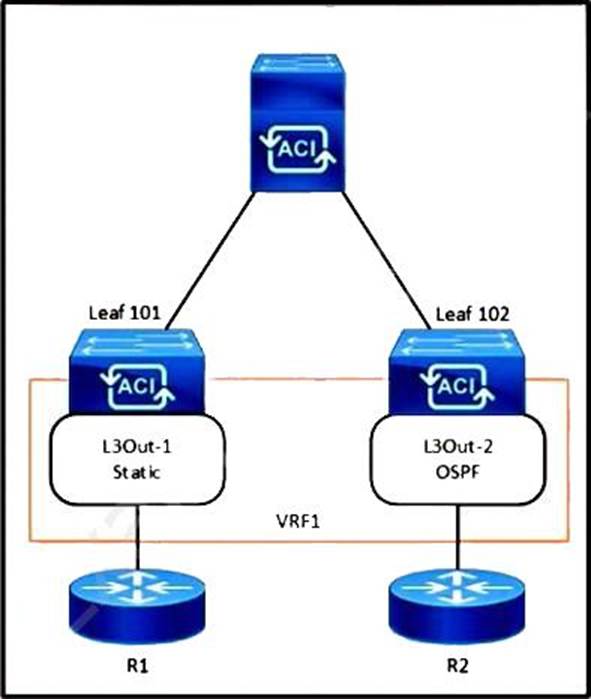
The 0.0.0.0/0 is configured as a default static route on L3Out-1.
Which action should be taken for the 0.0.0.0/0 prefix to advertise out on L3Out-2 OSPF?
- A . Enable Export Route Control Subnet.
- B . Enable Shared Security Import Subnet.
- C . Enable Shared Route Control Subnet.
- D . Enable Aggregate Export Subnet.
A
Explanation:
To advertise the 0.0.0.0/0 prefix out on L3Out-2 OSPF, when it is configured as a default static route
on L3Out-1, the action that should be taken is to enable the Export Route Control Subnet. This setting allows the default route to be advertised to other L3Outs, enabling the ACI fabric to act as a transit network1.
Reference: ACI Fabric L3Out White Paper – Cisco1
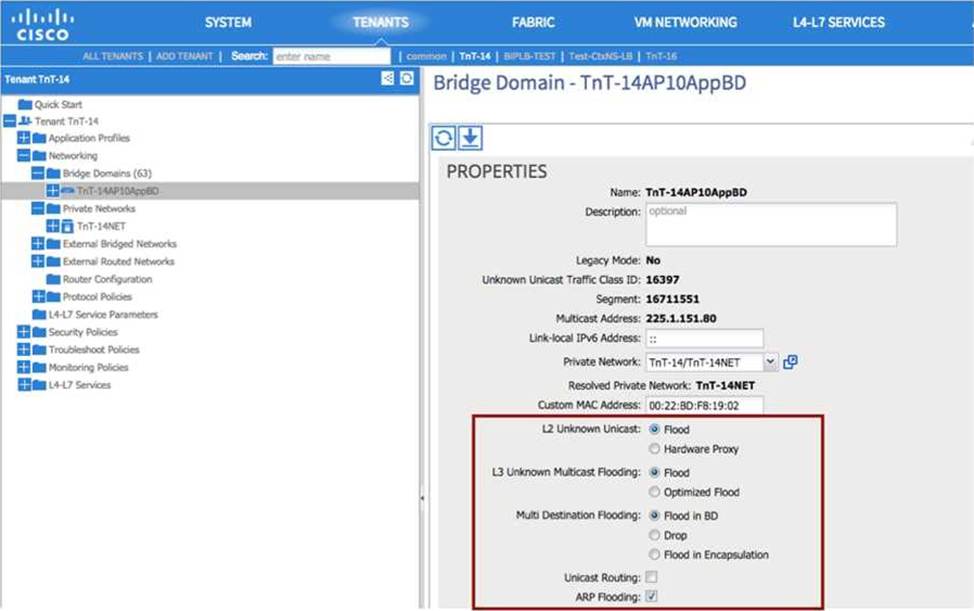
The existing network and ACI fabric have been connected to support workload migration. Servers will
physically terminate at the Cisco ACI, but their gateway must stay in the existing network. The solution needs to adhere to Cisco’s best practices. The engineer started configuring the relevant Bridge Domain and needs to complete the configuration.
Which group of settings are required to meet these requirements?
- A . L2 Unknown Unicast: Hardware Proxy
L3 Unknown Multicast Flooding: Flood
Multi Destination Flooding: Flood in BD
ARP Flooding: Enable - B . L2 Unknown Unicast: Flood
L3 Unknown Multicast Flooding: Flood
Multi Destination Flooding: Flood in BD
ARP Flooding: Enable - C . L2 Unknown Unicast: Flood
L3 Unknown Multicast Flooding: Optimize Flood
Multi Destination Flooding: Flood in BD
ARP Flooding: Disable - D . L2 Unknown Unicast: Hardware Proxy
L3 Unknown Multicast Flooding: Optimize Flood
Multi Destination Flooding: Flood in BD
ARP Flooding: Disable
B
Explanation:
The group of settings required to meet the requirements for workload migration where servers will physically terminate at the Cisco ACI, but their gateway must stay in the existing network, is:
L2 Unknown Unicast: Flood
L3 Unknown Multicast Flooding: Flood
Multi Destination Flooding: Flood in BD
ARP Flooding: Enable5
These settings ensure that the bridge domain is configured to handle unknown unicast and multicast traffic appropriately, and ARP flooding is enabled to allow for the resolution of IP addresses when the gateway is outside the fabric5.
https://www.cisco.com/c/en/us/td/docs/switches/datacenter/aci/apic/sw/migration_guides/migrati ng_existing_networks_to_aci.html

A RADIUS user resolves its role via the Cisco AV Pair.
What object does the Cisco AV Pair resolve to?
- A . tenant
- B . security domain
- C . primary Cisco APIC
- D . managed object class
D
Explanation:
The Cisco AV Pair resolves to a managed object class. In the context of Cisco ACI, the AV Pair is used to define specific attributes for RADIUS users, which then map to managed objects within the ACI fabric3.
Reference: https://www.cisco.com/c/en/us/td/docs/switches/datacenter/aci/apic/sw/2-x/Security_config/b_Cisco_APIC_Security_Configuration_Guide/b_Cisco_APIC_Security_Guide_chapter_01011.html
An engineer configures an L30ut in VRF-1 that was configured for Import Route Control Enforcement. The L30ut uses OSPF to peer with a core switch. The L30ut has one external EPG, it has been configured with a subnet 10.1.0.0/24.
Which scope must be set to force 10.1.0.0/24 to populate in the routing table for VRF-1?
- A . External Subnet for External EPG
- B . Export Route Control Subnet
- C . Shared Route for External EPG
- D . Import Route Control Subnet
D
Explanation:
The "Import Route Control Subnet" scope is used to control which external routes are imported into the ACI fabric’s routing table