
Cisco 300-620 Practice Exams
Last updated on Nov 16,2026- Exam Code: 300-620
- Exam Name: Implementing Cisco Application Centric Infrastructure (DCACI)
- Certification Provider: Cisco
- Latest update: Nov 16,2026
Cisco ACI fabric contains 10 standalone leaf switches. An engineer must configure only the first two leaf switches in a VPC.
Which VPC protection type must be configured to accomplish goal?
- A . serial
- B . explicit
- C . reciprocal
- D . consecutive
B
Explanation:
The scenario involves a Cisco ACI fabric with 10 standalone leaf switches, and the engineer must configure only the first two leaf switches (e.g., Leaf-1 and Leaf-2) in a Virtual Port Channel (vPC) configuration. The goal is to select the appropriate vPC protection type to achieve this specific pairing while leaving the other eight leaf switches standalone.
Requirement Analysis
In Cisco ACI, vPC is used to provide active-active link redundancy and load balancing between two leaf switches connected to the same set of endpoints (e.g., servers or external devices).
The fabric contains 10 standalone leaf switches, meaning no pre-existing vPC pairs are configured, and the task is to form a vPC specifically between the first two leaf switches.
The vPC protection type determines how the pair is defined and protected within the ACI fabric, ensuring the configuration is limited to the intended switches.
Option Evaluation
Which feature should be disabled on a bridge domain when a default gateway for endpoints is on an external device instead of a Cisco ACI bridge domain SVI?
- A . unknown unicast flooding
- B . ARP flooding
- C . unicast routing
- D . proxy ARP
C
Explanation:
When the default gateway for endpoints is on an external device instead of a Cisco ACI bridge domain Switched Virtual Interface (SVI), the unicast routing feature should be disabled on the bridge domain. This prevents the ACI fabric from attempting to route traffic for the endpoints, which should instead be directed to the external default gateway.
Refer to the exhibit.
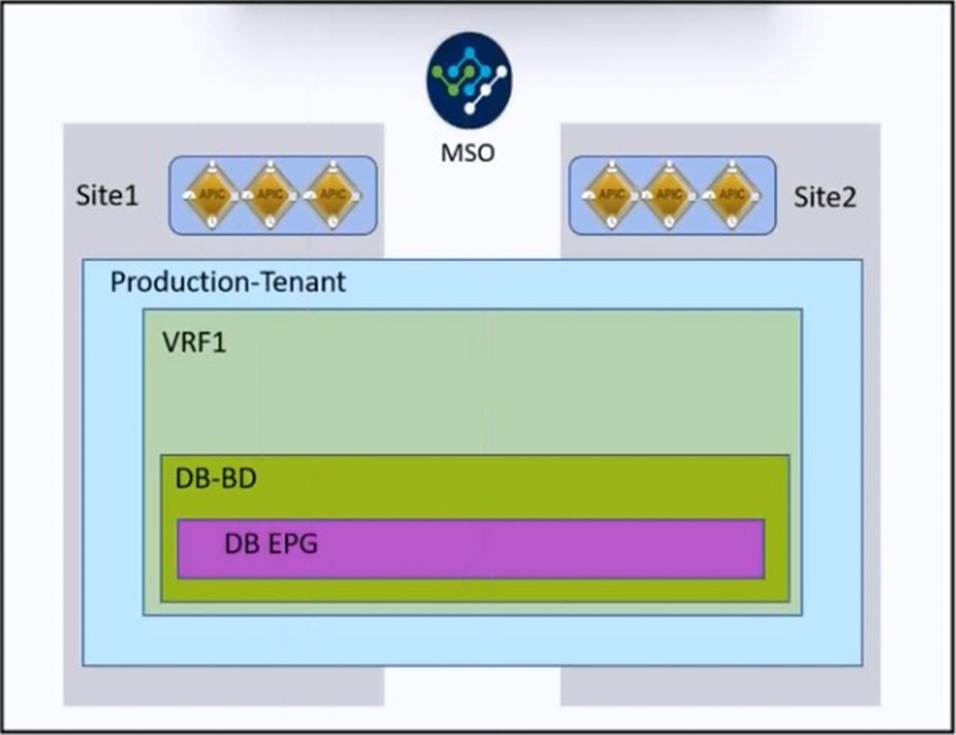
An engineer must allow IP mobility between Site1 and Site2 in a Cisco ACI Multi-Site orchestrator.
The design must meet these requirements:
• A disaster recovery (DR) solution must exist between the sites that do not require vMotion support.
• The application must be started at a DR site without having to re-IP the application servers.
• The solution must avoid any broadcast storms between the sites.
Which two actions meet these criteria? (Choose two.)
- A . Define a unique bridge domain subnet per site.
- B . Configure STP between Cisco ACI fabrics.
- C . Deploy a local EPG for Site1 and Site2.
- D . Disable Inter-site BUM Traffic.
- E . Apply the L2 Stretch feature.
D, E
Explanation:
To allow IP mobility between Site1 and Site2 in a Cisco ACI Multi-Site orchestrator while meeting the disaster recovery (DR) requirements and avoiding broadcast storms, the following actions should be taken:
Disable Inter-site BUM Traffic: Disabling Broadcast, Unknown unicast, and Multicast (BUM) traffic between sites helps to avoid broadcast storms that can occur when extending Layer 2 domains across multiple sites1.
Apply the L2 Stretch feature: The Layer 2 Stretch feature allows subnets to be extended across multiple sites without the need to re-IP the application servers. This supports IP mobility and enables applications to be started at a DR site using the same IP address space1.
These actions ensure that the design supports a DR solution without requiring vMotion support, allows applications to be started at a DR site without re-IPing servers, and avoids broadcast storms between the sites.
Reference: Cisco ACI Multi-Site Architecture White Paper1
Cisco Nexus Dashboard Orchestrator Overview2
Refer to exhibit.
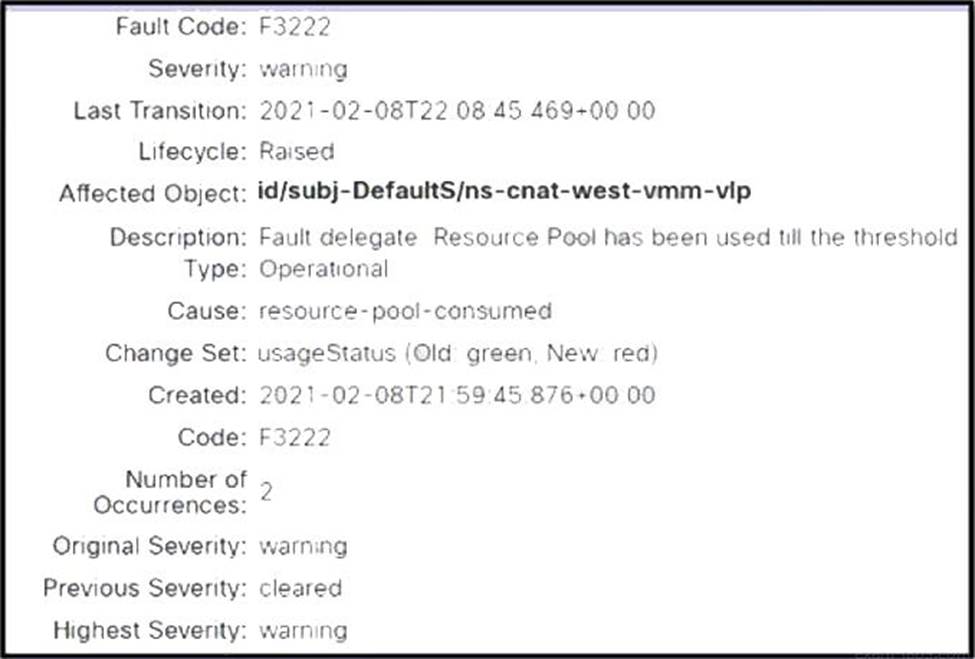
A Cisco APIC raises an error when the EPG must accept endpoints from a VMM domain created.
Which action clears the fault?
- A . Expand the VLAN pool for the VMM domain.
- B . Create a bridge domain for the VMM domain.
- C . Associate the EPG with the VMM domain.
- D . Associate the VLAN pool with the VMM domain.
C
Explanation:
To clear the fault raised by the Cisco APIC when the EPG must accept endpoints from a VMM domain, the EPG should be associated with the VMM domain. This association is necessary for the APIC to recognize the endpoints within the VMM domain as part of the EPG. Without this association, the APIC cannot apply the policies defined in the EPG to the endpoints, which can result in errors1.
Reference: APIC Policy Deployment and Resolution Immediacy For AVS VMM Domain – Cisco Community
Refer to the exhibit.
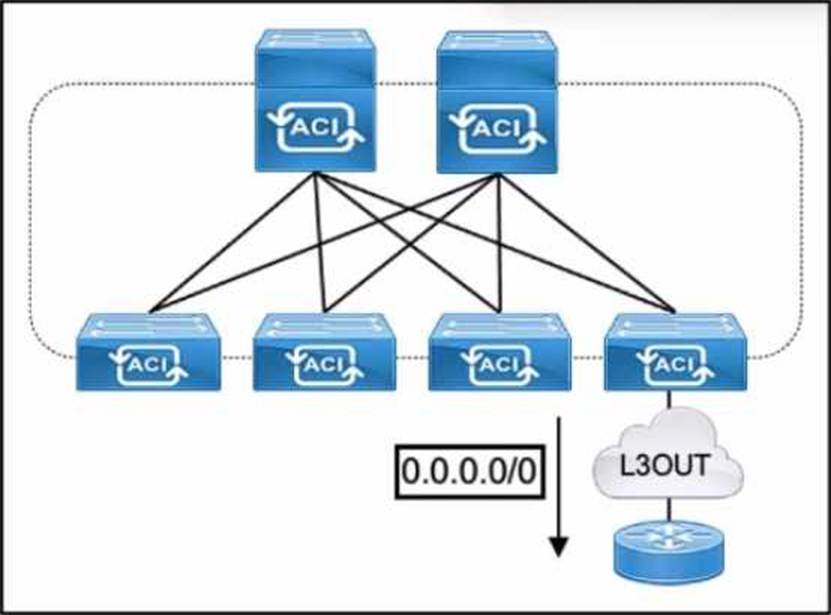
The default route is not present in the routing tables of the Cisco ACI leaf switches. All static and direct routes are currently being redistributed and advertised.
Which in must be taken to advertise a default route on the eBGP L30ut?
- A . Configure a static default route on the ACI node profiles with next-hop null.
- B . Create a Default Route Leak Policy on the L3Qut.
- C . Enable a BGP peer prefix policy set to Always.
- D . Implement an export route map matching 0.0.0.0/0.
B
Explanation:
For external connections to the fabric that only require a default route, there is support for originating a default route for OSPF, EIGRP, and BGP L3Out connections. If a default route is received from an external peer, this route can be redistributed out to another peer following the transit export route control as described earlier in this article. A default route can also be advertised out using a Default Route Leak policy. This policy supports advertising a default route if it is present in the routing table or it always supports advertising a default route. The Default Route Leak policy is configured in the L3Out connection.
https://www.cisco.com/c/en/us/td/docs/switches/datacenter/aci/apic/sw/2-x/L3_config/b_Cisco_APIC_Layer_3_Configuration_Guide/b_Cisco_APIC_Layer_3_Configuration_Gui
de_chapter_010100.html
Which statement about ACI syslog is true or Which statement describes the ACI syslog?
- A . Notifications for different scopes of syslog objects can be sent only to one destination.
- B . Syslog messages are sent to the destination through the spine.
- C . All syslog messages are sent to the destination through APIC.
- D . Switches send syslog messages directly to the destinations.
C
Explanation:
The correct statement about ACI syslog is that all syslog messages are sent to the destination through APIC1. This centralized approach allows for consistent logging and monitoring across the ACI fabric1.
Reference: https://www.ciscolive.com/c/dam/r/ciscolive/us/docs/2016/pdf/BRKACI-2303.pdf
Which feature allows firewall ACLs to be configured automatically when new endpoints are attached to an EPG?
- A . ARP gleaning
- B . dynamic endpoint attach
- C . hardware proxy
- D . network-stitching
A
Explanation:
The feature that allows firewall ACLs to be configured automatically when new endpoints are attached to an EPG is ARP gleaning. This feature helps in identifying the endpoints and applying the necessary ACLs to them as they are discovered
The company ESXi infrastructure is hosted on the Cisco UCS-B Blade Servers. The company decided to take advantage of ACI VMM integration to enable consistent enforcement of policies across virtual and physical workloads. The requirement is to prevent the packet loss between the distributed virtual switch and the ACI fabric.
Which setting must be implemented on a vSwitch policy to accomplish this goal?
- A . Static Channel
- B . MAC Pinning
- C . LACP
- D . LLDP
B
Explanation:
To prevent packet loss between the distributed virtual switch and the ACI fabric in a company’s ESXi infrastructure hosted on Cisco UCS-B Blade Servers, the vSwitch policy must implement MAC Pinning. This setting ensures that each virtual interface card (vNIC) on the UCS servers is pinned to an uplink Ethernet port, providing a stable and consistent path for traffic and preventing packet loss due to path changes.
What must be configured to allow SNMP traffic on the APIC controller?
- A . out-of-band management interface
- B . contract under tenant mgmt
- C . SNMP relay policy
- D . out-of-band bridge domain
B
Explanation:
To allow SNMP traffic on the APIC controller, a contract under tenant mgmt must be configured3.
Which endpoint learning operation is completed on the ingress leaf switch when traffic is received from a Layer 3 Out?
- A . The source MAC address of the traffic is learned as a local endpoint.
- B . The source MAC address of the traffic is learned as a remote endpoint.
- C . The source IP address of the traffic is learned as a remote endpoint.
- D . The source IP address of the traffic is learned as a local endpoint.
C
Explanation:
When traffic is received from a Layer 3 Out (L3Out) on the ingress leaf switch in a Cisco ACI fabric, the source IP address of the traffic is learned as a remote endpoint. This is because the traffic is entering the ACI fabric from an external network, and the source IP is considered remote to the fabric.