
Cisco 300-620 Practice Exams
Last updated on Nov 16,2026- Exam Code: 300-620
- Exam Name: Implementing Cisco Application Centric Infrastructure (DCACI)
- Certification Provider: Cisco
- Latest update: Nov 16,2026
Refer to the exhibit.
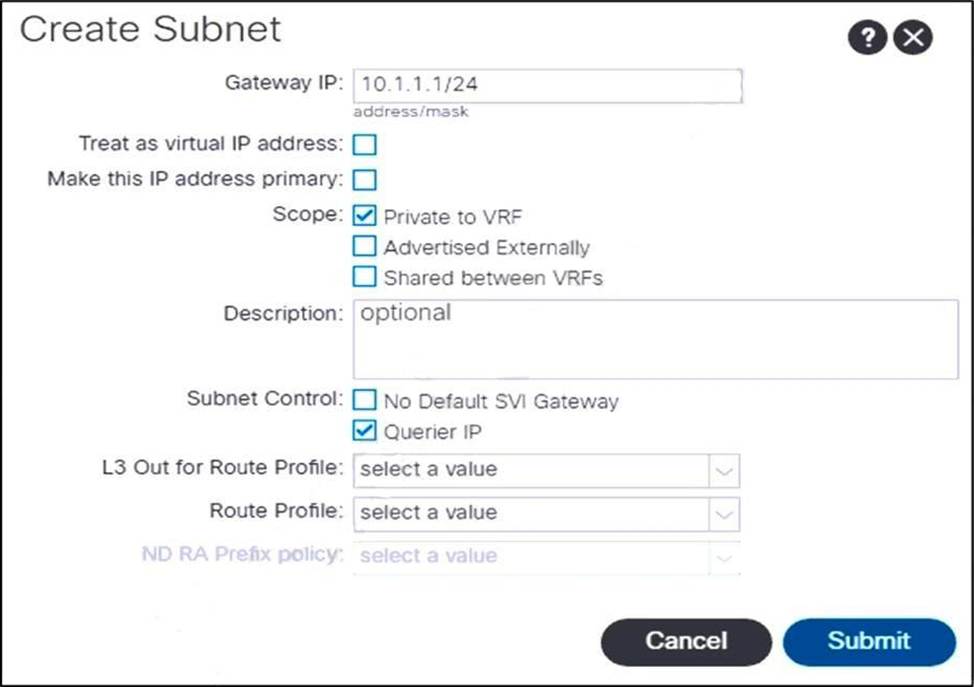
An engineer configures communication between the EPGs in different tenants.
Which action should be taken to create the subnet?
- A . Change Scope to Shared between VRFs.
- B . Leave Scope set to Private to VRF.
- C . Add the L3Out for Route Profile value.
- D . Change Scope to Advertised Externally.
A
Explanation:
To configure communication between the EPGs in different tenants, the subnet scope should be set to “Shared between VRFs”. This allows the subnet to be shared across different VRFs, enabling communication between EPGs that are in different tenants but within the same VRF. By marking the subnet as shared, it becomes visible to other VRFs, which is necessary for inter-tenant communication1.
Reference: Learning ACI – Part 12: Inter-VRF and Inter-Tenant Communication
Which two protocols are used for fabric discovery in ACI? (Choose two.)
- A . LLDP
- B . OSPF
- C . CDP
- D . DHCP
- E . ISIS
A, E
Explanation:
The two protocols used for fabric discovery in Cisco ACI are LLDP (Link Layer Discovery Protocol) and ISIS (Intermediate System to Intermediate System). LLDP is used for neighbor discovery on the data link layer, while ISIS is a routing protocol used for reachability between the TEP IPs (VTEPs) within the ACI fabric23.
Reference: https://www.dclessons.com/aci-fabric-discovery
A network administrator configures AAA inside the Cisco ACI fabric. The authentication goes through the local users if the TACACS+ server is not reachable. If the Cisco APIC is out of the cluster, the access must be granted through the fallback domain.
Which configuration set meets these requirements?
- A . Ping Check: True
Default Authentication Realm: Local
Fallback Check: True - B . Ping Check: True
Default Authentication Realm: TACACS+
Fallback Check: False - C . Ping Check: False
Default Authentication Realm: Local
Fallback Check: False - D . Ping Check: False
Default Authentication Realm: TACACS+
Fallback Check: True
D
Explanation:
For AAA configuration within the Cisco ACI fabric, where authentication should fall back to local users if the TACACS+ server is unreachable, and access must be granted through the fallback domain if the Cisco APIC is out of the cluster, the configuration set that meets these requirements is to have the Default Authentication Realm set to TACACS+ with Fallback Check enabled. This ensures that when the TACACS+ server cannot be reached, the system will fall back to using local authentication
What is MP-BGP used for in Cisco ACI fabric?
- A . MP-BGP VPNv4 AF is used to propagate L3Out routes that are received from a border leaf to the fabric.
- B . MP-BGP VPNv4 AF is used between spines in an ACI Multi-Pod fabric to propagate the endpoint
- C . MP-BGP VPNv4 AF is used as protocol on L3Out between a border leaf and an external router
- D . MP-BGP Layer 2 VPN EVPN AF is used to propagate L30ut routes that are received from a border leaf.
A
Explanation:
In Cisco ACI fabric, MP-BGP (Multi-Protocol Border Gateway Protocol) is utilized for several purposes, one of which includes the propagation of L3Out (Layer 3 Out) routes within the fabric. Specifically, MP-BGP with VPNv4 address family (AF) is used in the ACI infra VRF (overlay-1 VRF) to distribute external routes from a border leaf to other leaf switches1. This allows for the efficient dissemination of routing information and ensures that all relevant leaf switches are aware of the routes necessary to reach external networks.
Reference: ACI Fabric L3Out White Paper – Cisco1
Configuring ACI Fabric BGP Route Reflectors – Cisco2
ACI Fabric – Underlying protocols – Cisco Community3
Cisco Application Centric Infrastructure Fundamentals, Release 5.3(x)4
Which two protocols support accessing backup files on a remote location from the APIC? (Choose two.)
- A . TFTP
- B . FTP
- C . SFTP
- D . SMB
- E . HTTPS
B, C
Explanation:
The two protocols that support accessing backup files on a remote location from the APIC are FTP (File Transfer Protocol) and SFTP (SSH File Transfer Protocol). Both FTP and SFTP allow for the transfer of files to and from a remote location, but SFTP provides an additional layer of security by utilizing SSH.
Reference: https://www.cisco.com/c/en/us/td/docs/switches/datacenter/aci/apic/sw/1-x/troubleshooting/b_APIC_Troubleshooting/b_APIC_Troubleshooting_appendix_010011.html
Refer to the exhibit.
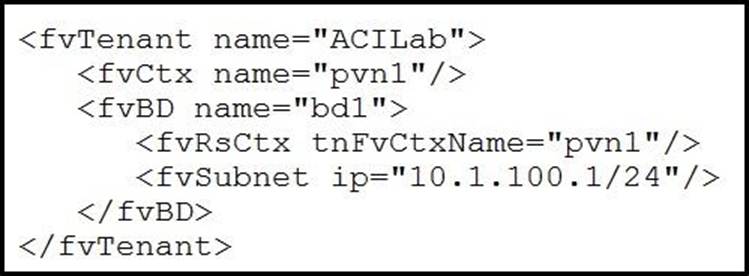
Which two objects are created as a result of the configuration? (Choose two.)
- A . application profile
- B . attachable AEP
- C . bridge domain
- D . endpoint group
- E . VRF
C, E
Explanation:
The XML configuration snippet provided in the exhibit results in the creation of two objects within the Cisco ACI environment:
Bridge Domain (Option C): This is indicated by the XML element <fvBD name="bd1">, which defines a bridge domain with the name “bd1”.
VRF (Option E): This is shown by the XML element <fvCtx name="pvn1"/>, which defines a Virtual Routing and Forwarding instance named “pvn1”.
These objects are essential for network segmentation and routing within the ACI fabric, where the bridge domain represents a Layer 2 broadcast domain and the VRF is used for Layer 3 routing separation.
Refer to the exhibit.
Which two objects are created as a result of the configuration? (Choose two.)
- A . application profile
- B . attachable AEP
- C . bridge domain
- D . endpoint group
- E . VRF
C, E
Explanation:
The XML configuration snippet provided in the exhibit results in the creation of two objects within the Cisco ACI environment:
Bridge Domain (Option C): This is indicated by the XML element <fvBD name="bd1">, which defines a bridge domain with the name “bd1”.
VRF (Option E): This is shown by the XML element <fvCtx name="pvn1"/>, which defines a Virtual Routing and Forwarding instance named “pvn1”.
These objects are essential for network segmentation and routing within the ACI fabric, where the bridge domain represents a Layer 2 broadcast domain and the VRF is used for Layer 3 routing separation.
Refer to the exhibit.
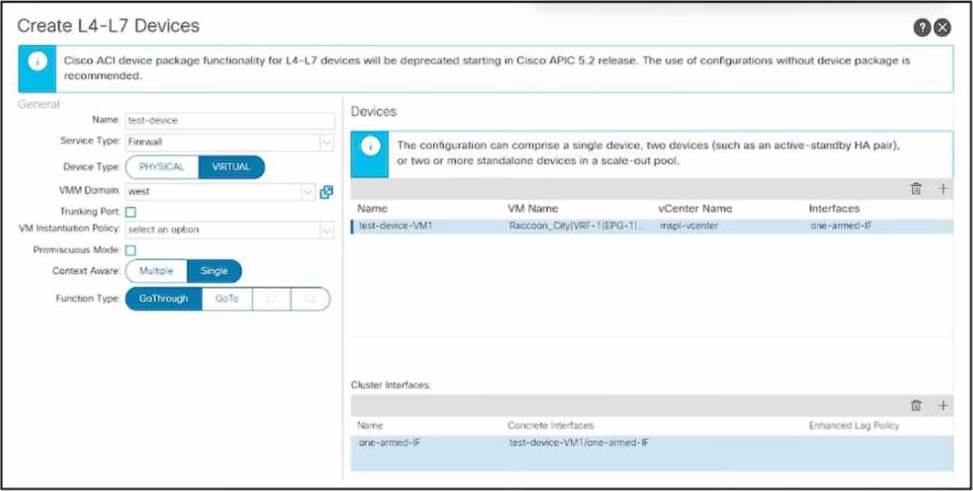
An engineer configures a Layer 4 to Layer 7 device object. The device is a virtual firewall with a single network adapter and it must be deployed in routed mode.
Which .. completes the configuration of the device object?
- A . Change Function Type to GoTo.
- B . Add an outside interface to the cluster interfaces.
- C . Change context awareness to Multiple.
- D . Enable Promiscuous Mode.
A
Explanation:
https://www.cisco.com/c/en/us/td/docs/dcn/aci/apic/6x/l4-l7-configuration/cisco-apic-layer-4-to-layer-7-services-deployment-guide-60x/defining-a-logical-device-60x.html
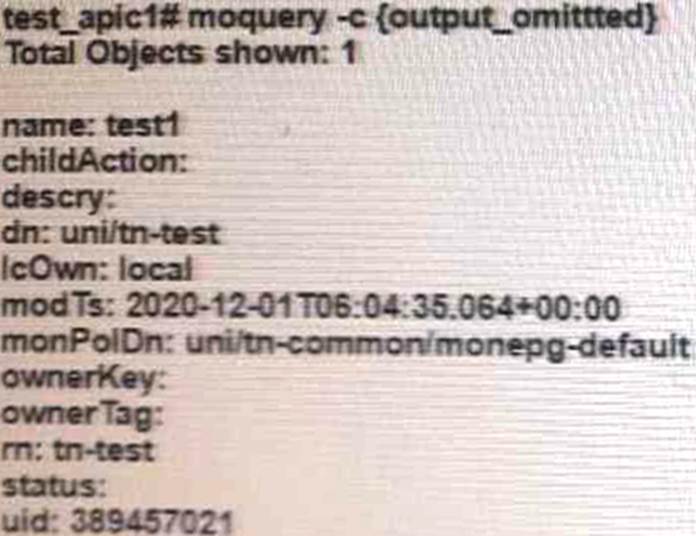
Which class of ACI object is presented in this output?
- A . Contract
- B . Bridge Domain
- C . Tenant
- D . Endpoint
C
Explanation:
In Cisco ACI, the object classes are used to categorize different types of managed objects within the ACI model. The output presented is indicative of a Tenant class object. Tenants in ACI are a top-level container for application policies, essentially providing a unit of isolation from other tenants. Each tenant can contain its own application policies, services, and network policies, and they are separate from other tenants to ensure multi-tenancy1.
Reference: Cisco ACI Policy Model Guide1
Object Renaming in Cisco ACI – Cisco2
Application Centric Infrastructure (ACI) REST API Guide – Cisco DevNet
https://www.cisco.com/c/en/us/td/docs/switches/datacenter/aci/apic/sw/4-x/openstack/ACI-Installation-Guide-for-Red-Hat-Using-OSP13-Director/m-configuring-ironic-for-openstack.html
Which type of port is used for in-band management within ACI fabric?
- A . spine switch port
- B . APIC console port
- C . leaf access port
- D . management port
A
Explanation:
The type of port used for in-band management within ACI fabric is the spine switch port4.