
Cisco 300-510 Practice Exams
Last updated on Nov 16,2026- Exam Code: 300-510
- Exam Name: Implementing Cisco Service Provider Advanced Routing Solutions (SPRI)
- Certification Provider: Cisco
- Latest update: Nov 16,2026
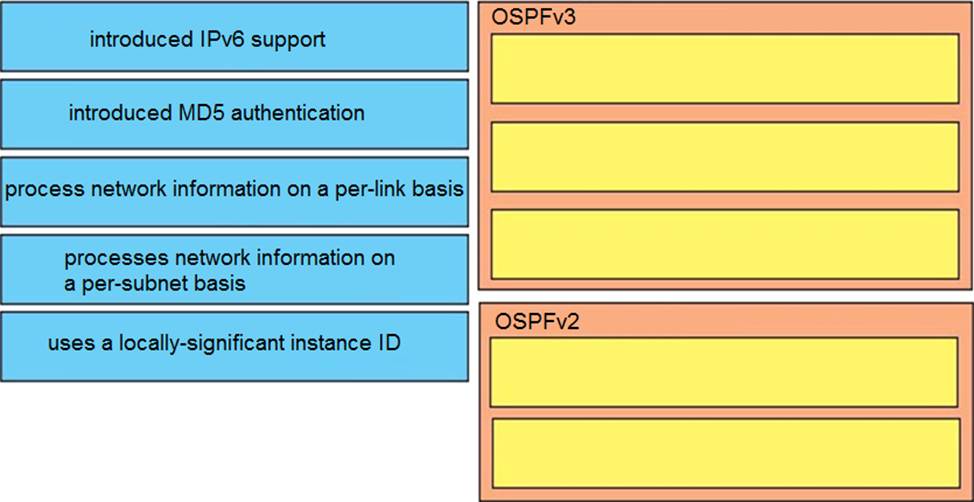
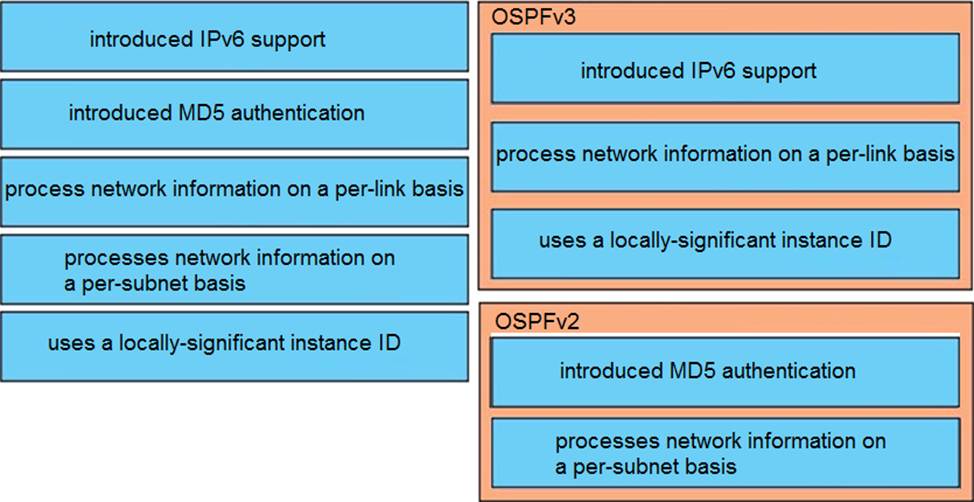
DRAG DROP
Compare different features between OSPFv2 and OSPFv3.
Drag and drop the descriptions of OSPF from the left onto the correct OSPF versions on the right.
Refer to the exhibit.
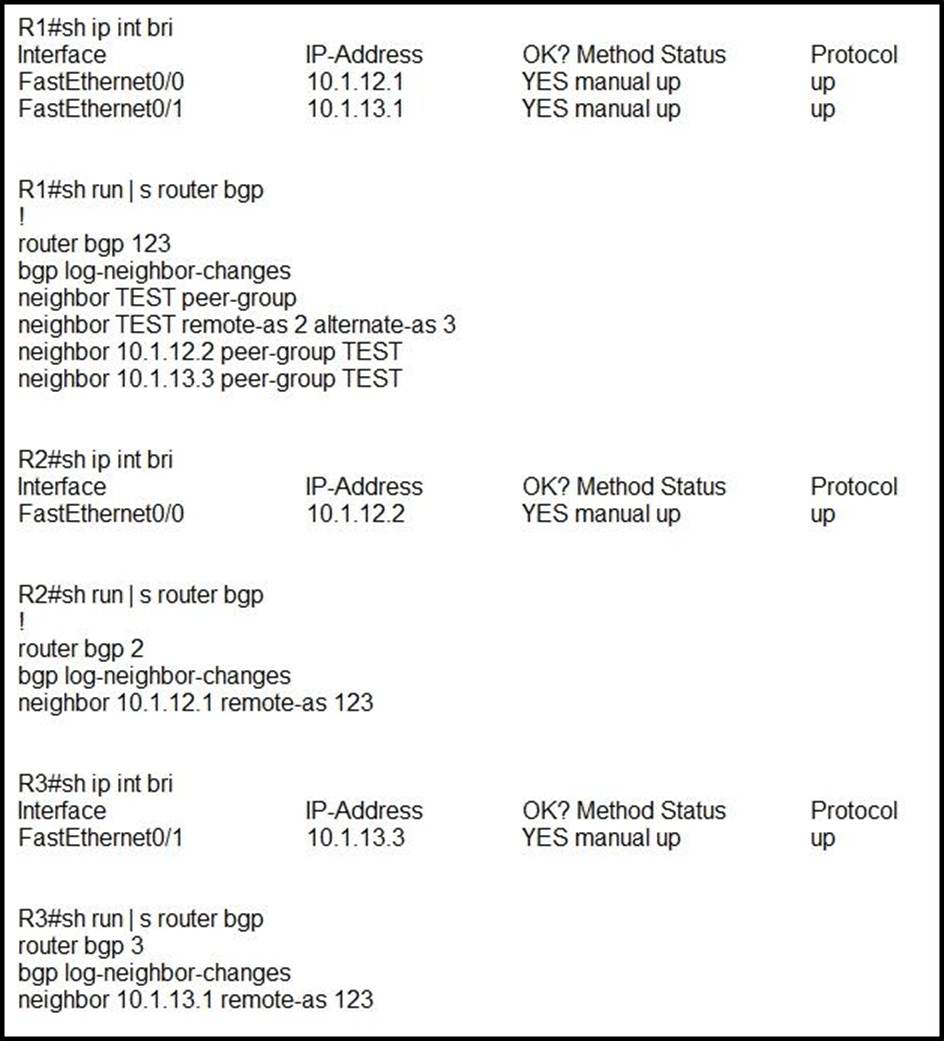
R1 is directly connected to R2 and R3. R1 is in BGP AS 123, R2 is in BGP AS 2, and R3 is in BGP AS 3. Assume that there is no connectivity issue between R1, R2 and R1, R3.
Which result between BGP peers R1, R2 and R1, R3 is true?
- A . The BGP session does not come up between R1 and R2 and between R1 and R3.
- B . The BGP session comes up between R1 and R2 and between R1 and R3.
- C . The BGP session comes up between R1 and R3, but not between R1 and R2.
- D . The BGP session comes up between R1 and R2, but not between R1 and R3.
Which two statements about mapping multicast IP addresses to MAC addresses are true? (Choose two.)
- A . All mapped multicast MAC addresses begin with 0x0100.5E
- B . The router performs the mapping before it hands the packet off to a switch
- C . All multicast MAC addresses end with 0x0100.5E
- D . The mapping process may generate overlapping addresses, which can cause receivers to receive unwanted packets
- E . All destination MAC addresses begin with an octet of binary 1s
Refer to the exhibit.
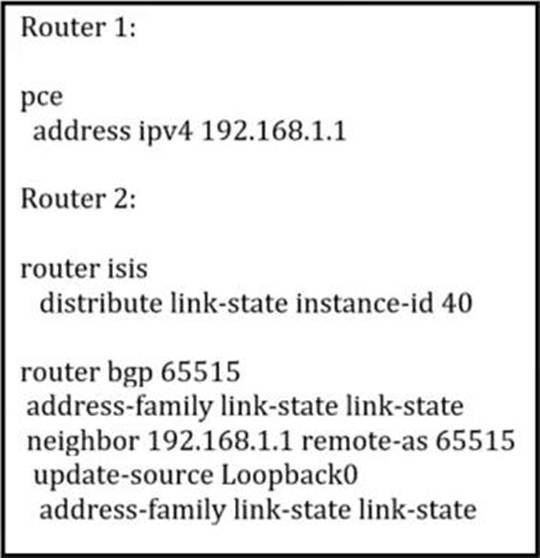
What is the relationship between Router 1 and Router 2?
- A . Router 1 centrally learns the topology of the network to aid in SR-TE path selection, and Router 2 is a node that feeds Router 1 topology information.
- B . Router 1 and Router 2 are participating in SR-TE tunnels and are both head-end routers.
- C . Router 1 and Router 2 centrally learn the topology of the network to aid in SR-TE path selection for peers.
- D . Router 2 is the head-end router in an SR-TE tunnel, and it is learning topology of the network from the PCE enabled on Router 1.
Refer to the exhibit.
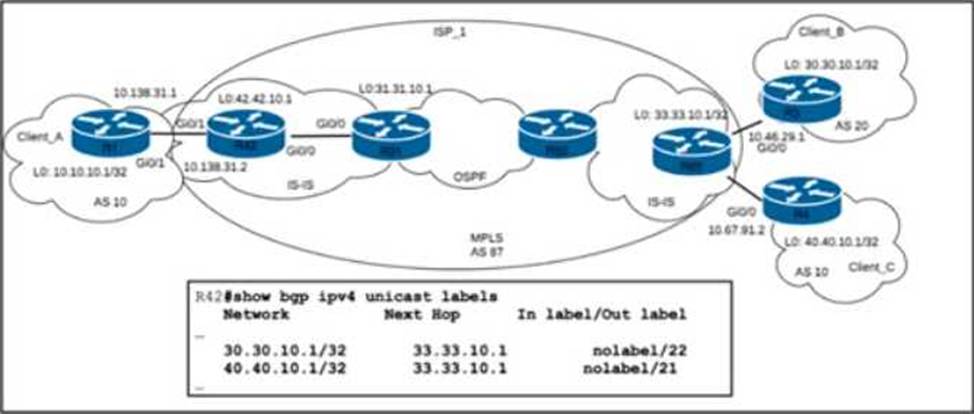
ISP_1 uses eBGP for connection to all clients LDP with OSPF and IS-IS is used in the ISP_1 network Client_A and Client_B are in the same VRF_VoD. After oftware upgrade on all routers on the ISP_1 network, Client_A has lost the connection to Client_C. A network engineer must troubleshoot the connection from R1 to R4 via M. After initial checks, the engineer confirmed that all routes are installed correctly.
Which two tasks must the engineer perform to correct the problem? (Choose two.)
- A . Configure next-hop-self under the BGP configuration on R42.
- B . Configure mpls label implicit-null under the global configuration on R31.
- C . Configure next-hop-unchanged under the BGP configuration on R31.
- D . Configure ip cef under the global configuration on R31.
- E . Configure send-label under the BGP configuration on R42
Refer to the exhibit.
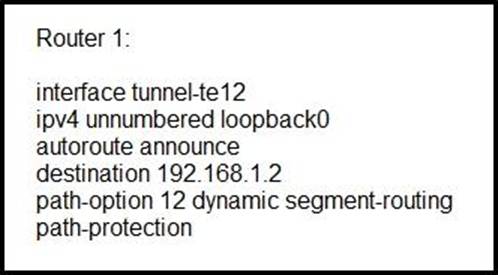
Router 1 has established an SR-TE tunnel with router 2.
Which statement describes this configuration?
- A . Router 1 has a list of labels used to explicitly lay out a path to router 2.
- B . Router 1 and router 2 have a bidirectional tunnel set up with dynamic path selection.
- C . Router 1 is the head-end tunnel and has dynamically chosen a path to router 2.
- D . Router 2 is the head-end tunnel and has explicitly set a path to router 1.
DRAG DROP
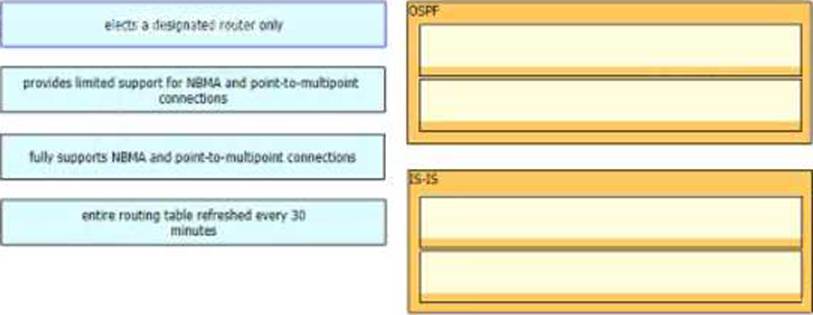
Drag and drop the features from the left onto the corresponding routing protocols on the right
Explanation:
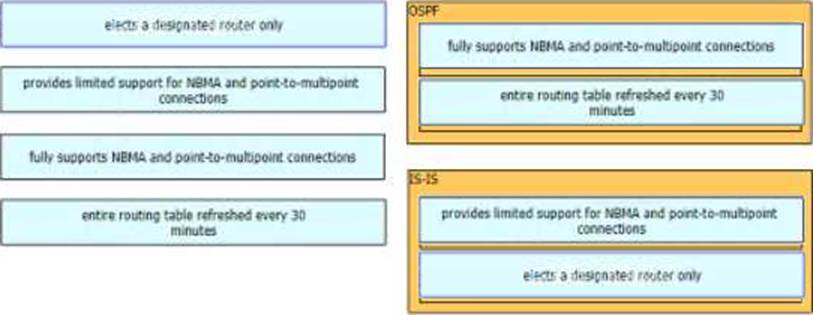
OSPF:
Fully supports NBMA and point to multipoint connections
entire roting table refreshed every 30 min
ISIS:
Provides limited support for NBMA and point to multipoint connectins
elects desigranted router only
Refer to the exhibits.
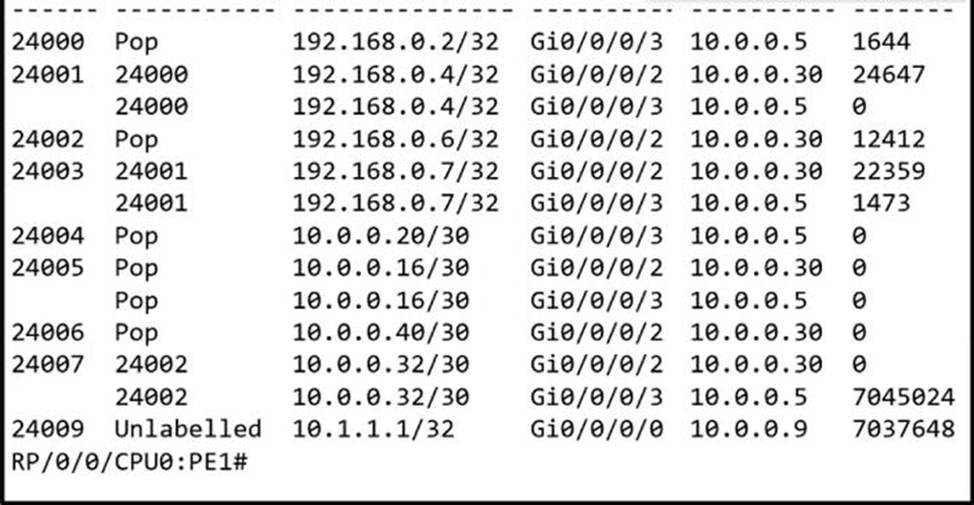
A network operator is troubleshooting packet loss seen from the R1 loopback interface to the R2 loopback interface over the core network. The operator is attempting to identify the next leg in the path from PE1.
Which interface and label path should the operator investigate next?
- A . PE1 C Gi0/0/0/3 – forwarding label 24002
- B . PE1 C Gi0/0/0/2 – forwarding label 24002
- C . PE1 C Gi0/0/0/3 – forwarding label 24001
- D . PE1 – Gi0/0/0/2 – forwarding label 24001
Refer to the exhibit. R1 is sending data traffic to R6 using the same SRGB range as the other routers in the topology, but it is also using a non-default SRLB range.
Which two configuration tasks must the engineer perform to enable normal SRGB and SRLB operations on this network? (Choose two.)
- A . Configure an adjacency SID from SRLB range 1002 to 6005.
- B . Configure router R2 with adjacency SID 4002 to enable it to reach R4.
- C . Configure router R1 with adjacency SID 1003 tcPegable it to reach R2.
- D . Set the default SRGB range to 16000 to 23999.
- E . Set the SRGB range to 1002 to 6005
Refer to the exhibit
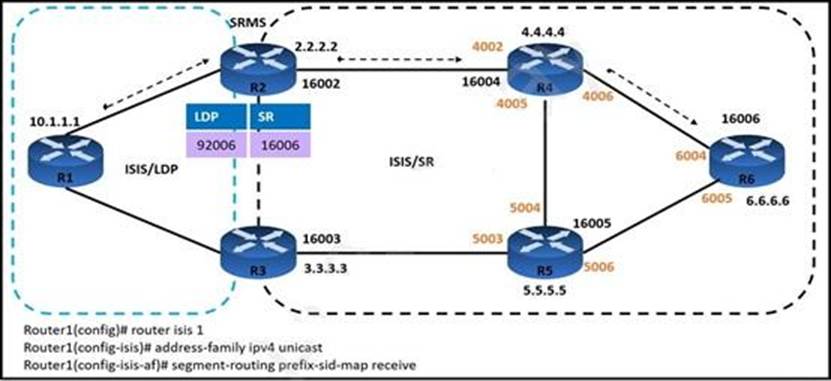
An engineer is configuring service traffic from router R1 to R6 as shown.
Which additional configuration must the engineer implement so that the LDP and SR domains will participate and interwork with each other?
- A . Router2(config)# segment-routing
Router2(config-sr)# ldp mapping-server
Router2(config-sr-ms)# prefix-sid-map
Router2(config-sr-ms-map)#
Router2(config-sr-ms-map-af)# 2.2.2.2/32 500 range 4 - B . Router2(config)# segment-routing
Router2(config-sr)# sr mapping-server
Router2(config-sr-ms)# ldp-sid-map
Router2(config-sr-ms-map)# address-family ipv4
Router2(config-sr-ms-map-af)# 10.1.1.1/32 500 range 50 - C . Router2(config)# segment-routing
Router2(config-sr)# mapping-server
Router2(config-sr-ms)# prefix-sid-map
Router2(config-sr-ms-map)# address-family ipv4
Router2(config-sr-ms-map-af)# 10.1.1.1/32 500 range 50 - D . Router2(config)# segment-routing
Router2(config-sr)# ldp mapping-server
Router2(config-sr-ms)# prefix-sid-map
Router2(config-sr-ms-map)# address-family ipv4
Router2(config-sr-ms-map-af)# 2.2.2.2/32 500 range 40
C
Explanation:
Reference: https://www.cisco.com/c/en/us/td/docs/routers/asr9000/software/segment-routing/configuration/guide/b-seg-routing-cg-asr9k/b-seg-routing-cg-asr9k_chapter_01001.html