
Cisco 300-510 Practice Exams
Last updated on Nov 16,2026- Exam Code: 300-510
- Exam Name: Implementing Cisco Service Provider Advanced Routing Solutions (SPRI)
- Certification Provider: Cisco
- Latest update: Nov 16,2026
Refer to the exhibit.
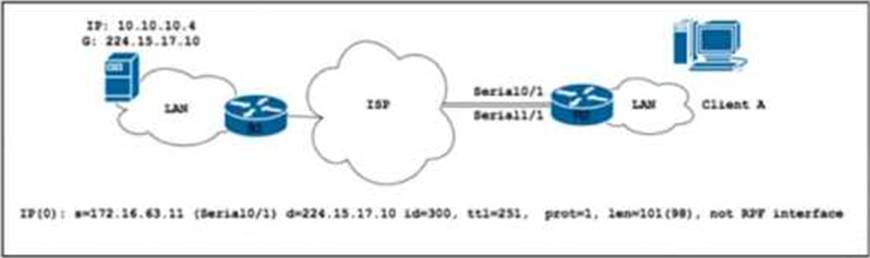
Mid-sized company Z connected two branch offices via a multicast-enabled ISP using the BGP routing protocol. PIM was implemented to support multicast streaming between the branches via MSDP Client A cannot connect to the multicast stream source of company Z. The network engineer ran a debug on the edge of the network as shown.
Which action resolves the issue?
- A . Implement MBGP and enable a multicast address family on R2
- B . Configure the PIM protocol on the Serial 1/1 interface and enable Auto-RP
- C . Deploy BSR on routers R1 and R2 and enable multicast on both LAN segments.
- D . Enable the BGP routing protocol and advertise the 10 10.10.0/24 subnet on R1.
Which feature provides service independence in service provider networks?
- A . binding SID that is used to stitch different domains
- B . prefix SID that contains router hops toward the destination
- C . adjacency SID that represents a path between the routers
- D . node SID that identifies the network device
Refer to the exhibit.
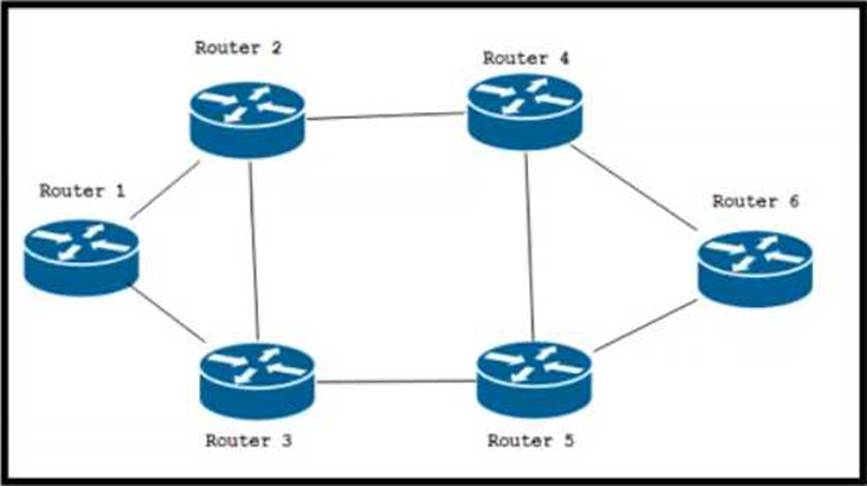
Router 1. Router 2. and Router 3 are co-located in an onsite data center of an office, but Router 4. Router 5. and Router 6 are installed in another data center ‘eral miles away A network engineer is troubleshooting an RSVP-TE issue on the network On most of the devices, the engineer can move all LSPs away from a selected interface and take it down for maintenance without interrupting traffic. However, when an interface on Router 3 is taken down, traffic on the network is disrupted.
What must the engineer enable to resolve the issue on Router 3?
- A . FRR
- B . NSR
- C . soft-preemption feature
- D . soft-disperse feature
What are three requirements for a static IPv6-in-IPv4 tunnel? (Choose three.)
- A . A static IPv6 address must be configured.
- B . A dynamic IPv6 address must be configured.
- C . Cisco Express Forwarding must be enabled.
- D . Each tunnel endpoint must support IPv4 and IPv6.
- E . A static IPv4 address must be configured.
- F . A dynamic IPv4 address must be configured.
A, D, E
Explanation:

Refer to the exhibit.
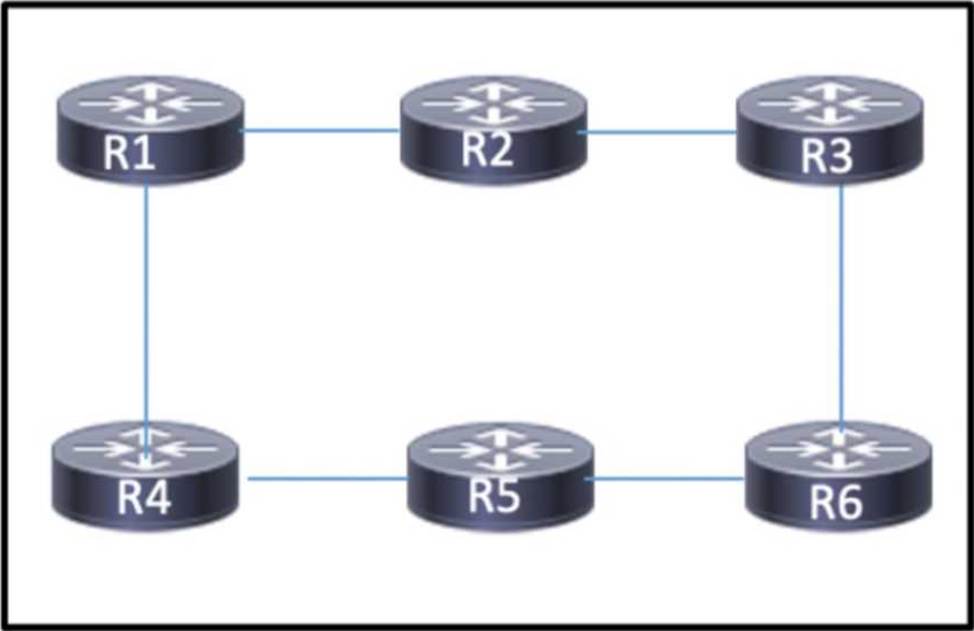
A service provider is running IS-IS in the core, and all routers use the default IS-IS configuration and reside in the same area. All routers maintain a different 6 bytes for the system ID. but the attached bits in the NET are the same. After an engineer added router R6 to the network. R3 and R5 began to experience CPU processing issues.
Which action must the engineer take to resolve the issue?
- A . Configure all routers lo operate as IS-IS Level 1 routers by altering the attached bit to ensure that a default route is Injected Into the routing tables.
- B . Configure R6 to operate as a Level 1 router only so that it maintains the Level 1 database for all routers.
- C . Configure routers R5 and R3 to operate as Level 1 routers only so that they inject a default routing into the routing tables of the other routers
- D . Configure all routers to operate as IS-IS Level 2 routers so that only a Level 2 database is maintained.
Refer to the exhibit.
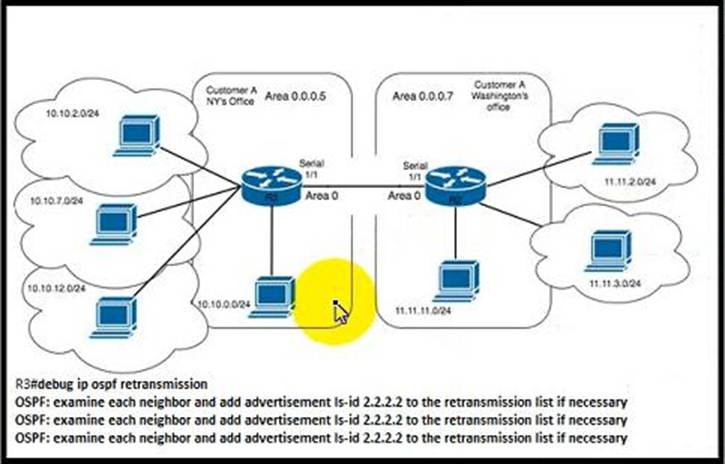
Customer A is a small media company with two offices connected by a 512 Kbps line. Their NY office is connected to several external partners by static routes on router R3. VoIP services use VoIP codec G729 Users reported poor voice quality and slow data transfer between the offices A network engineer configured ip tcp header-compression iphc-format on R2 and R3 routers Which additional action must the engineer take to fix the issue?
- A . Configure the ip ospf I area O command under Serial 1/1 interfaces on R2 and R3 to avoid routing loops
- B . Change the OSPF router ID on either router so that the router IDs are unique.
- C . Configure the summary-address 10.10.0.0 255.255.240.0 command on R3 to optimize OSPF communication
- D . Configure the BGP routing protocol between R2 and R3 to control route propagation.
Refer to the exhibit.
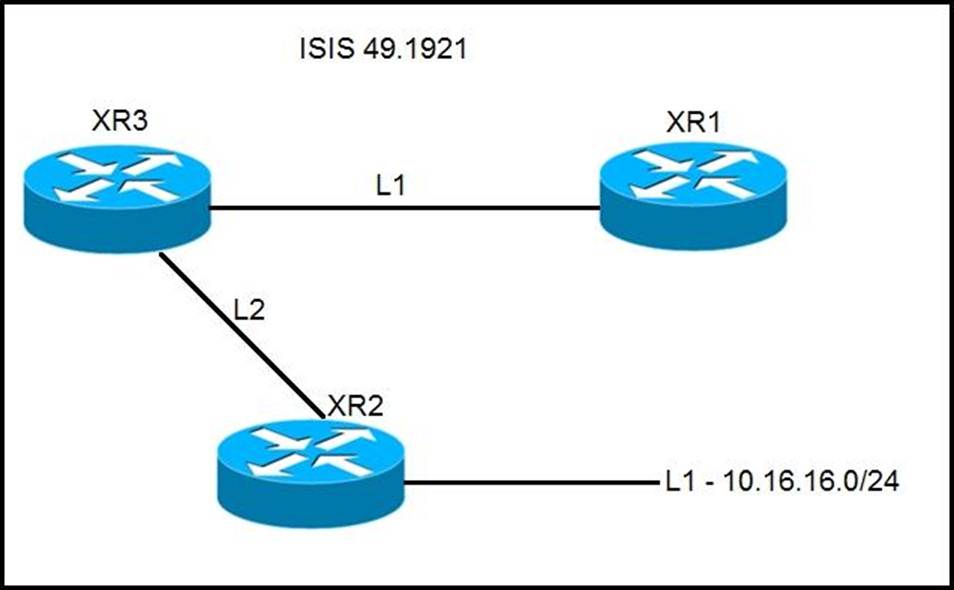
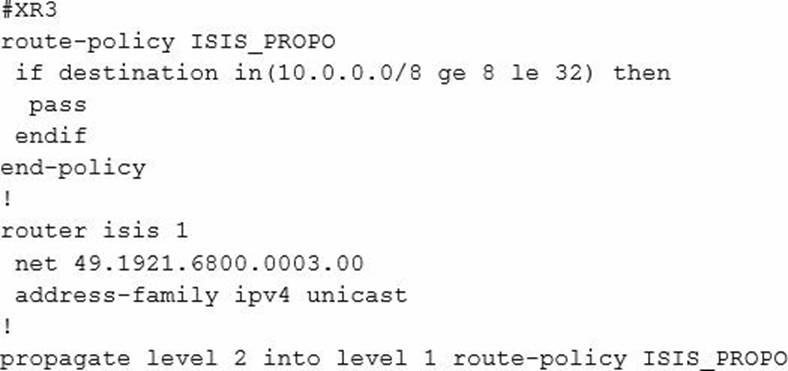
A network operator must inject a Level 1 route from XR2 (10.16.16.0/24) into the ISIS topology.
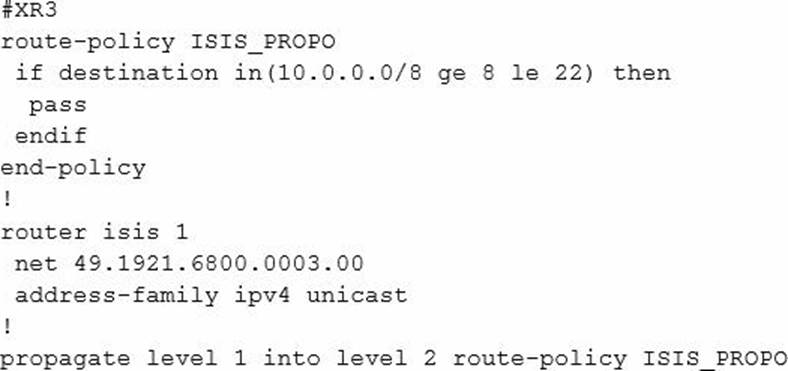
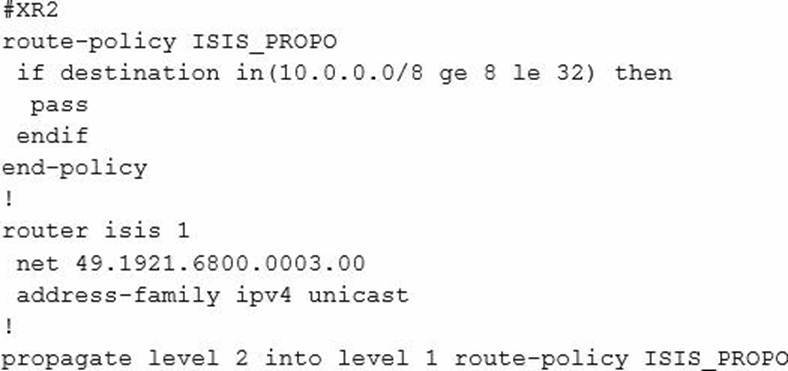
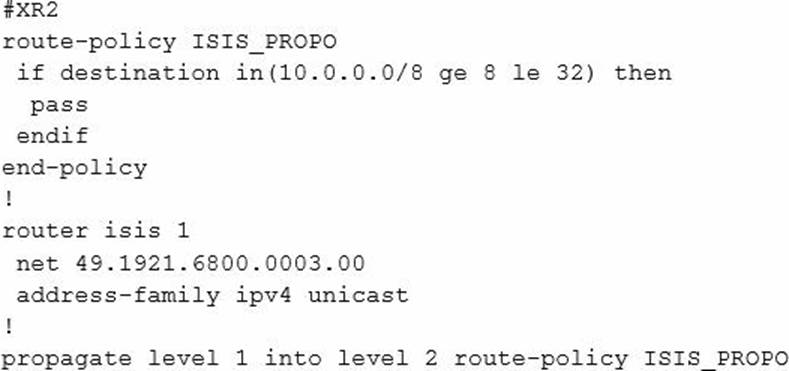
Which configuration allows the injection in a way that XR3 and XR1 have a valid and working route for 10.16.16.0/24?
A)
B)
C)
D)
- A . Option A
- B . Option B
- C . Option C
- D . Option D
D
Explanation:
L1 route injected by XR2 won’t be advertised to XR1, since L2 routes are NOT leaked to L1 by default.
An [L2-L1] route leak policy should be configured on L1/L2 router (XR3).
Refer to the exhibit.
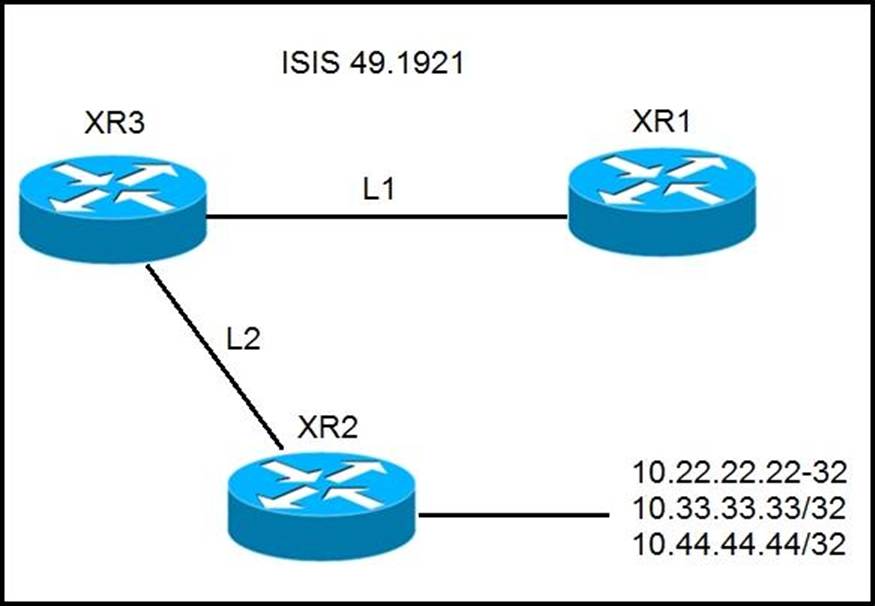
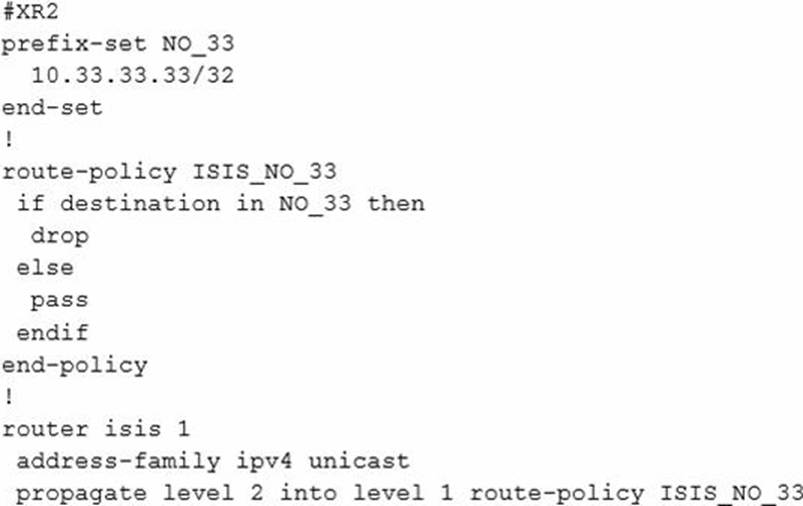
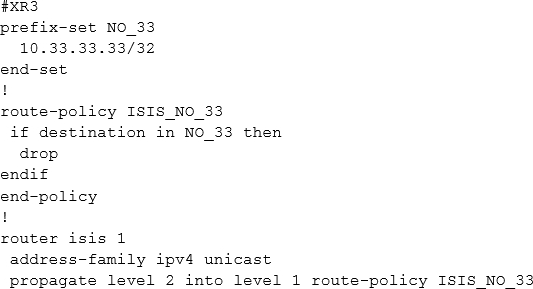
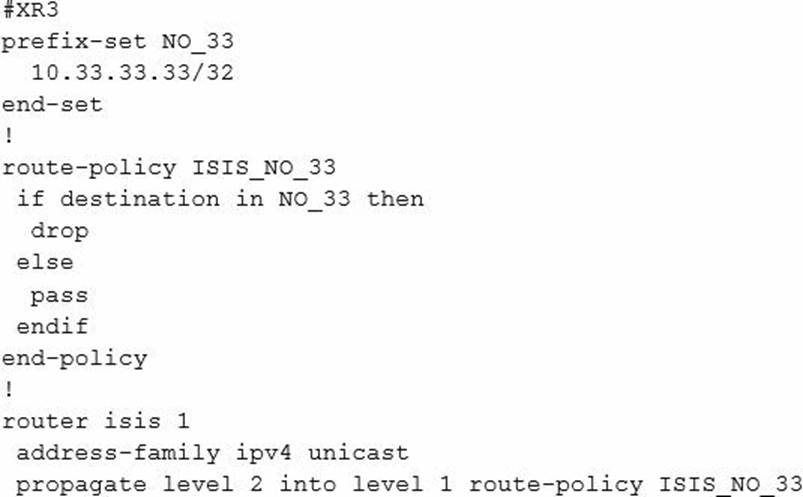
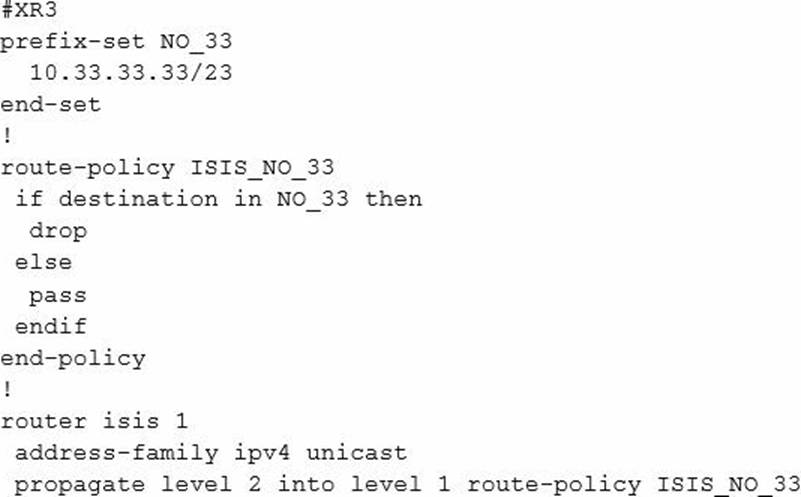
A network operator must stop 10.33.33.33/32 from being redistributed into Level 1 router XR1.
Which configuration meets this need?
A)
B)
C)
D)
- A . Option A
- B . Option B
- C . Option C
- D . Option D
An engineer is troubleshooting slow performance issues on a customer’s network after the last multicast configuration change was applied on it While checking the running configuration on the router the engineer notices there are many ip igmp join-group commands applied on several interfaces of the router which caused the high CPU utilization usage.
What action must the engineer take to solve this issue?
- A . Configure ip igmp static-group command on all interfaces
- B . Remove ip igmp join-group command on all unnecessary interfaces
- C . Configure all router interfaces to be process-switched by increasing the query interval
- D . Remove unnecessary members from the IGMP group