
Cisco 300-510 Practice Exams
Last updated on Nov 16,2026- Exam Code: 300-510
- Exam Name: Implementing Cisco Service Provider Advanced Routing Solutions (SPRI)
- Certification Provider: Cisco
- Latest update: Nov 16,2026
Refer to the exhibit.
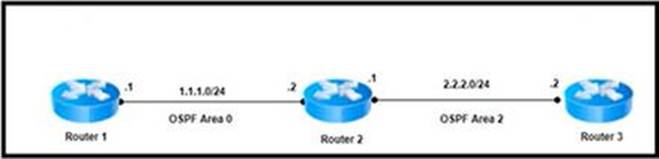
A network engineer installed a new router (router 3) at the regional hub running MPLS services for scalability Router 3 is connected to the 10.44 4.0,’24. 10.44 5.024. 10 44.6.0/24. and 10 44 7 0/24 subnets. The new router has been configured for OSPF area 2. and it is advertising the four connected networks. The engineer noticed that the same networks are listed as interarea summary routes, and they are being flooded into each area on the area borders.
Which action resolves the issue?
- A . On router 3, configure an access list to filter the networks.
- B . On router 2, configure a route map to filter the networks.
- C . Under the OSPF configuration on router 3. add area 2 range 10.44.4.0 255.255.252.0.
- D . Under the OSPF configuration on router 2, add area 2 range 10.44.4.0 255.255.252.0.
Refer to the exhibit.
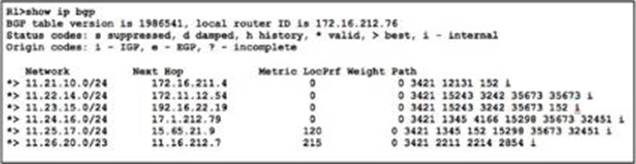
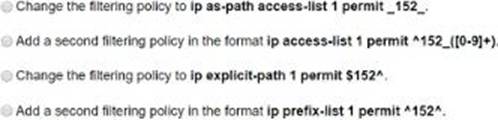
Company A established BGP sessions with several ISPs. A network engineer at the company must filter out all traffic except for routes that transit AS 152. The engineer configured the filtering policy “permit _152S_(_[0.9])” on R1, but after applying the configuration, the engineer notices that other routes are still visible.
Which action resolves the issue?
- A . Option A
- B . Option B
- C . Option C
- D . Option D
What are two differences between OSPF and IS-IS? (Choose two.)
- A . OSPF is a link-state routing protocol, and IS-IS is a distance-vector routing protocol.
- B . OSPF uses a router ID to identify a router, and IS-IS uses a system ID.
- C . OSPF elects a DR and a BDR, and IS-IS elects a DIS.
- D . Unlike OSPF. IS-IS supports virtual links.
- E . Unlike IS-IS routers, an OSPF router belongs to only one area in addition to the backbone area.
Which difference should be considered when intradomain or interdomain multicast routing is implemented?
- A . Interdomain multicast routing requires an IS-IS or OSPF neighbor relationship between the domains but intradomain multicast routing requires only BGP
- B . Interdomain multicast routing relies on PIM-DM and intradomain multicast routing relies on PIM-SM.
- C . interdomain multicast routing uses BIDR-PIM to establish neighbor relationships between AS and interdomain multicast routing uses MSDP
- D . A network uses intradomain multicast routing without interdomain routing but networks that use interdomain multicast routing must also apply intradomain routing
Refer to the exhibit.
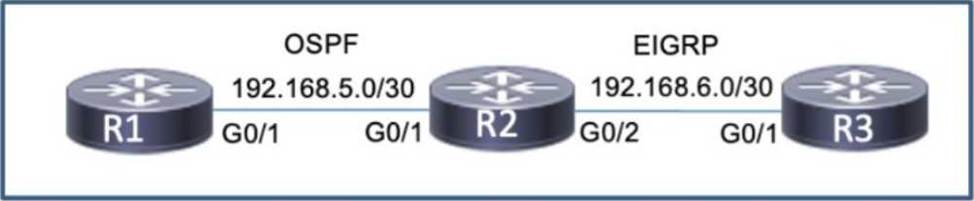
A company has been running OSPF and EIGRP on two separate portions of the network To allow communication flow between these previously isolated parts of the business the networking team just configured R2 to mutually redistribute routes between EIGRP and OSPF R3 has the OSPF routes in its routing table but R1 is failing to receive EIGRP routes for the link between R2 and R3.
Which action must the team take to resolve the issue?
- A . Configure EIGRP on R1
- B . Configure the redistribution statement with the subnets keyword under the R2 OSPF configuration
- C . Configure a virtual link between R1 and R2 to handle traffic without an assigned area
- D . Configure R1 with a static route with the next hop set to R3 with the vrf keyword to avo»d the global routing table
Refer to the exhibit.

Routers within the cluster are not receiving the desired prefixes.
What must be done to fix the issue?
- A . Clients in that cluster must have full mesh connectivity between eBGP peers.
- B . No client-to-client must be disabled.
- C . Clients in that cluster must have full mesh connectivity between iBGP peers.
- D . No client-to-client reflection must be enabled.
Refer to the exhibit.
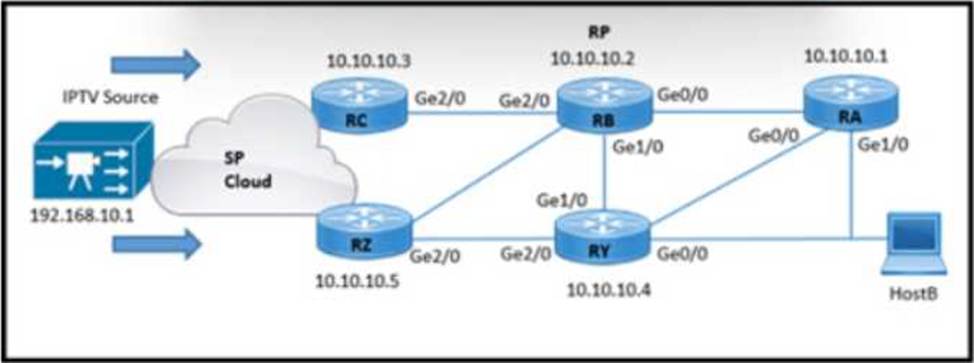
HostB receives an IPTV traffic stream from the multicast source at 192.168 10.1. When router RB is powered down, it impacts multicast traffic forwarding to downstream peers. The RA and RB routers reside in the same physical location.
Which two configurations must be implemented so that HostB receives the multicast stream even when RB is powered down? (Choose two)
- A . Enable PIM sparse mode on routers RC and RZ with a static RP address of 10.10.10.1.
- B . Set the backup RP address to 10 10 10.3 on routers RY and RZ.
- C . Enable bi-directional PIM on all routers.
- D . Enable PIM SSM mode on routers RA and RY.
- E . Set the RP address to 10.10.10.4 on all routers
Refer to the exhibit.
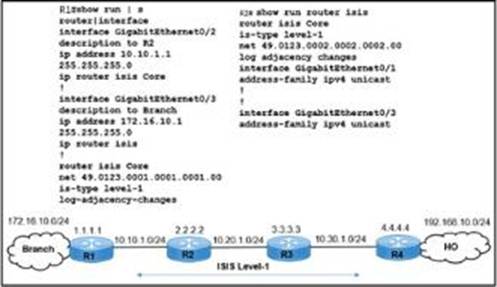
Users at the branch office on R1 reported issue with an application at the home office on R4.
While troubleshooting the issue, a network engineer determined that
✑ The branch-office users can connect to the home office.
✑ The IS-IS adjacencies between R1 and R2 and R1 and the branch office are up.
✑ Traffic from R1 to the R2 10.20.1.0/24 network is moving normally.
✑ The application at the home office is experiencing packet drops on the connection to the Branch, and R3 cannot reach the R1 172.16.10.0/24 network.
Which action resolves the issues?
- A . Redistribute static connected routes in IS-IS on router RI.
- B . Configure the IS-IS core instance on the RI GigabitEthernet0/3 interface.
- C . Redistribute static connected routes in IS-IS on router R4.
- D . Configure the IS-IS core instance on the R2 GigabitEthernet0/1 interface.
Which difference must an engineer consider when Implementing Inter-domain and Intra-domain multicast routing on the network?
- A . Intra-domain routing allows the service provider to control incoming and outgoing multicast data streams on its network, but inter-domain routing limits the service provider’s control.
- B . Intra-domain routing uses the PIM and MBGP protocols for multicast routing, but inter-domain routing must use PIM.SSM or MSDP.
- C . Intra-domain routing is dependent on the RP router within the same SP network, but inter-domain routing reduces the dependency on the other SP network.
- D . Inter-domain routing supports policy routing to connect different multicast domains using PIM.SM, but intra-domain routing supports policy routing using PIM-SM only within a single domain.
For which reason do you deploy BGP confederations within a BGP transit backbone?
- A . to support a larger number of eBGP peer sessions
- B . to increase the number of routes that can be redistributed between the running IGP and BGP
- C . to reduce the number of eBGP routes that must be shared between autonomous systems
- D . to reduce the number of iBGP peering sessions