
Cisco 300-510 Practice Exams
Last updated on Oct 01,2026- Exam Code: 300-510
- Exam Name: Implementing Cisco Service Provider Advanced Routing Solutions (SPRI)
- Certification Provider: Cisco
- Latest update: Oct 01,2026
Refer to the exhibit.
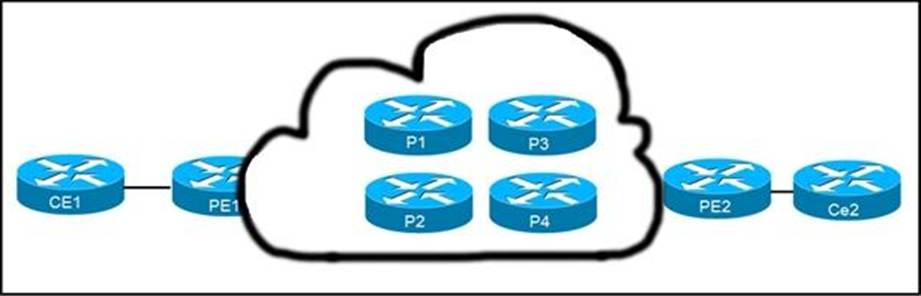
CE1 and CE2 cannot communicate through the service provider BGP peering is established between PE1 and PE2. IS-IS is the only routing protocol running in the service provider core.
What step can be done to troubleshoot the issue?
- A . Switch the IGPs running in the core from IS-IS to OSPF to support a Cisco MPLS TE tunnel from PE1 to PE2.
- B . Configure BGP between CE and PE routers.
- C . Confirm that IS-IS is running with metric-style narrow.
- D . Verify the MPLS LSPs.
Refer to the exhibit.
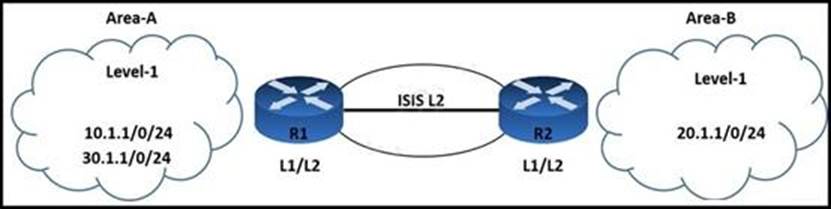
An engineer is troubleshooting IS-IS configuration between two areas. IS-IS Area-A network 30.1.1.0/24 is leaked into IS-IS Area-В. R2 is failing to filter the route updates from network 10.1.1.0/24.
Which configuration must the engineer apply to resolve the issue?
- A . R2(config)# ip prefix-list List2 seq 5 deny 10.1.1.0/24
R2(config)# interface fastethernet 0/0
R2(config-if)# ip router isis 100
R2(config-if)# router isis 100
R2(config-router)# distribute-list gateway List2 in - B . R2(config)# ip prefix-list List1 seq 3 deny 10.1.1.0/24
R2(config)# ip prefix-list List1 seq 5 permit 30.1.1.0/24 ge 25 1e
R2(config)# ip prefix-list List1 seq 10 permit 0.0.0.0/le 32
R2(config)# interface fastethernet 0/0
R2(config-if)# ip router isis 122
R2(config-if)# router isis 122
R2(config-router)# distribute-list prefix List1 in - C . R1(config)# ip prefix-list List2 seq 5 deny 10.1.1.0/24
R1(config)# interface fastethernet 0/0
R1(config-if)# ip router isis 100
R1(config-if)# router isis 100
R1(config-router)# distribute-list gateway List2 in
R (config-if)# router isis 150
R1(config-router)# distribute-list route-map Map1 in - D . R2(config)# access-list 101 deny ip any 10.1.1.0 0.0.0.127
R2(config)# access-list 101 permit ip any 30.1.1.0 0.0.0.63
R2(config)# access-list 101 deny ip any 0.0.0.0 0.0.0.0
R2(config)# interface fastethernet 0/0
R2(config-if)# ip router isis 121
R2(config-if)# router isis 121
R2(config-router)# distribute-list 101 in
C
Explanation:
Reference: https://www.cisco.com/c/en/us/td/docs/ios-xml/ios/iproute_isis/configuration/15-mt/irs-15-mt-book/isis-inbound-filtering.html
Refer to the exhibit.
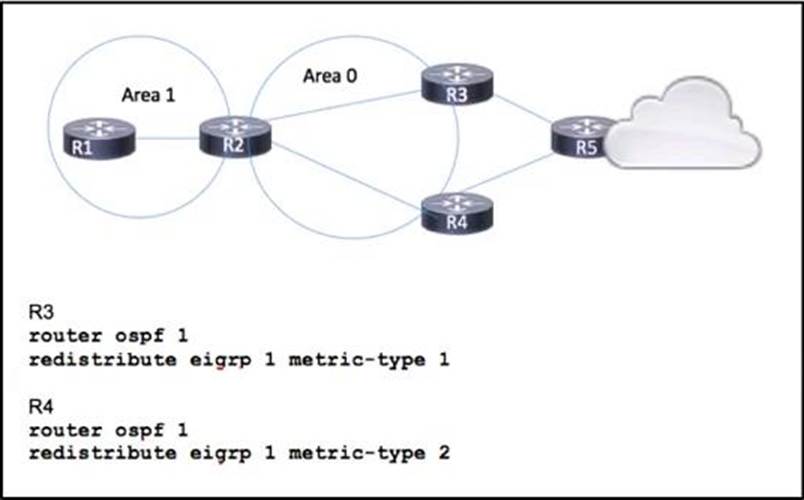
Routers R1, R2. R3, and R4 have been configured to run OSPF. and router R5 is running EIGRP Traffic from R1 to R5 is expected to pass via R4. but OSPF routing has calculated the best path via R3.
Which action corrects the problem?
- A . Configure R3 to use metric-type 1 with a higher metric than R4.
- B . Configure R1 with a static route to the R5 networks and set R5 as the next hop.
- C . Reconfigure R1 in Area 0.
- D . Change the metric-type value on R3 to 2.
Refer to the exhibit.
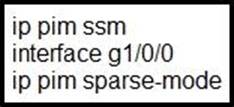
Which task must you perform on interface g1/0/0 to complete the SSM implementation?
- A . configure OSPFv3
- B . enable CDP
- C . disable IGMP
- D . configure IGMPv3
D
Explanation:
Reference: https://www.cisco.com/c/en/us/td/docs/ios-xml/ios/ipmulti_pim/configuration/xe-16/imc-pim-xe-16-book/imc-ssm.html
Which fact must a network architect consider when implementing IGMP in a multicast routing environment?
- A . If SSM is in use IGMPv3 must be enabled
- B . If BISS support is required IGMPv2 must be enabled
- C . If leave latency is critical IGMPv3 must be enabled
- D . If PIM-DM is required, IGMPv2 must be enabled
An ISP has an MPLS VPN-based network with 12 PE routers.
How many peerings are required between the 12 routers if the engineer has not configured route reflectors?
- A . 60
- B . 66
- C . 78
- D . 84
Refer to the exhibit.
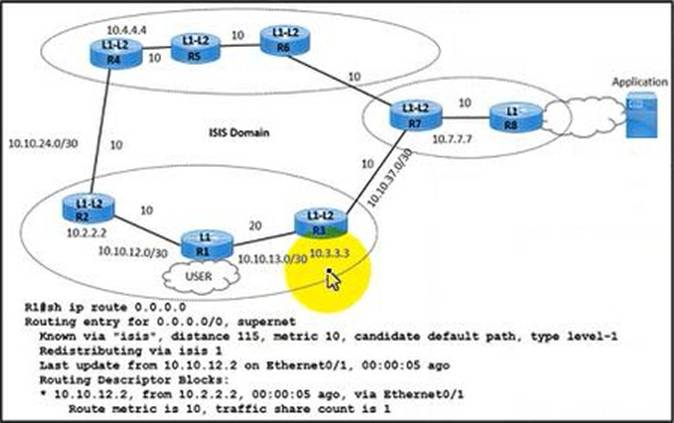
An engineer is troubleshooting a networking issue with several symptoms
✑ The shortest path from router R1 to R8 is underused and the longest path is overused
✑ Traffic from 10.1.1 1 to 10 8 8 8 is routed on the longest path
✑ Traffic between the R1 and the application server is experiencing packet drops and latency problems.
Which action resolves the issue?
- A . Configure route leaking for the IP address Of the application server on router RI.
- B . Increase the RI to R2 link metric to 20.
- C . Configure a Level 2 IS-IS domain on router RI.
- D . Block the advertisement of the application server IP address to router R6.
Refer to the exhibit.
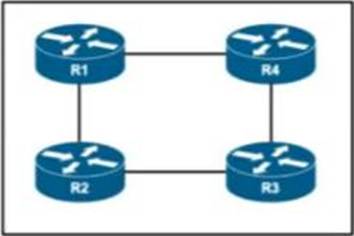
All routers on this network have been configured with P1M-SM and R1 is the rendezvous point However, when asymmetric routing is implemented to modify link usage the network begins to drop certain multicast traffic.
Which action corrects the problem?
- A . Place the routes affected by asymmetric routing in a VRF.
- B . Remove the asymmetric routing and use spanning tree to manage link usage.
- C . Add a static Mroute for routes that are failing.
- D . Configure the routers to use PIM-DM instead of PIM-SM.
What is one of the purposes of a default Multicast Distribution Tree?
- A . to offload traffic from data MDT
- B . to define the RP for PIM sparse mode and the different leafs
- C . to support control traffic between different VRFs
- D . to handle high-bandwidth source streams
Refer to the exhibit.
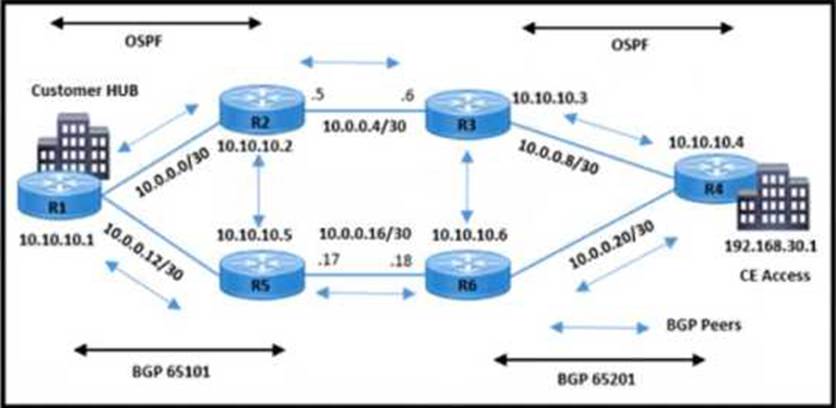
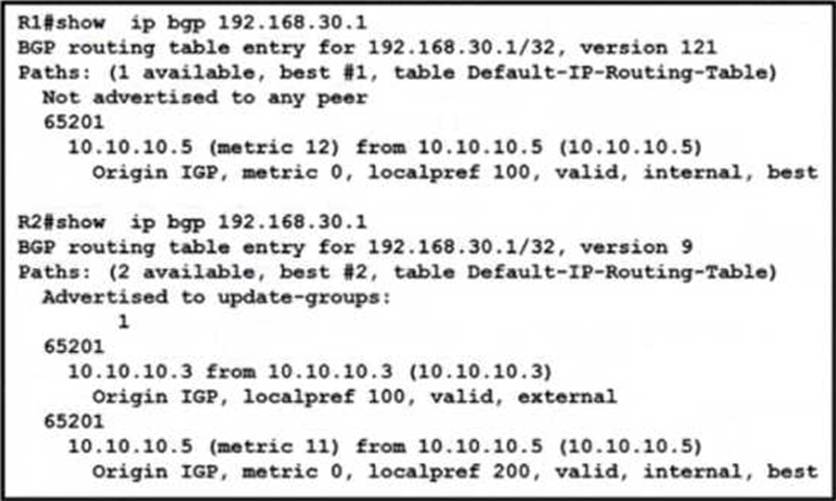
The service provider operations team was alerted that hub site traffic from BGP AS 65101 to AS 65201 uses a non-primary path via the R5-R6 link. IBGP peering between R1 and R2 is up. and no fiber failure has been reported on the R2-R3 link. The team determined that the traffic flow between 10.10.10.1 and 192.168.30.1 is not considering the R1-R2-R3-R4 path.
Which action resolves this issue?
- A . Change the metric attribute to 20 with neighbor 10.10.10.5 on R1.
- B . Change the local-preference attribute to 50 with neighbor 10.10 10 5 on R1
- C . Set the local-preference to the default value with BGP neighbor 10 10.10.3 on R2 for receiving routes.
- D . Add metric 5 with BGP neighbor 10.10.10.6 on R5for receiving routes.