
Cisco 300-510 Practice Exams
Last updated on Nov 16,2026- Exam Code: 300-510
- Exam Name: Implementing Cisco Service Provider Advanced Routing Solutions (SPRI)
- Certification Provider: Cisco
- Latest update: Nov 16,2026
Refer to the exhibit.
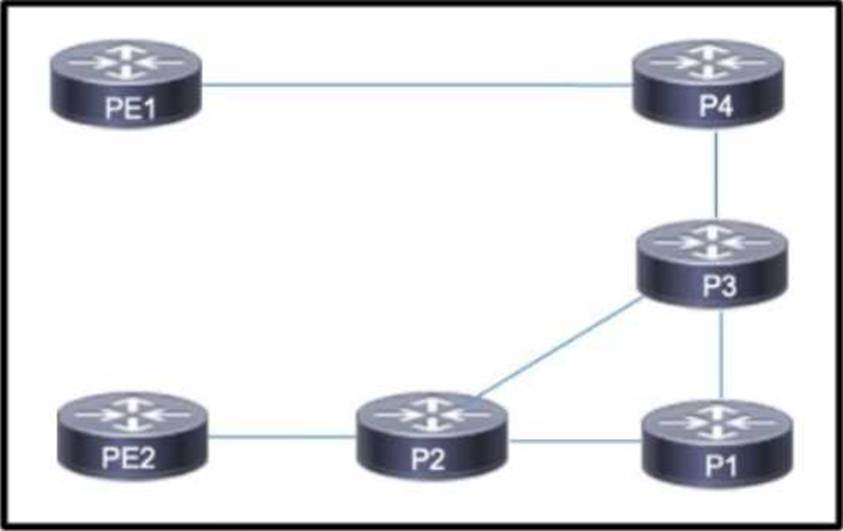
A regional service provider provides connectivity for several midsize businesses that run mission-critical applications between multiple offices connected via PE 1 and PE2 Links throughout the service provider network are connected using shared resources and an SR-TE tunnel is in use to route traffic over different paths depending on congestion policies The networking team must implement SR updates to reduce downtime in the event of a link failure.
Which action must the team take to meet the requirements?
- A . Implement SRLG protection to identify a post-convergence backup path
- B . Implement BGP timers to support immediate reconvergence when the BGP neighbor relationship status changes.
- C . Implement targeted LDP neighbors to prevent unwanted LDP relationships from forming
- D . Implement VRFs to segment the network and avoid large-scale network outages when a link fails
Refer to the exhibit.
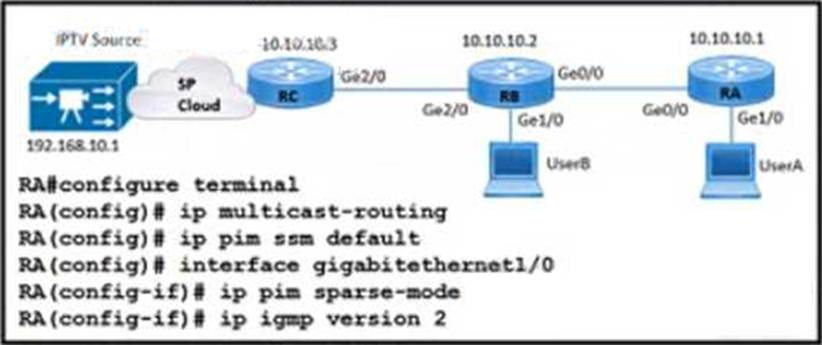
The UserA device fails to recede IPTV streaming traffic from the source While debugging the issue a network engineer finds that routers RB and RC receive the multicast traffic normally RC receives subscription messages from UserA to join the IPTV stream.
Which action must the engineer lake on router RA to correct this problem?
- A . Configure ip pim ssm with ip igmp version 2 on interface GigabitEthernet 1/0.
- B . Remove the ip pim ssm default configuration and replace it with ip pim rp-address 10.10.1.3
- C . Change ip igmp version 2 to ip igmp version 3 on interface GigabitEthernet 1/0.
- D . Configure ip pim bidir-enable in global mode and add ip pim rp-address 10.10.10.3
Which requirement must be met while using parameter with conditional matching in routing policy definition?
- A . Parameters must be used only in route maps.
- B . Parameters must start with the $ symbol.
- C . Parameters must be applied only to BGP statements.
- D . Parameters must be used in a hierarchal structure.
Refer to the exhibit.
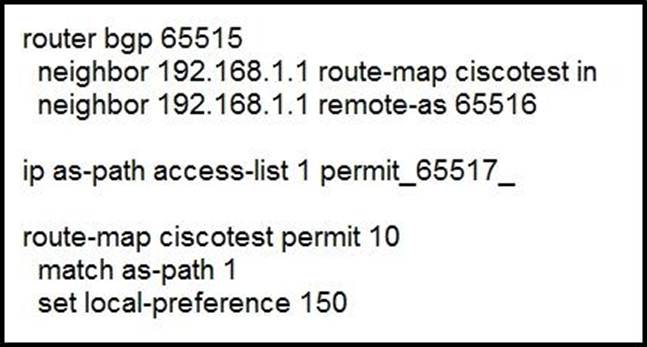
After troubleshooting BGP traffic steering issue, which action did the network operator take to achieve the correct effect of this configuration?
- A . Routes that have passed through AS 65517 have the local preference set to 150.
- B . Routes that have originated through AS 65517 have the local preference set to 150.
- C . Routes directly attached to AS 65517 have the local preference set to 150.
- D . Routes that have passed through AS 65517 have the local preference set to 150 and the traffic is denied.
The operator must leverage automated steering and coloring with the design.
Which two elements from an SR Policy tuple are used for automated steering inside of the network? (Choose two.)
- A . endpoint
- B . candidate labels
- C . color
- D . CM paths
- E . headend
Which cost is the default when redistributing routes from BGP to OSPF?
- A . 20
- B . 1
- C . infinite
- D . automatic
B
Explanation:
Reference: http://www.ciscopress.com/articles/article.asp?p=27573
Refer to the exhibit.
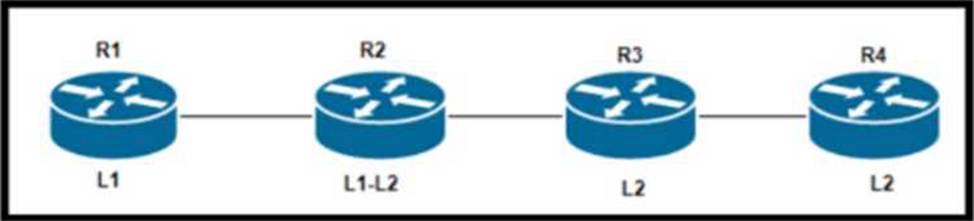
The four routers in this network have formed adjacencies. Router R2 is an IS-IS level 1-2 router that connects to other areas, and the attach bit is set in the R2 level 1 LSP advertisements to R1. According to the network design, R2 should push level 2 routes from its routing table to the R1 routing table. However, R1 installed a default route in its routing table.
Which action resolves this problem?
- A . Use The is-type level-1-2 backdoor command lo unset the attach bit on R1 and use a prefix List to filter prefixes from R2
- B . Set the attach bit on R1and use a prefix list to filter prefixes from R2.
- C . Use the is-type level-1-2 backdoor command to unset the attach bit on R2 and configure a distribute-list to redistribute prefixes to R1
- D . Configure R2 as a level 1 router and use a prefix list to filter prefixes to R1.
Refer to the exhibit.
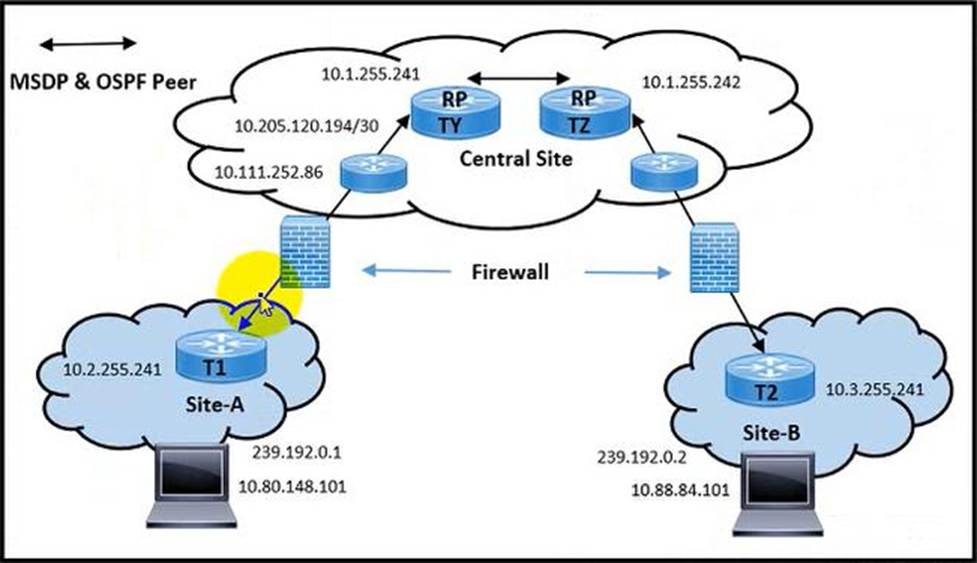
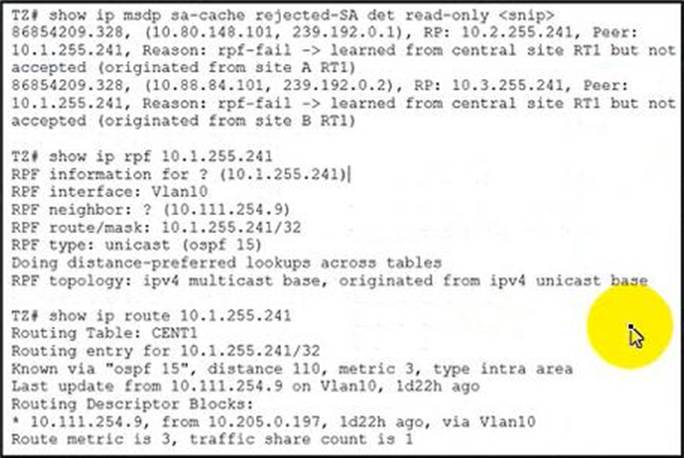
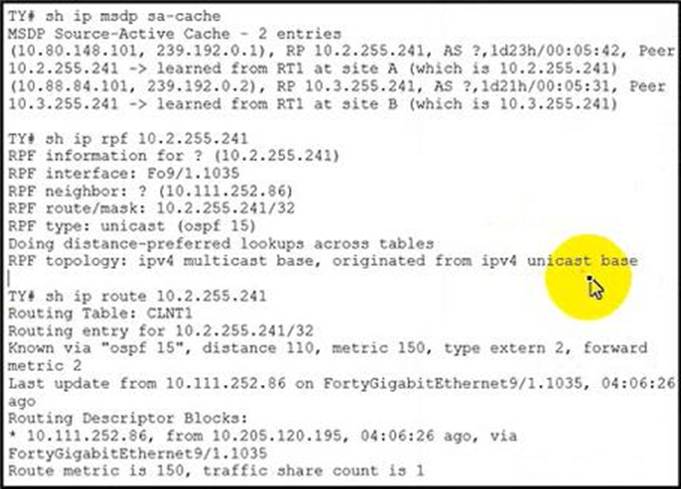
Multicast traffic destined from T1 and T2 routers to RP routers works well. A network engineer observes problems with multicast traffic flows between Site-A and Site-B. Site-A users fail to receive multicast stream on Site-B via RPTY site, while Site-B users fail to receive multicast stream on Site-Avia RPTZ site.
Which action must be implemented to resolve the issues?
- A . Establish MDSP peering with interface IP subnet.
- B . Configure Site-A and Site-B in 10.80.14804
- C . Allow the OSPF and MSDP packets on the firewall.
- D . Configure direct OSPF peering between Site-A and Ste-B
Refer to the exhibit. A network engineer must correct the security policy on the EDGE_R router, which is connected to two Tier 1 ISPs. After another engineer added ip as-path access-list 11 permit 11 to EDGE_R, some routes from AS 11 and AS 4832 started to appear in the routing information base (RIB). Traffic control via Community options is disabled on both ISPs.
How should the network engineer update the router configuration on EDGE_R so that only routes for AS 11 are permitted?
- A . Configure ip as-path prefix-list 11 permit _11$.
- B . Configure ip as-path access-list 11 permit _11_.
- C . Configure ip as-path distribution-list 11 deny A[0-9]+S.
- D . Configure ip as-path access-list 11 deny 4832$.
Which difference must an engineer consider when choosing whether to implement OSPF or IS-IS as the routing protocol on the network?
- A . The OSPF DR election process is deterministic, and the IS-IS DS election process is not deterministic.
- B . To support fast convergence. OSPF uses the LSA arrival timer and IS-IS uses the PRC-interval timer.
- C . IS-IS supports ordinary, stub, totally-stub. and NSSA areas, but OSPF supports only stub areas.
- D . IS-IS links are associated with either a Level 1 area or a Level 2 area at one time, but OSPF links are associated with multiple areas at one time.
B
Explanation:
Reference: https://www.cisco.com/c/en/us/td/docs/ios-xml/ios/iproute_isis/configuration/15-s/irs-15-s-book/irs-fscnt.html