
Cisco 300-425 Practice Exams
Last updated on Nov 16,2026- Exam Code: 300-425
- Exam Name: Designing Cisco Enterprise Wireless Networks (ENWLSD)
- Certification Provider: Cisco
- Latest update: Nov 16,2026
An enterprise has moved most services to the cloud, including email applications and real-time communication.
Which feature must be enabled on the wireless network to improve the user experience?
- A . QoS
- B . Radio management
- C . Interference mitigation
- D . Fast secure roaming
D
Explanation:
https://community.cisco.com/t5/wireless-mobility-documents/what-is-cckm-and-how-does-it-affect-fast-and-secure-roaming/ta-p/3130421
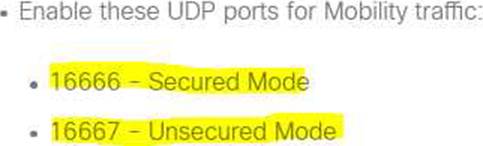
Which UDP port numbers are used for exchange mobility packets in an AireOS wireless deployment?
- A . UDP 16666 for control plane, EoIP (IP protocol 97) for data plane
- B . UDP 16668 for control plane, UDP 16667 for data plane
- C . UDP 16667 for control plane, UDP 16666 for data plane
- D . UDP 16666 for control plane, UDP 16667 for data plane
A
Explanation:
A customer called with a requirement that internal clients must be on different subnets depending on the building they are in. All access points are operating in local mode and will not be modified, and this is a single controller solution.
Which design approach creates the desired result?
- A . Create AP groups for each desired location, map the correct VLANs to the internal SSID, and add the access points for that location.
- B . Create an SSID place it to the desired VLAN under WLANs and configure 802.1x in ISE to assign the correct VLAN based on the SSID from which the client is authenticating
- C . Create FlexConnect groups, place the access points in, and set the correct VLAN to SSID mapping based on location.
- D . Create mobility anchors for the SSID and on the controller under the internal SSID create a foreign map to the desired VLAN based on location.
A
Explanation:
https://www.cisco.com/c/en/us/support/docs/wireless-mobility/wireless-vlan/71477-ap-group-vlans-wlc.html
Refer to the exhibit.
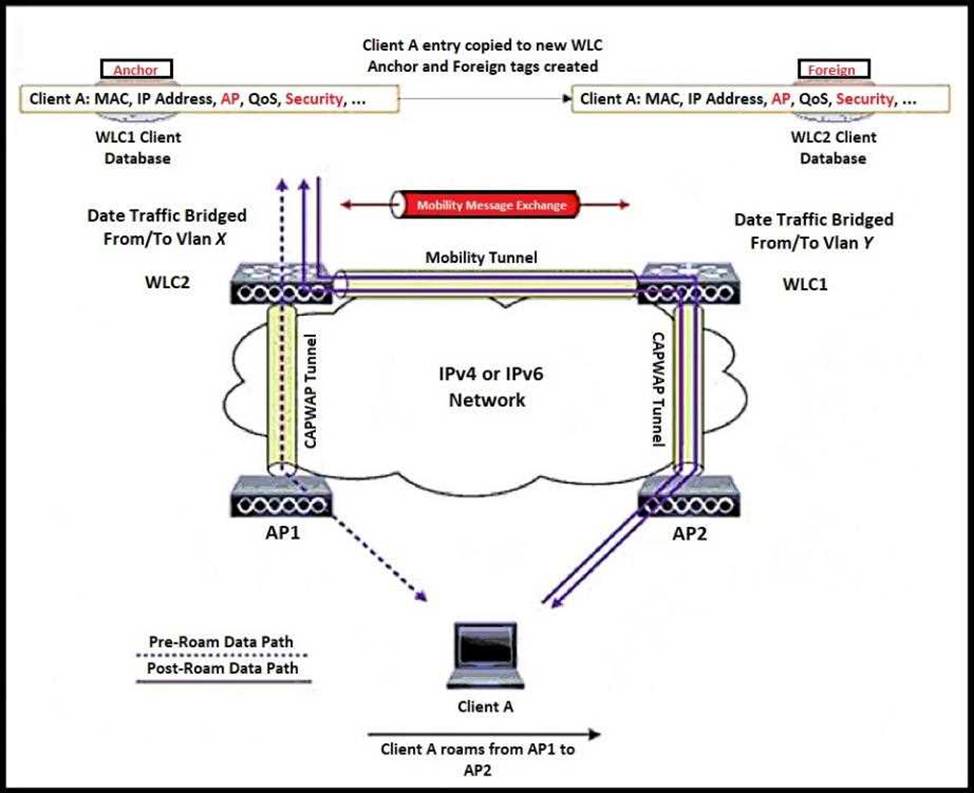
Client A is roaming from AP1 on WLC1 to AP2 on WLC2. The client roams between two APs registered to two different controllers. The WLAN on the two controllers is on a different subnet.
Which scenario explains the client’s roaming behavior?
- A . The client database entry is different than that of Layer 2 roam. (Instead of cop-ying, it moves the database to the new controller.)
- B . The client database entry is different than that of Layer 2 roam. (Instead of mov-ing, it copies the database to the new controller.)
- C . The client database entry is different than that of Layer 2 roam because the cli-ent database is neither moved nor copied into the new controller.
- D . The client database remains in the mobility anchor controller and it is not cop-ied or moved.
A customer asks an engineer to explain the concept of mobility domains and mobility groups.
Which statement does the engineer respond with?
- A . A mobility group does not constrain the distribution of security context of a client and also does not constrain AP fail-over between controllers when the WLC are in the same mobility domain.
- B . If WLCs are in the same mobility domain, they communicate with each other but, if an anchor WLC is present it must be in the same mobility domain for communication to be possible.
- C . If WLCs are in the same mobility domain, they communicate with each other. Mobility groups constrain the distribution of security context of a client and also constrain AP fail-over between controllers.
- D . WLCs do not need to be in the same mobility domain to communicate with each other. Mobility groups constrain the distribution of security context of a client and also constrain AP fail-over between controllers.
C
Explanation:
https://www.cisco.com/c/en/us/td/docs/wireless/controller/8-0/configuration-guide/b_cg80/b_cg80_chapter_010011.html
An engineer is designing an outdoor mesh network to cover several sports fields. The core of the network is located in a building at the entrance of a sports complex.
Which type of antenna should be used with the RAP for backhaul connectivity?
- A . 5 GHz. 8-dBi omnidirectional antenna
- B . 2.4 GHz. 8-dBi patch antenna
- C . 2.4 GHz. 14-dBi omnidirectional antenna
- D . 5 GHz. 14-DBi patch antenna
C
Explanation:
https://www.cisco.com/c/en/us/products/collateral/wireless/aironet-antennas-accessories/product_data_sheet09186a008008883b.html
What is the main purpose of using LAG in a wireless network design?
- A . To allow layer 3 roaming
- B . To provide redundancy in controller connections
- C . To increase the bandwidth available between switches
- D . To segment voice and data traffic
An engineer changed the TPC Power Threshold for a wireless deployment from the default value to – 65 dBm. The engineer conducts a new post-deployment Survey to validate the results.
What is the expected outcome?
- A . Increase cell size
- B . Decreased client signal strength
- C . Increased received sensitivity
- D . Decreased channel overlap
Refer to the exhibit.
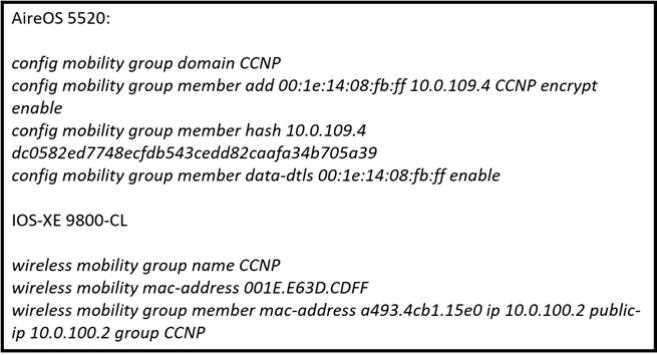
An engineer is about to establish a mobility peer connection between a Cisco Catalyst 9800-CL version 16.10.1e and Cisco AireOS 5520 version 8.8.120.0. The data path between the 9800-CL and AireOS 5520 is down, but its control path is up.
Based on the configuration, what is the cause of the issue?
- A . The certificate hash key is incorrect leading to data path down.
- B . The data-link-encryption configuration is missing from the 9800-CL configuration.
- C . Encrypted mobility is being used in the 5520 configuration leading to data path down.
- D . CAPS is used to key in MAC address in the IOS_XE configuration leading to data path down.
A wireless engineer must design mobility between two buildings at a campus site. The engineer has one controller at each site. The engineer is investigating inter-controller CAPWAP data and control traffic.
Which two ports must be open? (Choose two.)
- A . 5246
- B . 5247
- C . 8443
- D . 16666
- E . 16667