Cisco 300-420 Practice Exams
Last updated on Nov 16,2026- Exam Code: 300-420
- Exam Name: Designing Cisco Enterprise Networks (ENSLD)
- Certification Provider: Cisco
- Latest update: Nov 16,2026
Which function does the Cisco SD-Access intermediate node perform?
- A . Act as LISP proxy tunnel router.
- B . Route and transport IP traffic.
- C . Act as an anycast Layer 3 gateway.
- D . Map users to a virtual network.
A customer’s current Layer 2 infrastructure is running Spanning Tree 802.1d, and all configuration changes are manually implemented on each switch.
An architect must redesign the Layer 2 domain to achieve these goals:
✑ reduce the impact of topology changes
✑ reduce the time spent on network administration
✑ reduce manual configuration errors
Which two solutions should the architect include in the new design? (Choose two.)
- A . Implement Rapid PVST+ instead of STP.
- B . Implement MST instead of STP.
- C . Use VTP to propagate VLAN information and to prune unused VLANs.
- D . Configure broadcast and multicast storm control on all switches.
- E . Configure dynamic trunking protocol to propagate VLAN information.
An architect is creating a migration strategy for a large organization in which the choice made by the application between IPv6 and IPv4 is based on the DNS request.
Which migration strategy does the architect choose?
- A . AFT for public web presence
- B . host-initiated tunnels
- C . dual stack
- D . site-to-site IPv6 over IPv4 tunnels
Refer to the exhibit.
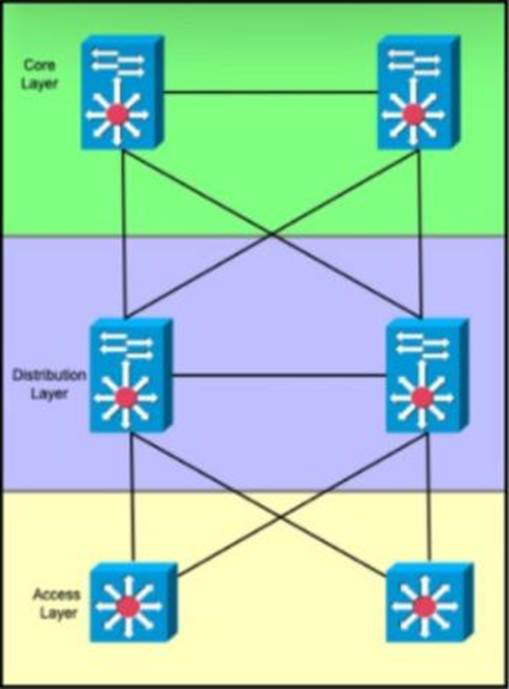
An engineer Is designing a multicampus Layer 3 Infrastructure using EIGRP as the routing protocol. The design must provide quick replies to queries In the event of a downlink, prevent unnecessary queries, and ensure that traffic does not unnecessarily transit the access layer.
Which two actions must the engineer take for the network design? (Choose two.)
- A . Configure core layer switches as stub routers.
- B . Configure distribution layer switches to summarize routes to the core layer.
- C . Configure access layer switches as stub routers.
- D . Configure access layer and core layer switches as stub routers.
- E . Configure access layer switches to summarize routes to the distribution layer.
Refer to the exhibit.
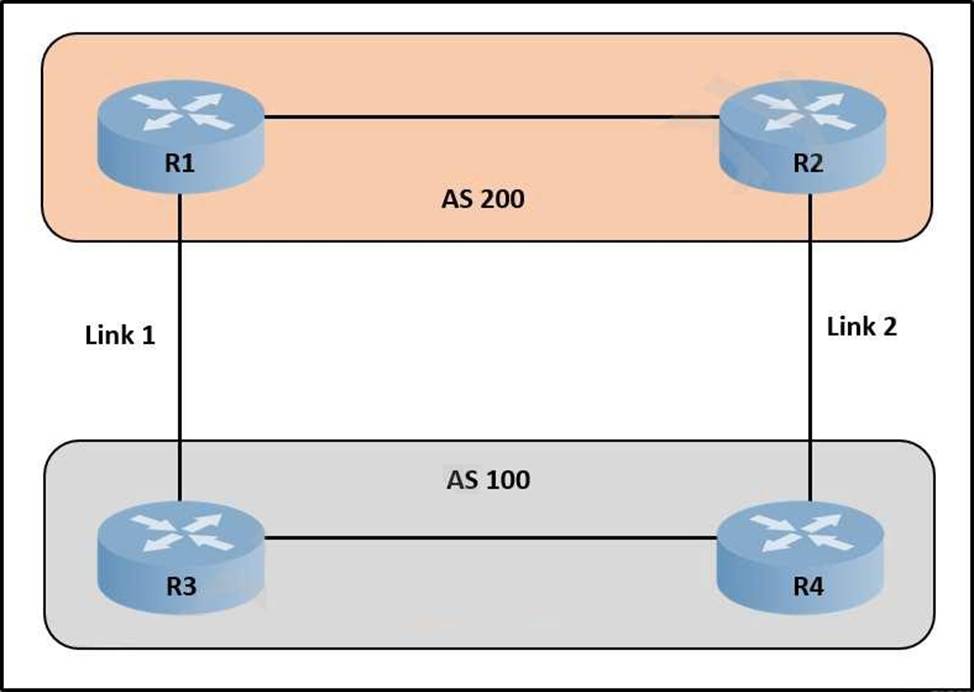
A network engineer is designing a network for AS100. The design should ensure that all traffic enters AS100 via link 1 unless there is a network failure. In the event of a failure, link 2 should function as the path for incoming traffic.
Which solution should the design include?
- A . Modify the next-hop attribute on R3.
- B . Use AS-Path prepending on R3.
- C . Modify the next-hop attribute on R4.
- D . Use AS-Path prepending on R4.
Refer to the exhibit.
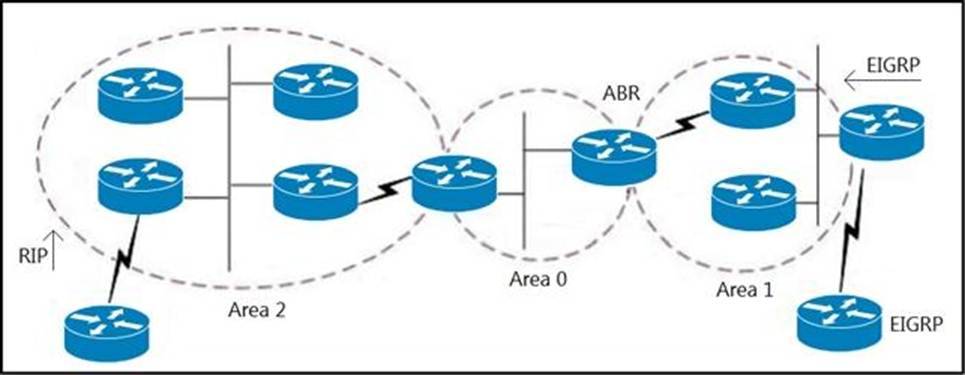
An engineer is designing an OSPF network for a client. Requirements dictate that the routers in Area 1 should receive all routes belonging to the network, including EIGRP, except the ones originated in the RIP domain.
Which action should the engineer take?
- A . Make area 1 a NSSA.
- B . Make area 1 a stub.
- C . Make area 1 a standard OSPF area.
- D . Make the area 1 routers part of area 0.
Refer to the exhibit. A network engineer is designing an OSPF solution to connect a company’s remote to a newly provisioned MPLS VPN backbone. Some of the branches have a direct dark fiber connection between each other. The engineer wants to ensure that the dark fibers are used only when the MPLS core is unavailable.
Which solution must the engineer choose?
- A . Stub area
- B . Sham link
- C . Virtual link
- D . NSSA
Which two functions does the control plane node provide in a Cisco SD-Access architecture? (Choose two.)
- A . LISP proxy ETR
- B . host tracking database
- C . policy mapping
- D . map server
- E . endpoint registration
When vEdge router redundancy is designed, which FHRP is supported?
- A . HSRP
- B . OMP
- C . GLBP
- D . VRRP
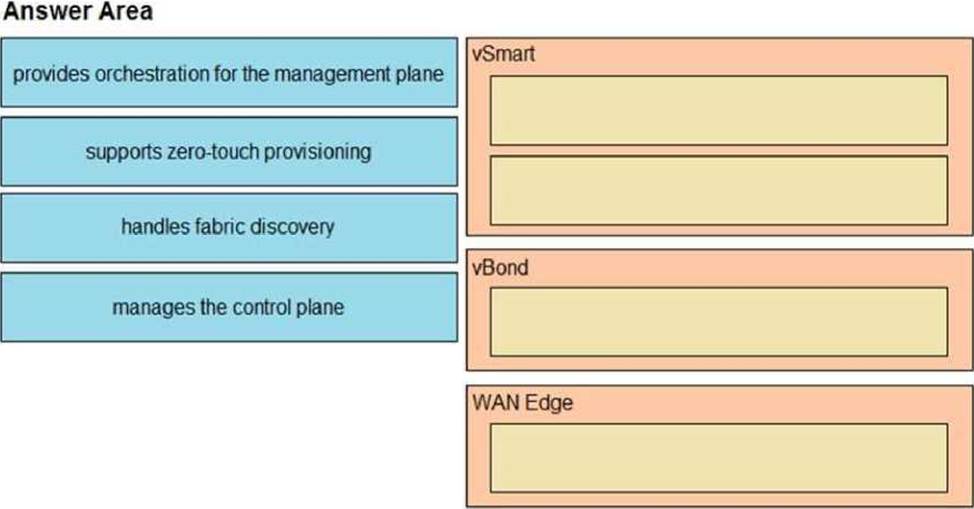
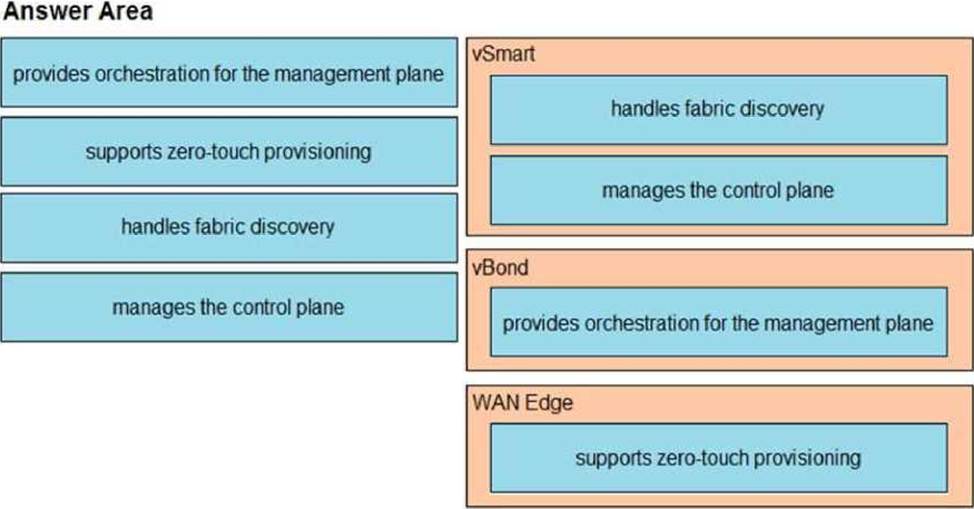
DRAG DROP
Drag and drop the properties from the left onto the Cisco SD-WAN components that perform them on the right.