
Cisco 300-410 Practice Exams
Last updated on Nov 16,2026- Exam Code: 300-410
- Exam Name: Implementing Cisco Enterprise Advanced Routing and Services (ENARSI)
- Certification Provider: Cisco
- Latest update: Nov 16,2026
Which two statements about redistributing EIGRP into OSPF are true? (Choose two)
- A . The redistributed EIGRP routes appear as type 3 LSAs in the OSPF database
- B . The redistributed EIGRP routes appear as type 5 LSAs in the OSPF database
- C . The administrative distance of the redistributed routes is 170
- D . The redistributed EIGRP routes appear as OSPF external type 1
- E . The redistributed EIGRP routes as placed into an OSPF area whose area ID matches the EIGRP autonomous system number
- F . The redistributed EIGRP routes appear as OSPF external type 2 routes in the routing table
A network administrator added a new spoke site with dynamic IP on the DMVPN network.
Which configuration command passes traffic on the DMVPN tunnel from the spoke router?
- A . ip nhrp registration ignore
- B . ip nhrp registration no-registration
- C . ip nhrp registration dynamic
- D . ip nhrp registration no-unique
An engineer is configuring a network and needs packets to be forwarded to an interface for any destination address that is not in the routing table.
What should be configured to accomplish this task?
- A . set ip next-hop
- B . set ip default next-hop
- C . set ip next-hop recursive
- D . set ip next-hop verify-availability
B
Explanation:

Exhibit:
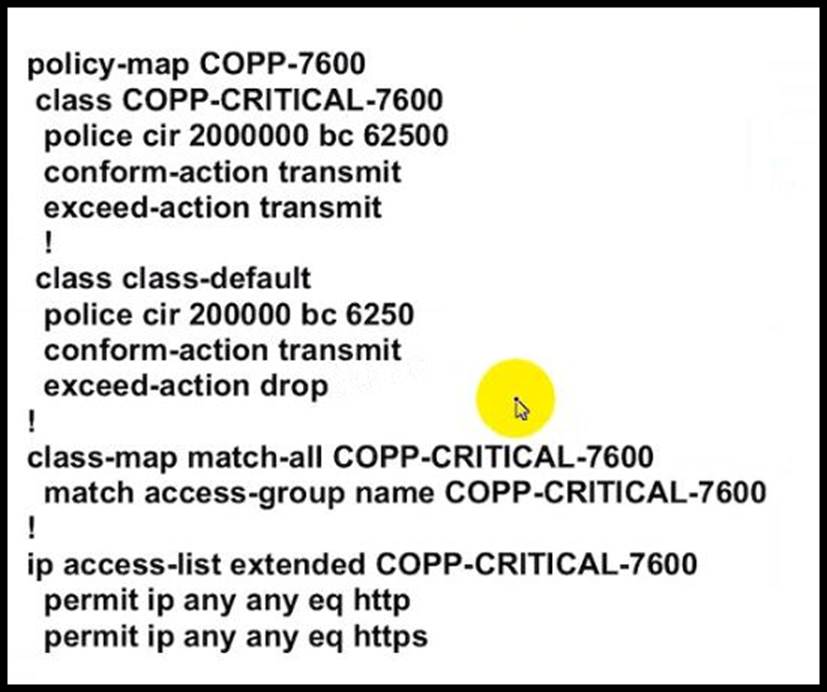
BGP is flapping after the Copp policy is applied.
What are the two solutions to fix the issue? (Choose two)
- A . Configure BGP in the COPP-CRITICAL-7600 ACL
- B . Configure a higher value for CIR under the default class to allow more packets during peak traffic
- C . Configure a higher value for CIR under the class COPP-CRITICAL-7600
- D . Configure a three-color policer instead of two-color policer under class COPP-CRITICAL-7600
- E . Configure IP CEF to CoPP policy and BGP to work
A,B
Explanation:
The policy-map COPP-7600 only rate-limit HTTP & HTTPS traffic (based on the ACL conditions) so any BGP packets will be processed in the class “class-default”, which drops exceeded BGP packets.
Therefore we have two ways to solve this problem:
+ Add BGP to the ACL with the statement “permit tcp any any eq bgp”
+ Configure higher value for CIR in default class as 2Mbps is too low for web traffic (http & https)
When provisioning a device in Cisco DNA Center, the engineer sees the error message “Cannot select the device. Not compatible with template”.
What is the reason for the error?
- A . The template has an incorrect configuration.
- B . The software version of the template is different from the software version of the device.
- C . The changes to the template were not committed.
- D . The tag that was used to filter the templates does not match the device tag.
D
Explanation:
If you use tags to filter the templates, you must apply the same tags to the device to which you want to apply the templates. Otherwise, you get the following error during provisioning: DCannot select the device. Not compatible with template.‖
Reference: https://www.cisco.com/c/en/us/td/docs/cloud-systems-management/network-automation-and-management/dna-center/1-2-10/user_guide/b_cisco_dna_center_ug_1_2_10/b_dnac_ug_1_2_10_chapter_0111.html
Which configuration enabled the VRF that is labeled “Inet” on FastEthernet0/0?
- A . R1(config)# ip vrf Inet
R1(config-vrf)#interface FastEthernet0/0
R1(config-if)#ip vrf forwarding Inet - B . R1(config)#router ospf 1 vrf Inet
R1(config-router)#ip vrf forwarding FastEthernet0/0 - C . R1(config)#ip vrf Inet FastEthernet0/0
- D . R1(config)# ip vrf Inet
R1(config-vrf)#ip vrf FastEthernet0/0
Refer to the exhibit.
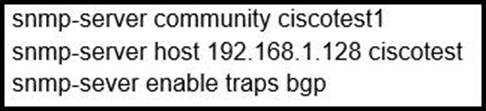
Network operations cannot read or write any configuration on the device with this configuration from the operations subnet.
Which two configurations fix the issue? (Choose two.)
- A . Configure SNMP rw permission in addition to community ciscotest.
- B . Modify access list 1 and allow operations subnet in the access list.
- C . Modify access list 1 and allow SNMP in the access list.
- D . Configure SNMP rw permission in addition to version 1.
- E . Configure SNMP rw permission in addition to community ciscotest 1.
Refer to the exhibit.
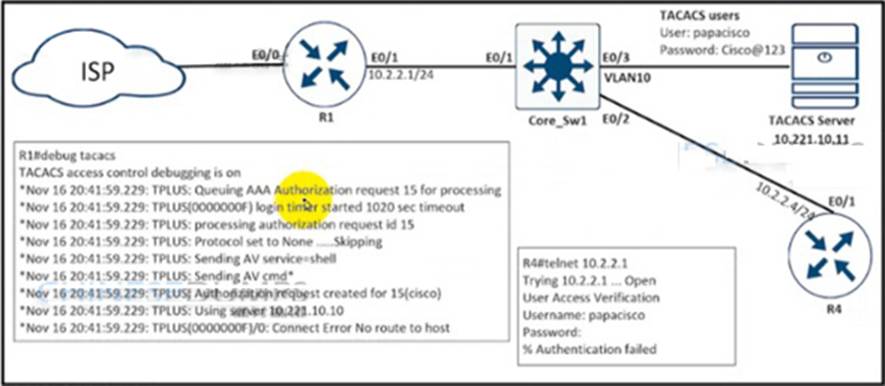
An engineer is trying to connect to R1 via Telnet with no success.
Which configuration resolves the issue?
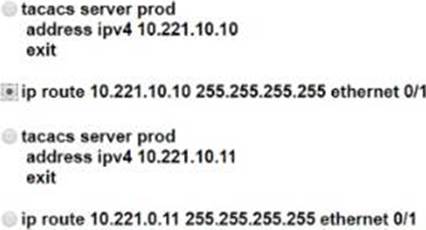
- A . Option A
- B . Option B
- C . Option C
- D . Option D
Refer to the exhibit.
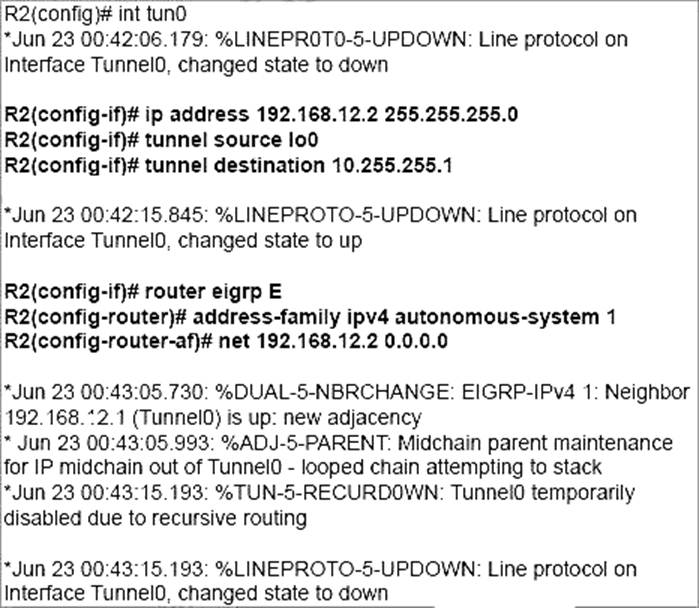
An administrator is configuring a GRE tunnel to establish an EIGRP neighbor to a remote router. The other tunnel endpoint is already configured. After applying the configuration as shown, the tunnel started flapping.
Which action resolves the issue?
- A . Modify the network command to use the Tunnel0 interface netmask
- B . Advertise the Loopback0 interface from R2 across the tunnel
- C . Stop sending a route matching the tunnel destination across the tunnel
- D . Readdress the IP network on the Tunnel0 on both routers using the /31 netmask
C
Explanation:
Explanation
In this question we are advertising the tunnel IP address 192.168.12.2 to the other side. When other end receives the EIGRP advertisement, it realizes it can reach the other side of the tunnel via EIGRP. In other words, it reaches the tunnel destination through the tunnel itself -> This causes “recursive routing” error.
Note: In order to avoid this error, do not advertise the tunnel destination IP address on the tunnel interface to other side.
Good recursive routing reference: https://networklessons.com/cisco/ccie-routing-switching/gretunnel-
recursive-routing-error
What is considered the primary advantage of running BFD?
- A . reduction in time needed to detect Layer 2 switched neighbor failures
- B . reduction in time needed to detect Layer 3 routing neighbor failures
- C . reduction in CPU needed to detect Layer 2 switch neighbor failures
- D . reduction in CPU needed to detect Layer 3 routing neighbor failures