
Cisco 300-410 Practice Exams
Last updated on Nov 16,2026- Exam Code: 300-410
- Exam Name: Implementing Cisco Enterprise Advanced Routing and Services (ENARSI)
- Certification Provider: Cisco
- Latest update: Nov 16,2026
Refer to the exhibit.
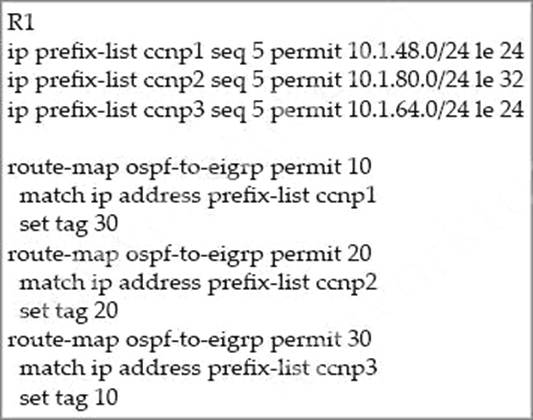
An engineer wanted to set a tag of 30 to route 10 1.80.65/32 but it failed
How is the issue fixed?
- A . Modify route-map ospf-to-eigrp permit 30 and match prefix-list ccnp2.
- B . Modify route-map ospf-to-eigrp permit 10 and match prefix-list ccnp2.
- C . Modify prefix-list ccnp3 to add 10.1.64.0/20 le 24
- D . Modify prefix-list ccnp3 to add 10.1.64.0/20 ge 32
What is a function of IPv6 Source Guard?
- A . It works with address glean or ND to find existing addresses.
- B . It inspects ND and DHCP packets to build an address binding table.
- C . It denies traffic from known sources and allocated addresses.
- D . It notifies the ND protocol to inform hosts if the traffic is denied by it.
A
Explanation:
IPv6 source guard is an interface feature between the populated binding table and data traffic filtering. This feature enables the device to deny traffic when it is originated from an address that is not stored in the binding table. IPv6 source guard does not inspect ND or DHCP packets; rather, it works in conjunction with IPv6 neighbor discovery (ND) inspection or IPv6 address glean, both of which detect existing addresses on the link and store them into the binding table.
Refer to the exhibit.
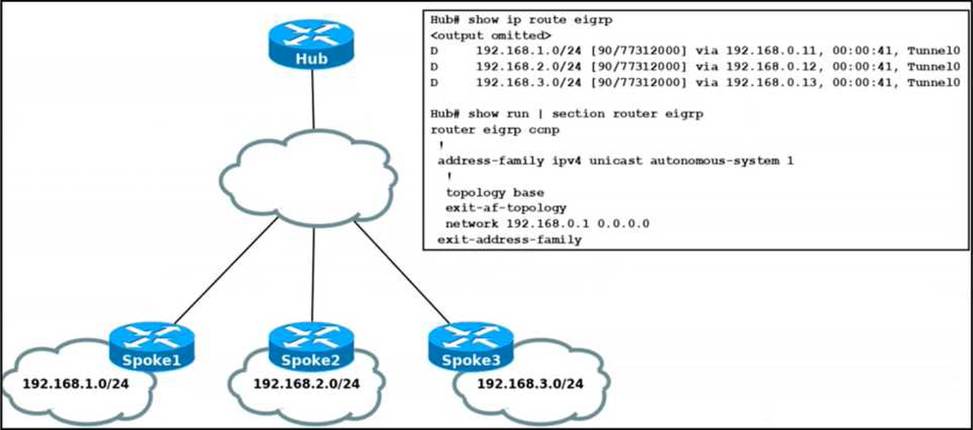
Spoke routers do not learn about each other’s routes in the DMVPN Phase2 network.
Which action resolves the issue?
- A . Remove default route from spoke routers to establish a spoke-to-spoke tunnel.
- B . Configure a static route in each spoke to establish a spoke-to-spoke tunnel.
- C . Rectify incorrect wildcard mask configured on the hub router network command.
- D . Disable EIGRP split horizon on the TunnelO interface of the hub router.
Which type of ports are protected by IPv6 Source Guard?
- A . Layer 2 ports
- B . access ports
- C . Layer 3 ports
- D . trunk ports
Refer to the exhibit.
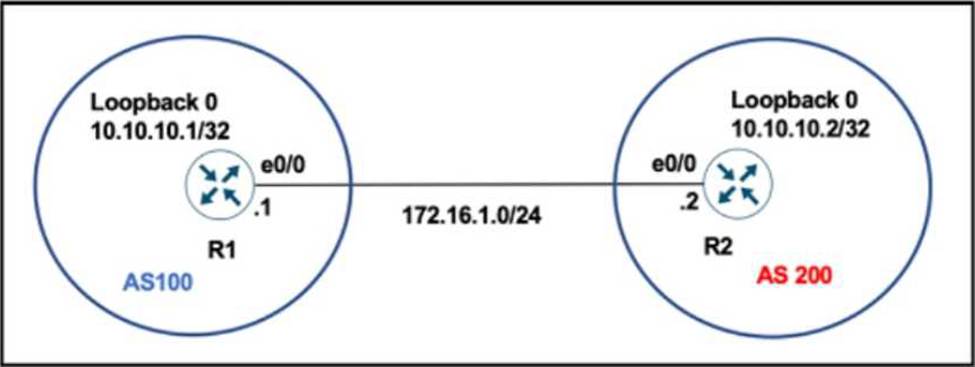
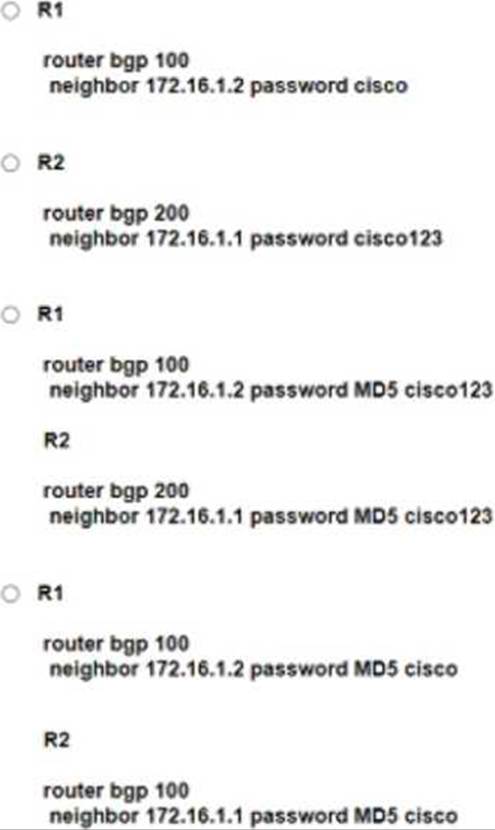
R1 and R2 have been configured where the neighbor relationship must be authenticated usmg MD5:
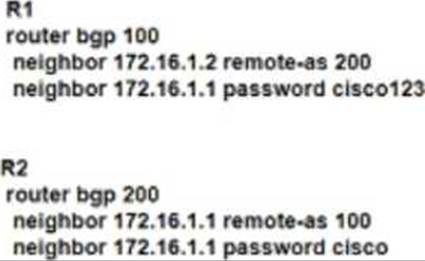
The neighbor relationship is not coming up.
Which configuration resolves the issue?
- A . Option A
- B . Option B
- C . Option C
- D . Option D
Refer to the exhibit.
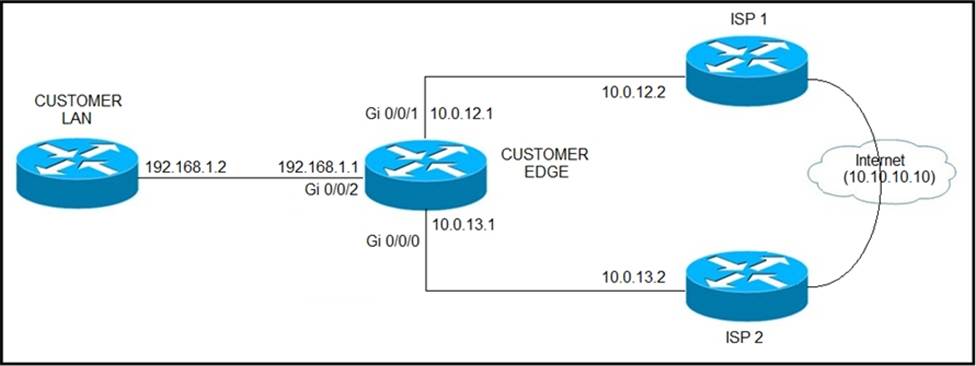
ISP 1 and ISP 2 directly connect to the Internet. A customer is tracking both ISP links to achieve redundancy and cannot see the Cisco IOS IP SLA tracking output on the router console.
Which command is missing from the IP SLA configuration?
- A . Start-time 00:00
- B . Start-time 0
- C . Start-time immediately
- D . Start-time now
D
Explanation:
Reference: https://www.cisco.com/c/en/us/td/docs/ios-xml/ios/ipsla/configuration/15-mt/sla-15-mt-book/sla_icmp_echo.html
Refer to the exhibit.
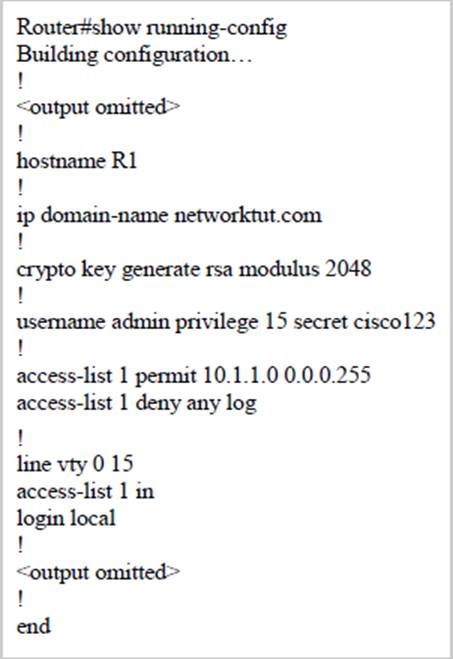
A user cannot SSH to the router.
What action must be taken to resolve this issue?
- A . Configure transport input ssh
- B . Configure transport output ssh
- C . Configure ip ssh version 2
- D . Configure ip ssh source-interface loopback0
A
Explanation:
https://www.cisco.com/c/en/us/td/docs/switches/lan/catalyst2960x/software/15-0_2_EX/security/configuration_guide/b_sec_152ex_2960-x_cg/b_sec_152ex_2960-x_cg_chapter_01001.html
What are two functions of MPLS Layer 3 VPNs? (Choose two.)
- A . LDP and BGP can be used for Pseudowire signaling.
- B . It is used for transparent point-to-multipoint connectivity between Ethernet links/sites.
- C . BGP is used for signaling customer VPNv4 routes between PE nodes.
- D . A packet with node segment ID is forwarded along with shortest path to destination.
- E . Customer traffic is encapsulated in a VPN label when it is forwarded in MPLS network.
C,E
Explanation:
MPLS Layer-3 VPNs provide IP connectivity among CE sites* MPLS VPNs enable full-mesh, hub-andspoke, and hybrid IP connectivity* CE sites connect to the MPLS network via IP peering across PE-CE links* MPLS Layer-3 VPNs are implemented via VRFs on PE edge nodes* VRFs providing customer routing and forwarding segmentation* BGP used for signaling customer VPN (VPNv4) routes between PE nodes* To ensure traffic separation, customer traffic is encapsulated in an additional VPN label when forwarded in MPLS network* Key applications are layer-3 business VPN services, enterprise network segmentation, and segmented layer-3 Data Center access
Reference: https://www.ciscolive.com/c/dam/r/ciscolive/us/docs/2018/pdf/BRKMPL-1100.pdf
Refer to the exhibit.
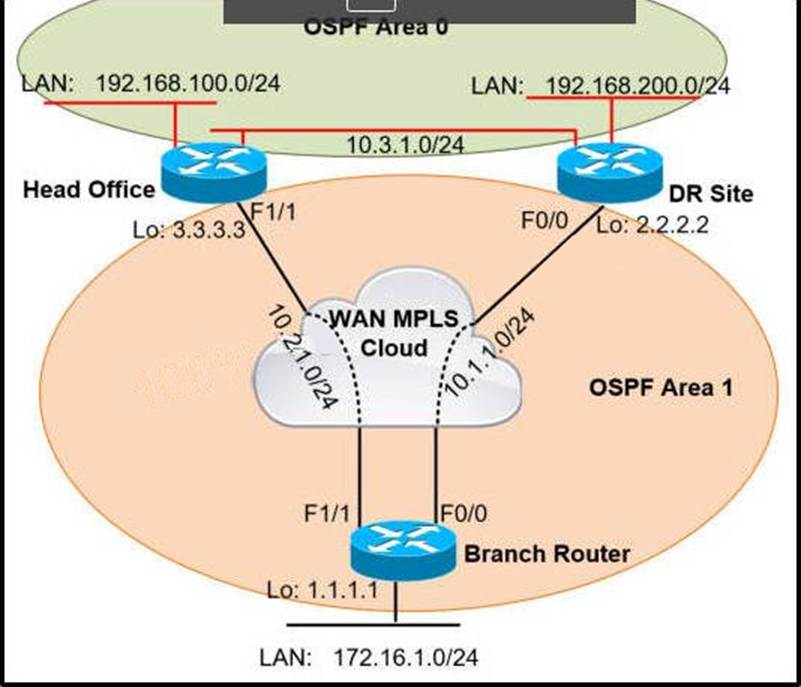
A network administrator reviews the branch router console log to troubleshoot the OSPF adjacency issue with the DR router.
Which action resolves this issue?
- A . Advertise the branch WAN interface matching subnet for the DR site.
- B . Configure matching hello and dead intervals between sites.
- C . Configure the WAN interface for DR site in the related OSPF area.
- D . Stabilize the DR site flapping link to establish OSPF adjacency.
Which is statement about IPv6 inspection is true?
- A . It teams and secures bindings for stateless autoconfiguration addresses in Layer 3 neighbor tables
- B . It learns and secures bindings for stateful autoconfiguration addresses in Layer 3 neighbor tables
- C . It teams and secures bindings for stateful autoconfiguration addresses in Layer 2 neighbor tables
- D . It team and secures binding for stateless autoconfiguration addresses in Layer 2 neighbor tables.