
Cisco 300-410 Practice Exams
Last updated on Nov 16,2026- Exam Code: 300-410
- Exam Name: Implementing Cisco Enterprise Advanced Routing and Services (ENARSI)
- Certification Provider: Cisco
- Latest update: Nov 16,2026
Which SNMP verification command shows the encryption and authentication protocols that are used in SNMPV3?
- A . show snmp group
- B . show snmp user
- C . show snmp
- D . show snmp view
Refer to the exhibit.
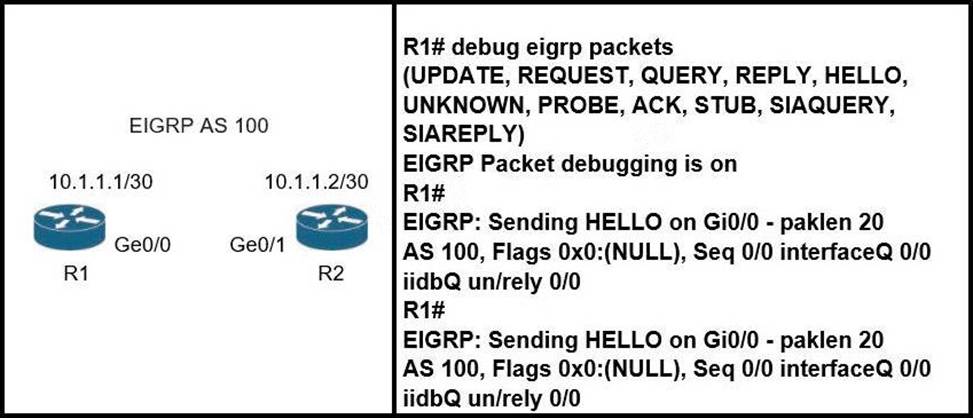
Which action resolves the adjacency issue?
- A . Match the hello interval timers.
- B . Configure the same EIGRP process IDs.
- C . Match the authentication keys.
- D . Configure the same autonomous system numbers.
D
Explanation:
EIGRP does not have process ID as it uses Autonomous System (AS) numbers only.
This is not an authentication problem or we would see this error from the debug:
EIGRP: Ethernet0/0: ignored packet from 10.1.1.3, opcode = 1 (missing authentication or key-chain missing)
If the AS numbers between two routers are different then the neighbor relationship cannot be formed.
Which control plane process allows the MPLS forwarding state to recover when a secondary RP takes over from a failed primary RP?
- A . MP-BGP uses control plane services for label prefix bindings in the MPLS forwarding table
- B . LSP uses NSF to recover from disruption *i control plane service
- C . FEC uses a control plane service to distribute information between primary and secondary processors
- D . LDP uses SSO to recover from disruption in control plane service
An engineer configured a router with this configuration
ip access-hst DENY TELNET
10 deny tcp any any eq 23 log-input
The router console starts receiving log message :%SEC-6-IPACCESSLOGP: list DENY_TELNET denied tcp 192.168.1.10(1022)(FastEthernet1/0 D508.89gb.003f) ->192.168.2.20(23), 1 packet"
Which action stops messages on the console while still denying Telnet?
- A . Configure a 20 permit ip any any command
- B . Remove log-Input keyword from the access list.
- C . Replace log-input keyword with the log keyword in the access list.
- D . Configure a 20 permit ip any any log-input command.
Refer to the exhibit.
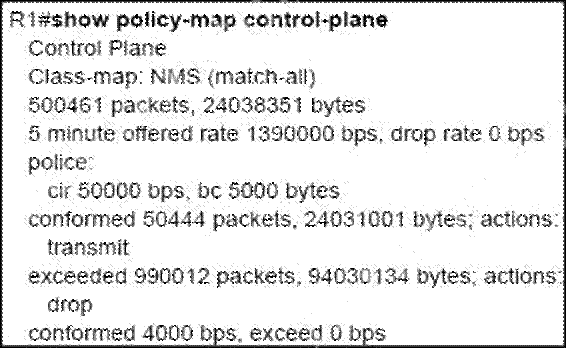
A company is evaluating multiple network management system tools. Trending graphs generated by SNMP data are returned by the NMS and appear to have multiple gaps. While troubleshooting the issue, an engineer noticed the relevant output.
What solves the gaps in the graphs?
- A . Remove the exceed-rate command in the class map.
- B . Remove the class map NMS from being part of control plane policing.
- C . Configure the CIR rate to a lower value that accommodates all the NMS tools
- D . Separate the NMS class map in multiple class maps based on the specific protocols with appropriate CoPP actions
D
Explanation:
Reference: https://tools.cisco.com/security/center/resources/copp_best_practices
The class-map NMS in the exhibit did not classify traffic into specific protocols so many packets
were dropped. We should create some class-map to classify the receiving traffic. It is also a
recommendation of CoPP/CPP policy:
“Developing a CPP policy starts with the classification of the control plane traffic. To that end, the control plane traffic needs to be first identified and separated into different class maps.”
Refer to the exhibit.
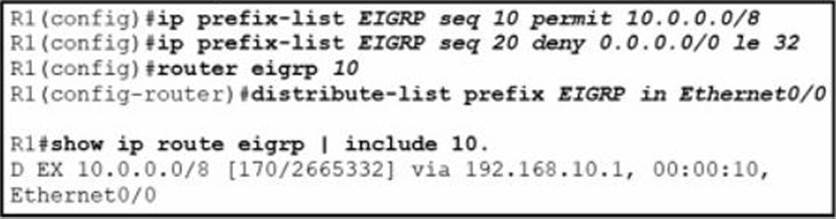
An engineer applies a prefix-list filter that filters most of the network 10 prefixes instead of allowing them.
Which action resolves the issue?
- A . Modify the ip prefix-list ElGRP seq 10 permit 10.0.0.0/8 le 9 command.
- B . Modify the command Modify the Ip prefix-list ElGRP seq 10 permit 10.0.0.0/8 le 32 command.
- C . Modify the Ip prefix-list ElGRP seq 20 permit 0.0.0.0/0 le 32 command.
- D . Modify the ip prefix-list ElGRP seq 20 permit 10.0.0.0/8 ge 9 command
Refer to the exhibit.
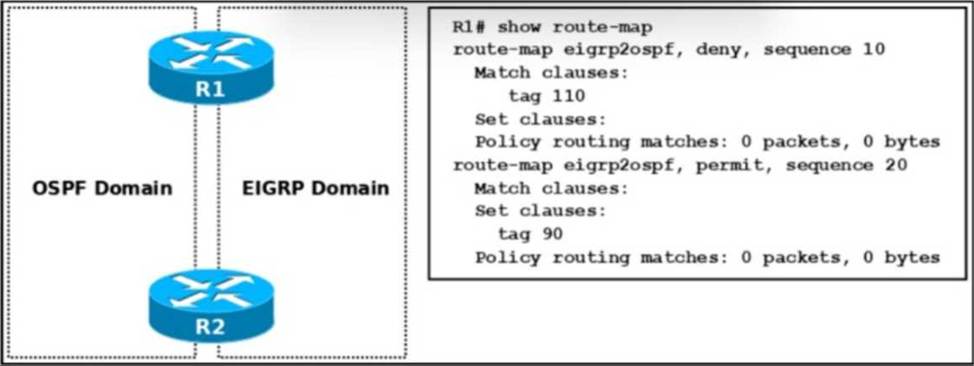
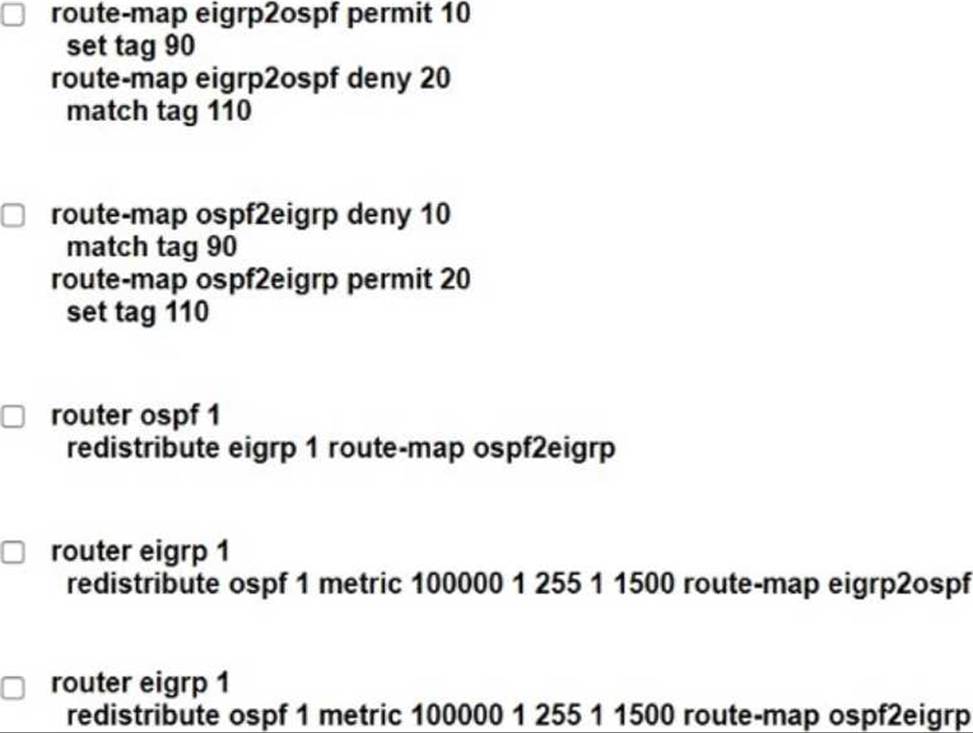
Which two configurations are required on R2 to prevent a routing loop caused by the redistribution from OSPF back into EIGRP? (Choose two.)
- A . Option A
- B . Option B
- C . Option C
- D . Option D
- E . Option E
Refer to the exhibit.
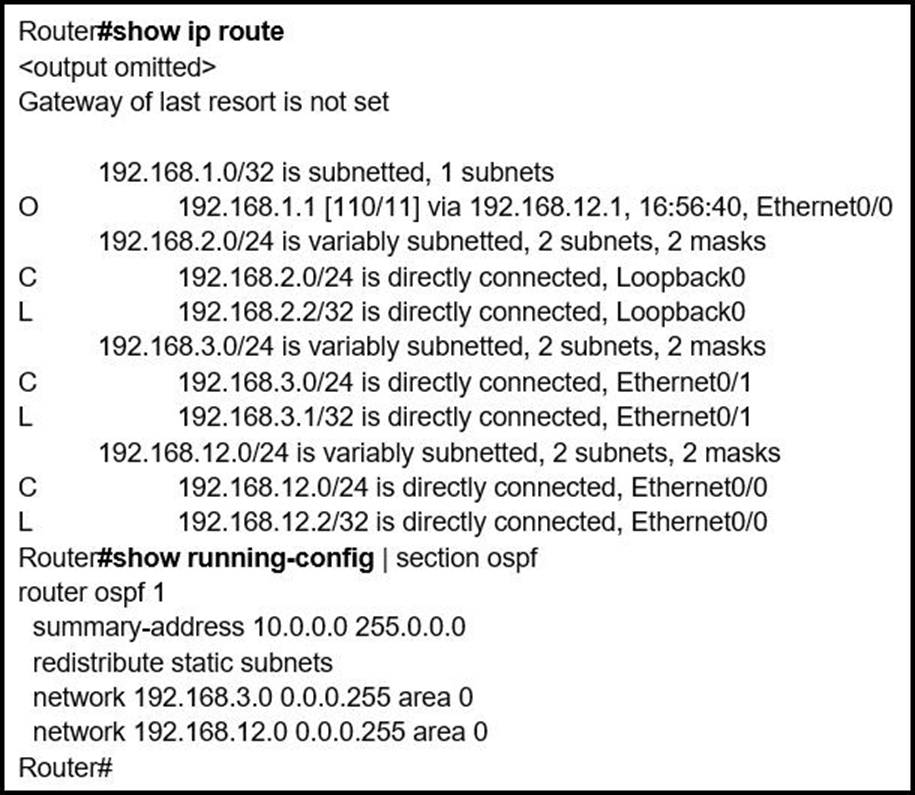
An engineer is trying to generate a summary route in OSPF for network 10.0.0.0/8, but the summary route does not show up in the routing table.
Why is the summary route missing?
- A . The summary-address command is used only for summarizing prefixes between areas.
- B . The summary route is visible only in the OSPF database, not in the routing table.
- C . There is no route for a subnet inside 10.0.0.0/8, so the summary route is not generated.
- D . The summary route is not visible on this router, but it is visible on other OSPF routers in the same area.
C
Explanation:
The Dsummary-address‖ is only used to create aggregate addresses for OSPF at an autonomous system boundary. It means this command should only be used on the ASBR when you are trying to summarize externally redistributed routes from another protocol domain or you have a NSSA area.
But a requirement to create a summarized route is:
DThe ASBR compares the summary route’s range of addresses with all routes redistributed into OSPF on that ASBR to find any subordinate subnets (subnets that sit inside the summary route range). If at least one subordinate subnet exists, the ASBR advertises the summary route.
Refer to the exhibit.
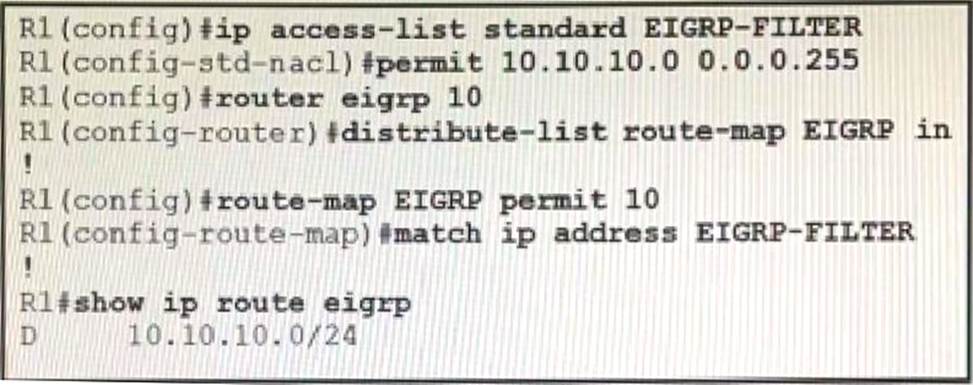
An engineer must filter incoming EIGRP updates to allow only a set of specific prefixes. The distribute list is tested, and it filters out all routes except network 10.10.10.0/24.
How should the engineer temporarily allow all prefixes to be learned by the routers again without adjusting the existing access list?
- A . A permit 20 statement should be added before completing the ACL with the required prefixes, and then the permit 20 statement can be removed.
- B . A permit any statement should be added before completing the ACL with the required prefixes and then the permit any statement can be removed.
- C . A continue statement should be added within the permit 10 statement before completing the ACL with the required prefixes, and then the continue statement can be removed.
- D . An extended access list must be used instead of a standard access list to accomplish the task
DRAG DROP
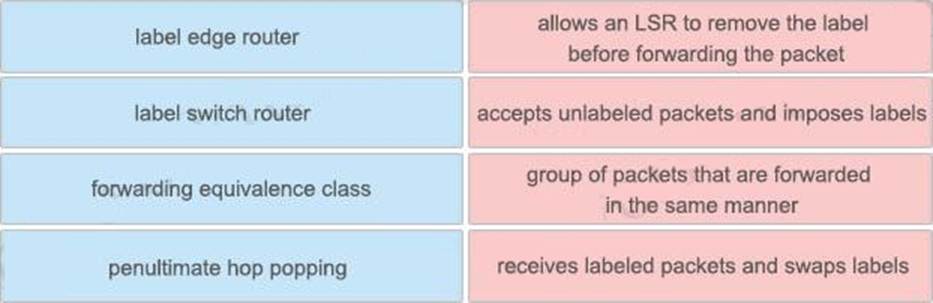
Drag and drop the MPLS concepts from the left onto the descriptions on the right.
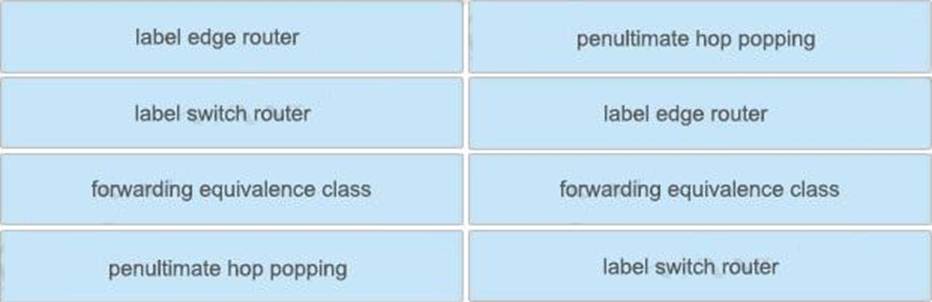
Explanation:
+ allows an LSR to remove the label before forwarding the packet: penultimate hop popping
+ accepts unlabeled packets and imposes labels: label edge router
+ group of packets that are forwarded in the same manner: forwarding equivalence class
+ receives labeled packets and swaps labels: label switch router
A label edge router (LER, also known as edge LSR) is a router that operates at the edge of an MPLS network and acts as the entry and exit points for the network. LERspush an MPLS label onto an incoming packet and pop it off an outgoing packet.
A forwarding equivalence class (FEC) is a term