
Cisco 300-410 Practice Exams
Last updated on Nov 16,2026- Exam Code: 300-410
- Exam Name: Implementing Cisco Enterprise Advanced Routing and Services (ENARSI)
- Certification Provider: Cisco
- Latest update: Nov 16,2026
Which function does LDP provide in an MPLS topology?
- A . It enables a MPLS topology to connect multiple VPNs to P routers.
- B . It provides hop-by-hop forwarding in an MPLS topology for LSRs.
- C . It exchanges routes for MPLS VPNs across different VRFs.
- D . It provides a means for LSRs to exchange IP routes.
B
Explanation:
LDP provides a standard methodology for hop-by-hop, or dynamic label, distribution in an MPLS network by assigning labels to routes that have been chosen by the underlying Interior Gateway Protocol (IGP) routing protocols. The resulting labeled paths, called label switch paths (LSPs), forward label traffic across an MPLS backbone to particular destinations.
Reference: https://www.cisco.com/c/en/us/td/docs/ios-xml/ios/mp_ldp/configuration/12-4t/mp-ldp-12-4t-book.pdf
Refer to the exhibit.
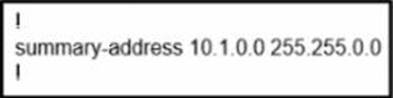
The none area 0 routers in OSPF still receive more specific routes of 10.1.1.0.10.1.2.0.10.1.3.0 from area 0.
Which action resolves the issue?
- A . Configure route summarization on OSPF-enabled interfaces.
- B . Summarize by using the summary-address 10.1.0.0 255.255.252.0 command.
- C . Summarize by using the area range command on ABRs
- D . Configure the summary-address 10.1.0.0 255.255.252.0 command under OSPF process.
Refer to the exhibit.
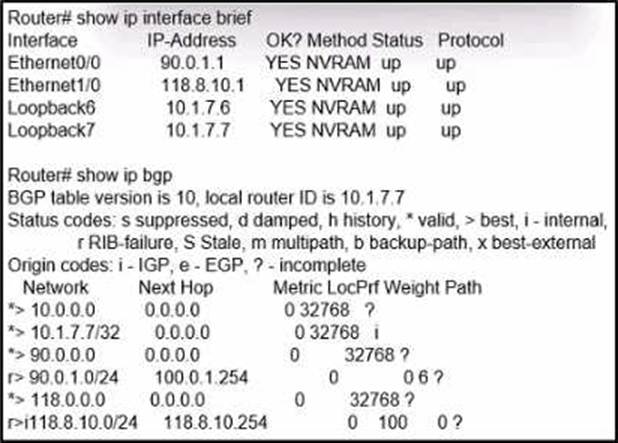
Which action adds the 10 1 7.6-32 route to the BGP table?
- A . Add a static roue for the 10 1 7 &32 network
- B . Add the network 10.1.7.6 mask 255.255.255.255 backdoor command
- C . Add summaty-address10.1.7.6.255.255.2550
- D . Add the network 10.1.7.6 mask 255.255.255.255 command
Which two technologies optimize MPLS infrastructure using bandwidth protection services when experiencing slow response7 (Choose two.)
- A . IPLFA
- B . MPLS OAM
- C . VPLS
- D . SO-MPLS
- E . Fast-Rwoute
Refer to the exhibit.
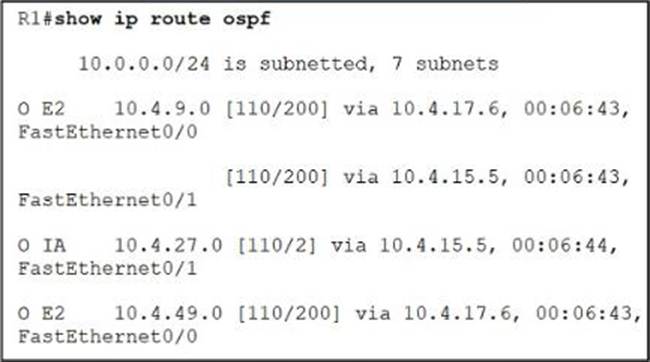
An engineer configures two ASBRs 10 4 17.6 and 10 4 15 5 in an OSPF network to redistribute routes from EIGRP However, both ASBRs show the EIGRP routes as equal costs even though the next-hop router 10 4 17 6 is closer to R1.
How should the network traffic to the EIGRP prefixes be sent via 10 4.17.6?
- A . The administrative distance should be raised to 120 from the ASBR 10.4.15 5.
- B . The redistributed prefixes should be advertised as Type 1
- C . The ASBR 10 4 17 6 should assign a tag to match and assign a lower metnc on R1
- D . The administrative distance should be raised to 120 from the ASBR 104.17.6
- E . The admitstrative distance should be raised to 120 from the ASBR 104 15.5.
- F . The redistributed prefixes should be advertised as Type 1.
- G . The ASBR 10 4 17 6 should assign a tag to match and assign a tower metnc on R1
- H . The administrative distance should be raised to 120 from the ASBR 104 17 6
Refer to Exhibit.
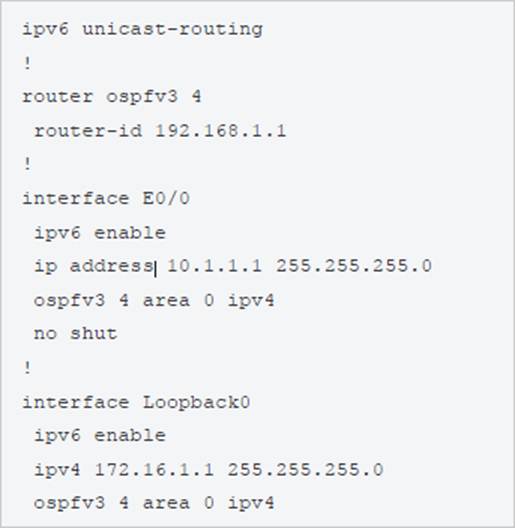
The network administrator configured the branch router for IPv6 on the E0/0 interface. The neighboring router is fully configured to meet requirements, but the neighbor relationship is not coming up.
Which action fixes the problem on the branch router to bring the IPv6 neighbors up?
- A . Enable the IPv4 address family under the router ospfv3 4 process by using the address-family ipv4 unicast command
- B . Disable IPv6 on the E0/0 interface using the no ipv6 enable command
- C . Enable the IPv4 address family under the E0/0 interface by using the address-family ipv4 unicast command
- D . Disable OSPF for IPv4 using the no ospfv3 4 area 0 ipv4 command under the E0/0 interface
A
Explanation:
Explanation
Once again, Cisco changed the IOS configuration commands required for OSPFv3 configuration. The new OSPFv3 configuration uses the “ospfv3” keyword instead of the earlier “ipv6 router ospf” routing process command and “ipv6 ospf” interface commands.
The Open Shortest Path First version 3 (OSPFv3) address families feature enables both IPv4 and IPv6 unicast traffic to be supported. With this feature, users may
have two processes per interface, but only one process per address family (AF).
Which attribute eliminates LFAs that belong to protected paths in situations where links in a network are connected through a common fiber?
- A . shared risk link group-disjoint
- B . linecard-disjoint
- C . lowest-repair-path-metric
- D . interface-disjoint
A
Explanation:
Reference: https://www.cisco.com/c/en/us/td/docs/ios-xml/ios/iproute_eigrp/configuration/xe-3s/asr1000/ire-xe-3s-asr1000/ire-ipfrr.html
Refer to the exhibit.
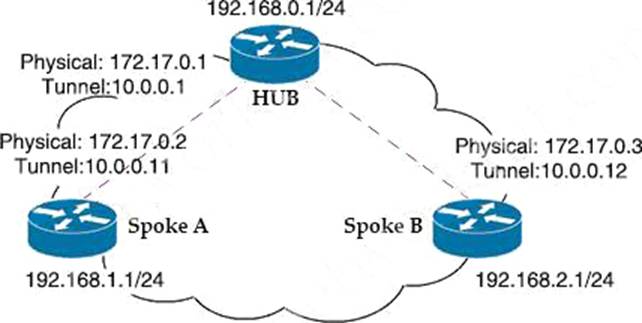
Which interface configuration must be configured on the spoke A router to enable a dynamic DMVPN tunnel with the spoke B router?
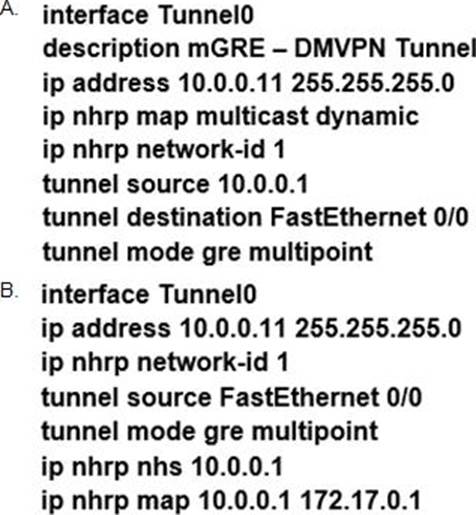
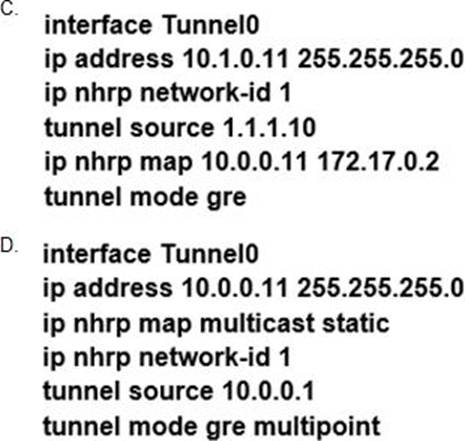
- A . Option A
- B . Option B
- C . Option C
- D . Option D
SIMULATION
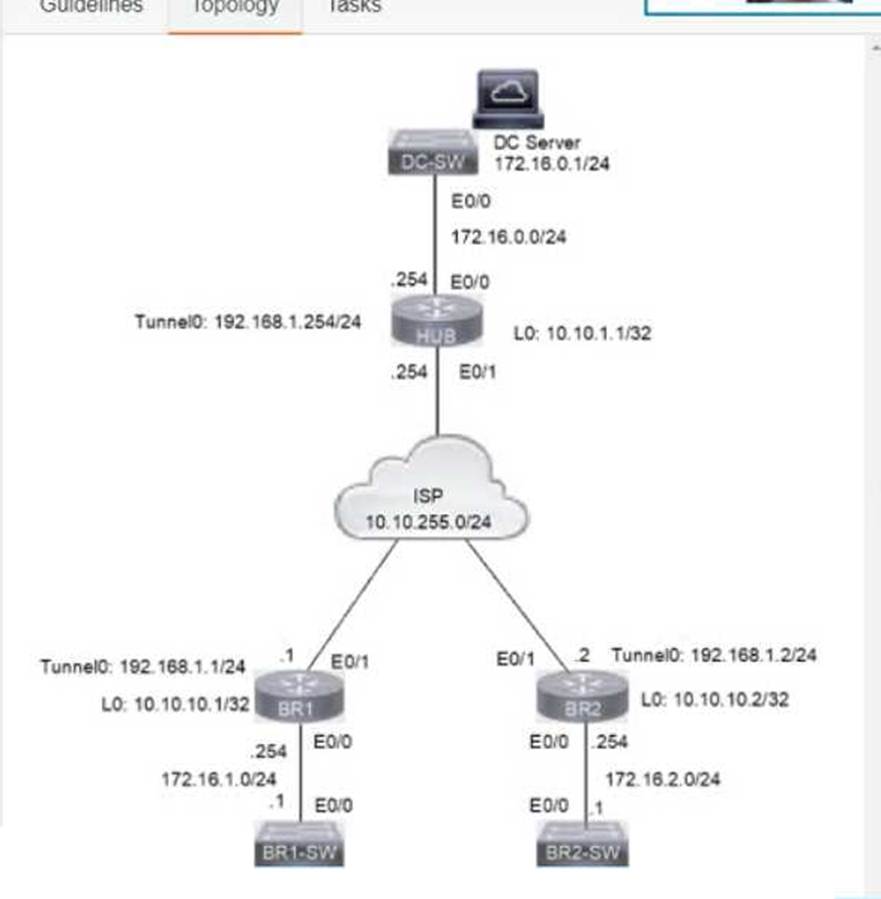
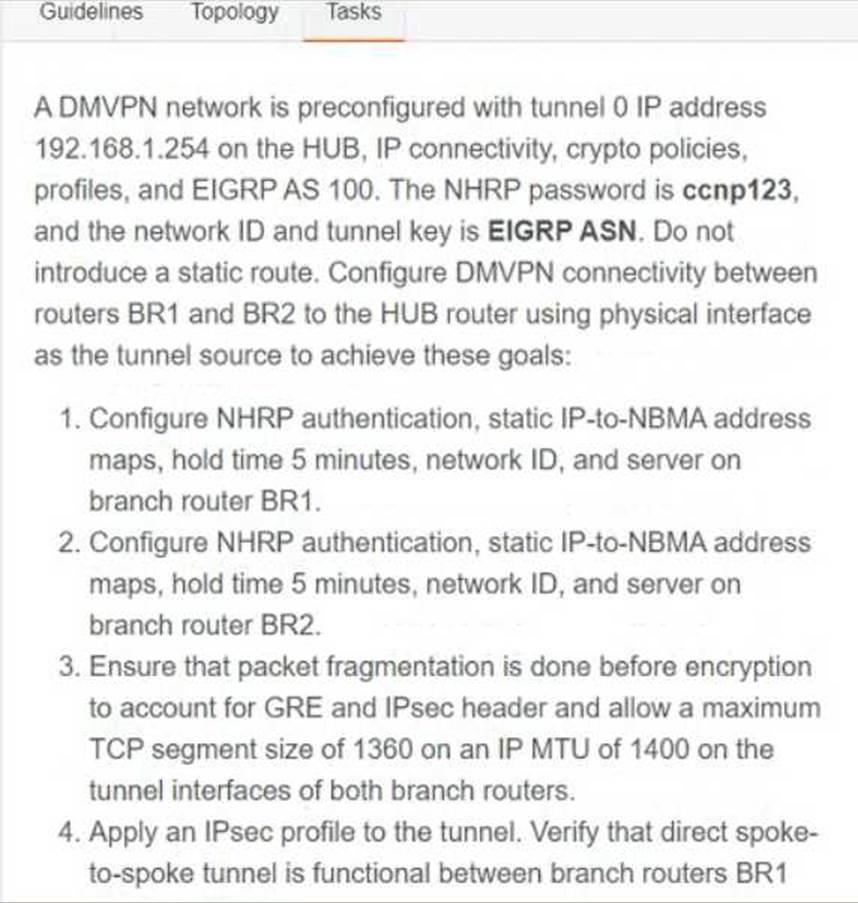
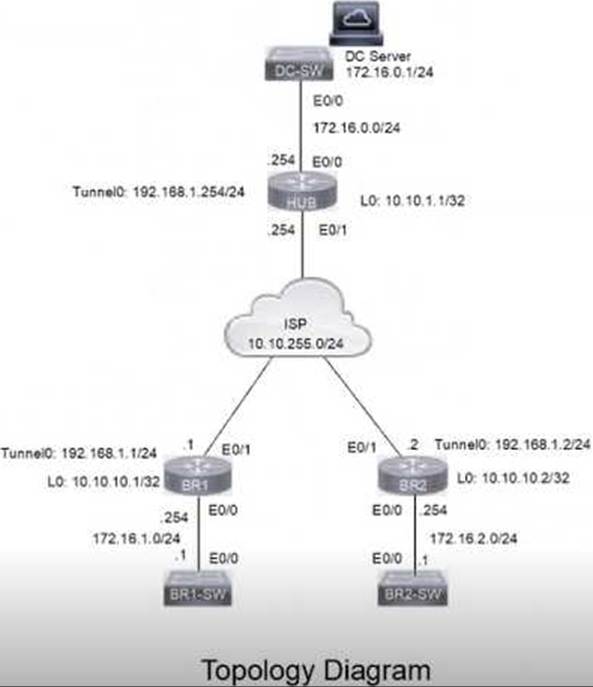
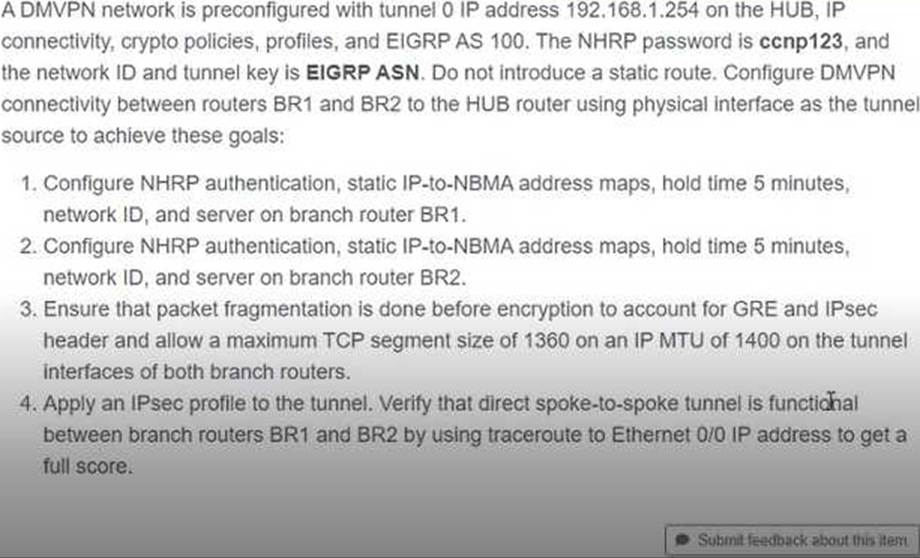
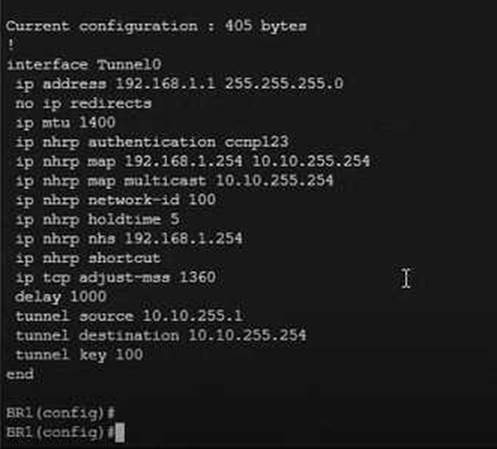
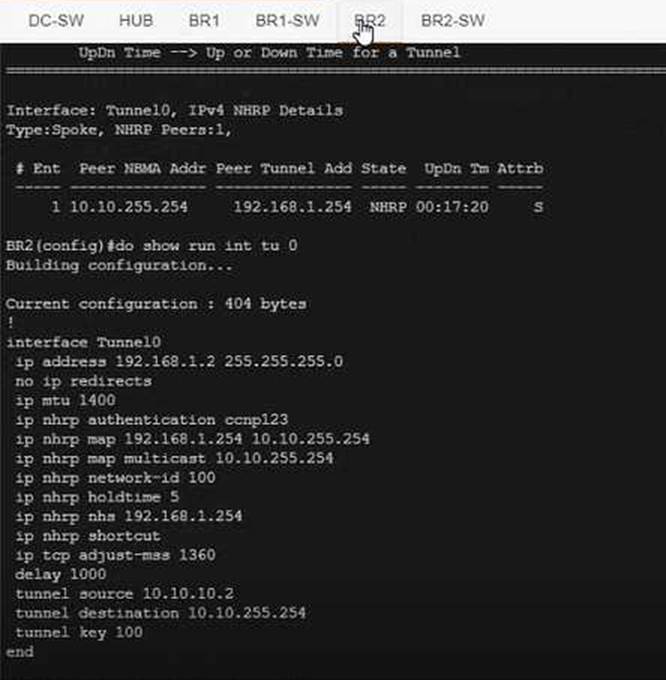
A DMVPN network is preconfigured with tunnel 0 IP address 192.168.1.254 on the HUB, IP connectivity, crypto policies, profiles, and EIGRP AS 100. The NHRP password is ccnp123, and the network ID and tunnel key is EIGRP ASN Do not introduce a static route.
Configure DMVPN connectivity between routers BR1 and BR2 to the HUB router using physical interface as the tunnel source to achieve these goals:
ON BR2
Refer to the exhibit.
SIMULATION
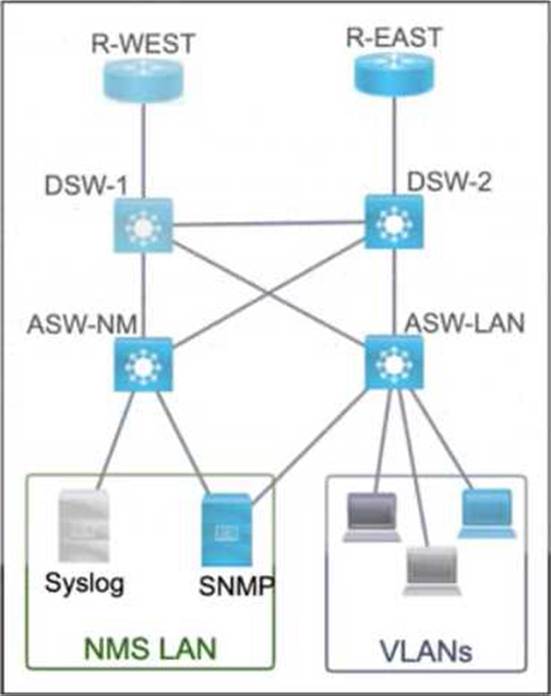
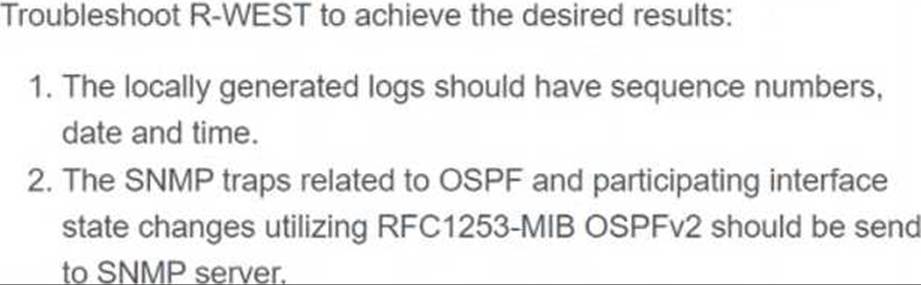
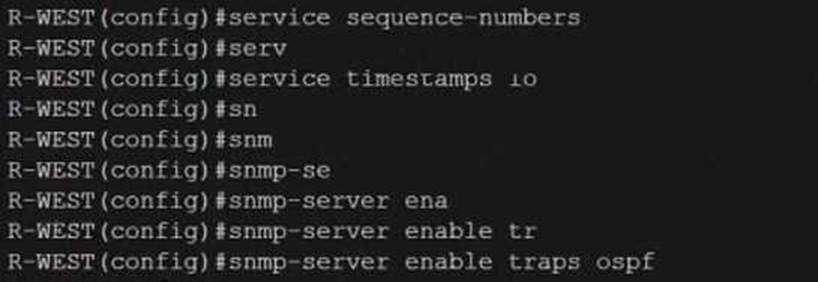
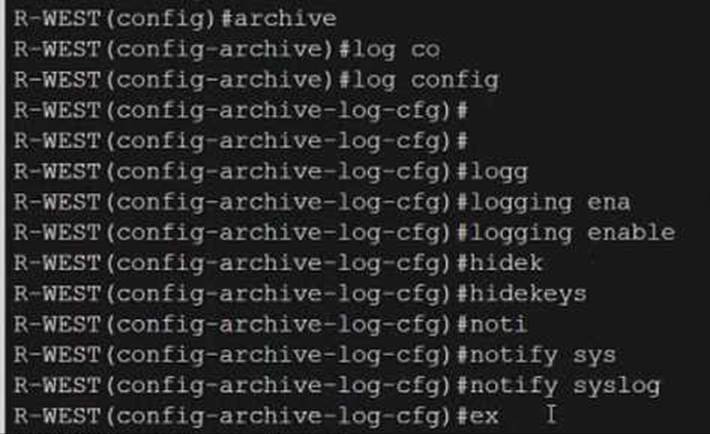
R-West#
service sequence-numbers
service timestamps log datetime msec
snmp-server enable traps ospf
archieve
log config
logging enable
hidekeys
notify syslog
exit
snmp-server enable traps ospf lsa
snmp-server enable traps ospf cisco-specific lsa
wr
end
wr