
Cisco 300-410 Practice Exams
Last updated on Nov 16,2026- Exam Code: 300-410
- Exam Name: Implementing Cisco Enterprise Advanced Routing and Services (ENARSI)
- Certification Provider: Cisco
- Latest update: Nov 16,2026
Refer to the exhibit.
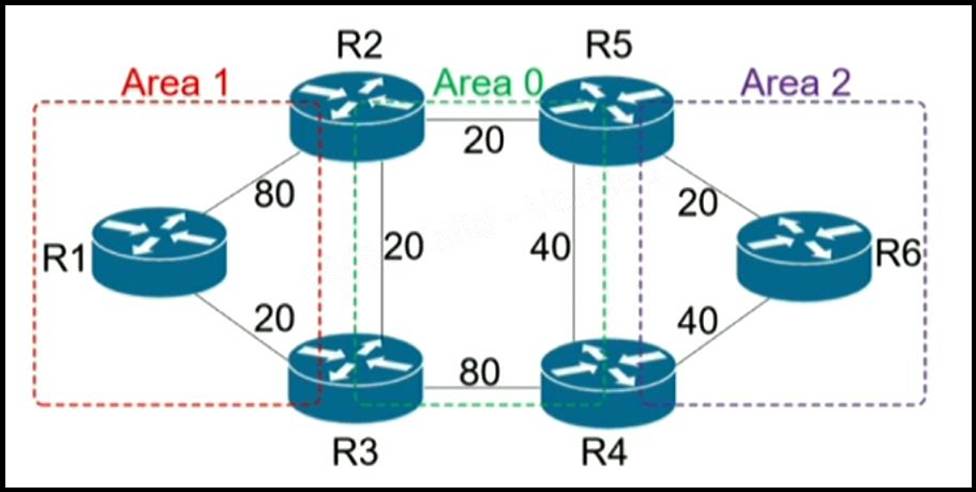
R6 should reach R1 via R5>R2>R1.
Which action resolves the issue?
- A . Increase the cost to 61 between R2-R3-R1
- B . Increase the cost to 61 between R2 and R3
- C . Decrease the cost to 2 between R6-R5-R2
- D . Decrease the cost to 41 between R2 and R1
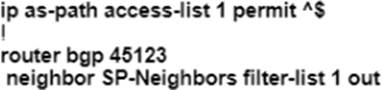
After some changes in the routing policy, it is noticed that the router in AS 45123 is being used as a transit AS router for several service provides.
Which configuration ensures that the branch router in AS 45123 advertises only the local networks to all SP neighbors?
A)
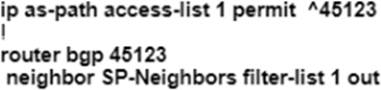
B)
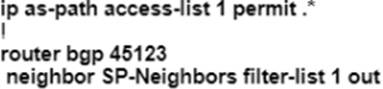
C)
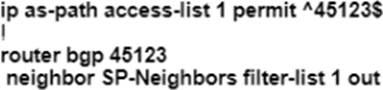
D)
- A . Option A
- B . Option B
- C . Option C
- D . Option D
D
Explanation:
By default BGP advertises all prefixes to external BGP neighbors. This means that if you are multi-homed (connected to two or more ISPs) then you might become a transit AS.
For example, ISP 2 in AS 200 can send traffic to your router in AS 100 to reach ISP 3 in AS 300 because you advertised prefixes in ISP 3 to ISP 2.
This is what will be seen in the BGP routing table of ISP1:

DRAG DROP
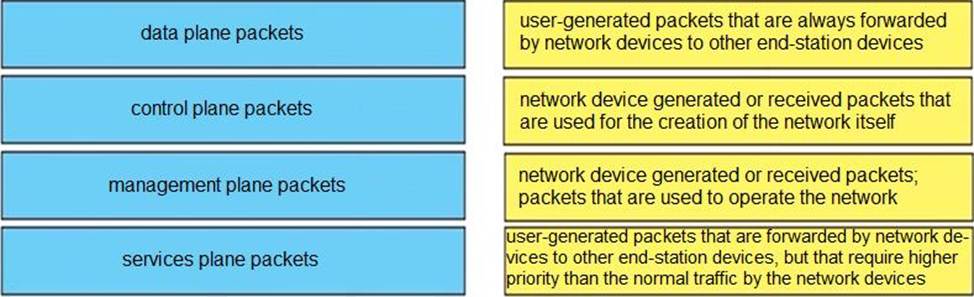
Drag and drop the packet types from the left onto the correct descriptions on the right.
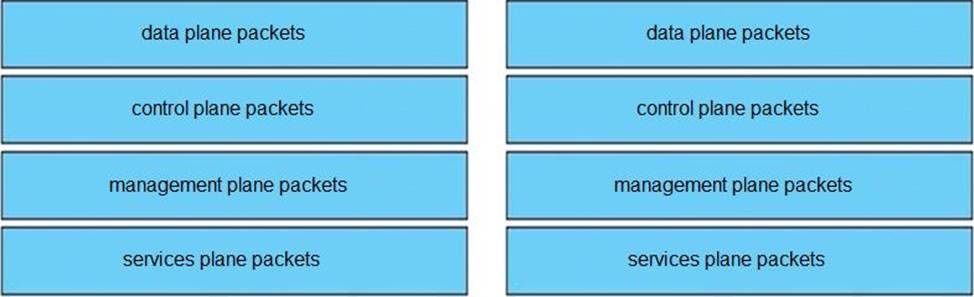
Explanation:
Unlike legacy network technologies such as ISDN, Frame Relay, and ATM that defined separate data and control channels, IP carries all packets within a single pipe. Thus, IP network devices such as routers and switches must be able to distinguish between data plane, control plane, and management plane packets to treat each packet appropriately. From an IP traffic plane perspective, packets may be divided into four distinct, logical groups:1. Data plane packets C End-station, user-generated packets that are always forwarded by network devices to other end-station devices. From the perspective of the network device, data plane packets always have a transit destination IP address and can be handled by normal, destination IP address-based forwarding processes.2. Control plane packets C Network device generated or received packets that are used for the creation and operation of the network itself. From the perspective of the network device, control plane packets
always have a receive destination IP address and are handled by the CPU in the network device route processor. Examples include protocols such as ARP, BGP, OSPF, and other protocols that glue the network together.3. Management plane packets C Network device generated or received packets, or management station generated or received packets that are used to manage the network. From the perspective of the network device, management plane packets always have a receive destination IP address and are handled by the CPU in the network device route processor. Examples include protocols such as Telnet, Secure Shell (SSH), TFTP, SNMP, FTP, NTP, and other protocols used to manage the device and/or network.4. Services plane packets C A special case of data plane packets, services plane packets are also user-generated packets that are also forwarded by network devices to other end-station devices, but that require high-touch handling by the network device (above and beyond normal, destination IP address-based forwarding) to forward the packet. Examples of high-touch handling include such functions as GRE encapsulation, QoS, MPLS VPNs, and SSL/IPsec encryption/decryption, etc. From the perspective of the network device, services plane packets may have a transit destination IP address, or may have a receive destination IP address (for example, in the case of a VPN tunnel endpoint).
Reference: https://tools.cisco.com/security/center/resources/copp_best_practices
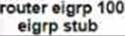
Network engineer must configure an ElGRP stub router at a site that advertises only connected and summary routes.
Which configuration performs this task?
A)
B)
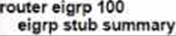
C)
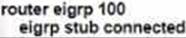
D)

- A . Option A
- B . Option B
- C . Option C
- D . Option D
B
Explanation:
In EIGRP (Enhanced Interior Gateway Routing Protocol), a stub router is one that is connected to one or more neighbors and should not be a transit router1. The EIGRP stub routing feature improves network stability, reduces resource utilization, and simplifies the stub router’s configuration1.
The network engineer wants to configure an EIGRP stub router that advertises only connected and summary routes. This can be achieved with the configuration provided in Option B:
router eigrp 100
eigrp stub summary
This configuration ensures that the EIGRP stub router advertises only connected and summary routes12. The summary keyword after the eigrp stub command indicates that the router should advertise only auto-summarized or statically configured summary routes12.
Reference: EIGRP STUB and Configuration – Cisco Community
EIGRP Stub And Summary Routes Explained – Networkel
Refer to the exhibit.
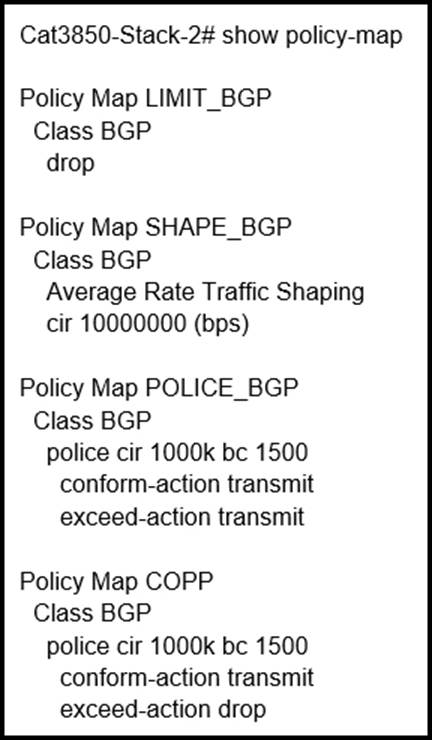
Which control plane policy limits BGP traffic that is destined to the CPU to 1 Mbps and ignores BGP traffic that is sent at higher rate?
- A . policy-map SHAPE_BGP
- B . policy-map LIMIT_BGP
- C . policy-map POLICE_BGP
- D . policy-map COPP
Refer to the exhibit.
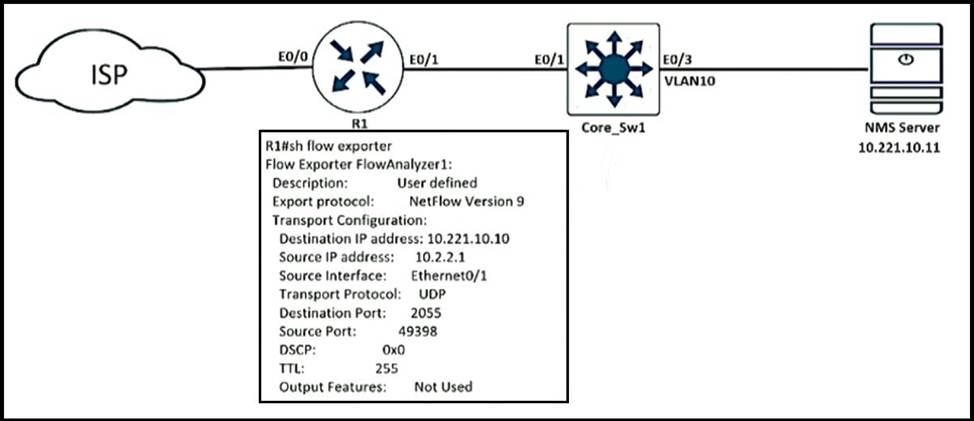
An engineer configured NetFlow on R1, but the NMS server cannot see the flow from R1.
Which configuration resolves the issue?
- A . flow monitor Flowmonitor1destination 10.221.10.11
- B . flow exporter FlowAnalyzer1destination 10.221.10.11
- C . interface Ethernet0/1flow-destination 10.221.10.11
- D . interface Ethernet0/0flow-destination 10.221.10.11
B
Explanation:
From the output we notice that the destination IP address is not correct. The NMS server IP address should be 10.221.10.11, not 10.221.10.10. Therefore we have to change this information under “flow exporter …” configuration.
NetFlow configuration reference: https://www.cisco.com/c/en/us/td/docs/iosxml/ios/fnetflow/configuration/15-mt/fnf-15-mt-book/cfg-de-fnflow-exprts.html
Refer to the exhibit.
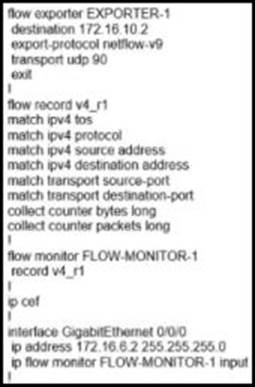
An engineer configured NetFlow to capture traffic information through the router, but it iOS not working as expected.
Which action captures the flow information from this router to the collector?
- A . Change the interface configuration FLOW-MONITOR-1 from input to output.
- B . Configure a flow exporter under flow FLOW-MONITOR-1.
- C . Configure more than one flow exporter destination addresses.
- D . Change the flow exporter transport protocol from UDP to TCP
Refer to the exhibit.
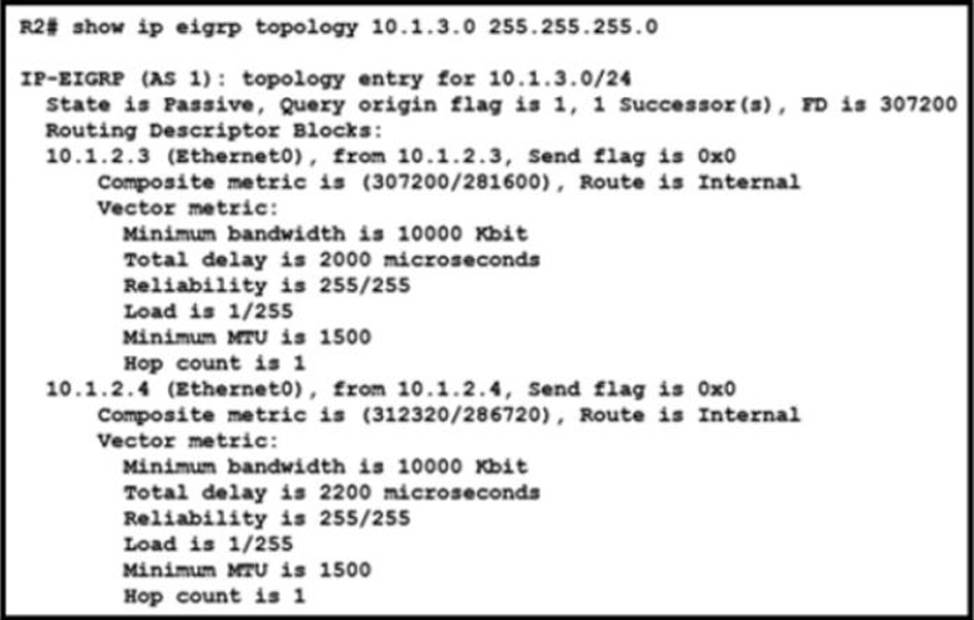
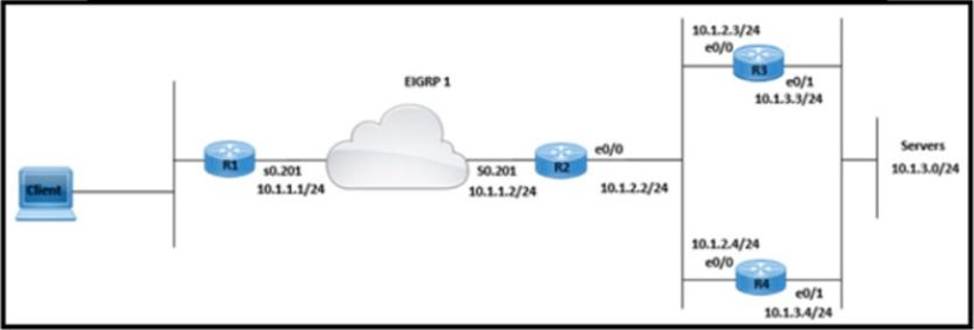
A network is configured for EIGRP equal-cost load balancing, but the traffic destined to the servers is not load balanced. Link metrics from router R2 to R3 and R4 are the same.
Which delay value must be configured to resolve the issue?
- A . 208 oon R3 E0/0
- B . 120 on R4 E0/1
- C . 120/on R3 E0/1
- D . 2200 on R4 E0/1
Exhibit:
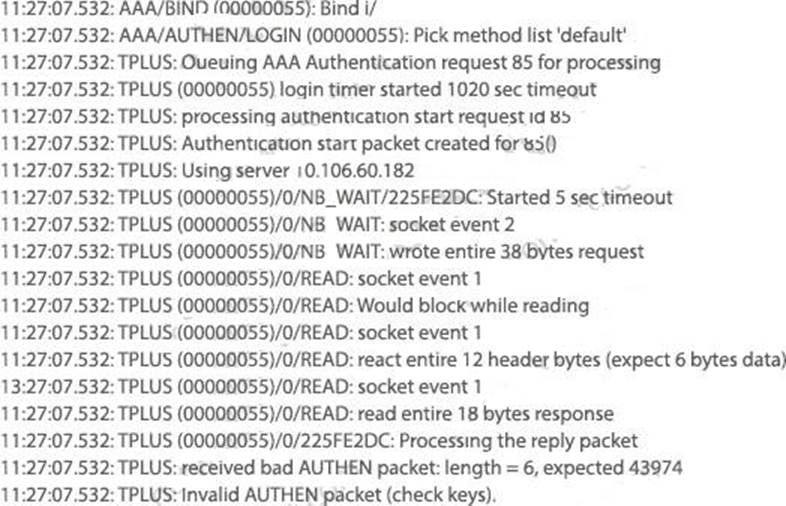
Which action resolves the authentication problem?
- A . Configure the user name on the TACACS+ server
- B . Configure the UDP port 1812 to be allowed on the TACACS+ server
- C . Configure the TCP port 49 to be reachable by the router
- D . Configure the same password between the TACACS+ server and router.
D
Explanation:
Explanation
From the last line of the output, we notice that the result was “Invalid AUTHEN packet”. Therefore something went wrong with the username or password.
Reference: https://www.cisco.com/c/en/us/support/docs/security-vpn/terminal-access-controller-access-control-system-tacacs-/200467-Troubleshoot-TACACS-Authentication-Issue.html
Which protocol must be secured with MD-5 authentication across the MPLS cloud to prevent hackers from introducing bogus routers?
- A . MP-BGP
- B . LSP
- C . RSVP
- D . LDP