
Cisco 300-410 Practice Exams
Last updated on Nov 16,2026- Exam Code: 300-410
- Exam Name: Implementing Cisco Enterprise Advanced Routing and Services (ENARSI)
- Certification Provider: Cisco
- Latest update: Nov 16,2026
What action is performed for untagged outgoing labels in an MPLS router?
- A . Convert the incoming MPLS packet to an untagged packet and then do a FIB lookup
- B . Convert the incoming MPLS packet to an untagged packet and then do a RIB lookup.
- C . Convert the untagged packet to a labeled packet and forward it to the next router
- D . Convert the incoming MPLS packet to an IP packet and forward it to the next router.
An engineer configured a Cisco router to send reliable and encrypted notifications for any events to the management server. It was noticed that the notification messages are reliable but not encrypted.
Which action resolves the issue?
- A . Configure all devices for SNMPv3 informs with priv.
- B . Configure all devices for SNMPv3 informs with auth.
- C . Configure all devices for SNMPv3 traps with auth.
- D . Configure all devices for SNMPv3 traps with priv.
A
Explanation:
SNMP notifications can be sent as traps or inform requests. Traps are unreliable because the receiver does not send acknowledgments when this device receives traps. “Send reliable and encrypted notifications for any events” so it is SNMP notifications. For encryption we need to configure “priv”.
An engineer configured a Cisco router to send reliable and encrypted notifications for any events to the management server. It was noticed that the notification messages are reliable but not encrypted.
Which action resolves the issue?
- A . Configure all devices for SNMPv3 informs with priv.
- B . Configure all devices for SNMPv3 informs with auth.
- C . Configure all devices for SNMPv3 traps with auth.
- D . Configure all devices for SNMPv3 traps with priv.
A
Explanation:
SNMP notifications can be sent as traps or inform requests. Traps are unreliable because the receiver does not send acknowledgments when this device receives traps. “Send reliable and encrypted notifications for any events” so it is SNMP notifications. For encryption we need to configure “priv”.
Refer to Exhibit.
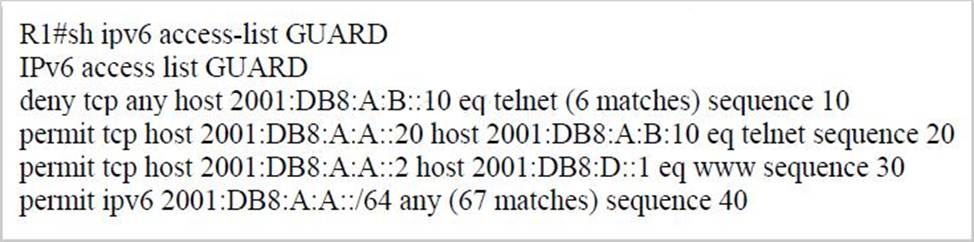
PC2 is directly connected to R1. A user at PC2 cannot Telnet to 2001:db8:a:b::10. The user can ping 2001:db8:a:b::10 and receive DHCP-related information from the DHCP server.
Which action resolves the issue?
- A . Remove sequence 10 and put it back as sequence 25.
- B . Remove sequence 20 and put it back as sequence 45.
- C . Remove sequence 30 and put it back as sequence 5.
- D . Remove sequence 40 and put it back as sequence 15.
Refer to Exhibit.
PC2 is directly connected to R1. A user at PC2 cannot Telnet to 2001:db8:a:b::10. The user can ping 2001:db8:a:b::10 and receive DHCP-related information from the DHCP server.
Which action resolves the issue?
- A . Remove sequence 10 and put it back as sequence 25.
- B . Remove sequence 20 and put it back as sequence 45.
- C . Remove sequence 30 and put it back as sequence 5.
- D . Remove sequence 40 and put it back as sequence 15.
The network administrator configured the router for Control Plane Policing to limit OSPF traffic to be policed to 1 Mbps. Any traffic that exceeds this limit must also be allowed at this point for traffic analysis.
The router configuration is:
access-list 100 permit ospf any any
!
class-map CM-OSPF
match access-group 100
!
policy-map PM-COPP
class CM-OSPF
police 1000000 conform-action transmit
!
control-plane
service-policy output PM-COPP
The Control Plane Policing failed to monitor and police OSPF traffic.
Which configuration resolves this issue?
- A . no access-list 100
access-list 100 permit tcp any any eq 179
access-list 100 permit ospf any any
access-list 101 permit tcp any any range 22 23
!
!
class-map CM-MGMT
no match access-group 100
match access-group 101
!
control-plane
no service-policy output PM-COPP
service-policy input PM-COPP - B . No access-list 100
access-list 100 permit tcp any any eq 179
access-list 100 permit tcp any any range eq 22
access-list 100 permit tcp any any range eq 23
access-list 100 permit ospf any any - C . control-plane
no service-policy output PM-COPP
service-policy input PM-COPP - D . no access-list 100
access-list 100 deny ospf any any
access-list 100 permit ip any any
!
policy-map PM-COPP
class CM-OSPF
no police 1000000 conform-action transmit
police 1000000 conform-action transmit
exceed-action drop
!
control-plane
no service-policy output PM-COPP
service-policy input PM-COPP
Refer to the exhibit.
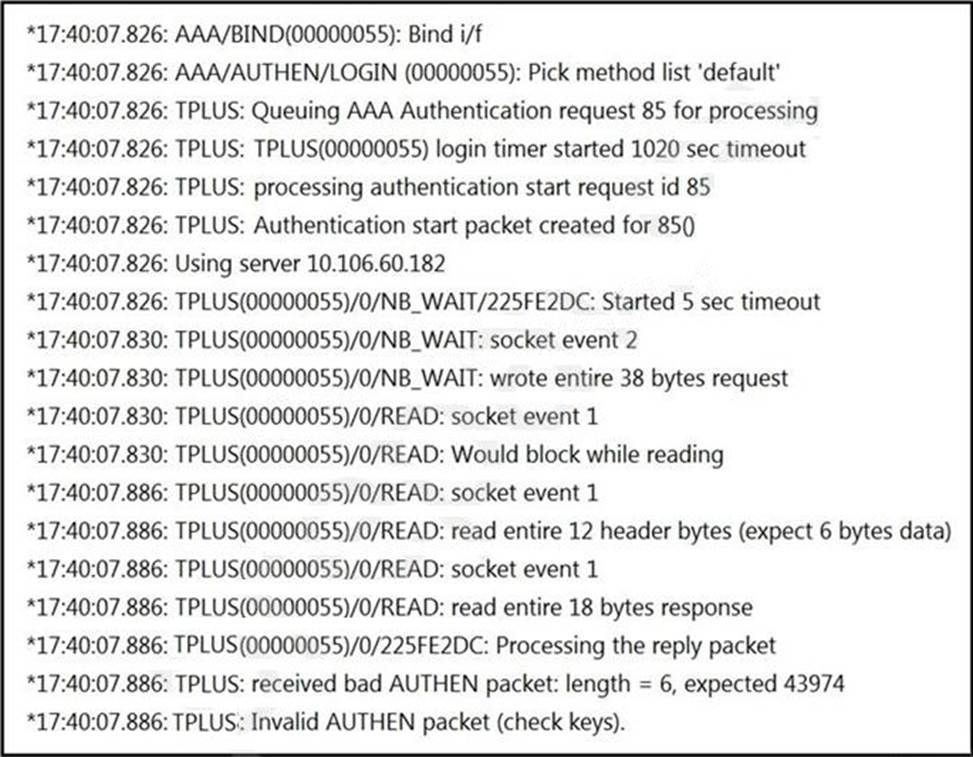
An engineer is troubleshooting a TACACS problem.
Which action resolves the issue?
- A . Configure a matching TACACS server IP.
- B . Configure a matching preshared key.
- C . Generate authentication from a relative source interface.
- D . Apply a configured AAA profile to the VTY.
B
Explanation:
Reference: https://community.cisco.com/t5/network-access-control/issues-with-tacacs-authentication/td-p/3412001
The last line shows us the reason, which is “Invalid AUTHEN packet (check keys)” so the most likely cause of this problem is key mismatch.
Refer to the exhibit.
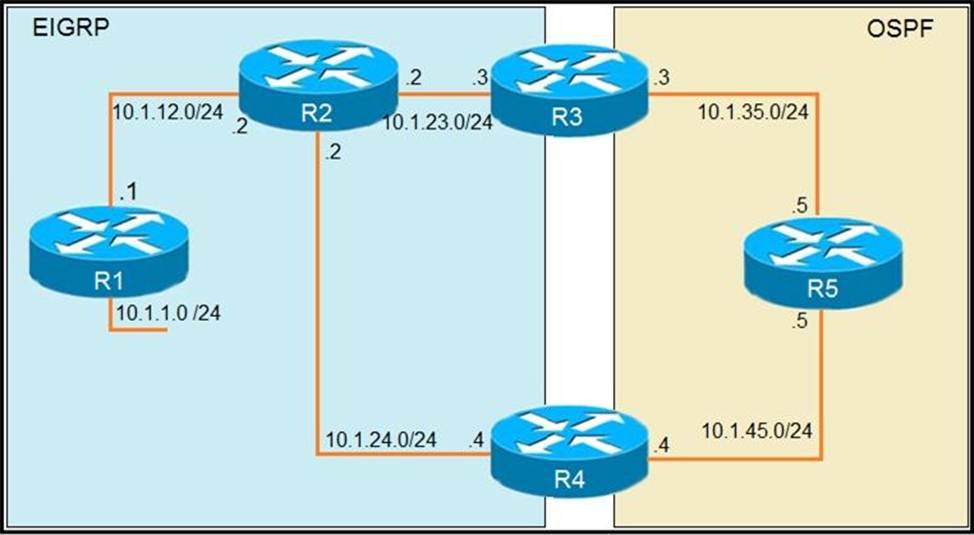
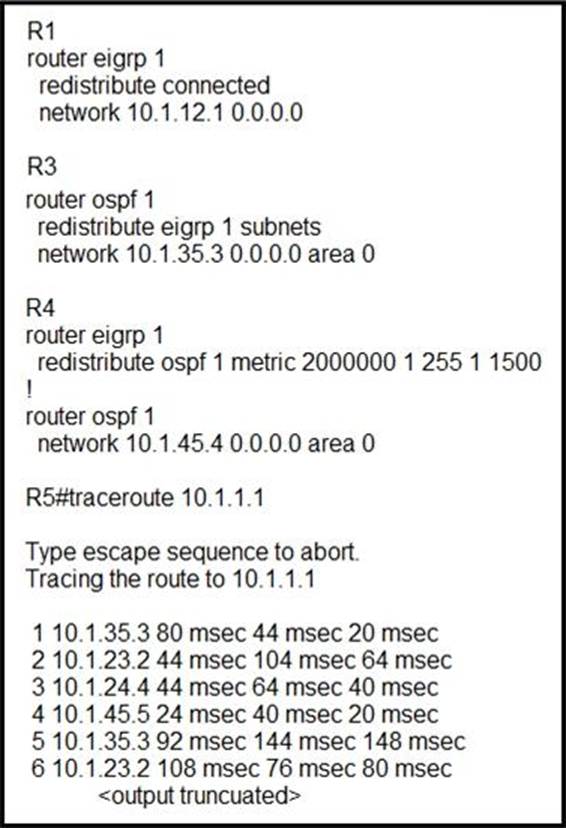
The output of the trace route from R5 shows a loop in the network.
Which configuration prevents this loop?
A)
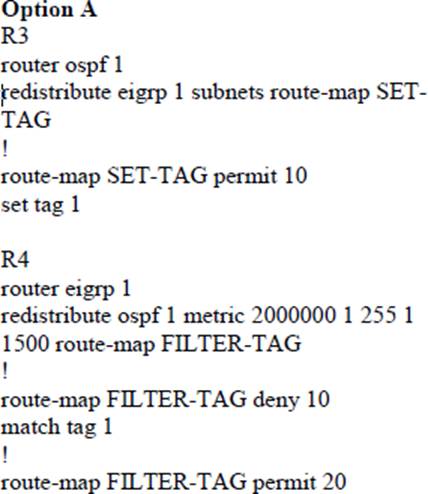
B)
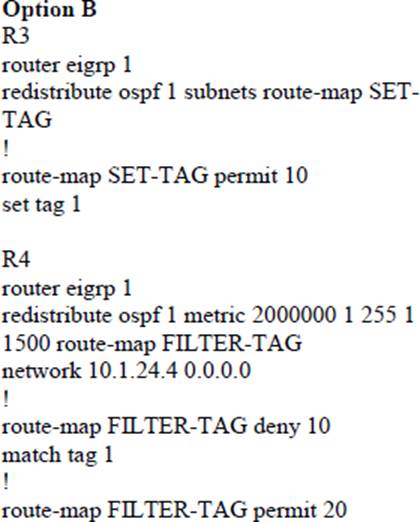
C)
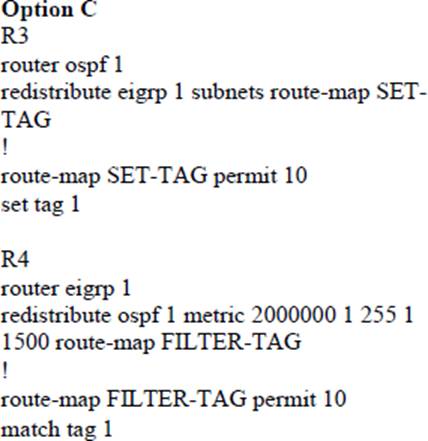
D)
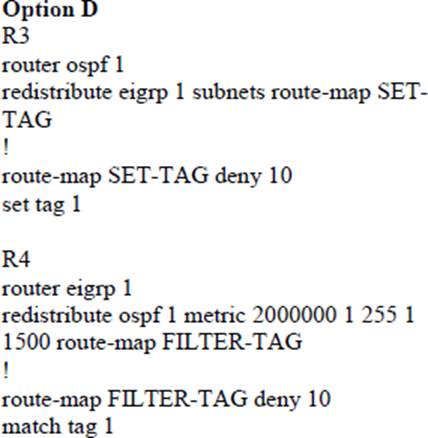
- A . Option A
- B . Option B
- C . Option C
- D . Option D
A
Explanation:
The reason for the loop is that R2 is forwarding the packets destined to 10.1.1.1 to R4, instead of R1. This is because in the redistribute OSPF statement, BW metric has a higher value and delay has a value of 1. So, R2 chooses R4 over R1 for 10.1.1.0/24 subnet causing a loop. Now, R5 learns 10.1.1.0/24 from R3 and advertises the same route to R4, that R4 redistributes back in EIGRP. If R3 sets a tag of 1 while redistributing EIGRP in OSPF, and R4 denies all the OSPF routes with tag 1 while redistributing, it will not advertise 10.1.1.0/24 back into EIGRP. Hence, the loop will be broken.
Refer to the exhibit.
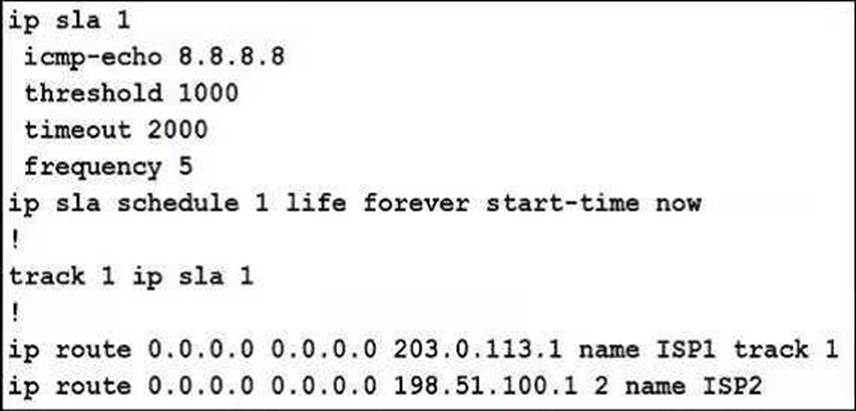
The administrator noticed that the connection was flapping between the two ISPs instead of switching to ISP2 when the ISP1 failed.
Which action resolves the issue?
- A . Include a valid source-interface keyword in the icmp-echo statement.
- B . Reference the track object 1 on the default route through ISP2 instead of ISP1.
- C . Modify the static routes to refer both to the next hop and the outgoing intertace.
- D . Modify the threshold to match the administrative distance of the ISP2 route.
A
Explanation:
https://www.cisco.com/c/en/us/support/docs/ip/ip-routing/200785-ISP-Failover-withdefault-routes-using-I.html
Refer to the exhibit.
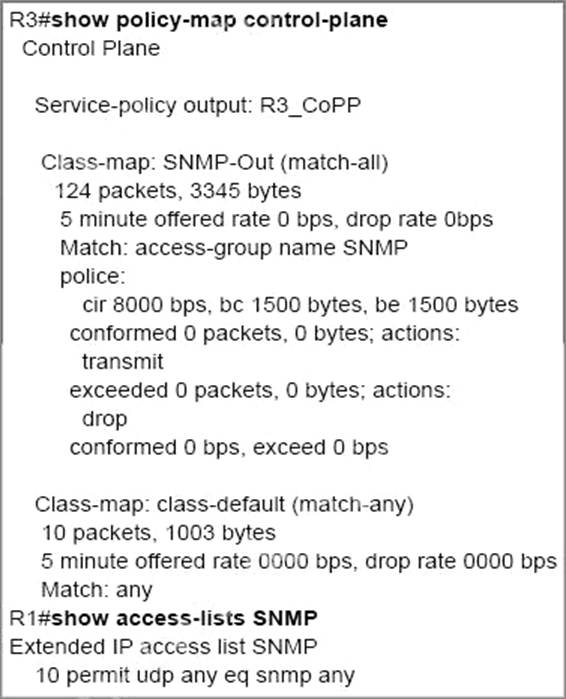
R1 is being monitored using SNMP and monitoring devices are getting only partial information.
What action should be taken to resolve this issue?
- A . Modify the CoPP policy to increase the configured exceeded limit for SNMP.
- B . Modify the access list to include snmptrap.
- C . Modify the CoPP policy to increase the configured CIR limit for SNMP.
- D . Modify the access list to add a second line to allow udp any any eq snmp