
Cisco 300-410 Practice Exams
Last updated on Nov 16,2026- Exam Code: 300-410
- Exam Name: Implementing Cisco Enterprise Advanced Routing and Services (ENARSI)
- Certification Provider: Cisco
- Latest update: Nov 16,2026
DRAG DROP
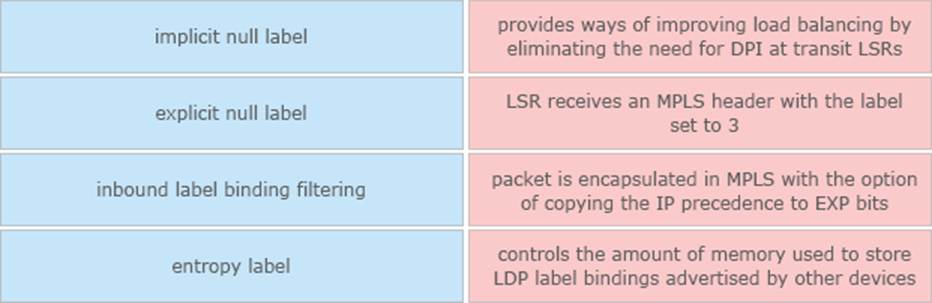
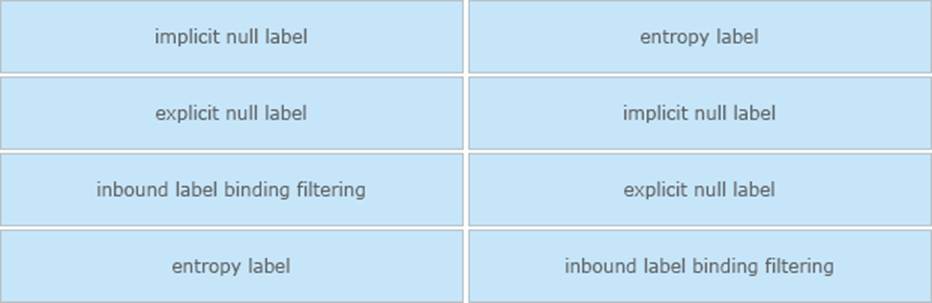
Drag and drop the LDP features from the left onto the descriptions on the right
Explanation:
Diagram Description automatically generated
The MPLS LDP Inbound Label Binding Filtering feature can be used to control the amount of memory used to store Label Distribution Protocol (LDP) label bindings advertised by other devices. For example, in a simple Multiprotocol Label Switching (MPLS) Virtual Private Network (VPN) environment, the VPN provider edge (PE) devices might require label switched paths (LSPs) only to their peer PE devices (that is, they do not need LSPs to core devices). Inbound label binding filtering enables a PE device to accept labels only from other PE devices.
Reference: https://www.cisco.com/c/en/us/td/docs/ios-xml/ios/mp_ldp/configuration/15-sy/mp-ldp-15-sy-book/mp-ldp-inbound-filtr.html
Refer to the exhibit.
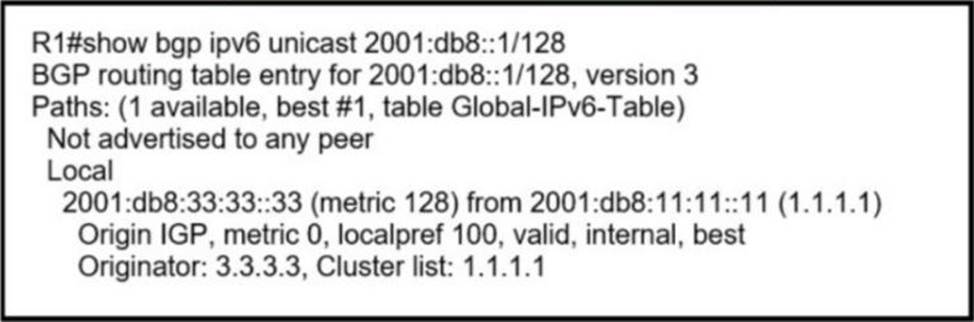
An engineer examines the BGP update for the IPv6 prefix 2001:db8::1/128. which should have been summarized into a /64 prefix.
Which sequence of actions achieves the summarization?
- A . R1 is a route reflector client of a RR with a router ID of 1.1.1.1. and the originator of the prefix has a router ID of 3.3.3.3. Both routers belong to different ASs. The prefix is not advertised to any peer and must be advertised using the network statement on R3.
- B . R1 is a route reflector with a router ID of 3.3.3.3. and the originator of the prefix is a route reflector client, which has a router ID of 3.3.3.3. Both routers belong to the same AS Configure an aggregate address on the router with ID 1.1.1.1 for the prefix
- C . R1 is a route reflector with a router ID of 1.111. and the originator of the prefix is a route reflector client, which has a router ID of 3.3.3.3. Both routers belong to the same AS Configure an aggregate address on the router with ID 1.1.1.1 for the prefix
- D . R1 is a route reflector client of a RR with a router ID of 1.1.1.1. and the originator of the prefix has a router ID of 3.3.3.3. Both routers belong to the same AS. Configure an aggregate address on the router with ID 3 3.3.3 for the prefix.
Which two protocols are used by a P router to transfer VPN traffic between PE routers in an MPLS network? (Choose two.)
- A . BGP
- B . OSPF
- C . MP-BGP
- D . LDP
- E . RSVP
Refer to the Exhibit.
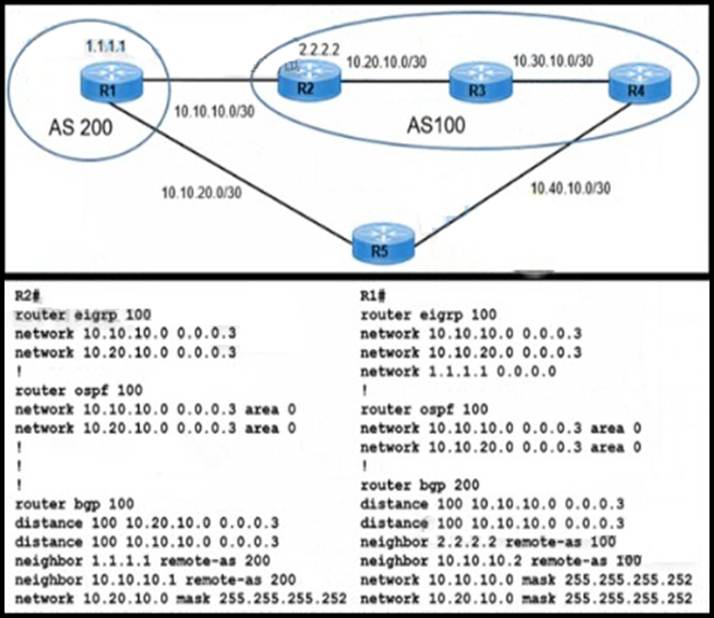
R1 and R2 use IGP protocol to route traffic between AS 100 and AS 200 despite being configured to use BGP.
Which action resolves the issue and ensures the use of BGP?
- A . Configure distance to 100 under the EIGRP process of R1 and R2.
- B . Remove distance commands under BGP AS 100 and AS 200.
- C . Remove distance commands under BGP AS 100.
- D . Configure distance to 100 under the OSPF process of R1 and R2
Refer to the exhibit.

Routers R1, R2, R3, and R4 use EIGRP However, traffic always prefers R1 to R5 backup links in nonfailure scenarios.
Which configuration resolves the issue?
A)

B)

C)

D)

- A . Option A
- B . Option B
- C . Option C
- D . Option D
DRAG DROP
Drag and Drop the IPv6 First-Hop Security features from the left onto the definitions on the right.
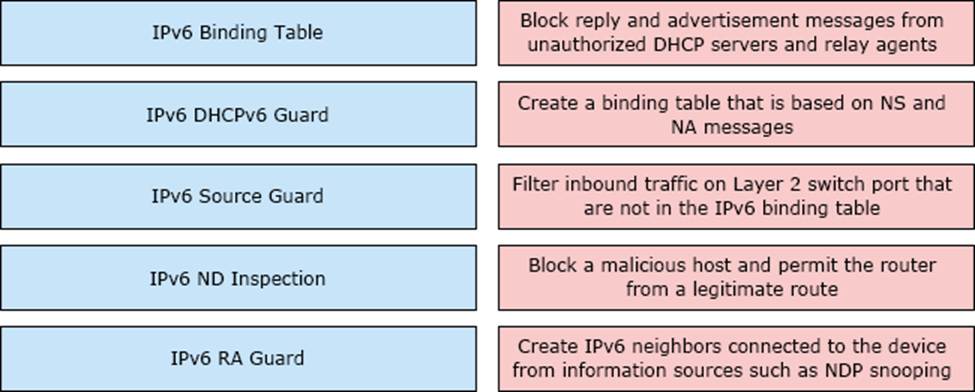
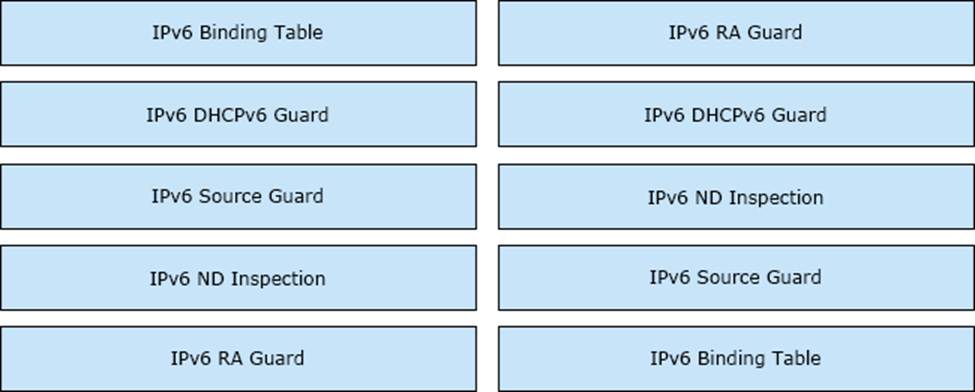
Explanation:
Graphical user
interface, chart Description automatically generated
165.202.128/27 from ISP2. An engineer is ISP1 reports they are receiving ISP2 routes from AS65401.
Which configuration onR1 resolves the issue?
- A . access-list 10 deny 209.165.202.128 0.0.0.31
access-list 10 permit any
!
router bgp 65401
neighbor 209.165.201.1 distribute-list 10 out - B . access-list 10 deny 209.165.202.128 0.0.0.31
access-list 10 permit any
!
router bgp 65401
neighbor 209.165.201.1 distribute-list 10 in - C . ip route 209.165.200.224 255.255.255.224 209.165.201.1
ip route 209.165.202.128 255.255.255.224 209.165.201.5 - D . ip route 0.0.0.0 0.0.0.0 209.165.201.1
ip route 0.0.0.0 0.0.0.0 209.165.201.5
A
Explanation:
https://www.cisco.com/c/en/us/support/docs/ip/border-gateway-protocol-bgp/23675-27.html
What are two functions of LDP? (Choose two.)
- A . It is defined in RFC 3038 and 3039.
- B . It requires MPLS Traffic Engineering.
- C . It advertises labels per Forwarding Equivalence Class.
- D . It must use Resource Reservation Protocol.
- E . It uses Forwarding Equivalence Class
C,E
Explanation:
https://www.cisco.com/c/en/us/td/docs/switches/datacenter/sw/5_x/nx-os/mpls/configuration/guide/mpls_cg/mp_mpls_overview.pdf
Refer to the exhibit.

Which configuration denies Telnet traffic to router 2 from 198A:0:200C::1/64?
A)

B)

C)

D)

- A . Option A
- B . Option B
- C . Option C
- D . Option D
Refer to the exhibit.
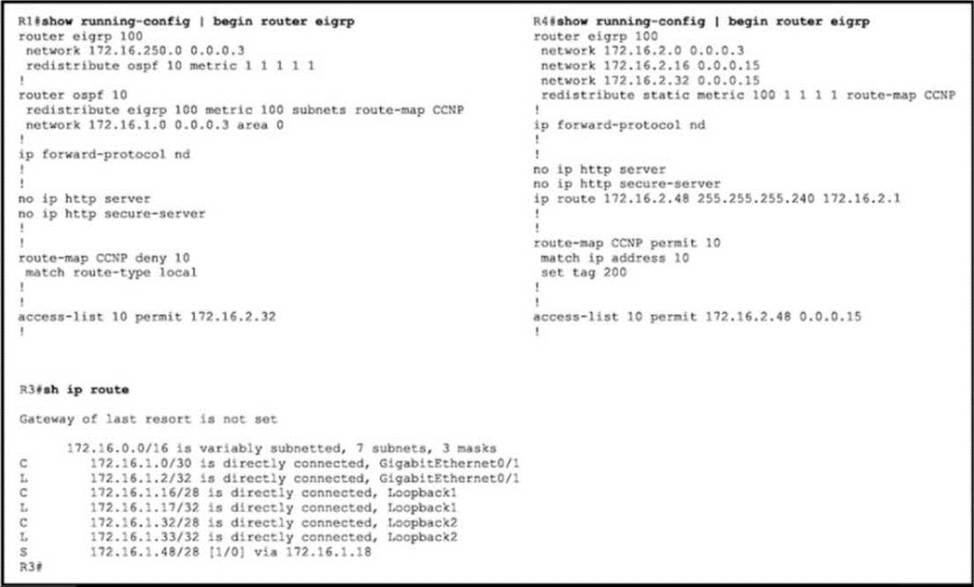
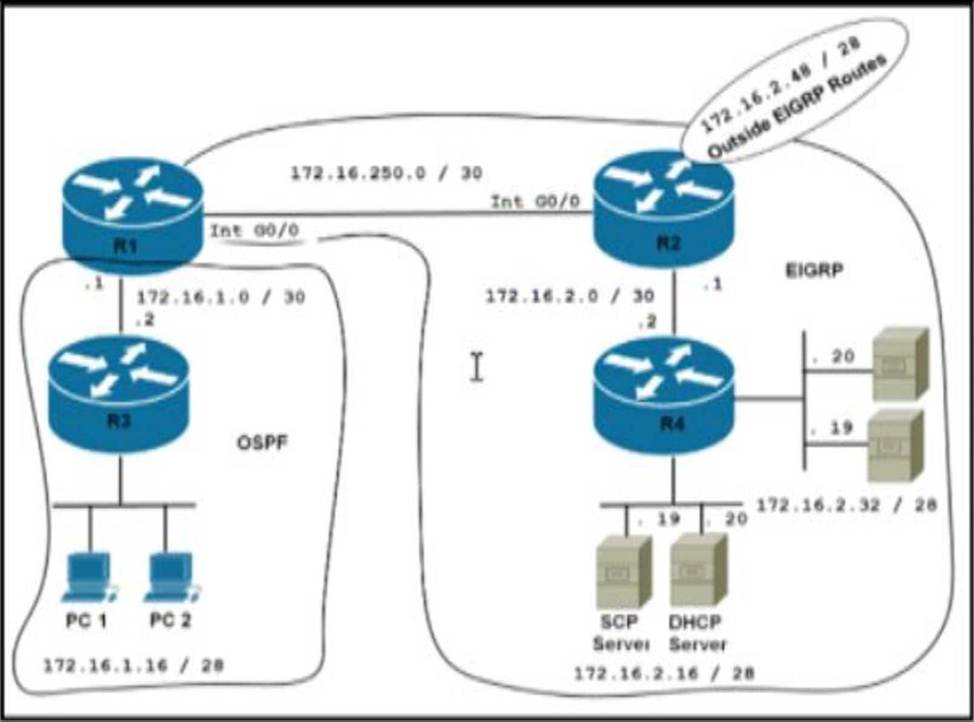
Which configuration resolves the route filtering issue on R1 to redistribute all the routes except 172.16.2.48/28?
A)

B)

C)
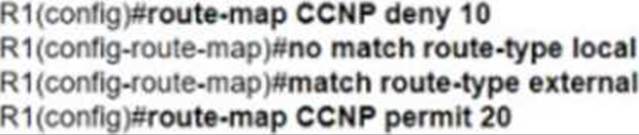
D)

- A . Option A
- B . Option B
- C . Option C
- D . Option D