
Cisco 300-410 Practice Exams
Last updated on Nov 16,2026- Exam Code: 300-410
- Exam Name: Implementing Cisco Enterprise Advanced Routing and Services (ENARSI)
- Certification Provider: Cisco
- Latest update: Nov 16,2026
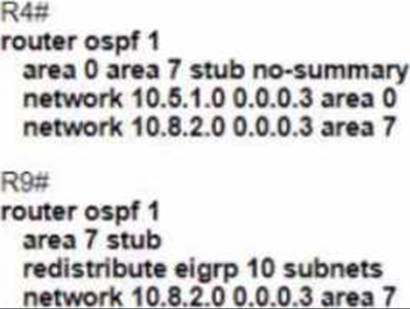
Refer to the exhibit.
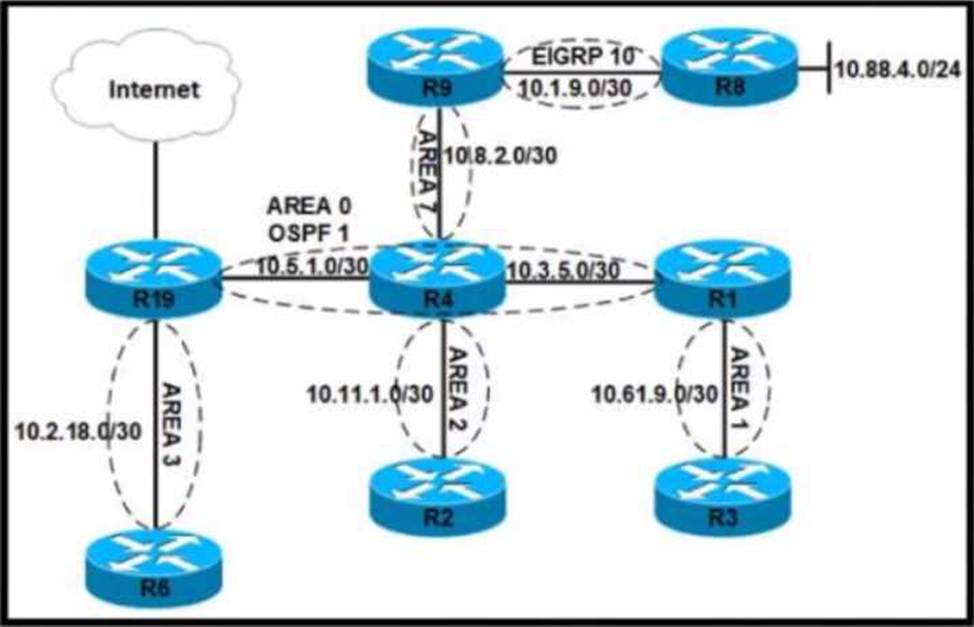
After an engineer modified the configuration for area 7 to permit type 1 2 and 7 LSAs only users connected to router R9 reported that they could no longer access the internet.
Which configuration restores internet access to users on R9 and permits only LSA type 1,2, and 7?
A)
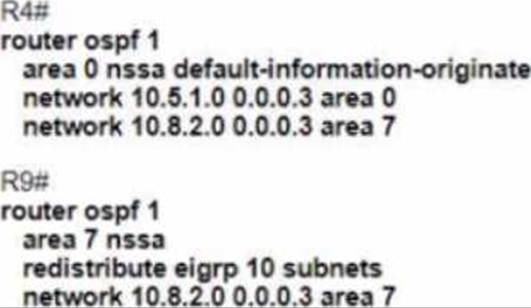
B)
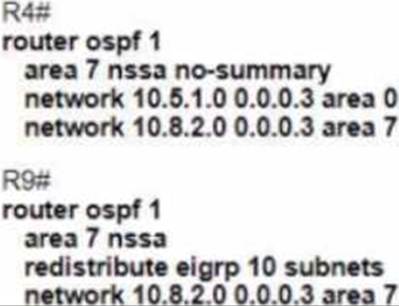
C)
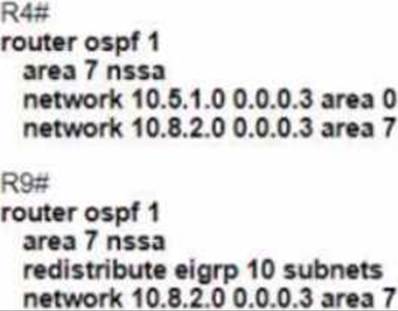
D)
- A . Option A
- B . Option B
- C . Option C
- D . Option D
B
Explanation:
Option B configures area 7 as a not-so-stubby area (NSSA) with the no-summary option on the area border router (ABR) R4. This allows the injection of external routes from EIGRP into the OSPF domain as type 7 LSAs, while preventing the propagation of inter-area summary LSAs into area 7. The no-summary option also generates a default summary route for area 7, which can be used by R9 to reach the internet2.
Option A configures area 7 as a stub area, which does not allow any external routes or type 7 LSAs in the area. This prevents R9 from learning the EIGRP routes and accessing the internet3.
Option C configures area 7 as a NSSA without the no-summary option on R4. This allows the injection of type 7 LSAs into the area, but also allows the propagation of inter-area summary LSAs into the area. However, this option does not generate a default summary route for area 7, which means R9 has no route to reach the internet4.
Option D configures area 7 as a NSSA with the default-information originate option on R4. This allows the injection of type 7 LSAs into the area, but also allows the propagation of inter-area summary LSAs into the area. The default-information originate option generates a type 7 default route for area 7, which can be used by R9 to reach the internet. However, this option is redundant and less efficient than Option B, because it injects both a type 3 and a type 7 LSA for the default route into the area5.
Refer to the exhibit.
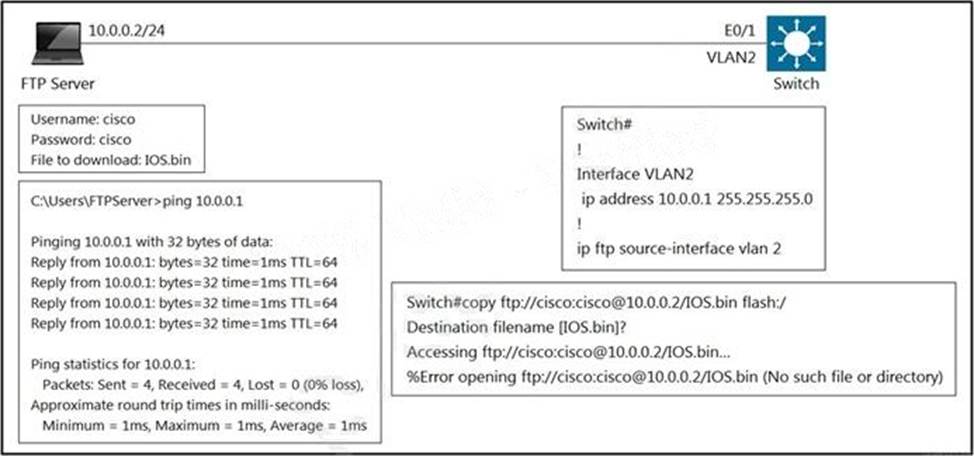
An engineer cannot copy the IOS.bin file from the FTP server to the switch.
Which action resolves the issue?
- A . Allow file permissions to download the file from the FTP server.
- B . Add the IOS.bin file, which does not exist on FTP server.
- C . Make memory space on the switch flash or USB drive to download the file.
- D . Use the copy flash:/ftp://[email protected]/IOS.bin command.
Which list defines the contents of an MPLS label?
- A . 20-bit label; 3-bit traffic class; 1-bit bottom stack; 8-bit TTL
- B . 32-bit label; 3-bit traffic class; 1-bit bottom stack; 8-bit TTL
- C . 20-bit label; 3-bit flow label; 1-bit bottom stack; 8-bit hop limit
- D . 32-bit label; 3-bit flow label; 1-bit bottom stack; 8-bit hop limit
A
Explanation:
The first 20 bits constitute a label, which can have 2^20 values. Next comes 3 bit value called Traffic Class. It was formerly called as experimental (EXP) field. Now it has been renamed to Traffic Class (TC). This field is used for QoS related functions. Ingress router can classify the packet according to some criterion and assign a 3 bit value to this filed. If an incoming packet is marked with some IP Precedence or DSCP value and the ingress router may use such a field to assign an FEC to the packet. Next bit is Stack bit which is called bottom-of-stack bit. This field is used when more than one label is assigned to a packet, as in the case of MPLS VPNs or MPLS TE. Next byte is MPLS TTL field which serves the same purpose as that of IP TTL byte in the IP header
Reference: https://tools.ietf.org/html/rfc5462
Which list defines the contents of an MPLS label?
- A . 20-bit label; 3-bit traffic class; 1-bit bottom stack; 8-bit TTL
- B . 32-bit label; 3-bit traffic class; 1-bit bottom stack; 8-bit TTL
- C . 20-bit label; 3-bit flow label; 1-bit bottom stack; 8-bit hop limit
- D . 32-bit label; 3-bit flow label; 1-bit bottom stack; 8-bit hop limit
A
Explanation:
The first 20 bits constitute a label, which can have 2^20 values. Next comes 3 bit value called Traffic Class. It was formerly called as experimental (EXP) field. Now it has been renamed to Traffic Class (TC). This field is used for QoS related functions. Ingress router can classify the packet according to some criterion and assign a 3 bit value to this filed. If an incoming packet is marked with some IP Precedence or DSCP value and the ingress router may use such a field to assign an FEC to the packet. Next bit is Stack bit which is called bottom-of-stack bit. This field is used when more than one label is assigned to a packet, as in the case of MPLS VPNs or MPLS TE. Next byte is MPLS TTL field which serves the same purpose as that of IP TTL byte in the IP header
Reference: https://tools.ietf.org/html/rfc5462
Refer to the exhibit.
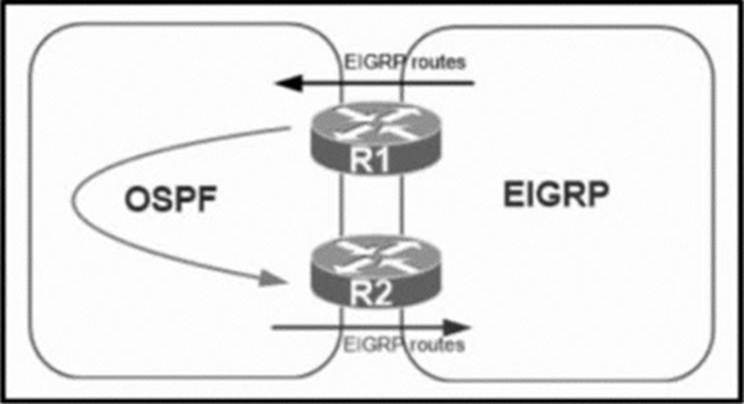
A network administrator configured mutual redistribution on R1 and R2 routers, which caused instability in the network.
Which action resolves the issue?
- A . Set a tag in the route map when redistributing EIGRP into OSPF on R1. and match the same tag on R2 to deny when redistributing OSPF into EIGRP.
- B . Set a tag in the route map when redistributing EIGRP into OSPF on R1. and match the same tag on R2 to allow when redistributing OSPF into EIGRP.
- C . Advertise summary routes of EIGRP to OSPF and deny specific EIGRP routes when redistributing into OSPF.
- D . Apply a prefix list of EIGRP network routes in OSPF domain on R1 to propagate back into the EIGRP routing domain.
A
Explanation:
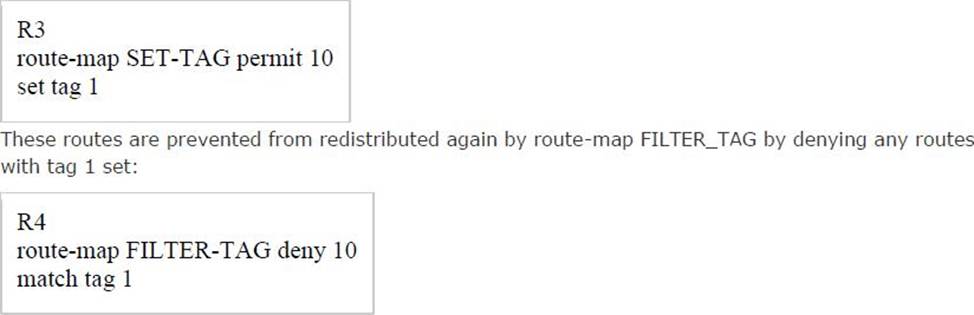
When doing mutual redistribution at multiple points (between OSPF and EIGRP on R1 & R2), we may create routing loops so we should use route-map to prevent redistributed routes from redistributing again into the original domain.
In the below example, the route-map “SET-TAG” is used to prevent any routes that have been redistributed into EIGRP from redistributed again into OSPF domain by tagging these routes with tag 1:
Refer to the exhibit.
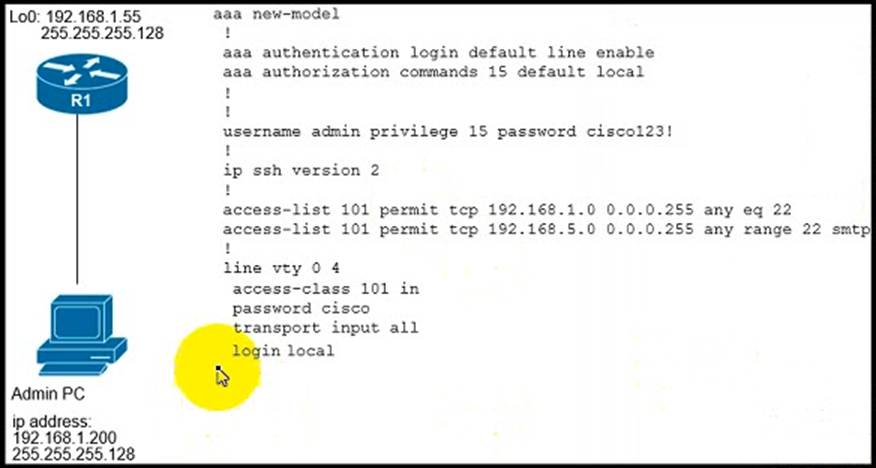
An engineer configured user login based on authentication database on the router, but no one can log into the router.
Which configuration resolves the issue?
- A . aaa authentication login default enable
- B . aaa authorization network default local
- C . aaa authentication login default local
- D . aaa authorization exec default local
A switch has been configured to provide DHCP relay on VLAN 100 to a server with an IP address of 10.1.1.1. The DHCP server is sending syslog reports of multiple TFTP requests that also originate from the switch. As a result, the server CPU exceeded a configured threshold.
Which action does the network administrator recommend to bring the server CPU threshold down?
- A . Configure the switch with an access list on VLAN100 to deny TFTP.
- B . Configure the switch with a VACL on VLAN100 to deny TFTP.
- C . Configure the switch with ip forward-protocol udp 67 globally.
- D . Configure the switch with no ip forward-protocol udp 69 on VLAN100.
Refer to the exhibit.
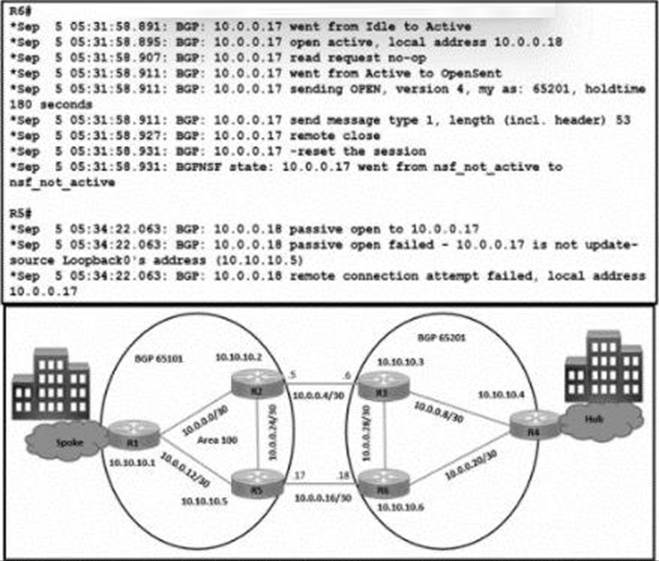
The traffic from spoke to hub is dropping.
The operations team observes:
✑ R2-R3 link is down due to the fiber cut.
✑ R2 and R5 receive traffic from R1 in AS 65101.
✑ R3 and R5 receive traffic from R4 in AS 65201.
Which configuration resolves the issue?
A)

B)

C)

D)

- A . Option A
- B . Option B
- C . Option C
- D . Option D
Refer to the exhibit.
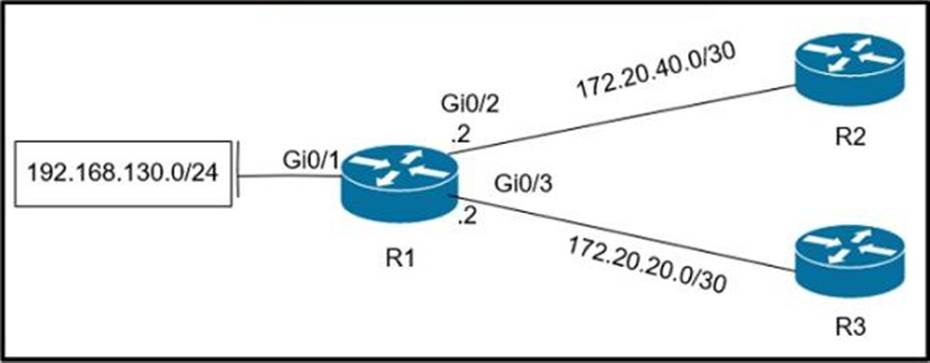
Which policy configuration on R1 forwards any traffic that is sourced from the 192 168 130 0’24 network to R2?
A)
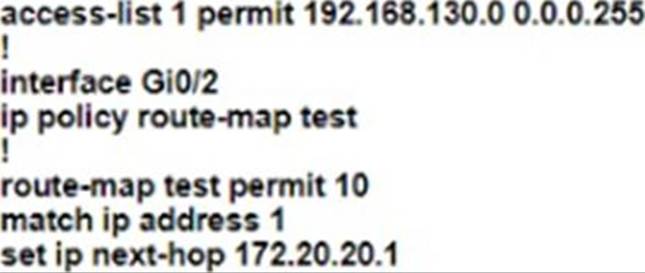
B)
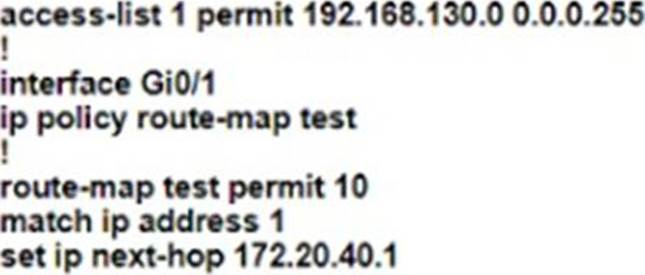
C)
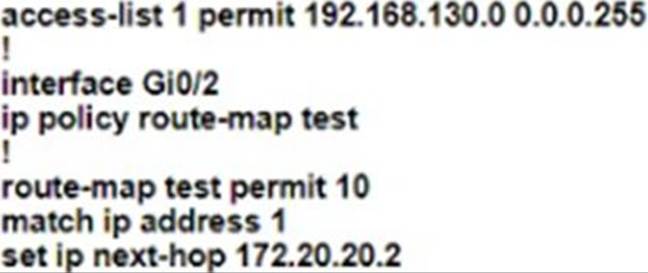
D)
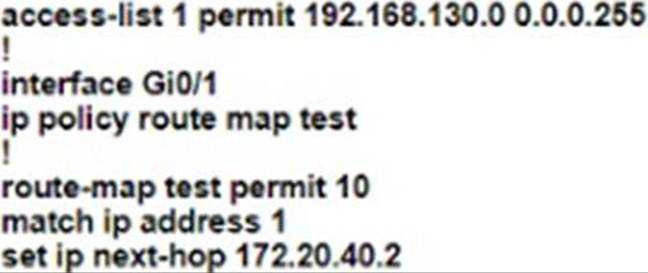
- A . Option A
- B . Option B
- C . Option C
- D . Option D
Clients on ALS2 receive IPv4 and IPv6 addresses but clients on ALS1 receive only IPv4 addresses and not IPv6 addresses.
Which action on DSW1 allows clients on ALS1 to receive IPv6 addresses?
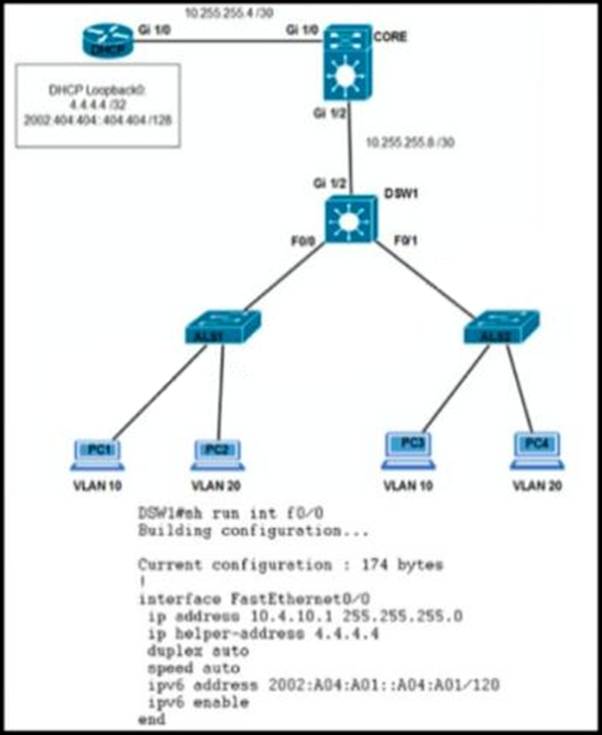
- A . Configure DSW1(config-if)#ipv6 helper address 2002:404:404::404:404
- B . Configure DSW1(dhcp-config)#default-router 2002:A04:A01::A04:A01
- C . Configure DSW1(config)#ipv6 route 2002:404:404:404:404/128 FastEthernet1/0
- D . Configure DSW1(config-if)#ipv6 dhcp relay destination 2002:404:404::404:404 GigabitEthernet1/2
B
Explanation:
https://community.cisco.com/t5/networking-documents/stateful-dhcpv6-relay-configuration-example/ta-p/3149338