
Cisco 300-410 Practice Exams
Last updated on Nov 16,2026- Exam Code: 300-410
- Exam Name: Implementing Cisco Enterprise Advanced Routing and Services (ENARSI)
- Certification Provider: Cisco
- Latest update: Nov 16,2026
Refer to the exhibit.
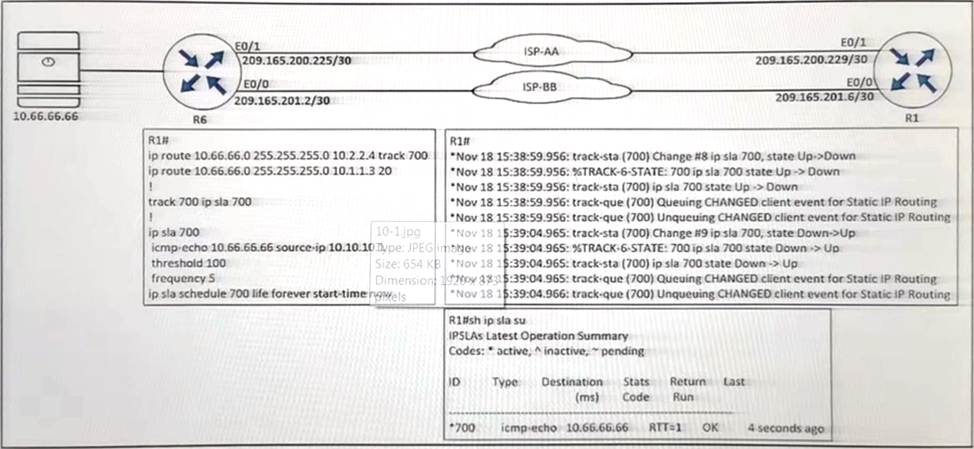
An engineer configured IP SLA on R1 to avoid the ISP link flapping problem. but it is not working as designed IP SLA should wait 30 seconds before switching traffic to a secondary connection and then revert to the primary link after waning 20 seconds, when the primary link is available and stabilized.
Which configuration resolves the issue?
- A . R1(config)#ip sla 700
R1(config-ip-sla)#delay down 30 up 20 - B . R1(config)#ip sla 700
R1(config-ip-sla)#delay down 20 up 30 - C . R1(config)#track 700 ip sla 700
R1(config-track)#delay down 30 up 20 - D . R1(config)#track 700 ip sla 700
R1(config-track)#delay down 20 up 30
C
Explanation:
“wait 30 seconds before switching traffic to a secondary connection” -> delay down 30 “then revert to the primary link after waiting 20 seconds” -> up 20
Under the track object, you can specify delays so we have to configure delay under “track 700 ip sla 700” (not under “ip sla 700”).
Which configuration adds an IPv4 interface to an OSPFv3 process in OSPFv3 address family
configuration?
- A . Router ospf3 1 address-family ipv4
- B . Router(config-router)#ospfv3 1 ipv4 area 0
- C . Router(config-if)#ospfv3 1 ipv4 area 0
- D . Router ospfv3 1 address-family ipv4 unicast
C
Explanation:
Reference: https://www.cisco.com/c/en/us/td/docs/ios-xml/ios/iproute_ospf/configuration/xe-3s/iro-xe-3s-book/ip6-route-ospfv3-add-fam-xe.html
Which Layer 3 VPN attribute allows different customers to connect to the same MPLS network with overlapping IP ranges?
- A . VRF
- B . RT
- C . MP-BGP
- D . RD
D
Explanation:
In a Layer 3 VPN (Virtual Private Network) over an MPLS (Multiprotocol Label Switching) network, the attribute that allows different customers to connect with overlapping IP ranges is the Route Distinguisher (RD)123.
RD is a unique identifier that is prepended to each IP address in a customer’s VPN to create a unique VPNv4 address. This allows customers to use overlapping IP addresses without conflict123. The RD makes it possible for the same IP prefix to exist in different VPNs, which is crucial when customers have overlapping IP ranges123.
Reference: MPLS Layer 3 VPN Explained – NetworkLessons.com
MPLS: Layer 3 VPNs Configuration Guide – Cisco
Understanding Using MPLS-Based Layer 3 VPNs on Switches – Juniper
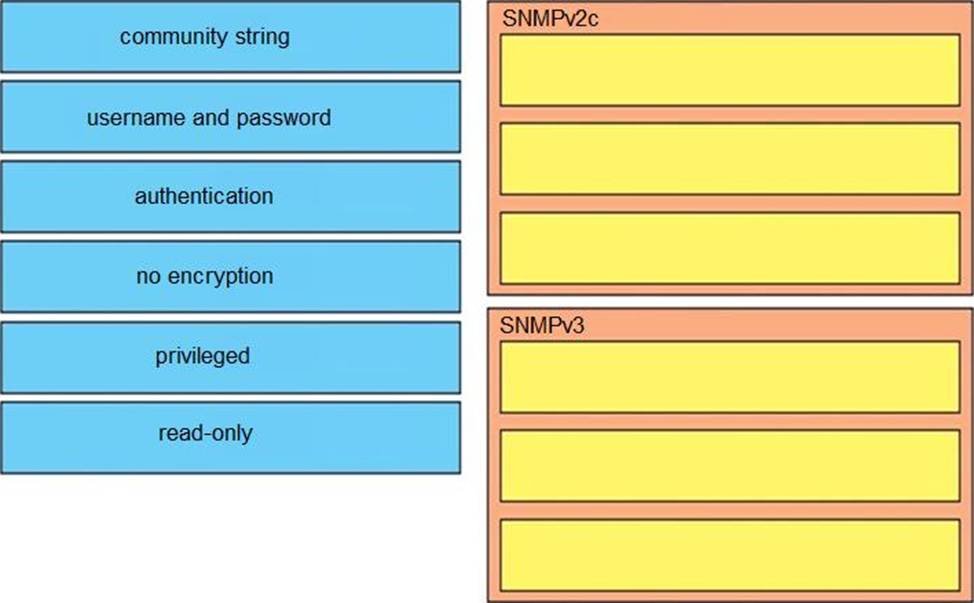
DRAG DROP
Drag and drop the SNMP attributes in Cisco IOS devices from the left onto the correct SNMPv2c or SNMPV3 categories on the right.
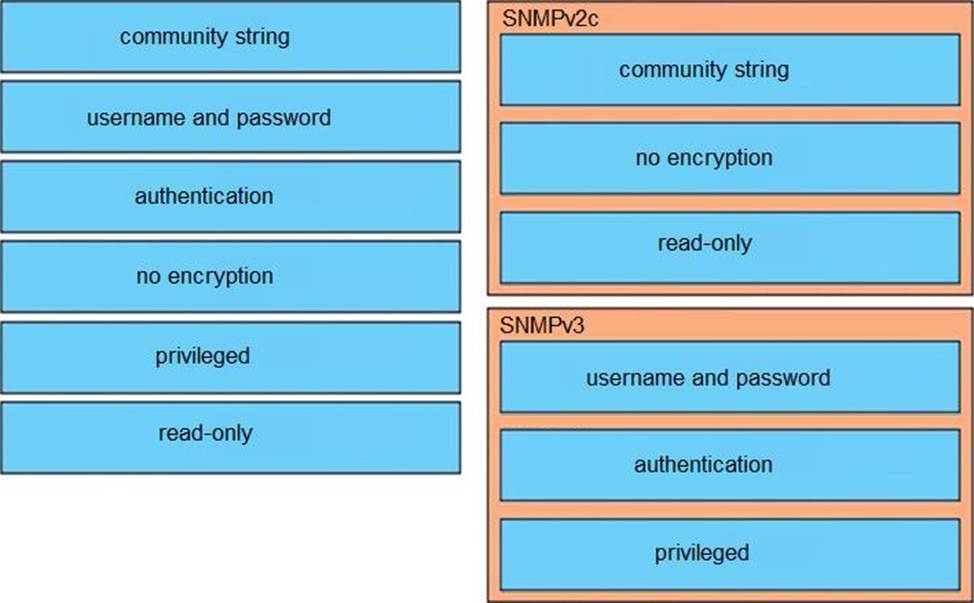
Explanation:
Graphical user interface, application Description automatically generated
What does IPv6 Source Guard utilize to determine if IPv6 source addresses should be forwarded?
- A . ACE
- B . ACLS
- C . DHCP
- D . Binding Table
D
Explanation:

Exhibit:
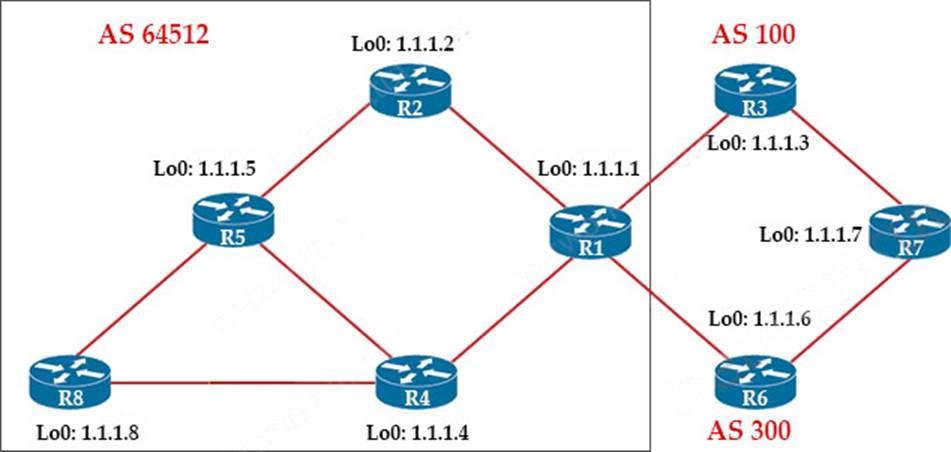
An engineer configured R2 and R5 as route reflectors and noticed that not all routes are sent to R1 to advertise to the eBGP peers.
Which iBGP routers must be configured as route reflectors to advertise all routes to restore reachability across all networks?
- A . R1 and R4
- B . R1 and R5
- C . R4 and R5
- D . R2 and R5
C
Explanation:
When R2 & R5 are route reflectors (RRs), routes from R4 & R8 are advertised to R5 and R5 advertises to R2. But R2 would drop them as R2 is also a RR. Therefore some routes are missing on R1 to advertise to eBGP peers.
Good reference:
https://www.ciscolive.com/c/dam/r/ciscolive/emea/docs/2015/pdf/TECRST-2310.pdf
Route reflectors (RR) must be fully iBGP meshed so we cannot configure RR on both R1 and R5.
We should choose routers at the center of the topology RRs, in this case R4 & R5.
Exhibit:
An engineer configured R2 and R5 as route reflectors and noticed that not all routes are sent to R1 to advertise to the eBGP peers.
Which iBGP routers must be configured as route reflectors to advertise all routes to restore reachability across all networks?
- A . R1 and R4
- B . R1 and R5
- C . R4 and R5
- D . R2 and R5
C
Explanation:
When R2 & R5 are route reflectors (RRs), routes from R4 & R8 are advertised to R5 and R5 advertises to R2. But R2 would drop them as R2 is also a RR. Therefore some routes are missing on R1 to advertise to eBGP peers.
Good reference:
https://www.ciscolive.com/c/dam/r/ciscolive/emea/docs/2015/pdf/TECRST-2310.pdf
Route reflectors (RR) must be fully iBGP meshed so we cannot configure RR on both R1 and R5.
We should choose routers at the center of the topology RRs, in this case R4 & R5.
Exhibit:
An engineer configured R2 and R5 as route reflectors and noticed that not all routes are sent to R1 to advertise to the eBGP peers.
Which iBGP routers must be configured as route reflectors to advertise all routes to restore reachability across all networks?
- A . R1 and R4
- B . R1 and R5
- C . R4 and R5
- D . R2 and R5
C
Explanation:
When R2 & R5 are route reflectors (RRs), routes from R4 & R8 are advertised to R5 and R5 advertises to R2. But R2 would drop them as R2 is also a RR. Therefore some routes are missing on R1 to advertise to eBGP peers.
Good reference:
https://www.ciscolive.com/c/dam/r/ciscolive/emea/docs/2015/pdf/TECRST-2310.pdf
Route reflectors (RR) must be fully iBGP meshed so we cannot configure RR on both R1 and R5.
We should choose routers at the center of the topology RRs, in this case R4 & R5.
Refer to the exhibit.
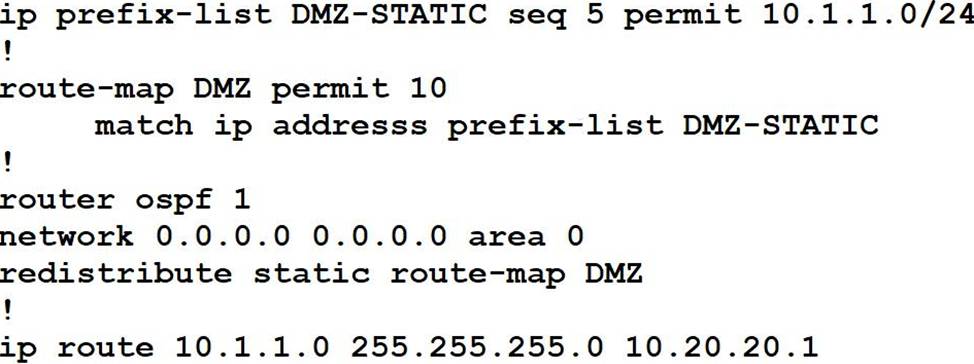
The static route is not present in the routing table of an adjacent OSPF neighbor router.
Which action resolves the issue?
- A . Configure the next hop of 10.20.20.1 in the prefix list DMZ-STATIC
- B . Configure the next-hop interface at the end of the static router for it to get redistributed
- C . Configure a permit 20 statement to the route map to redistribute the static route
- D . Configure the subnets keyword in the redistribution command
While troubleshooting connectivity issues to a router, these details are noticed:
✑ Standard pings to all router interfaces, including loopbacks, are successful.
✑ Data traffic is unaffected.
✑ SNMP connectivity is intermittent.
✑ SSH is either slow or disconnects frequently.
Which command must be configured first to troubleshoot this issue?
- A . show policy-map control-plane
- B . show policy-map
- C . show interface | inc drop
- D . show ip route