
Cisco 300-410 Practice Exams
Last updated on Nov 16,2026- Exam Code: 300-410
- Exam Name: Implementing Cisco Enterprise Advanced Routing and Services (ENARSI)
- Certification Provider: Cisco
- Latest update: Nov 16,2026
An engineer configured Reverse Path Forwarding on an interface and noticed that the routes are dropped when a route lookup fails on that interface for a prefix that is available in the routing table.
Which interface configuration resolves the issue?
- A . ip verify unicast source reachable-via rx
- B . ip verify unicast source reachable-via any
- C . ip verify unicast source reachable-via allow-default
- D . ip verify unicast source reachable-via 12-src
B
Explanation:
According to this question, uRPF is running in strict mode because packets are dropped even when that route exists in the routing table. Maybe packets are dropped because the receiving interface is different from the interface the local router uses to send packets to that destination. The ip verify unicast source reachable-via rx command enables Unicast RPF in strict mode.
To enable loose mode, administrators can use the any option (ip verify unicast source reachable-via any). In loose mode, it doesn’t matter if we use this interface to reach the source or not.
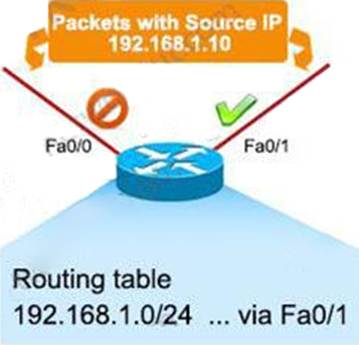
The allow-default option allows the use of the default route in the source verification process.
Which Ipv6 first-hop security feature helps to minimize denial of service attacks?
- A . IPv6 Router Advertisement Guard
- B . IPv6 Destination Guard
- C . DHCPv6 Guard
- D . IPv6 MAC address filtering
B
Explanation:
The Destination Guard feature helps in minimizing denial-of-service (DoS) attacks. It performs address resolutions only for those addresses that are active on the link, and requires the FHS binding table to be populated with the help of the IPv6 snooping feature. The feature enables the filtering of IPv6 traffic based on the destination address, and blocks the NDP resolution for destination addresses that are not found in the binding table. By default, the policy drops traffic coming for an unknown destination.
Reference: https://www.cisco.com/c/en/us/td/docs/routers/7600/ios/15S/configuration/guide/7600_15_0s_book/IPv6_Security.pdf
DRAG DROP
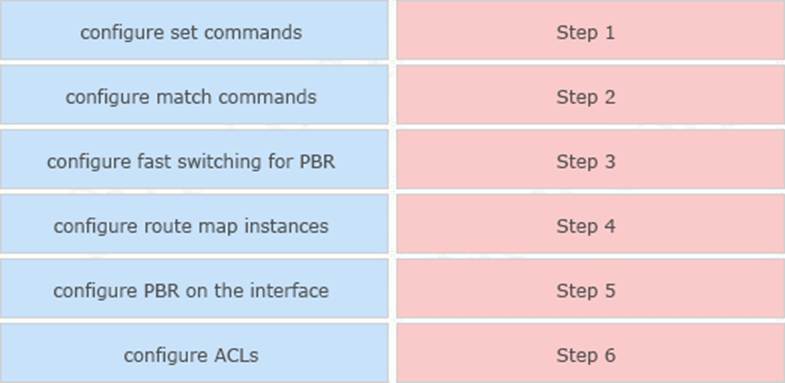
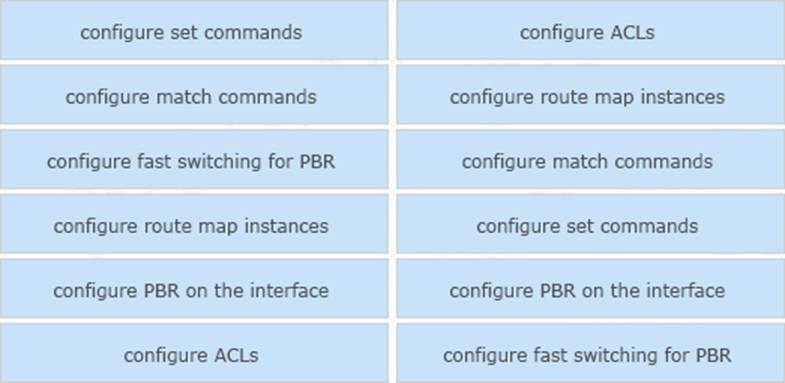
Drag and drop the actions from the left into the correct order on the right to configure a policy to avoid following packet forwarding based on the normal routing path.
Explanation:
https://community.cisco.com/t5/networking-documents/how-to-configure-pbr/ta-p/3122774
Refer to the exhibit.
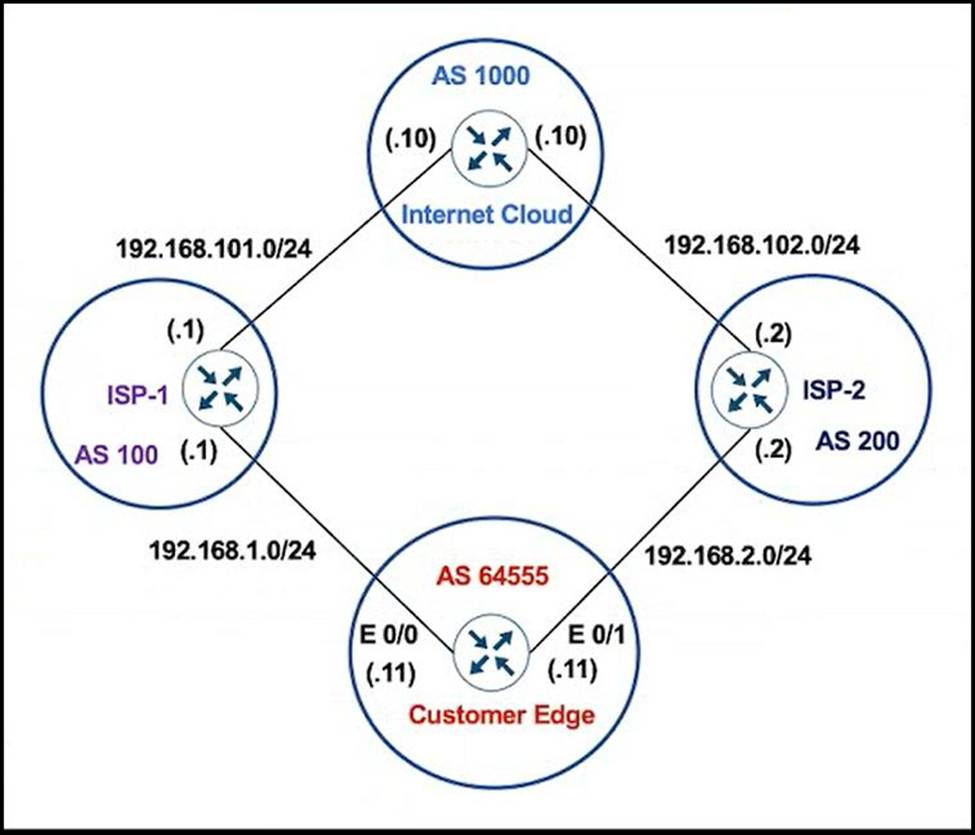
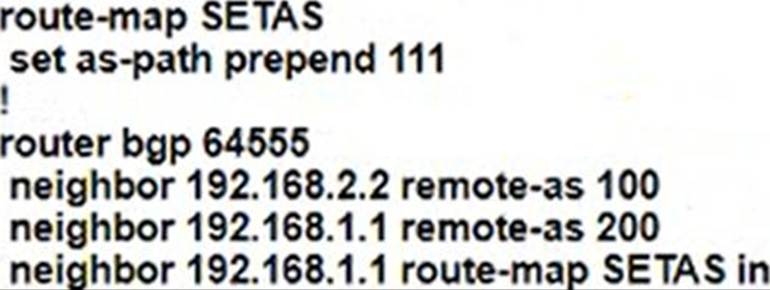
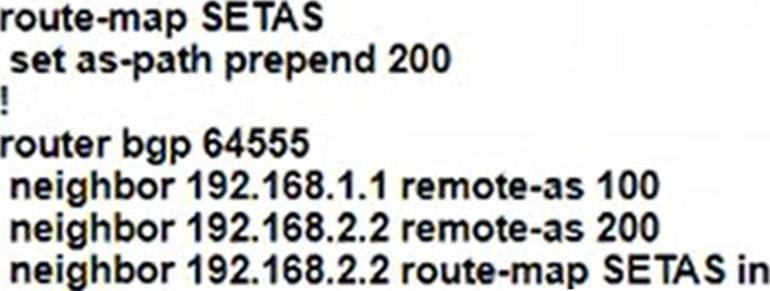
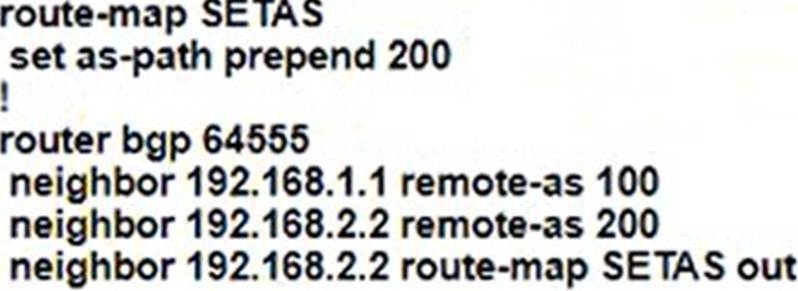
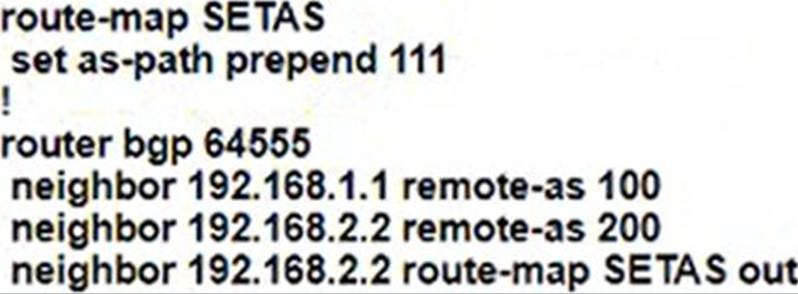
The Customer Edge rouler wants to use AS 100 as the preferred ISP for all external routes and ISP-2 as a backup.
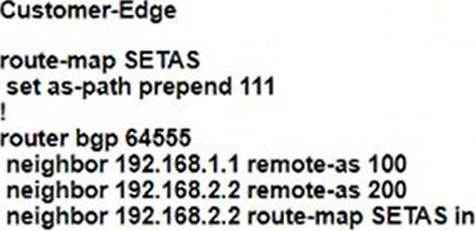
After this configuration, all the backup routes have disappeared from the BGP table on the Customer Edge router.
Which set of configurations resolves the issue on the Customer Edge router?
A)
B)
C)
D)
- A . Option A
- B . Option B
- C . Option C
- D . Option D
Refer to the exhibit.
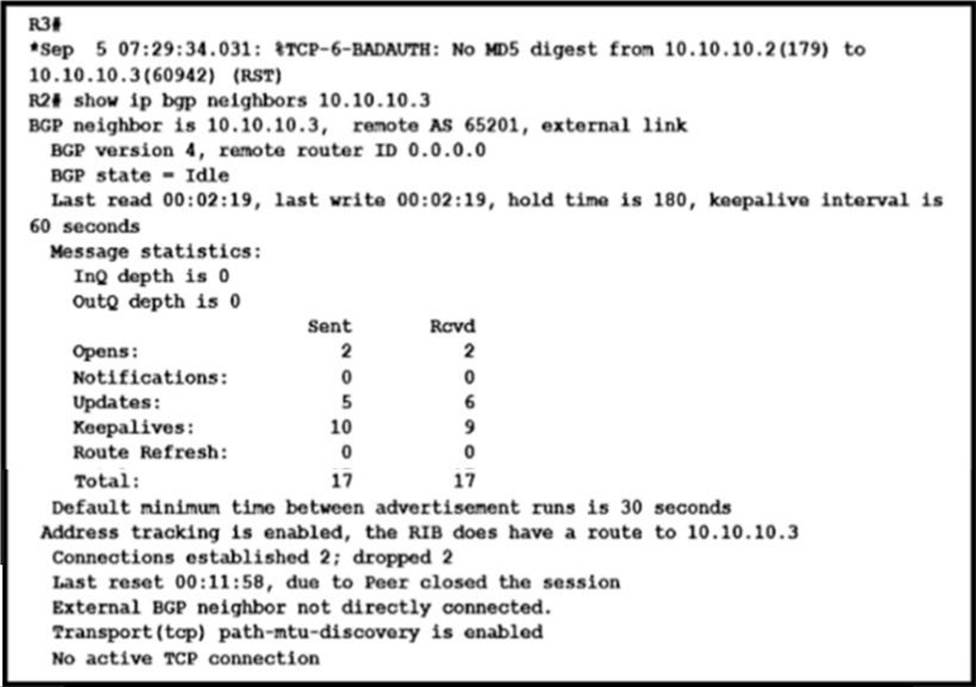
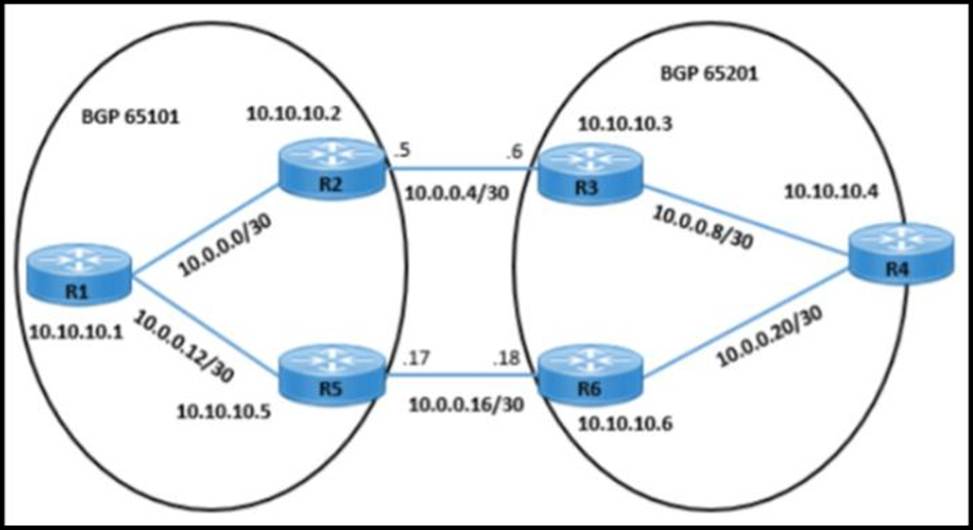
The network operation team observes a traffic forwarding issue between R2 and R3:
✑ Ping and traceroute of loopback IP address from R2 to R3 is successful.
✑ iBGP peering in AS 65101 and AS 65201 is up.
Which configuration resolves the issue?
- A . Configure MD5 password authentication on R2.
- B . Advertise R2 and R3 loopback IPs in AS 65101 and AS 65201.
- C . Remove MD5 password authentication on R3.
- D . Set up eBGP multihop on R2 and R3 routers.
Refer to the exhibit.
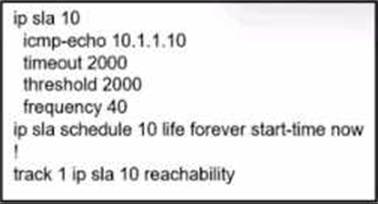
An engineer configured IP SLA to monitor a next hop on a router for reachability When the next hop
is unreachable, the router is executing tracking and failing over another route, but packet loss is experienced because the reachability is flapping.
Which action resolves the issue?
- A . Append delay up 0 down Ovto the track command
- B . Increase the timeout of the sla probe to 6000
- C . Append delay up SO down 60vto the track command
- D . Increase the frequency of the sla probe to 60.
C
Explanation:
IP SLA (Internet Protocol Service Level Agreement) is a feature that allows you to measure network performance such as latency, jitter, packet loss, and so on. In this case, it’s being used to monitor the reachability of a next hop on a router123.
When the next hop is unreachable, the router is executing tracking and failing over to another route. However, packet loss is experienced because the reachability is flapping. This could be due to the router switching back and forth between the primary and backup routes too quickly.
To resolve this issue, you can introduce a delay in the tracking process. This can be done by appending a delay to the track command. Option C suggests appending a delay of 50 seconds for the up state and 60 seconds for the down state45. This means that the router will wait for 50 seconds before declaring the tracked object as up (reachable) and 60 seconds before declaring it as down (unreachable). This delay can help prevent the router from switching routes too quickly, thus reducing the chances of reachability flapping and packet loss45.
Reference: Configure ISP Failover with Default Routes Using IP SLA Tracking – Cisco
Using IPSLA to change routing – Cisco Community
How to Use IP SLA Technology to Assess WAN Performance
Reliable Static Routing with IP SLA – NetworkLessons.com
Configuring Static Route Tracking using IP SLA (Basic)
A newly installed spoke router is configured for DMVPN with the ip mtu 1400 command.
Which configuration allows the spoke to use fragmentation with the maximum negotiated TCP MTU over GRE?
- A . ip tcp adjust-mss 1360
crypto ipsec fragmentation after-encryption - B . ip tcp adjust-mtu 1360
crypto ipsec fragmentation after-encryption - C . ip tcp adjust-mss 1360
crypto ipsec fragmentation mtu-discovery - D . ip tcp adjust-mtu 1360
crypto ipsec fragmentation mtu-discovery
A
Explanation:
https://www.cisco.com/c/en/us/support/docs/security/dynamic-multipoint-vpn-dmvpn/111976-dmvpn-troubleshoot-00.html
Refer to the exhibit.
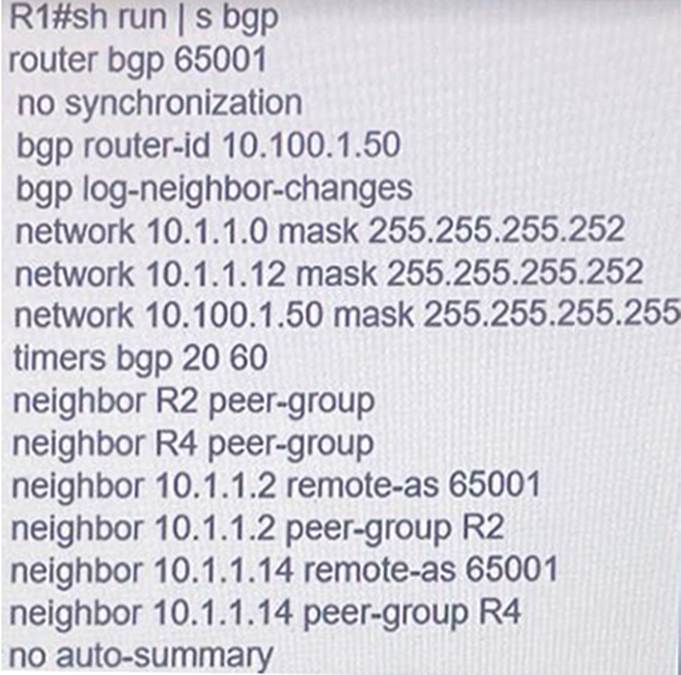
While troubleshooting a BGP route reflector configuration, an engineer notices that reflected routes are missing from neighboring routers.
Which two BGP configurations are needed to resolve the issue? (Choose two)
- A . neighbor 10.1.1.14 route-reflector-client
- B . neighbor R2 route-reflector-client
- C . neighbor 10.1.1.2 allowas-in
- D . neighbor R4 route-reflector-client
- E . neighbor 10.1.1.2 route-reflector-client
Refer to the exhibit.

When the FastEthemet0/1 goes down, the route to 172.29.0 0/16 via 192.168.253 2 is not installed in the RIB.
Which action resolves the issue?
- A . Configure reported distance greater than the feasible distance
- B . Configure feasible distance greater than the successor’s feasible distance.
- C . Configure reported distance greater than the successor’s feasible distance.
- D . Configure feasible distance greater than the reported distance
D
Explanation:
From the exhibit, we notice network 172.29.0.0/16 was learned via two routes:
+ From 192.168.254.2 with FD = 307200 and AD = 281600
+ From 192.168.253.2 with FD = 410200 and AD = 352300
The first route is installed into the RIB as the successor route because of lower FD.
When the first route fails, router will not use the second route as it does not satisfy the feasibility condition. The feasibility condition states that, the Advertised Distance (AD, also called the reported distance) of a route must be lower than the feasible distance of the current successor route.
Refer to Exhibit.
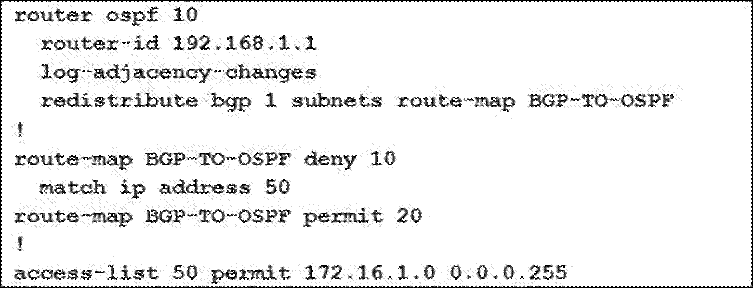
Which statement about redistribution from BGP into OSPF process 10 is true?
- A . Network 172.16.1.0/24 is not redistributed into OSPF.
- B . Network 10.10 10.0/24 is not redistributed into OSPF
- C . Network 172.16.1.0/24 is redistributed with administrative distance of 1.
- D . Network 10.10.10.0/24 is redistributed with administrative distance of 20.