
Cisco 300-410 Practice Exams
Last updated on Nov 16,2026- Exam Code: 300-410
- Exam Name: Implementing Cisco Enterprise Advanced Routing and Services (ENARSI)
- Certification Provider: Cisco
- Latest update: Nov 16,2026
While working with software images, an engineer observes that Cisco DNA Center cannot upload its software image directly from the device.
Why is the image not uploading?
- A . The device must be resynced to Cisco DNA Center.
- B . The software image for the device is in install mode.
- C . The device has lost connectivity to Cisco DNA Center.
- D . The software image for the device is in bundle mode
B
Explanation:
Upload Software Images for Devices in Install Mode
The Image Repository page might show a software image as being in Install Mode. When a device is in Install Mode, Cisco DNA Center is unable to upload its software image directly from the device. When a device is in install mode, you must first manually upload the software image to the Cisco DNA Center repository before marking the image as golden, as shown in the following steps.
Reference: https://www.cisco.com/c/en/us/td/docs/cloud-systems-management/network-automation-andmanagement/dna-center/1-2-10/user_guide/b_cisco_dna_center_ug_1_2_10/b_dnac_ug_1_2_10_chapter_0100.html
Refer to the exhibit.
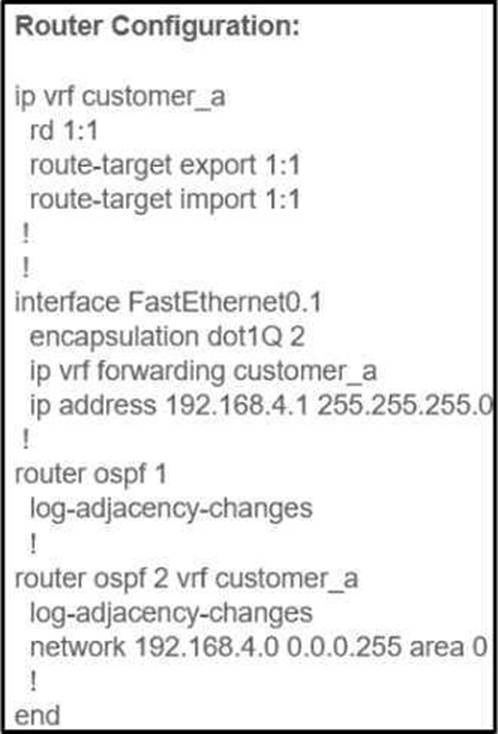
The network administrator configured VRF lite for customer A. The technician at the remote site misconfigured VRF on the router.
Which configuration will resolve connectivity for both sites of customer_a?
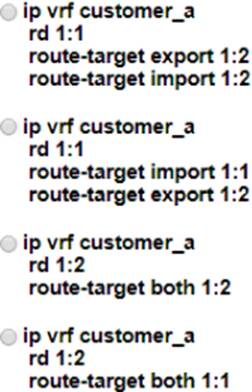
- A . Option A
- B . Option B
- C . Option C
- D . Option D
D
Explanation:
From the exhibit, we learned:
+ VRF customer_a was exported with Route target (RT) of 1:1 so at the remote site it must be imported with the same RT 1:1.
+ VRF customer_a was imported with Route target (RT) of 1:1 so at the remote site it must be exported with the same RT 1:1.
Therefore at the remote site we must configure the command “route-target both 1:1” (which is equivalent to two commands “route-target import 1:1” & “route-target export 1:1”.
Refer to the exhibit.
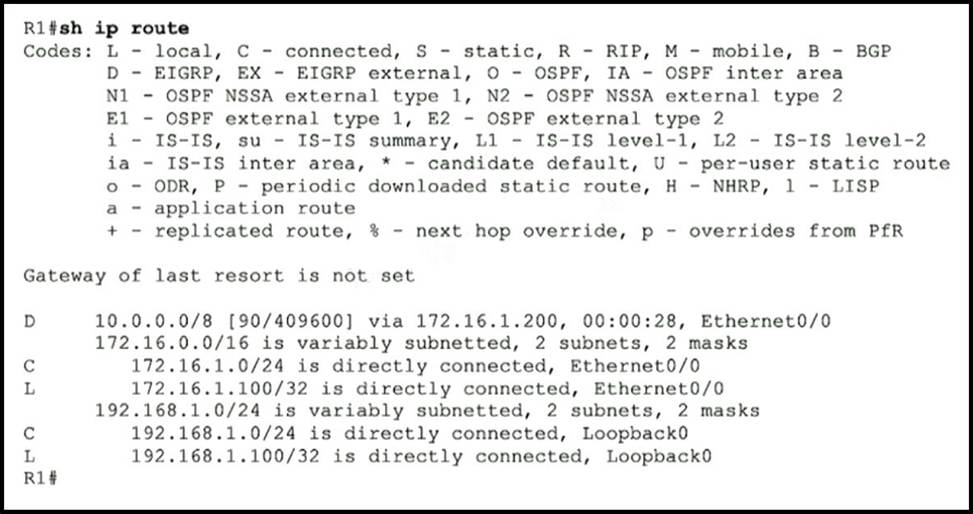
The R2 loopback interface is advertised with RIP and EIGRP using default values.
Which configuration changes make R1 reach the R2 loopback using RIP?
- A . R1(config)# router rip
R1(config-router)# distance 90 - B . R1(config)# router rip
R1(config-router)# distance 100 - C . R1(config)# router eigrp 1
R1(config-router)# distance eigrp 130 120 - D . R1(config)# router eigrp 1
R1(config-router)# distance eigrp 120 120
C
Explanation:
distance (AD Number u want to change to) (neighbor IP) (Wildcard Mask) (access-list number)
Refer to the exhibit.
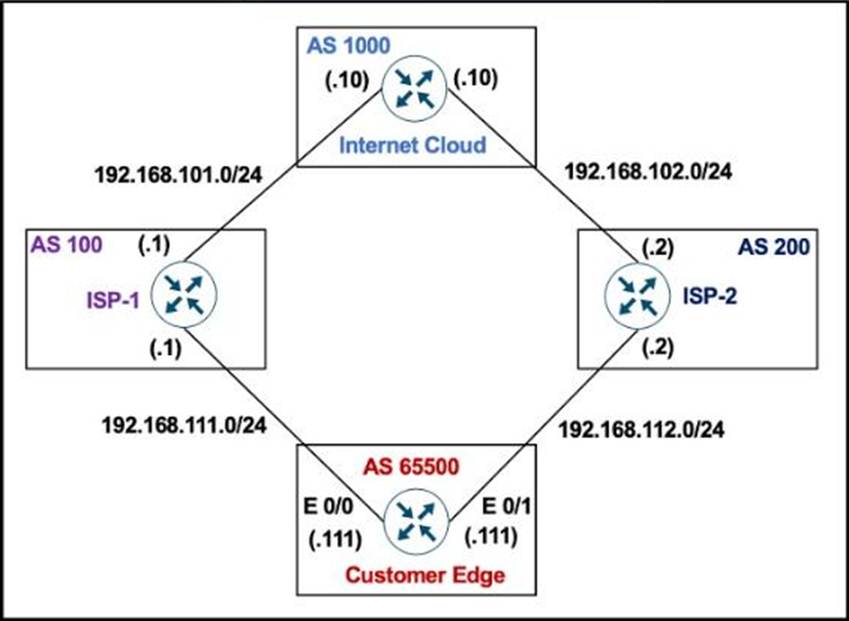
The Customer Edge router (AS 65500) wants to use ASC100 as the preferred ISP for all external routes.
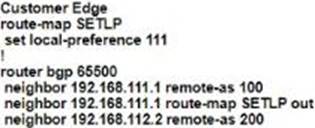
This configuration failed to send routes to AS 100 as the preferred path.
Which set of configuration resolves the issue?
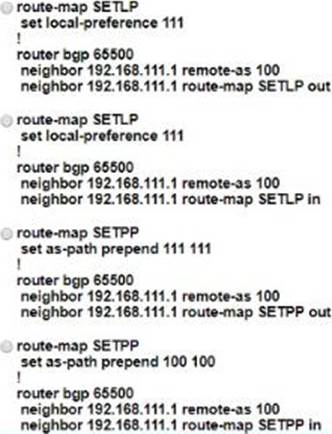
- A . Option A
- B . Option B
- C . Option C
- D . Option D
Refer to the exhibit.
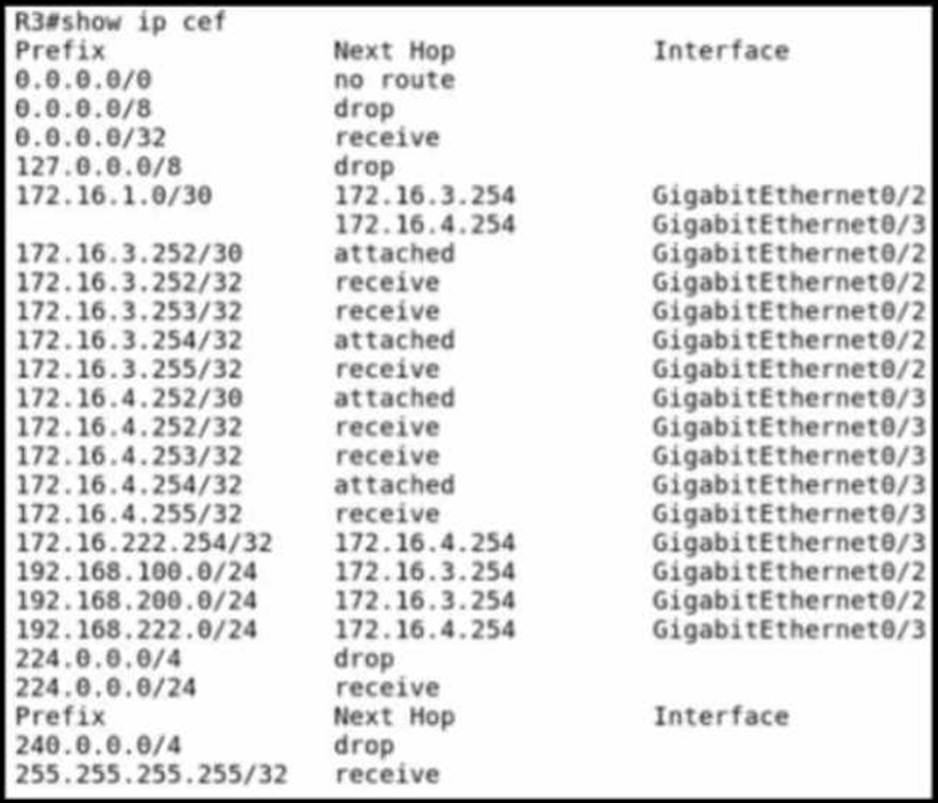
An engineer recently implemented uRPF by configuring the ip verify unicast source reachable-via rx command on interface gi0/3 The engineer noticed right after implementing F that an inbound packet on the giO-3 interface with a source address of 172 16 3 251 was dropped.
Which action resolves the issue?
- A . Configure uRPF loose mode to forward the packet.
- B . Permit the 172.16.3.251 in the inbound ACL on interface gi0/3.
- C . Permit the 172.16.3.251 in the inbound ACL on interface gi0/3 to allow 172.16.3.251.
- D . Configure uRPF strict mode to forward the packet
A
Explanation:
Option A configures uRPF loose mode to forward the packet. This mode allows the router to check if there is a route in the routing table that matches the source IP address of the incoming packet, regardless of the interface that is used to reach the source. This mode is suitable for networks that have asymmetric routing, where the incoming and outgoing interfaces for a packet may differ2.
Option B permits the 172.16.3.251 in the inbound ACL on interface gi0/3. This option does not resolve the issue, because it only allows the packet to pass the ACL check, but not the uRPF check. The packet will still be dropped by uRPF if there is no route to reach the source IP address via the same interface3.
Option C permits the 172.16.3.251 in the inbound ACL on interface gi0/3 to allow 172.16.3.251. This option is redundant and incorrect, because it repeats the same IP address twice in the ACL statement. It also does not resolve the issue for the same reason as Option B3.
Option D configures uRPF strict mode to forward the packet. This option does not resolve the issue, because it is the same mode that was already configured on the interface. Strict mode requires that the router has a route to reach the source IP address via the same interface where the packet was received. If this condition is not met, the packet will be dropped4.
The network administrator configured CoPP so that all routing protocol traffic toward the router CPU is limited to 1 mbps. All traffic that exceeds this limit must be dropped.
The router is running BGP and OSPF Management traffic for Telnet and SSH must be limited to 500kbps.
access-list 100 permit tcp any any eq 179
access-list 100 permit tcp any any range 22 23
access-list 100 permit ospf any any
!
class-map CM-ROUTING
match access-group 100
class-map CM-MGMT
match access-group 100
!
policy-map PM-COPP
class CM-ROUTING
police 1000000 conform-action transmit
class CM-MGMT
police 500000 conform-action transmit
!
control-plane
service-policy output PM-COPP
No traffic is filtering through CoPP,which is resulting in high CPU utilization,which configuration resolves
the issue?
- A . no access-list 100access-list 100 permit tcp any any eq 179
access-list 100 permit ospf any any
access-list 101 Permit tcp any any range 22 23
!
class-map CM-MGMT
no match access-group 100
match access-group 101 - B . control-plane
no service-policy output PM-COPP
service-policy input PM-COPP - C . No access-list 100
access-list 100 permit tcp any any eq 179
access-list 100 permit tcp any any range eq 22
access-list 100 permit tcp any any range eq 23
access-list 100 permit ospf any any - D . no access-list 100
access-list 100 permit tcp any any eq 179
access-list 100 permit ospf any any
access-list 101 Permit tcp any any range 22 23
!
class-map CM-MGMT
no match access-group 100
match access-group 101
!
control-plane
no service-policy output PM-COPP
service-policy input PM-COPP
An engineer needs dynamic routing between two routers and is unable to establish OSPF adjacency.
The output of the show ip ospf neighbor command shows that the neighbor state is EXSTART/EXCHANGE.
Which action should be taken to resolve this issue?
- A . match the passwords
- B . match the hello timers
- C . match the MTUs
- D . match the network types
C
Explanation:

Refer to the exhibit.
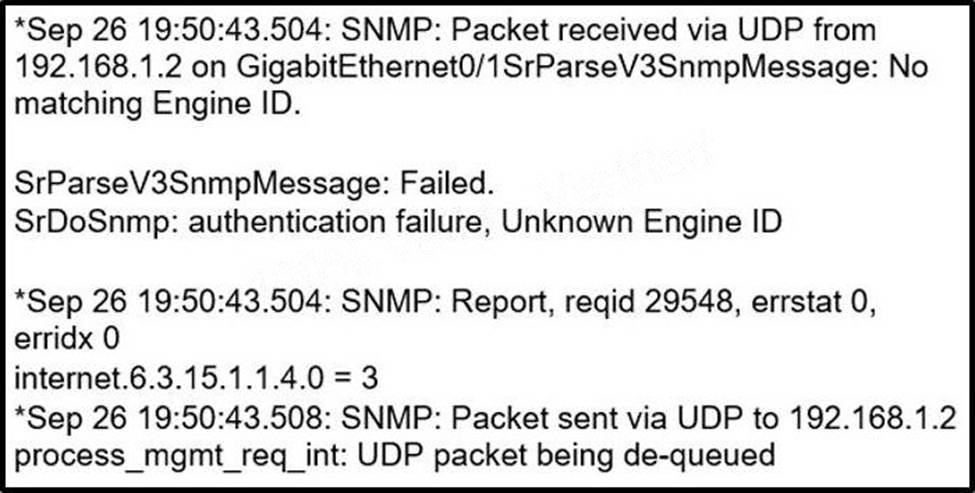
Which two commands provide the administrator with the information needed to resolve the issue? (Choose two.)
- A . Show snmp user
- B . debug snmp engine-id
- C . debug snmpv3 engine-id
- D . debug snmp packet
- E . showsnmpv3 user
A,D
Explanation:
There are 3 values in the SNMPv3 header that must match for the communication to take place: snmpEngineID, snmpEngineTime, snmpEngineBoots. The error received indicates a problem with the EngineID value: “authentication failure, Unknown Engine ID”
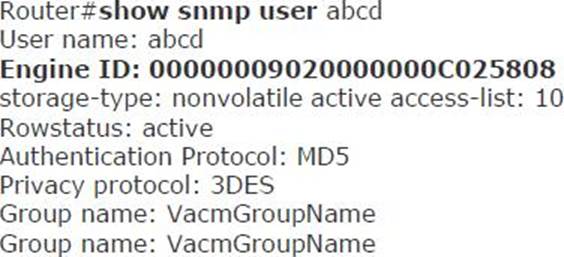
To specify the Engine ID, we can use the command “show snmp user”. The following example specifies the username as abcd with Engine ID: 00000009020000000C025808:
The “debug snmp packet” command displays all SNMP packets that are arriving and being replied to.
Refer to the exhibit.
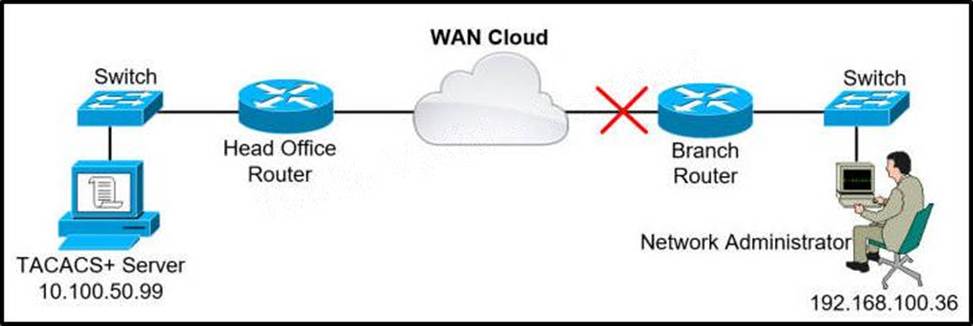
A network administrator is trying to access a branch router using TACACS+ username and password credentials, but the administrator cannot log in to the router because the WAN connectivity is down.
The branch router has following AAA configuration:
aaa new-model
aaa authorization commands 15 default group tacacs+
aaa accounting commands 1 default stop-only group tacacs+
aaa accounting commands 15 default stop-only group tacacs+
tacacs-server host 10.100.50.99
tacacs-server key CI$co123
Which command will resolve this problem when WAN connectivity is down?
- A . aaa authentication login default group tacacs+ local
- B . aaa authentication login default group tacacs+ enable
- C . aaa authentication login default group tacacs+ console
- D . aaa authentication login console group tacacs+ enable
A
Explanation:
With the “aaa authentication login default group tacacs+ local ” command configured, when logging in, the password supplied will be attempted to be verified by the TACACS+ server before access is granted. If the server is unavailable/unreachable, then the switch will fall back to using the local authentication database.
Refer to the exhibit.
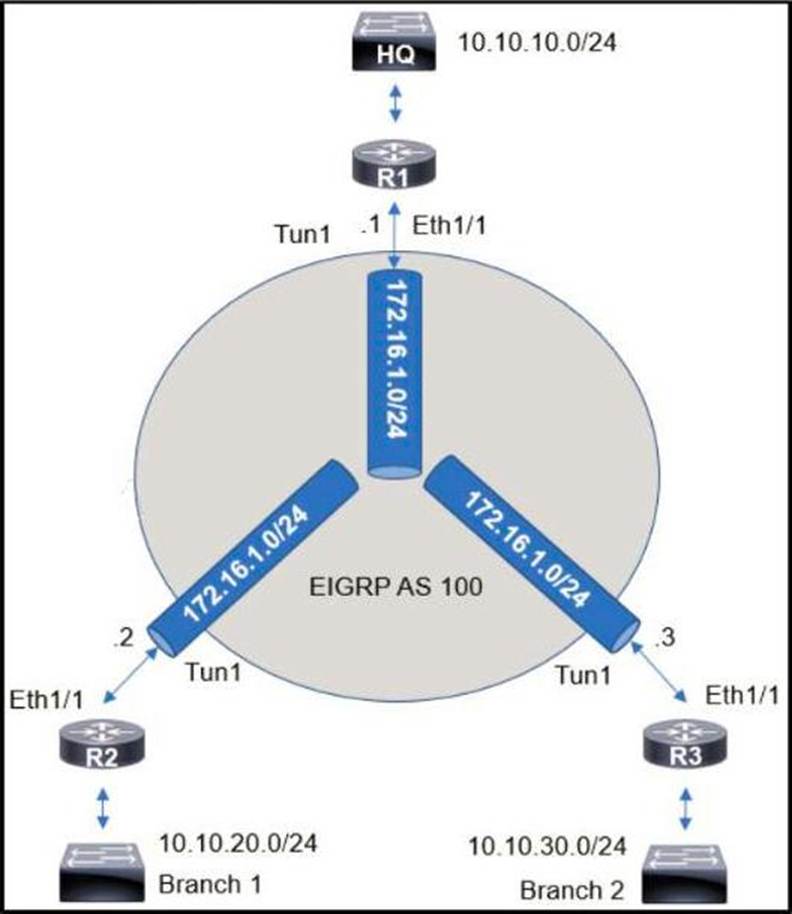
An engineer sets up a DMVPN connection to connect branch 1 and branch 2 to HQ branch 1 and branch 2 cannot communicate with each other.
Which change must be made to resolve this issue?
- A . Option A
- B . Option B
- C . Option C
- D . Option D
D
Explanation:
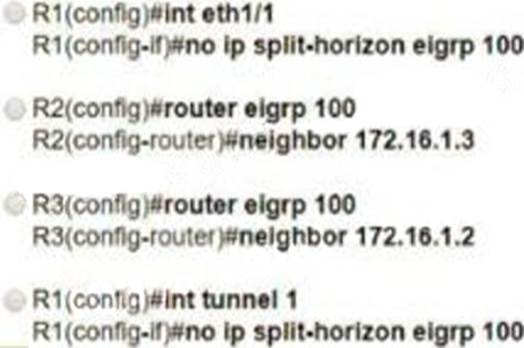
R1(config)#int tunnel 1
R1(config-if) no ip split-horizon eigrp 100