
Cisco 300-410 Practice Exams
Last updated on Nov 16,2026- Exam Code: 300-410
- Exam Name: Implementing Cisco Enterprise Advanced Routing and Services (ENARSI)
- Certification Provider: Cisco
- Latest update: Nov 16,2026
How do devices operate in MPLS L3VPN topology?
- A . P and associated PE routers with IGP populate the VRF table in different VPNs.
- B . CE routers connect to the provider network and perform LSP functionality
- C . P routers provide connectivity between PE devices with MPLS switching.
- D . P routers support PE to PE VPN tunnel without LSP functionality
Which router translates the customer routing information into VPNv4 routes to exchange VPNv4 routes with other devices through MP-BGP?
- A . PE
- B . CE
- C . P
- D . VPNv4 RR
Refer to the exhibit.
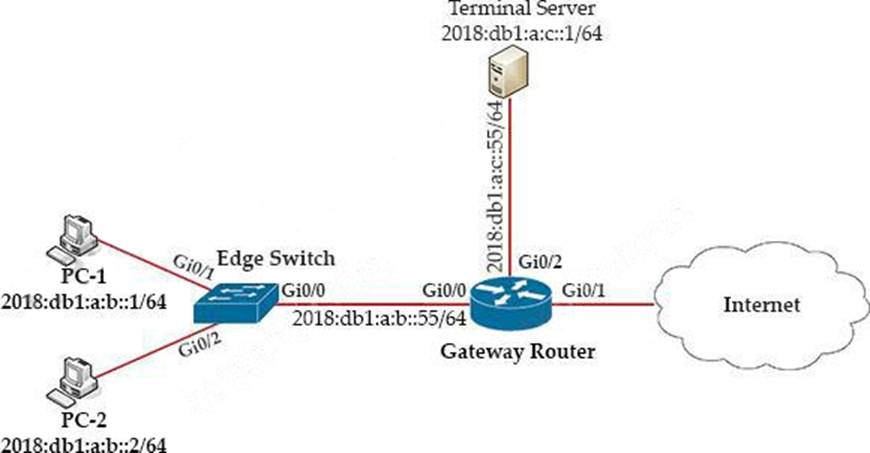
Gateway-Router# show ipv6 access-list
IPv6 access list Default_Access
permit tcp host 2018:DB1: A: B::1 host 2018:DB1:A:C::1 eq www sequence 10
deny tcp any host 2018:DB1: A:C::1 eq telnet sequence 20
permit tcp host 2018:DB1: A: B::2 host 2018:DB1:A:C::1 eq telnet sequence 30
permit ipv6 2018:DB1: A: B::/64 any sequence 40
PC-2 failed to establish a Telnet connection to the terminal server.
Which configuration resolves the issue?
- A . Gateway-Router(config)#ipv6 access-list Default Access
Gateway-Router(config-ipv6-acl)#sequence 15 permit tcp host 2018:DB1:A:B::2 host 2018:DB1:A:C. :1 eq telnet - B . Gateway-Router(config)#ipv6 access-list Default Access
Gateway-Router(config-ipv6-acl)#permit tcp host 2018:DB1:A:B::2 host 2018:DB1:A:C::1 eq telnet - C . Gateway-Router(config)#ipv6 access-list Default Access
Gateway-Router(config-ipv6-acl)#no sequence 20
Gateway-Router(config-ipv6-acl)#sequence 5 permit tcp host 2018:DB1:A:B::2 host 2018:DB1:A:C::1 eq telnet - D . Gateway-Router(config)#fipv6 access-list Default Access
Gateway-Router(confia-ipv6-acl)#sequence 25 permit tcp host 2018:DB1:A:B:2 host 2018:DB1:A:C. :1 eq telnet
A
Explanation:
In fact in this question both answer A and answer C are correct but we believe answer A is the better choice as it only allows PC-2 to telnet to terminal server. All other hosts are refused to telnet to terminal server via sequence 20.
What is the output of the following command:
show ip vrf
- A . Show’s default RD values
- B . Displays IP routing table information associated with a VRF
- C . Show’s routing protocol information associated with a VRF.
- D . Displays the ARP table (static and dynamic entries) in the specified VRF
What is the role of LDP in MPLS networks?
- A . It enables label binding that exchanges route descriptors
- B . It creates MPLS packet forwarding along with the IGP routes.
- C . It disables label binding information to exchange with peer LSRs.
- D . It enables label binding information to exchange with peer LSRs
D
Explanation:
The Label Distribution Protocol (LDP) plays a crucial role in MPLS (Multiprotocol Label Switching) networks. It enables label switch routers (LSRs) to exchange label binding information, which is essential for supporting hop-by-hop forwarding in an MPLS network1.
LDP establishes LSPs (Label Switched Paths) that follow the existing IP routing table2. This process is particularly well-suited for establishing a full mesh of LSPs between all of the routers on the network2.
When a packet arrives at a router in an MPLS network, the router looks at the incoming label, looks up the label in a table, and then forwards the packet to the next hop1. This method of label distribution is also called hop-by-hop forwarding1.
Reference: MPLS LDP (Label Distribution Protocol) – NetworkLessons.com
MPLS Label Distribution Protocol (LDP) – Cisco
What is Label Distribution Protocol (LDP)? – Metaswitch
Label Distribution Protocol – Wikipedia
What is MPLS LDP in networking? C CCNA-Classes
Refer to the exhibit.
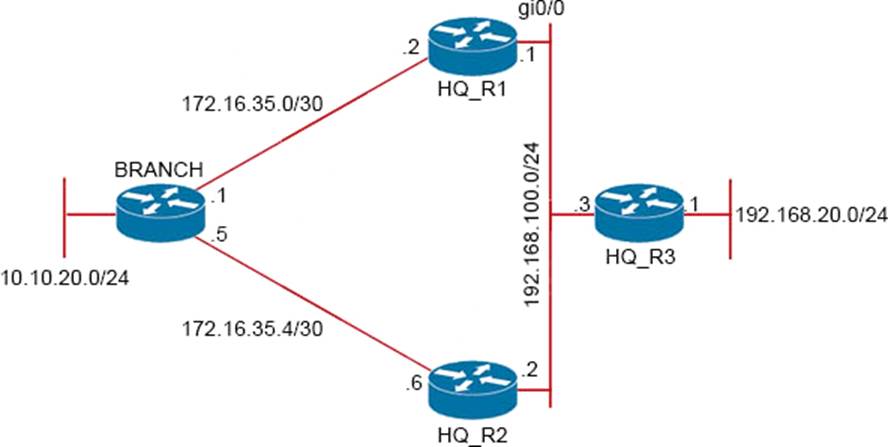
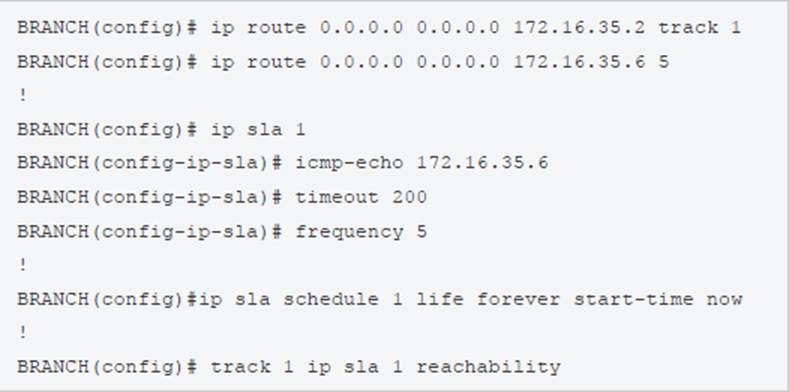
An engineer has successfully set up a floating static route from the BRANCH router to the HQ network using HQ_R1 as the primary default gateway When the g0/0 goes down on HQ_R1, the branch network cannot reach the HQ network 192.168.20.0/24.
Which set of configurations resolves the issue?
- A . HQ_R3(config)# ip sla responder
HQ_R3(config)# ip sla responder icmp-echo 172.16.35.1 - B . BRANCH(config)# ip sla 1
BRANCH(config-ip-sla)# icmp-echo 192.168.100.2 - C . HQ R3(config)# Ip sla responder
HQ R3(config)# Ip sla responder Icmp-echo 172.16.35.5 - D . BRANCH(config)# Ip sla 1
BRANCH(config-ip-sta)# Icmp-echo 192.168.100.1
Refer to the exhibit.
An engineer has successfully set up a floating static route from the BRANCH router to the HQ network using HQ_R1 as the primary default gateway When the g0/0 goes down on HQ_R1, the branch network cannot reach the HQ network 192.168.20.0/24.
Which set of configurations resolves the issue?
- A . HQ_R3(config)# ip sla responder
HQ_R3(config)# ip sla responder icmp-echo 172.16.35.1 - B . BRANCH(config)# ip sla 1
BRANCH(config-ip-sla)# icmp-echo 192.168.100.2 - C . HQ R3(config)# Ip sla responder
HQ R3(config)# Ip sla responder Icmp-echo 172.16.35.5 - D . BRANCH(config)# Ip sla 1
BRANCH(config-ip-sta)# Icmp-echo 192.168.100.1
Refer to the exhibit.
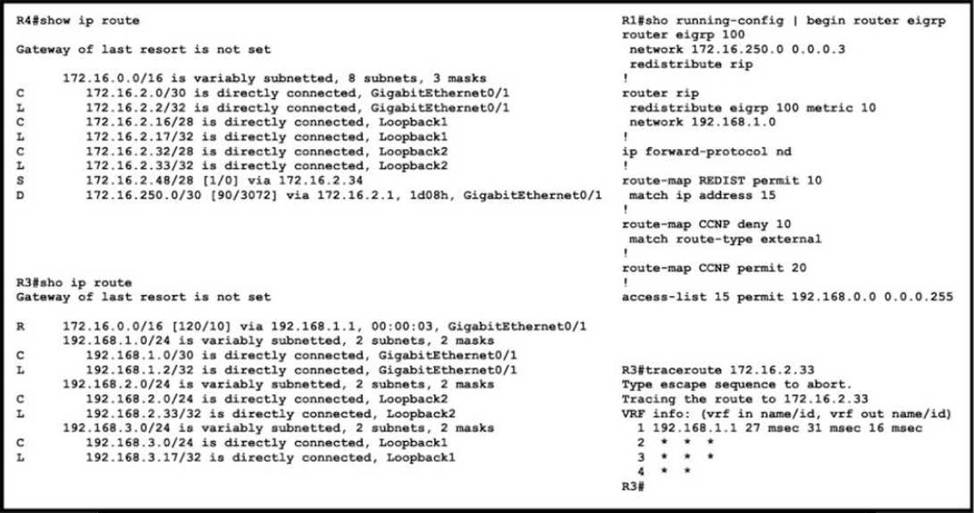
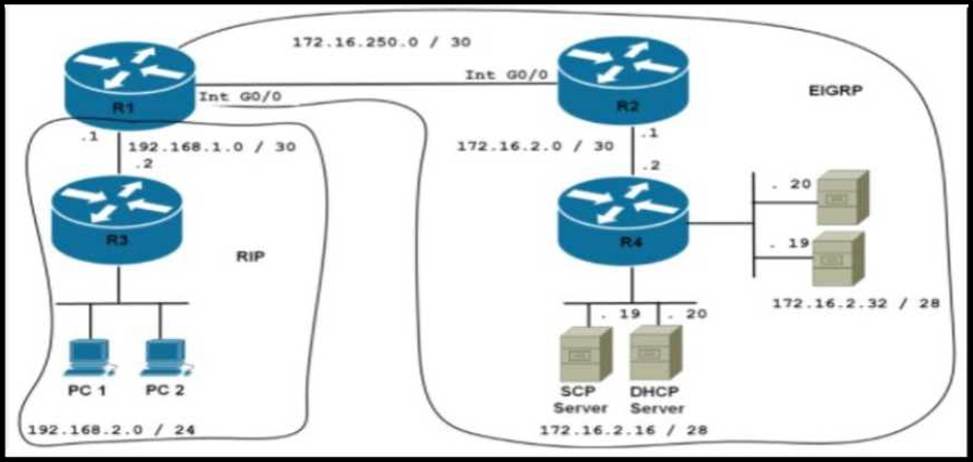
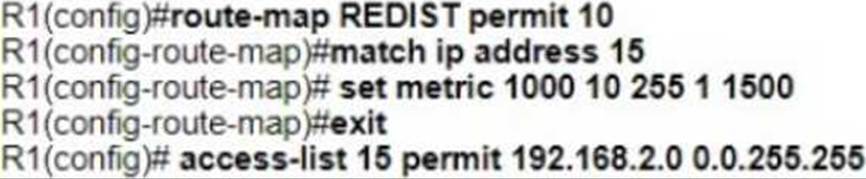
Users from the 192 168.2.0/24 network cannot connect to the 172.16 2 32/28 network.
Which configuration resolves the issue’?
A)

B)
C)

D)

- A . Option
- B . Option
- C . Option
- D . Option
DRAG DROP
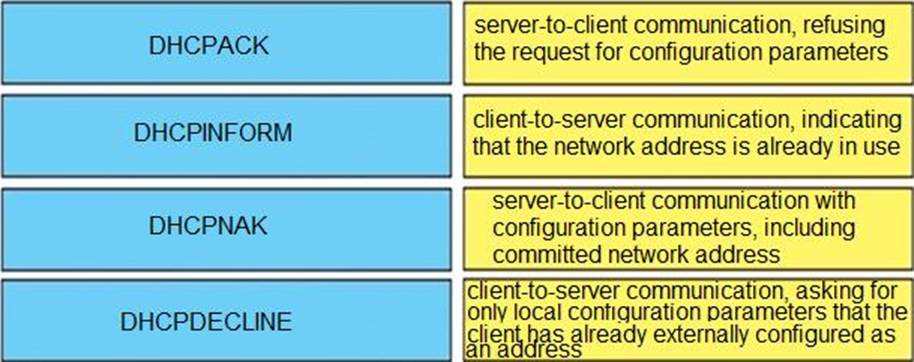
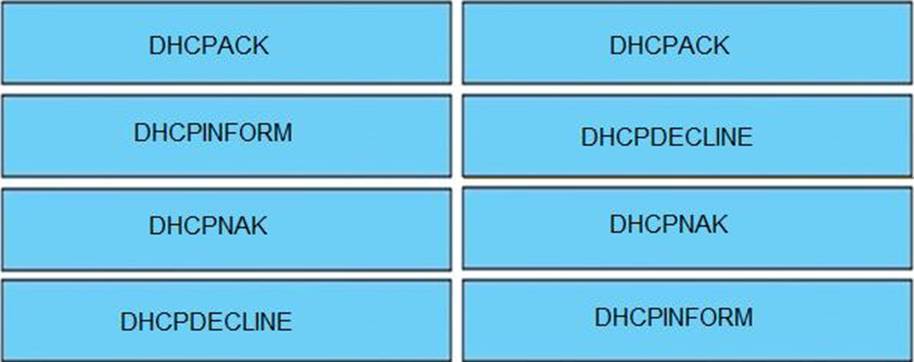
Drag and drop the DHCP messages from the left onto the correct uses on the right.
Explanation:
DHCPACK
The server-to-client communication with configuration parameters, including committed network address.
DHCPINFORM
The client-to-server communication, asking for only local configuration parameters that the client already has externally configured as an address.
DHCPNAK
The server-to-client communication, refusing the request for configuration parameter.
DHCPDECLINE
The client-to-server communication, indicating that the network address is already in use
Reference: https://www.cisco.com/c/en/us/support/docs/ip/dynamic-address-allocation-resolution/27470-100.html
DHCPINFORM: If a client has obtained a network address through some other means or has a manually configured IP address, a client workstation may use a DHCPINFORM request message to obtain other local configuration parameters, such as the domain name and Domain Name Servers (DNSs). DHCP servers receiving a DHCPINFORM message construct a DHCPACK message with any local configuration parameters appropriate for the client without allocating a new IP address. This DHCPACK will be sent unicast to the client.
DHCPNAK: If the selected server is unable to satisfy the DHCPREQUEST message, the DHCP server will respond with a DHCPNAK message. When the client receives a DHCPNAK message, or does not receive a response to a DHCPREQUEST message, the client restarts the configuration process by going into the Requesting state. The client will retransmit the DHCPREQUEST at least four times within 60 seconds before restarting the Initializing state.
DHCPACK: After the DHCP server receives the DHCPREQUEST, it acknowledges the request with a DHCPACK message, thus completing the initialization process.
DHCPDECLINE: The client receives the DHCPACK and will optionally perform a final check on the parameters. The client performs this procedure by sending Address Resolution Protocol (ARP) requests for the IP address provided in the DHCPACK. If the client detects that the address is already in use by receiving a reply to the ARP request, the client will send a DHCPDECLINE message to the server and restart the configuration process by going into the Requesting state.
Reference: https://www.cisco.com/c/en/us/support/docs/ip/dynamic-address-allocation-resolution/27470-100.html
Refer to Exhibit.
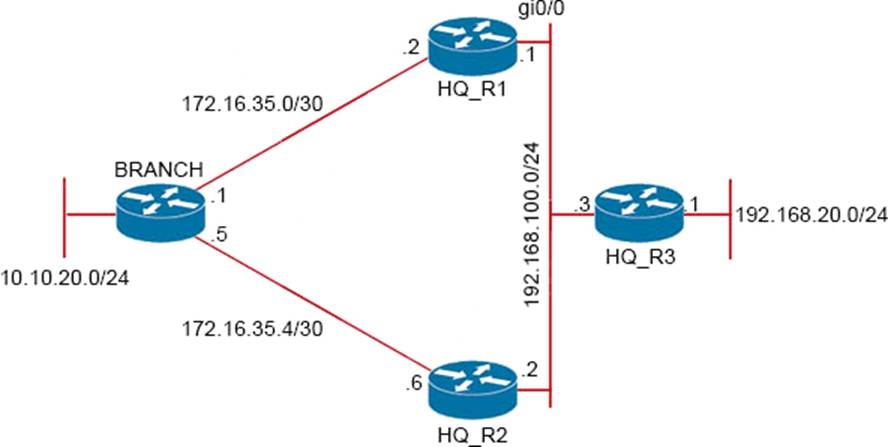
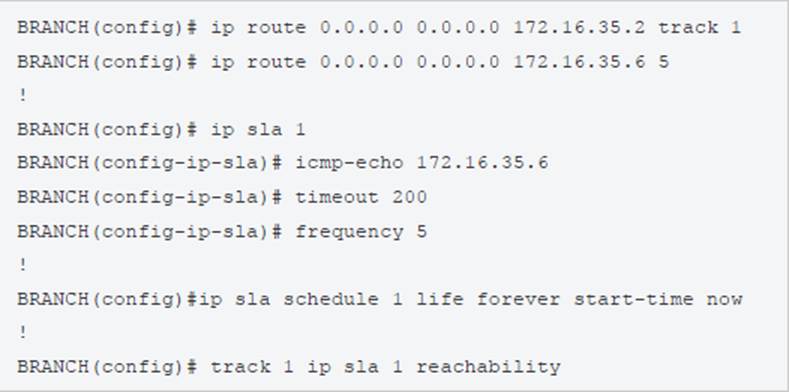
Traffic from the branch network should route through HQ R1 unless the path is unavailable. An engineer tests this functionality by shutting down interface on the BRANCH router toward HQ_R1 router but 192.168.20.0/24 is no longer reachable from the branch router.
Which set of configurations resolves the issue?
- A . HQ_R1(config)# ip sla responder
HQ_R1(config)# ip sla responder icmp-echo 172.16.35.2 - B . BRANCH(config)# ip sla 1
BRANCH(config-ip-sla)# icmp-echo 172.16.35.1 - C . HQ_R2(config)# ip sla responder
HQ_R2(config)# ip sla responder icmp-echo 172.16.35.5 - D . BRANCH(config)# ip sla 1
BRANCH(config-ip-sla)# icmp-echo 172.16.35.2
D
Explanation:
In the configuration above, the engineer has made a mistake as he was tracking 172.16.35.6 (the backup path) instead of tracking the main path (172.16.35.2). Therefore, when he shut down the main path, the track 1 was still up so traffic still went through the main path -> it failed.
To fix this issue, we just need to correct the tracking interface of the main path.