
Cisco 300-410 Practice Exams
Last updated on Nov 16,2026- Exam Code: 300-410
- Exam Name: Implementing Cisco Enterprise Advanced Routing and Services (ENARSI)
- Certification Provider: Cisco
- Latest update: Nov 16,2026
Which mechanism must be chosen to optimize the reconvergence time for OSPF at company location 407173257 that is less CPU-intensive than reducing the hello and dead timers?
- A . BFD
- B . Dead Peer Detection keepalives
- C . SSO
- D . OSPF demand circuit
Refer to the exhibit.
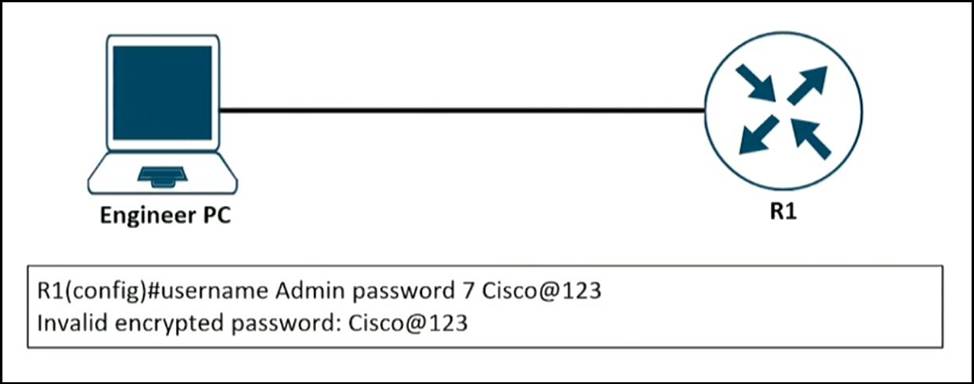
An engineer is trying to add an encrypted user password that should not be visible in the router configuration.
Which two configuration commands resolve the issue? (Choose two)
- A . password encryption aes
- B . username Admin password Cisco@maedeh motamedi
- C . username Admin password 5 Cisco@maedeh motamedi
- D . username Admin secret Cisco@maedeh motamedi
- E . no service password-encryption
- F . service password-encryption
Refer to the exhibit.
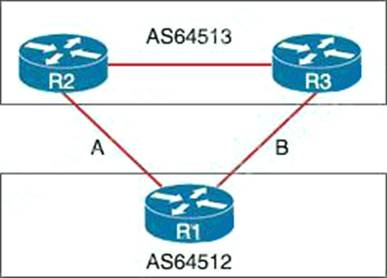
A network engineer for AS64512 must remove the inbound and outbound traffic from link A during maintenance without closing the BGP session so that there ………… a backup link over link A toward the ASN.
Which BGP configuration on R1 accomplishes this goal?
A)
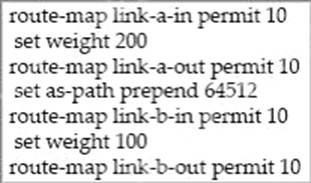
B)
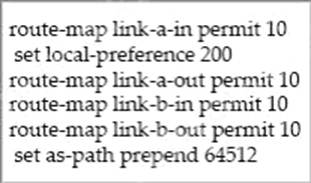
C)
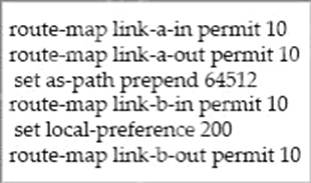
D)
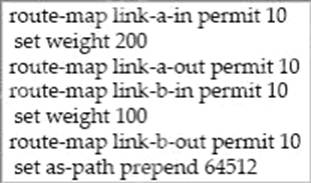
- A . Option A
- B . Option B
- C . Option C
- D . Option D
What is a characteristic of IPv6 RA Guard?
- A . RA messages are allowed from the host port to the switch
- B . It is unable to protect tunneled traffic
- C . It filters rogue RA broadcasts from connected hosts
- D . It is supported on the egress direction of the switch
Refer to the exhibit.
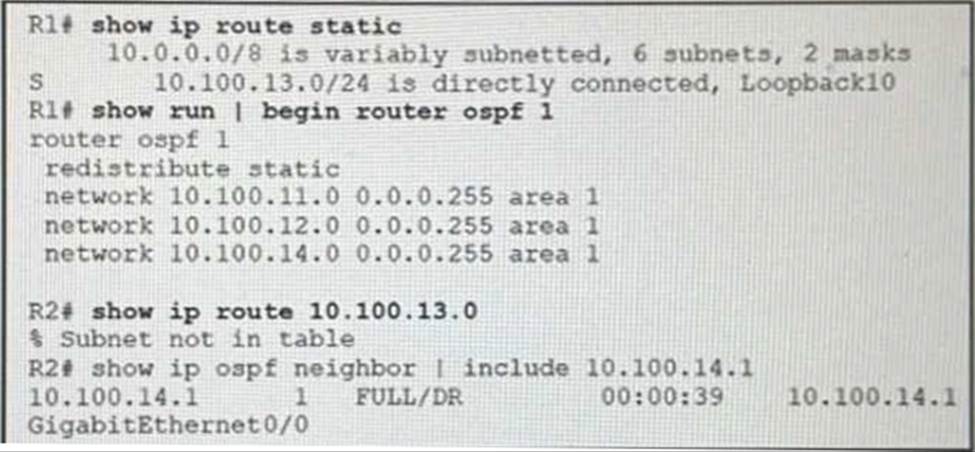
R1 is directly connected to R2 over network 10.100.14.0/24. An engineer configures R1 to advertise a static route that is connected to a local loopback for network 10.100.13.0/24. The network is not in the routing table of R2.
Which action resolves the issue?
- A . The redistribution command is incorrect on R1 The default metric metric 200 should be inducted
with the redistribution command. - B . The Loopback interface on R1 is administratively down The interface should be enabled with the no shutdown command
- C . R2 must use a different OSPF process number and should be changed lo ospf 1 to match R1
- D . The redistribution command is incorrect on R1 The keyword subnets should be included with the redistribution command
Which two solutions are used to overcome a flapping link that causes a frequent label binding exchange between MPLS routers? (Choose two)
- A . Create link dampening on links to protect the session.
- B . Increase input queue on links to protect the session.
- C . Create targeted hellos to protect the session.
- D . Increase a hold-timer to protect the session.
- E . Increase a session delay to protect the session.
A, C
Explanation:
To avoid having to rebuild the LDP session altogether, you can protect it. When the LDP session between two directly connected LSRs is protected, a targeted LDP session is built between the two LSRs. When the directly connected link does go down between the two LSRs, the targeted LDP session is kept up as long as an alternative path exists between the two LSRs.
For the protection to work, you need to enable it on both the LSRs. If this is not possible, you can enable it on one LSR, and the other LSR can accept the targeted LDP Hellos by configuring the command mpls ldp discovery targeted-hello accept.
Reference: https://www.ccexpert.us/mpls-network/mpls-ldp-session-protection.html Or from the reference at https://www.ciscolive.com/c/dam/r/ciscolive/us/docs/2019/pdf/5eU6DfQV/TECMPL-3201.pdf
Troubleshooting LDP Issues
Problem:
I. When a link flaps (for a short time),
…
Solution:
+ When LDP session supported by link hello is setup, create a targeted hello to protect the session.
Refer to the exhibit.
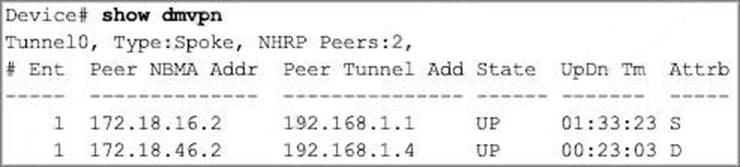
An engineer has configured DMVPN on a spoke router.
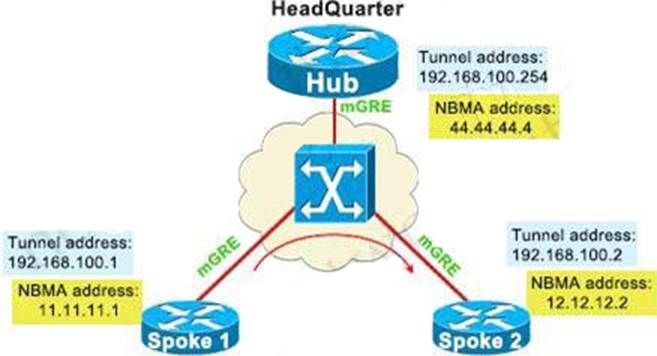
What is the WAN IP address of another spoke router within the DMVPN network?
- A . 172.18.46.2
- B . 192.168.1.4
- C . 172.18.16.2
- D . 192.168.1.1
A
Explanation:
From the output we can see there are 2 NHRP Peers. The first one with the NBMA Address of 172.18.16.2 and the “Attribute” (Attrb) of Static (S) so we can deduce it is the Hub device. Therefore the second one must be the remaining Spoke device with the attribute of Dynamic (D).
–> S – Static, D – Dynamic, I – Incomplete
N – NATed, L – Local, X – No Socket
# Ent –> Number of NHRP entries with same NBMA peer
NHS Status: E –> Expecting Replies, R –> Responding, W –> Waiting UpDn Time –> Up or Down Time for a Tunnel
======================================================================== ==
Interface: Tunnel1, IPv4 NHRP Details
Type: Spoke, NHRP Peers:2,
# Ent Peer NBMA Addr Peer Tunnel Add State UpDn Tm Attrb
—– ————— ————— —– ——– —–
1 44.44.44.4 192.168.100.254 UP 00:03:40 S
1 12.12.12.2 192.168.100.2 UP 00:03:20 D
What is a function of an end device configured with DHCPv6 guard?
- A . If it is configured as a server, only prefix assignments are permitted.
- B . If it is configured as a relay agent, only prefix assignments are permitted.
- C . If it is configured as a client, messages are switched regardless of the assigned role.
- D . If it is configured as a client, only DHCP requests are permitted.
C
Explanation:
The DHCPv6 Guard feature blocks reply and advertisement messages that come from unauthorized DHCP servers and relay agents.
Packets are classified into one of the three DHCP type messages. All client messages are always switched regardless of device role. DHCP server messages are only processed further if the device role is set to server. Further processing of server messages includes DHCP server advertisements (for source validation and server preference) and DHCP server replies (for permitted prefixes).
If the device is configured as a DHCP server, all the messages need to be switched, regardless of the device role configuration.
SIMULATION
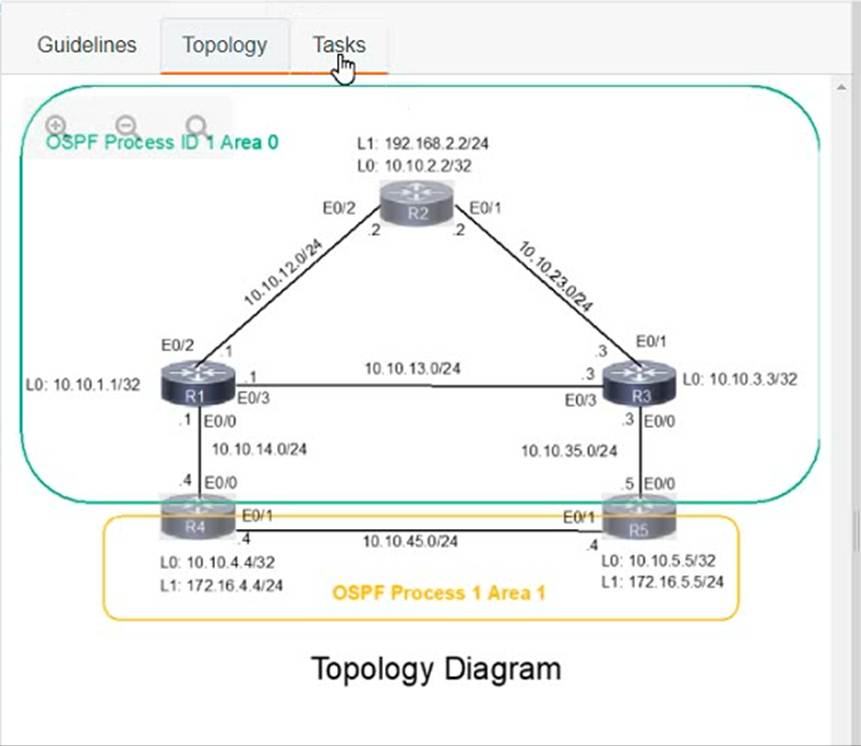
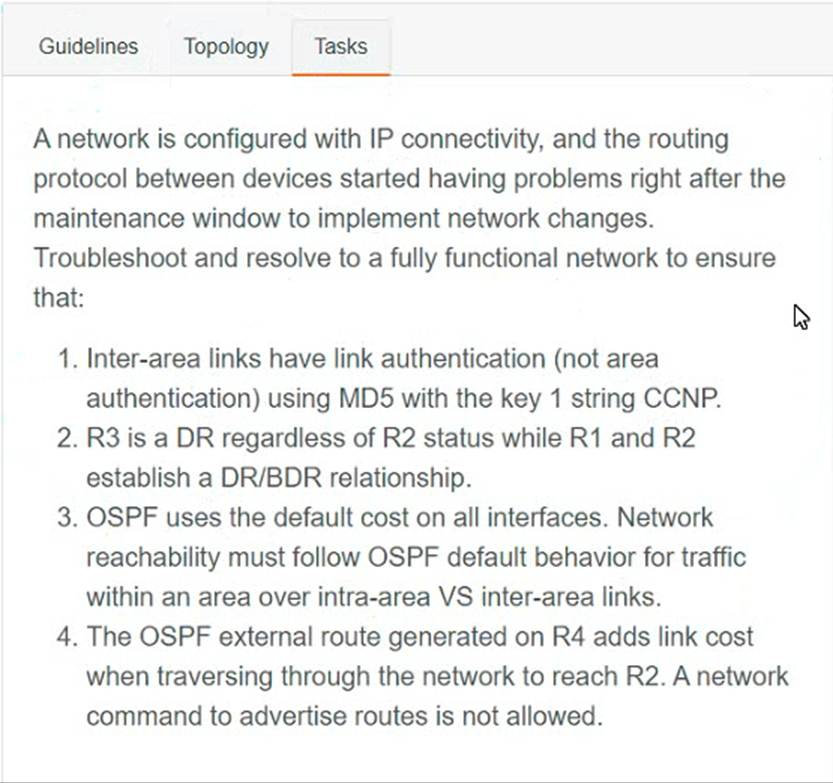
A network is configured with IP connectivity, and the routing protocol between devices started having problems right after the maintenance window to implement network changes.
Troubleshoot and resolve to a fully functional network to ensure that:
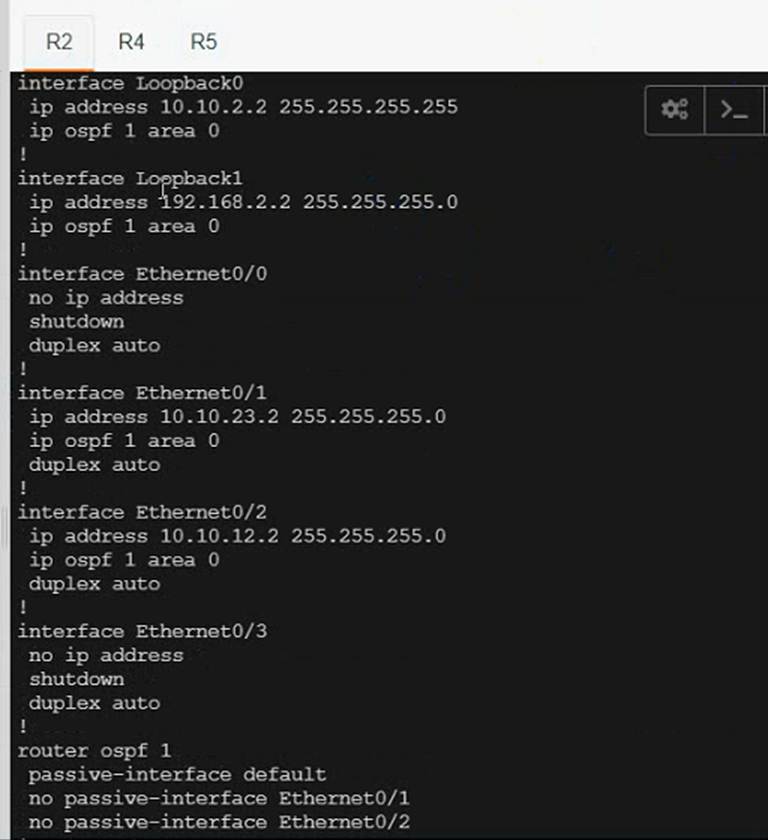
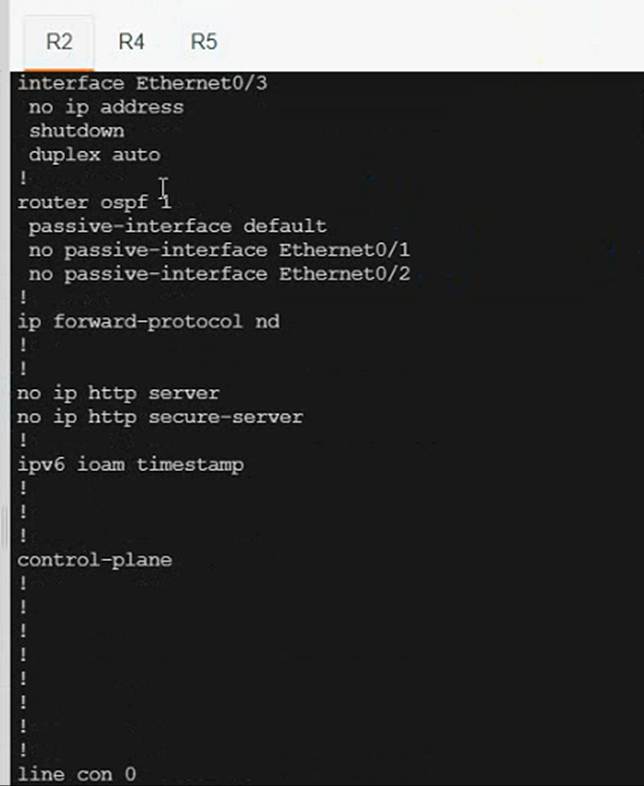
R4
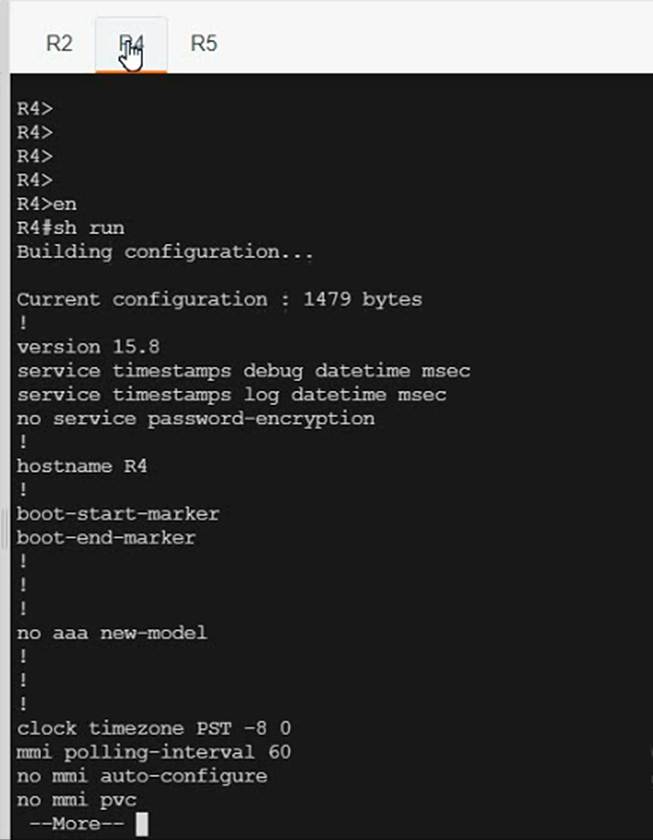
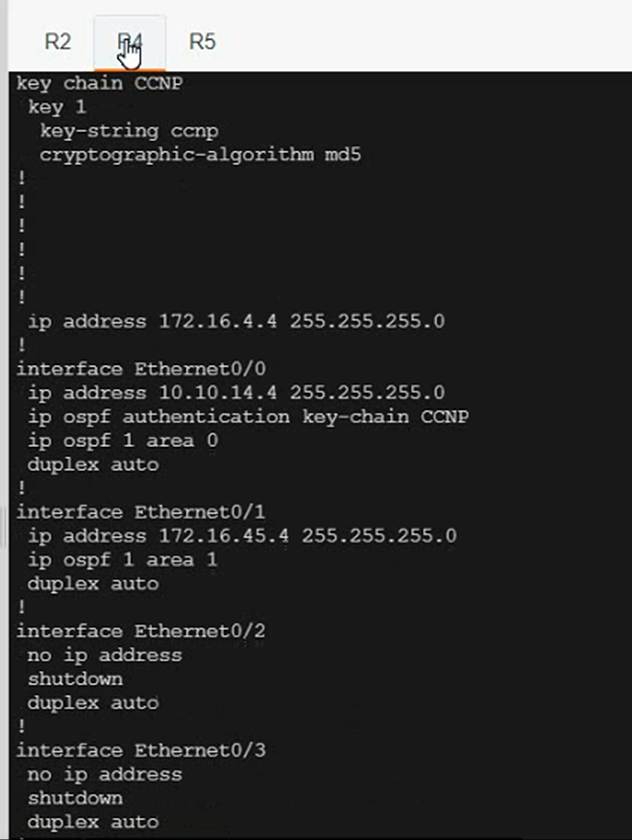
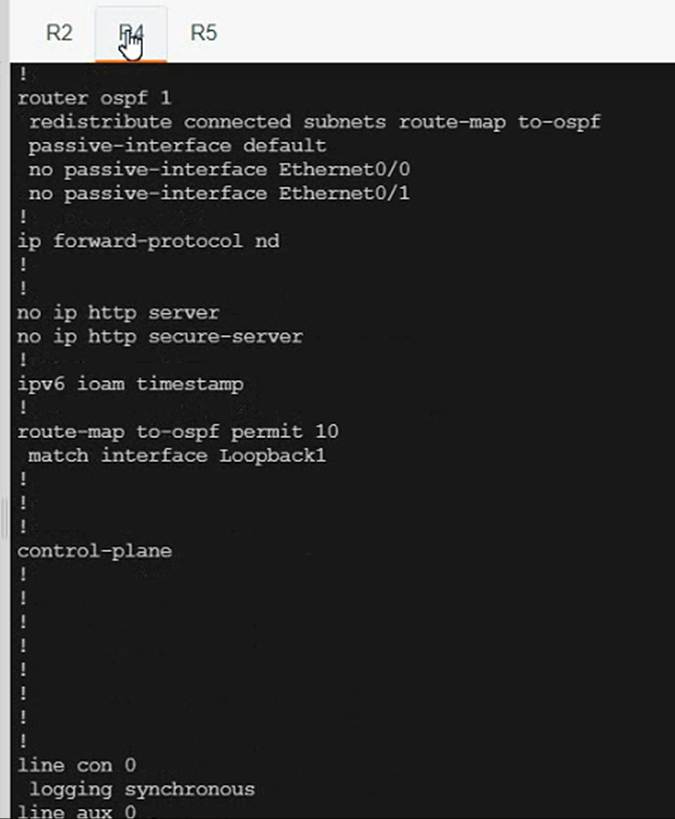
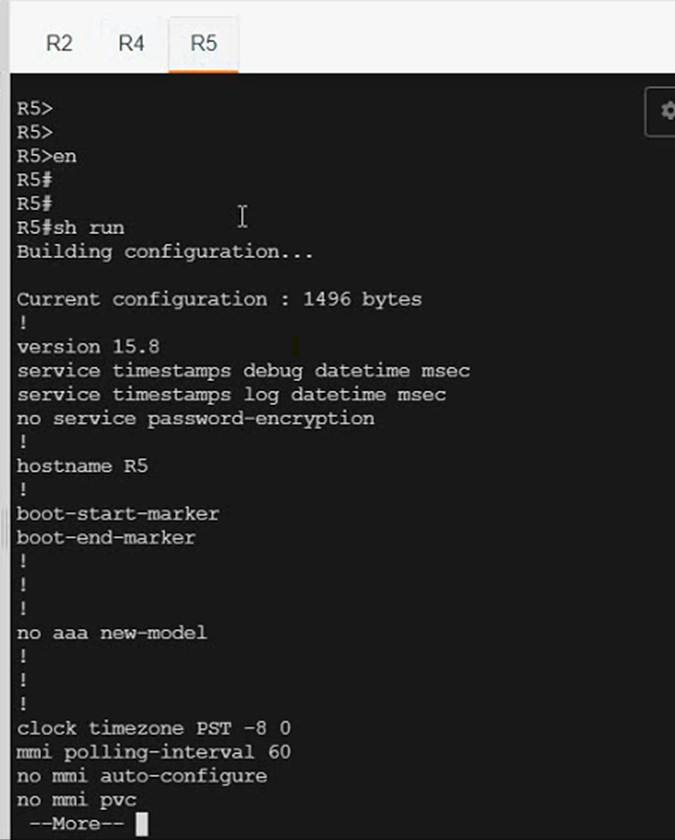
R5
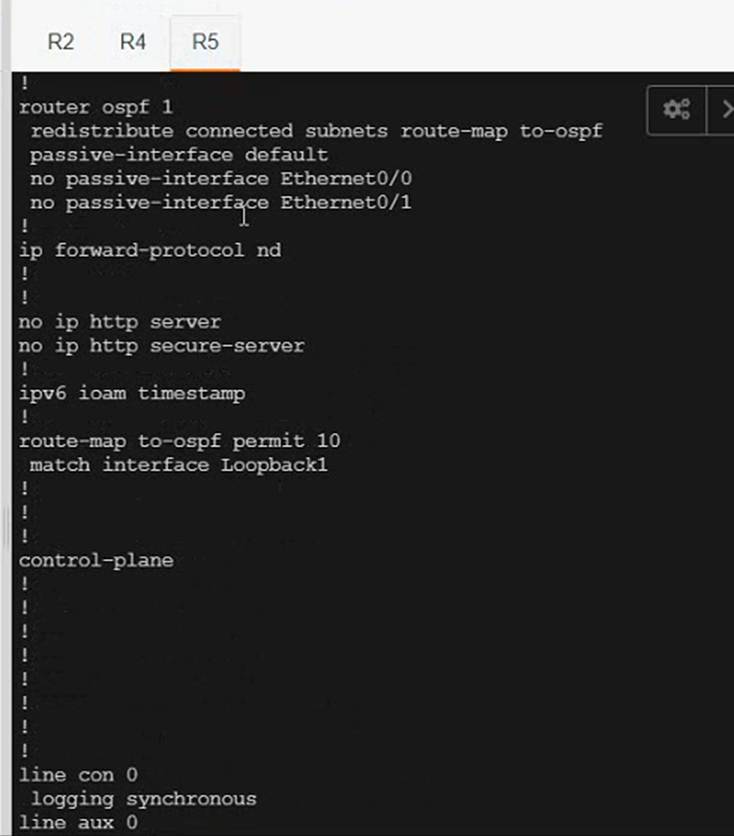
R4
Int range et0/0 C 1
Ip ospf authentication message-digest
Ip ospf message-digest-key 1 md5 CCNP
Router ospf 1
Redistribute connected subnets route-map to-ospf metric-type 1
Copy run start
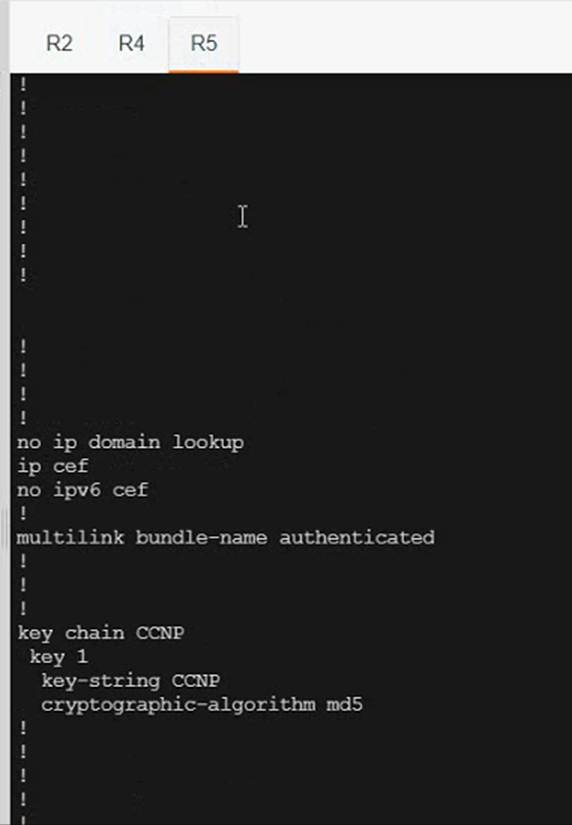
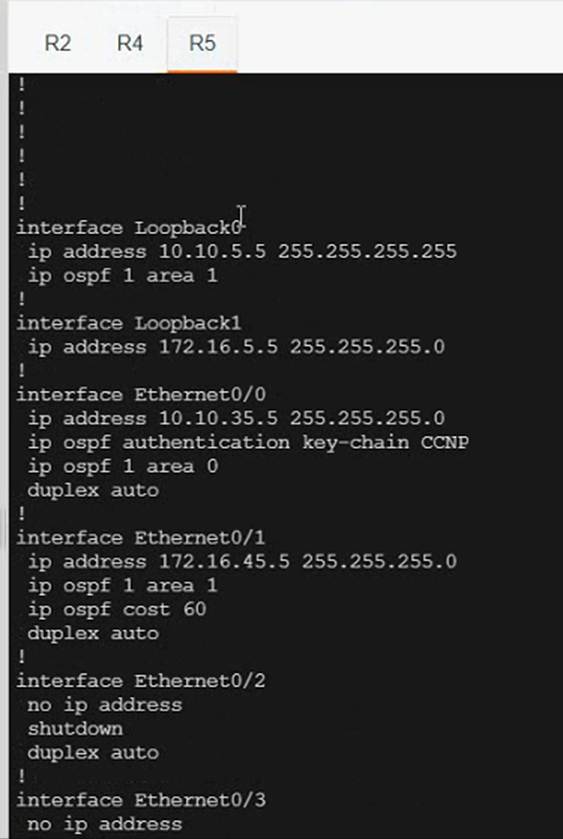
R5
Int range et0/0 C 1
Ip ospf authentication message-digest
Ip ospf message-digest-key 1 md5 CCNP
Interface eth 0/1
Ip ospf cost 10
Copy run start
VERIFICATION: –
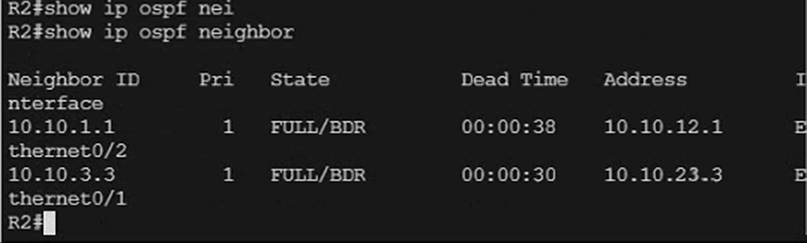
Refer to the exhibit.
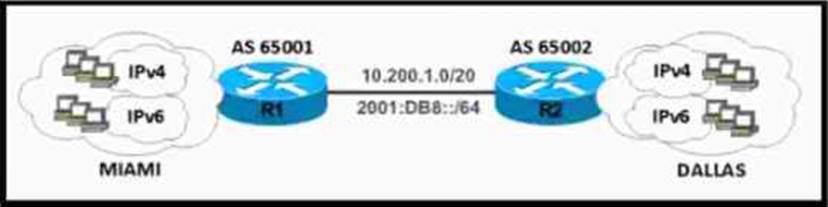
A network engineer configured routers R1 and R2 with MP-BGP. The engineer noticed that the routers cannot exchange any IPv6 routes, however, the IPv4 neighbor relationship is working fine.
Which configuration must the engineer apply to router R2 to exchange IPv6 routes?
- A . Ipv6cef
I
Interface Loopback100
Ipv6 address 2001: DB8:128::2/128 Interface GigabitEthernet1/0 Ipv6 address 2001:DB8:1::2/64
I
router bgp 65002
no bgp default ipv4-unlcast
neighbor 2001: DB8:1::1 emote-as 65001
I
address-family ipv6
network 2001:DB8:128::2/128
neighbor 2001:DB8:1::1 activate - B . Ipv6 unicast-routing ipv6 cef
Interface Loopback100
ipv6 address 2001: DB8:12C:2 129
I
interface GigabitEthernet1/0 ipv6 address 2001: DB8:1::2 64 description AS65001 ID B466:A83D:3D7::1
!
router bgp 65002
no bgp default Ipv4-unicast
neighbor 2001: DB8:1::1 remote-as 65001
!
address-family Ipv4
neighbor 2001:DB8:1::1 activate - C . Ipv6 unicast-routing
ipvG cef
I
Interface Loopback100
Ipv6 address 2001:DB8:128::2/128 I interface GigabitEthernet1/0
ipv6 address 2001:DB8:1::2/64
!
router bgp 65002 no bgp default ipv4-unicast neighbor 2001: DB8:1::1 remote-as 65001
!
address-family ipv6 network 2001:DB8:128::2I128 - D . Ipv6 unicast-routing Ipv6 cef
I
interface Loopback100
ipv6 address 2001: DB8:128::2/128
!
interface GigabitEthernet1/0 ipv6 address 2001:DB8:1::2/64 i
router bgp 65002 no bgp default ipv4-unicast neighbor 2001: DB8:1::1 remote-as 65001
!
address-family ipv6
network 2001:DB8:128::2/128 neighbor 2001:DB8:1::1 activate