
Cisco 300-410 Practice Exams
Last updated on Nov 16,2026- Exam Code: 300-410
- Exam Name: Implementing Cisco Enterprise Advanced Routing and Services (ENARSI)
- Certification Provider: Cisco
- Latest update: Nov 16,2026
Refer to the exhibit.
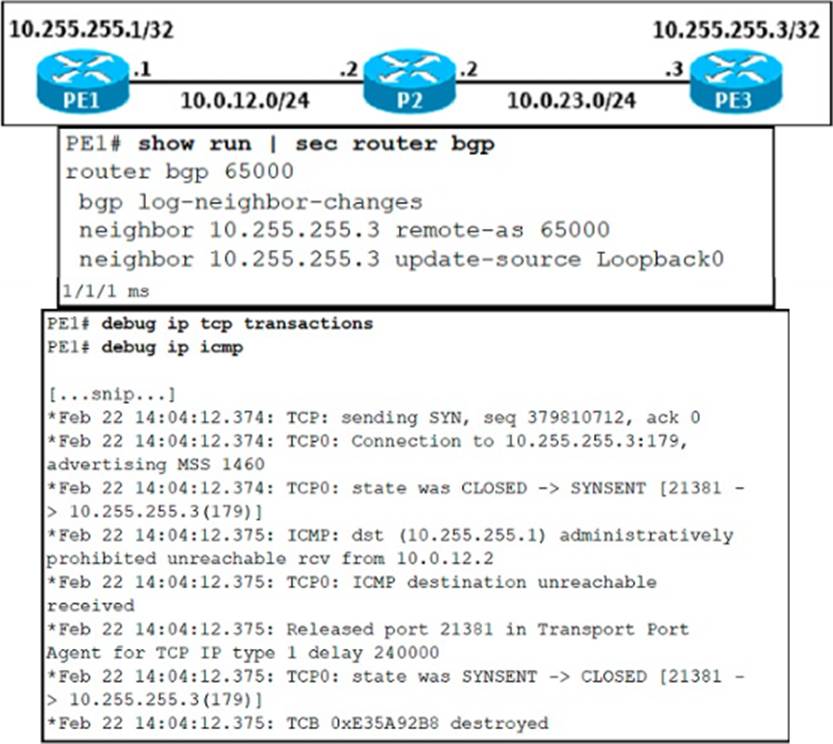
The administrator is troubleshooting a BGP peering between PE1 and PE3 that is unable to establish.
Which action resolves the issue?
- A . P2 must have a route to PE3 to establish a BGP session to PE1
- B . Disable sending ICMP unreachables on P2 to allow PE1 to establish a session with PE3
- C . Ensure that the PE3 loopback address is used as a source for BGP peering to PE1
- D . Remove the traffic filtering rules on P2 blocking the BGP communication between PE1 and PE3
Which statement about IPv6 ND inspection is true?
- A . It learns and secures bindings for stateless autoconfiguration addresses in Layer 3 neighbor tables.
- B . It learns and secures bindings for stateless autoconfiguration addresses in Layer 2 neighbor tables.
- C . It learns and secures bindings for stateful autoconfiguration addresses in Layer 3 neighbor tables.
- D . It learns and secures bindings for stateful autoconfiguration addresses in Layer 2 neighbor tables.
B
Explanation:
IPv6 ND inspection learns and secures bindings for stateless autoconfiguration addresses in Layer 2 neighbor tables. IPv6 ND inspection analyzes neighbor discovery messages in order to build a trusted binding table database, and IPv6 neighbor discovery messages that do not have valid bindings are dropped. A neighbor discovery message is considered trustworthy if its IPv6-to-MAC mapping is verifiable.
This feature mitigates some of the inherent vulnerabilities for the neighbor discovery mechanism, such as attacks on duplicate address detection (DAD), address resolution, device discovery, and the neighbor cache.
Reference: https://www.cisco.com/c/en/us/td/docs/ios-xml/ios/ipv6_fhsec/configuration/15-s/ip6f-15-s-book/ip6-snooping.pdf
What statement about route distinguishes in an MPLS network is true?
- A . Route distinguishes make a unique VPNv4 address across the MPLS network.
- B . Route distinguishers allow multiple instances of a routing table to coexist within the edge router.
- C . Route distinguishes are used for label bindings
- D . Route distinguishes define which prefixes are imported and exported on the edge router
Refer to the exhibit.
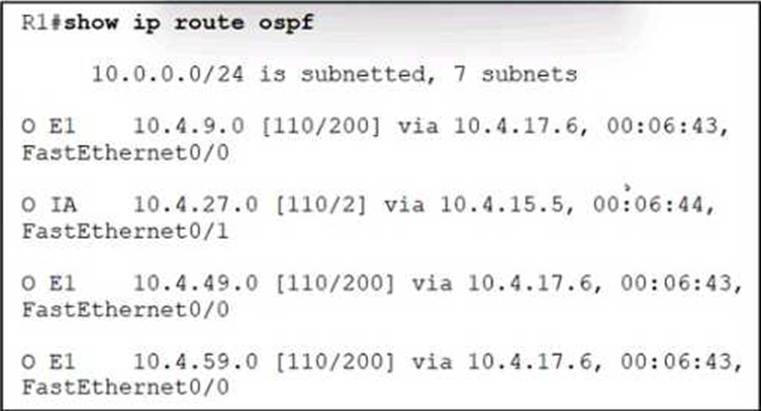
An engineer configured two ASBRs, 10.4.17.6 and 10.4.15.5, in an OSPF network to redistribute identical routes from BGR However, only prefixes from 10.4.17.6 are installed into the routing table on R1.
Which action must the engineer take to achieve load sharing for the BGP-originated prefixes?
- A . The ASBRs are advertising the redistributed prefixes with the iBGP metric and must be modified to Type 1 on ASBR 10.4.17.6.
- B . The ASBRs are advertising the redistributed prefixes with a different admin distance and must be changed to 110 on ASBR 10.4.15.5.
- C . The admin distance of the prefixes must be adjusted to 20 on ASBR 10.4.15.5 to advertise prefixes to R1 identically from both ASBRs.
- D . The ASBRs are advertising the redistributed prefixes as Type 1 and must be modified to Type 2
Refer to the exhibit.
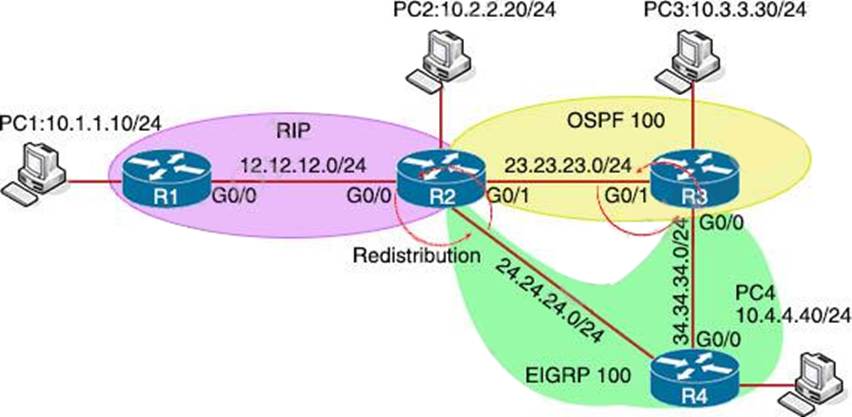
Redistribution is enabled between the routing protocols, and nowPC2 PC3, and PC4 cannot reach PC1.
What are the two solutions to fix the problem? (Choose two.)
- A . Filter RIP routes back into RIP when redistributing into RIP in R2
- B . Filter OSPF routes into RIP FROM EIGRP when redistributing into RIP in R2.
- C . Filter all routes except RIP routes when redistributing into EIGRP in R2.
- D . Filter RIP AND OSPF routes back into OSPF from EIGRP when redistributing into OSPF in R2
- E . Filter all routes except EIGRP routes when redistributing into OSPF in R3.
A,C
Explanation:
Even PC2 cannot reach PC1 so there is something wrong with RIP redistribution in R2. Because RIP has higher Administrative Distance (AD) value than OSPF and EIGRP so it will be looped when doing mutual redistribution.
Refer to the exhibit.
A network administrator is troubleshooting OSPF adjacency issue by going through the console logs in the router, but due to an overwhelming log message stream it is impossible to capture the problem.
Which two commands reduce console log messages to relevant OSPF neighbor problem details so that the issue can be resolved? (Choose two)
- A . debug condition interface
- B . debug condition ip
- C . debug condition ospf neighbor
- D . debug condition session-id ADJCHG
- E . debug condition all
Refer to the exhibit.
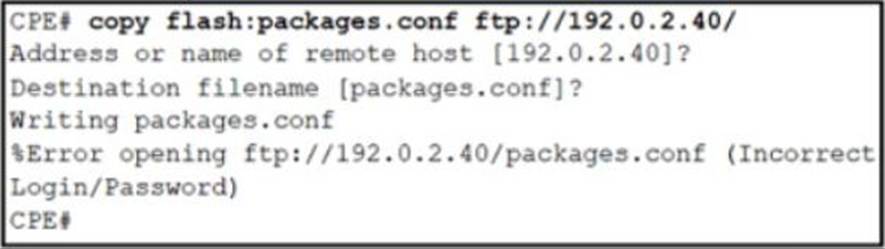
An administrator must upload the packages conf Me to an FTP server.
However, the FTP server rejected anonymous service and required users to authenticate.
What are the two ways to resolve the issue? (Choose two.)
- A . Use is ftp username and ip ftp password configuration commands to specify valid FTP server credentials.
- B . Use the copy flash:packages.conf scp: command instead and enter the FTP server credentials when prompted.
- C . Enter the FTP server credentials directly In the FTP URL using the ftp://username:passwordQ192.0.2.40/ syntax.
- D . Create a user on the rooter matching the username and password on the FTP server and log in before attempting the copy
- E . Use the copy flash-packages conf ftp: command instead and enter the FTP server credent-ais when prompted.
The network administrator must implement IPv6 in the network to allow only devices that not only have registered IP addresses but are also connecting from assigned locations.
Which security feature must be implemented?
- A . IPv6 Snooping
- B . IPv6 Destination Guard
- C . IPv6 Prefix Guard
- D . IPv6 Router Advertisement Guard
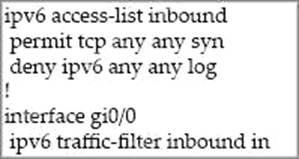
Refer to the exhibit.
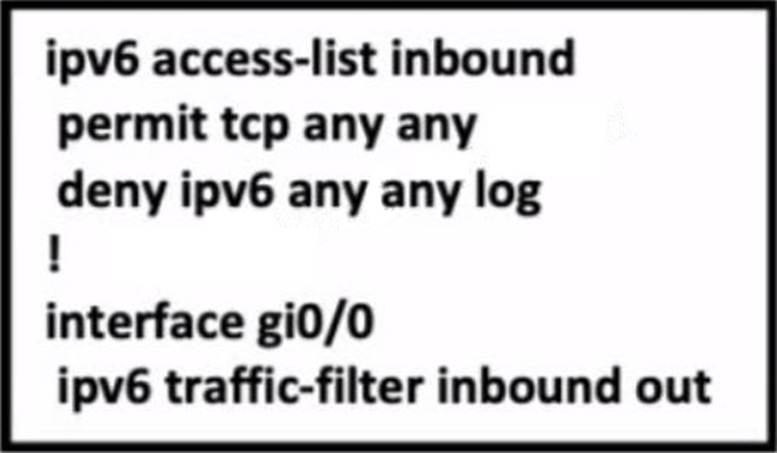
A network administrator configured an IPv6 access list to allow TCP return traffic only, but it is not working as expected.
Which changes resolve this issue?
A)
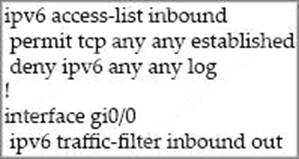
B)
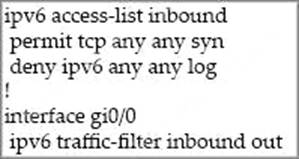
C)
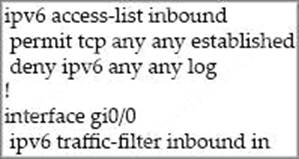
D)
- A . Option A
- B . Option B
- C . Option C
- D . Option D
Which two components are needed for a service provider to utilize the LVPN MPLS application? (Choose two.)
- A . The P routers must be configured for MP-iBGP toward the PE routers
- B . The P routers must be configured with RSVP.
- C . The PE routers must be configured for MP-iBGP with other PE routers
- D . The PE routers must be configured for MP-eBGP to connect to CEs
- E . The P and PE routers must be configured with LDP or RSVP
C,E
Explanation:
MPLS Network Protocols
+ IGP: OSPF, EIGRP, IS-IS on core facing and core links+ RSVP and/or LDP on core and/or core facing links ->
+ MP-iBGP on PE devices (for MPLS services), MP-BGP: Multiprotocol Border Gateway Protocol, used for MPLS L3 VPN -> .
Reference: https://www.uio.no/studier/emner/matnat/ifi/IN3230/h19/kursmateriell/mpls-lecture.pdf