Cisco 300-410 Practice Exams
Last updated on Nov 16,2026- Exam Code: 300-410
- Exam Name: Implementing Cisco Enterprise Advanced Routing and Services (ENARSI)
- Certification Provider: Cisco
- Latest update: Nov 16,2026
An engineer notices that R1 does not hold enough log messages to Identity the root cause during troubleshooting.
Which command resolves this issue?
- A . #logging buffered 4096 critical
- B . (config)#logging buffered 16000 informational
- C . #logging buffered 16000 critical
- D . (config)#logging buffered 4096 informational
How are CE advertised routes segmented from other CE routers on an MPLS PE router?
- A . with a combination of VRF-Lite and MP-BGP
- B . by pushing MPLS labels advertised by LDP on customer routes
- C . by enabling multiple instances of BGP. one for each CE router
- D . by assigning CE-facing interfaces to different VRFs
D
Explanation:
In an MPLS PE router, CE advertised routes are segmented from other CE routers by assigning CE-facing interfaces to different Virtual Routing and Forwarding (VRF) instances12. A VRF is a technology that allows multiple instances of a routing table to co-exist within the same router at the same time. By associating a network interface with a VRF, the network layer (Layer 3) has a different view of the network topology. This allows the segmentation of routing paths for traffic from different customers or different types of traffic. In the context of MPLS, VRFs are used to create separate routing instances for each customer on a PE router3.
Reference: Implementing Cisco Enterprise Advanced Routing and Services (ENARSI) training videos CCNP Enterprise Advanced Routing ENARSI 300-410 Official Cert Guide Implementing Cisco Enterprise Advanced Routing and Services source documents or study guide MPLS routes to advertise from CE to PE – Cisco Community Configuring Route Exchange Between PE and CE Devices – CloudEngine 12800 and 12800E V200R005C10 Configuration Guide – VPN C Huawei Customer edge router – Wikipedia
Refer to the exhibit.
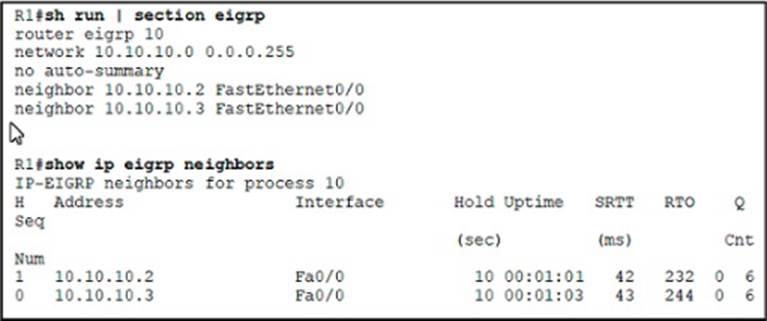
The remote branch locations have a static neighbor relationship configured to R1 only R1 has successful neighbor relationships with the remote locations of R2 and R3, but the end users cannot communicate with each other.
Which configuration resolves the issue’
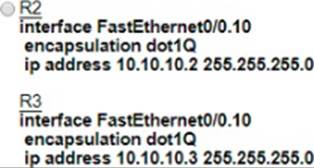
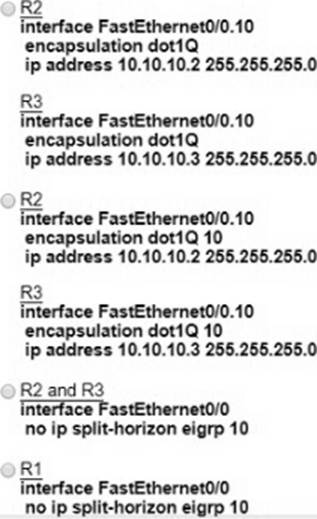
- A . Option A
- B . Option B
- C . Option C
- D . Option D
- E . Option E
Refer to the exhibit.
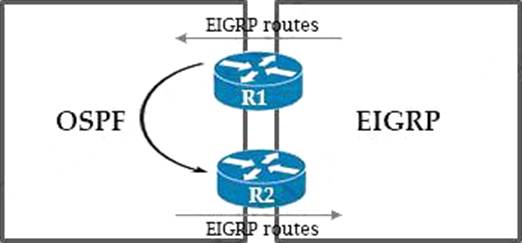
A network administrator configured mutual redistribution on R1 and R2 routers, which caused instability in the network.
Which action resolves the issue?
- A . Set a tag in the route map when redistributing EIGRP into OSPF on R1. and match the same tag on R2 to allow when redistributing OSPF into EIGRP.
- B . Apply a prefix list of EIGRP network routes in OSPF domain on R1 to propagate back into the EIGRP routing domain.
- C . Set a tag in the route map when redistributing EIGRP into OSPF on R1, and match the same tag on R2 to deny when redistributing OSPF into EIGRP.
- D . Advertise summary routes of EIGRP to OSPF and deny specific EIGRP routes when redistributing into OSPF.
C
Explanation:
https://www.cisco.com/c/en/us/support/docs/ip/enhanced-interior-gateway-routing-protocol-eigrp/8606-redist.html
Refer to the exhibit.
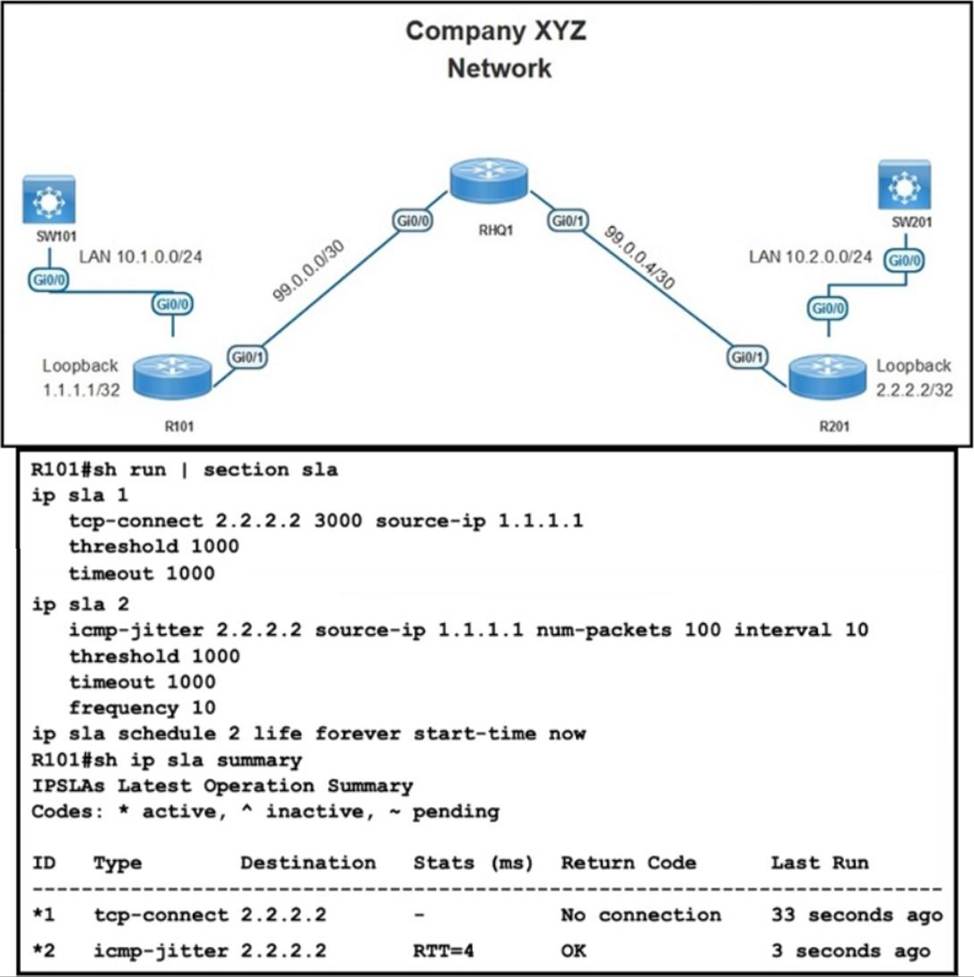
While troubleshooting an issue on the network, an engineer notices that a TCP Connect operation failed on port 3000 between R101 and R201.
Which command must be configured on R201 to respond to the R101 IP SLA configurations with a control connection on UDP port 1967?
- A . ip sla responder udp-echo ipaddress 1.1.1.1 port 1967
- B . ip sla responder tcp-connect ipaddress 1.1.1.1 port 3000
- C . ip sla responder tcp-connect ipaddress 2.2.2.2 port 3001
- D . ip sla responder
What must be configured by the network engineer to circumvent AS_PATH prevention mechanism in IP/VPN Hub and Spoke deployment scenarios?
- A . Use allows in and as-override at all Pes.
- B . Use allowas in and as-override at the PE-Hub.
- C . Use Allowas-in the PE_Hub
- D . Use as-override at the PE_Hub
Refer to the exhibit.
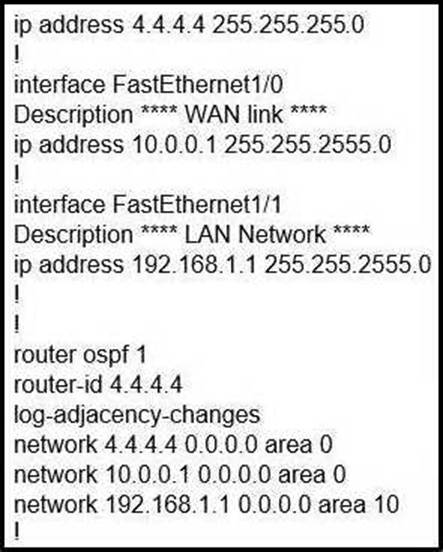
Which set of commands restore reachability to loopback0?
- A . interface loopback0
ip address 4.4.4.4 255.255.255.0
ip ospf network point-to-point - B . interface loopback0
ip address 4.4.4.4 255.255.255.0
ip ospf network broadcast - C . interface loopback0
ip address 4.4.4.4 255.255.255.0
ip ospf interface area 10 - D . interface loopback0
ip address 4.4.4.4 255.255.255.0
ip ospf interface type network
A
Explanation:
We tested this config in GNS3 (except the LAN interface) but R1 loopback0 was advertised normally on R2 and R2 could reach this loopback0.
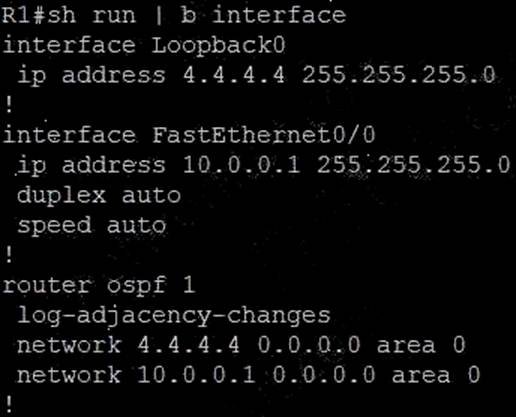
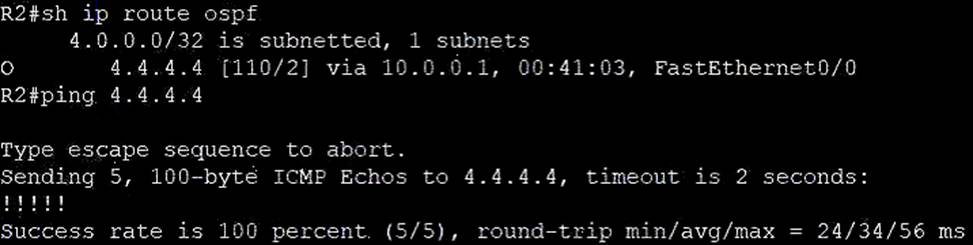
Note: Although the configured loopback address is 4.4.4.4/24 but by default OSPF will advertise this route to loopback0 as 4.4.4.4/32 (most specific route to that loopback). In order to override this, we have to change the network type to point-to-point. After this OSPF will advertise the address to loopback as 4.4.4.0/24.
Refer to the exhibit.
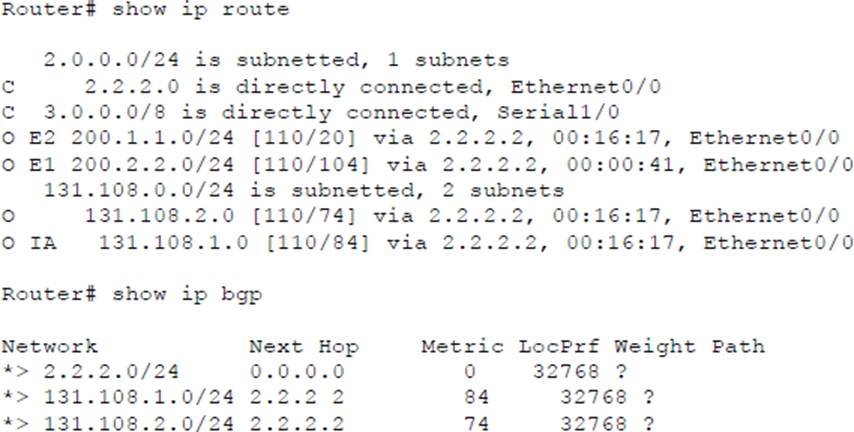
The OSPF routing protocol is redistributed into the BGP routing protocol, but not all the OSPF routes are distributed into BGP.
Which action resolves the issue?
- A . Include the word external in the redistribute command
- B . Use a route-map command to redistribute OSPF external routes defined in an access list
- C . Include the word internal external in the redistribute command
- D . Use a route-map command to redistribute OSPF external routes defined in a prefix list.
C
Explanation:
If you configure the redistribution of OSPF into BGP without keywords, only OSPF intra-area and inter-area routes are redistributed into BGP, by default. You can use the internal keyword along with the redistribute command under router bgp to redistribute OSPF intra- and inter-area routes.
Use the external keyword along with the redistribute command under router bgp to redistribute OSPF external routes into BGP.
-> In order to redistribute all OSPF routes into BGP, we must use both internal and external keywords. The full command would be (suppose we are using OSPF 1): redistribute ospf 1 match internal external
Note: The configuration shows match internal external 1 external 2. This is normal because
OSPF automatically appends “external 1 external 2” in the configuration. In other words,
keyword external = external 1 external 2. External 1 = O E1 and External 2 = O E2.
Reference: https://www.cisco.com/c/en/us/support/docs/ip/border-gateway-protocol-bgp/5242-bgp-ospf-redis.html
Refer to the exhibit.
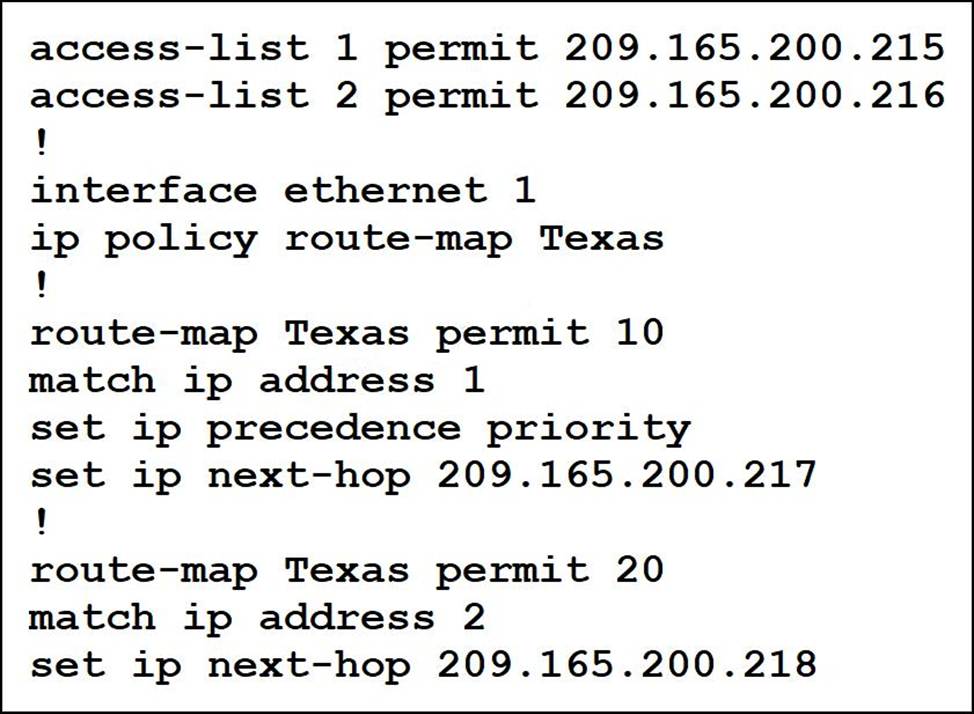
Packets arriving from source 209.165.200.215 must be sent with the precedence bit set to 1, and packets arriving from source 209.165.200.216 must be sent with the precedence bit set to 5.
Which action resolves the issue?
- A . set ip precedence critical in route-map Texas permit 10
- B . set ip precedence critical in route-map Texas permit 20
- C . set ip precedence immediate in route-map Texas permit 10
- D . set ip precedence priority in route-map Texas permit 20
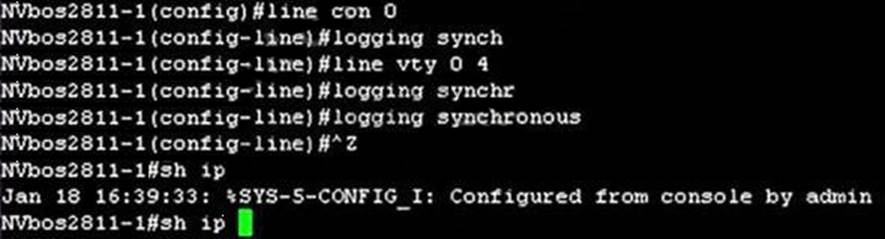
An engineer is troubleshooting on the console session of a router and turns on multiple debug commands. The console screen is filled with scrolling debug messages that none of the commands can be verified if entered correctly or display any output.
Which action allows the engineer to see entered console commands while still continuing the analysis of the debug messages?
- A . Configure the logging synchronous command
- B . Configure the no logging console debugging command globally
- C . Configure the logging synchronous level all command
- D . Configure the term no mon command globally
A
Explanation:
Let’s see how the “logging synchronous” command affect the typing command:
Without this command, a message may pop up and you may not know what you typed if that message is too long. When trying to erase (backspace) your command, you realize you are erasing the message instead.

With this command enabled, when a message pops up you will be put to a new line with your typing command which is very