
Cisco 300-410 Practice Exams
Last updated on Nov 16,2026- Exam Code: 300-410
- Exam Name: Implementing Cisco Enterprise Advanced Routing and Services (ENARSI)
- Certification Provider: Cisco
- Latest update: Nov 16,2026
Refer to the exhibit.
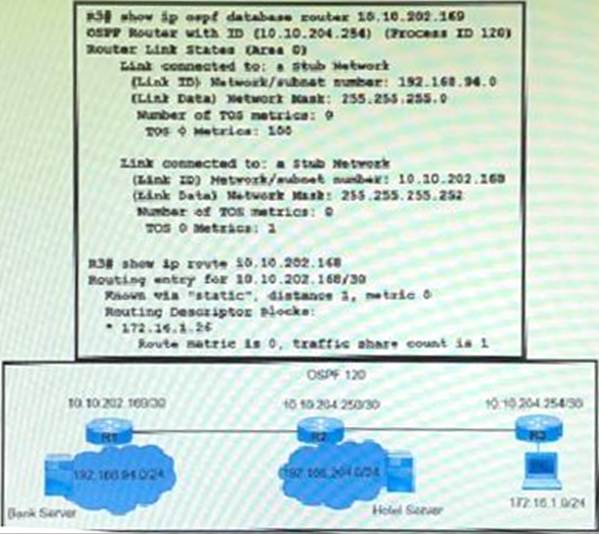
A network engineer finds that PC1 is accessing the hotel website to do the booking but fails to make payment.
Which action resolves the issue?
- A . Allow stub network 10.10.202.168/30 on router R3 OSPF.
- B . Decrease the AD to 5 OSPF route 192.168.94.0 on R1.
- C . Increase the AD to 200 of static route 192.168.94.0 on R3.
- D . Configure a reverse route on R1 for PC1 172.16.1.0/24.
10.10.0/24 and forward 10.1.1.1. The traffic must also have its IP precedence set to 5. All other traffic
should be forward toward 10.1.1.2 and have its IP precedence set to 0.
Which configuration meets the requirements?
- A . access-list 1 permit 10.10.10.0 0.0.0.255
access-list 2 permit any
route-map CCNP permit 10
match ip address 1
set ip next-hop 10.1.1.1
set ip precedence 5
!
route-map CCNP permit 20
match ip address 2
set ip next-hop 10.1.1.2
set ip precedence 0route-map CCNP permit 30 - B . access-list 100 permit ip any 10.10.10.0 0.0.0.255
route-map CCNP permit 10
match ip address 100
set ip next-hop 10.1.1.1
set ip precedence 0
!
route-map CCNP permit 20
set ip next-hop 10.1.1.2
set ip precedence 5
!
route-map CCNP permit 30 - C . access-list 1 permit 10.10.10.0 0.0.0.255
route-map CCNP permit 10
match ip address 1
set ip next-hop 10.1.1.1
set ip precedence 5
!
route-map CCNP permit 20
set ip next-hop 10.1.1.2
set ip precedence 0 - D . access-list 100 permit ip any 10.10.10.0 0.0.0.255
route-map CCNP permit 10
match ip address 100
set ip next-hop 10.1.1.1
set ip precedence 5
!
route-map CCNP permit 20
set ip next-hop 10.1.1.2
set ip precedence 0
An administrator attempts to download the pack NBAR2 file using TFTP from the CPE router to another device over the Gi0/0 interface.
The CPE is configured as below:
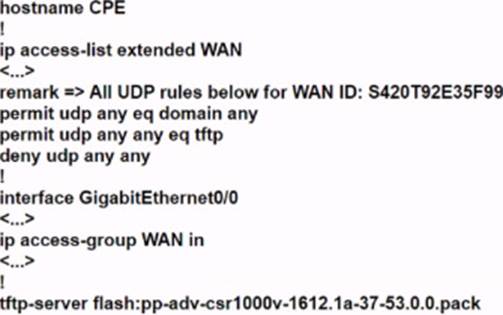
The transfer fails.
Which action resolves the issue?
- A . Change the WAN ACL to permit the UDP port 69 to allow TFTP
- B . Make the permit udp any eq tftp any entry the last entry in the WAN ACL.
- C . Change the WAN ACL to permit the entire UDP destination port range
- D . Shorten the file name to the 8+3 naming convention.
Refer to the exhibit.
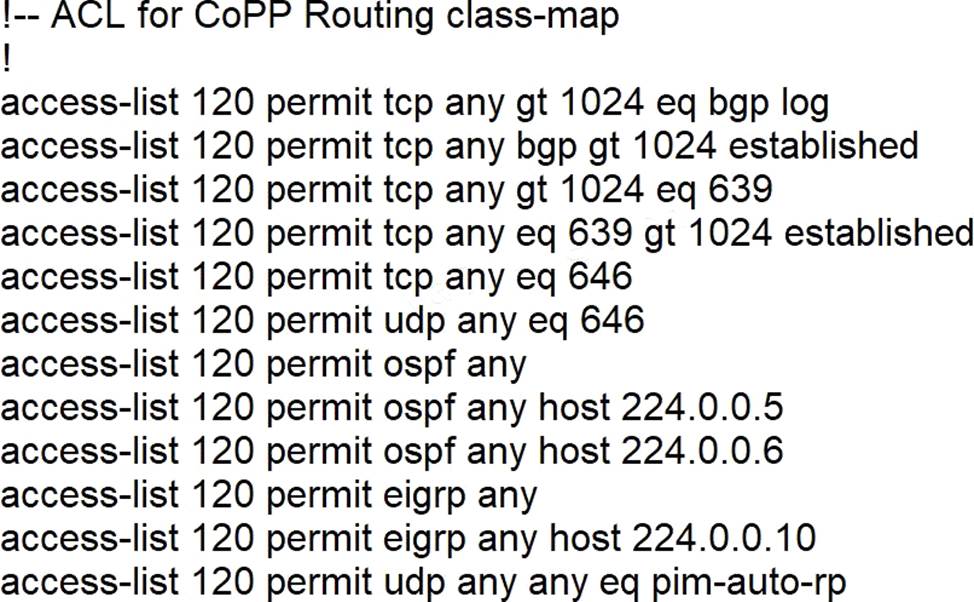
The control plane is heavily impacted after the CoPP configuration is applied to the router.
Which command removal lessens the impact on the control plane?
- A . access-list 120 permit udp any any eq pim-auto-rp
- B . access-list 120 permit eigrp any host 224.0.0.10
- C . access-list 120 permit ospf any
- D . access-list 120 permit tcp any gt 1024 eq bgp log
Refer to the exhibit.
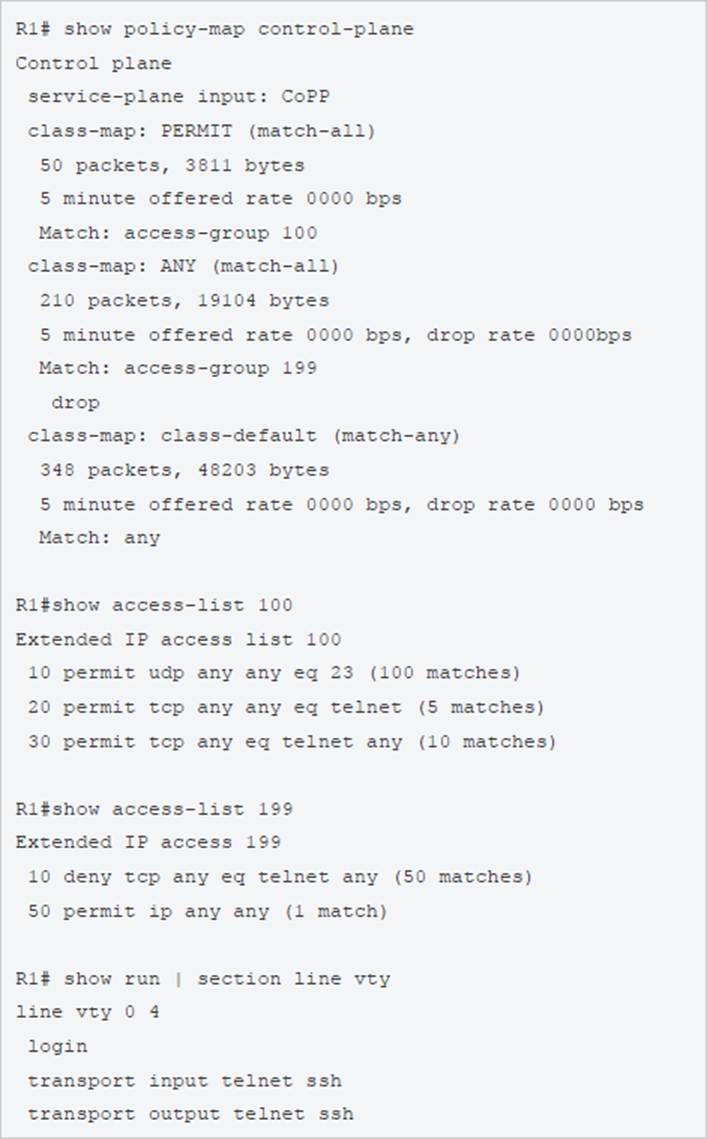
Which two actions restrict access to router R1 by SSH? (Choose two.)
- A . Configure transport input ssh on line vty and remove sequence 30 from access list 100.
- B . Configure transport output ssh on line vty and remove sequence 20 from access list 100.
- C . Remove class-map ANY from service-policy CoPP
- D . Configure transport output ssh on line vty and remove sequence 10 from access list 199.
- E . Remove sequence 10 from access list 100 and add sequence 20 deny tcp any any eq telnet to access list 199
Refer to the exhibit.
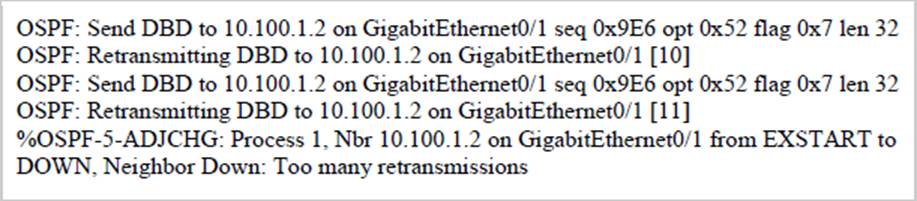
The OSPF neighbor relationship is not coming up.
What must be configured to restore OSPF neighbor adjacency?
- A . OSPF on the remote router
- B . matching hello timers
- C . use router ID
- D . matching MTU values
A CoPP policy is applied for receiving SSH traffic from the WAN interface on a Cisco ISR4321 router. However, the SSH response from the router is abnormal and stuck during the high link utilization. The problem is identified as SSH traffic does not match in the ACL.
Which action resolves the issue?
- A . Rate-limit SSH traffic to ensure dedicated bandwidth.
- B . Apply CoPP on the control plane interface.
- C . Increase the IP precedence value of SSH traffic to 6.
- D . Apply CoPP on the WAN interface inbound direction.
B
Explanation:
Explanation
The problem is “SSH traffic does not match in the ACL” and “CoPP policy is applied for receiving SSH traffic from the WAN interface” so we should apply CoPP on the control plane interface instead.
Refer to the exhibit.
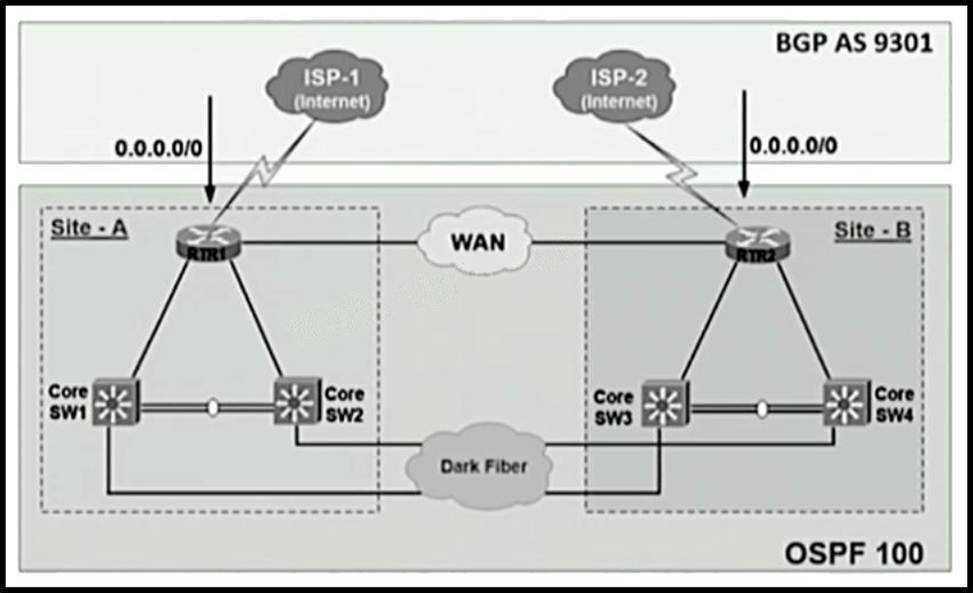
The Internet traffic should always prefer Site-A ISP-1 if the link and BGP connection are up; otherwise, all Internet traffic should go to ISP-2 Redistribution is configured between BGP and OSPF routing protocols and it is not working as expected.
What action resolves the issue?
- A . Set metric-type 2 at Site-A RTR1, and set metric-type 1 at Site-B RTR2
- B . Set OSPF cost 100 at Site-A RTR1, and set OSPF Cost 200 at Site-B RTR2
- C . Set OSPF cost 200 at Site: A RTR1 and set OSPF Cost 100 at Site-B RTR2
- D . Set metric-type 1 at Site-A RTR1, and set metric-type 2 at Site-B RTR2
D
Explanation:
OSPF type 1 route is always preferred over a type 2 route for the same destination so we can set metric-type 1 at Site-A RTR1 so that it is preferred over Site-B RTR2.
Note:
Routes are redistributed in OSPF as either type 1 (E1) routes or type 2 (E2) routes, with type 2 being the default.
C A type 1 route has a metric that is the sum of the internal OSPF cost and the external redistributed cost.
C A type 2 route has a metric equal only to the redistributed cost.
C If routes are redistributed into OSPF as type 2 then every router in the OSPF domain will see the same cost to reach the external networks.
C If routes are redistributed into OSPF as type 1, then the cost to reach the external networks could vary from router to router.
When determining if a system is capable of support, what is the minimum time spacing required for a BFD control packet to receive once a control packet is arrived?
- A . Desired Min TX Interval
- B . Detect Mult
- C . Required Min RX Interval
- D . Required Min Echo RX Interval
C
Explanation:
Required Min RX Interval: This is the minimum interval, in microseconds, between received BFD Control packets that this system is capable of supporting.
Reference: https://www.cisco.com/en/US/technologies/tk648/tk365/tk480/technologies_white_paper0900aecd80244005.html
Refer to the exhibit. An engineer is trying to log in to R1 via R3 loopback address.
Which action resolves the issue?
- A . Add transport input SCP
- B . Add transport input none
- C . Remove the IPv6 traffic filter from R1, which is blocking the Telnet.
- D . Remove the IPv6 traffic from R1, which is blocking the SSH