
Cisco 300-410 Practice Exams
Last updated on Nov 16,2026- Exam Code: 300-410
- Exam Name: Implementing Cisco Enterprise Advanced Routing and Services (ENARSI)
- Certification Provider: Cisco
- Latest update: Nov 16,2026
Users report issues with reachability between areas as soon as an engineer configured summary routes between areas in a multiple area OSPF autonomous system.
Which action resolves the issue?
- A . Configure the summary-address command on the ASBR.
- B . Configure the summary-address command on the ABR.
- C . Configure the area range command on the ABR.
- D . Configure the area range command on the ASBR.
C
Explanation:
For OSPF, we can only summary at the ABR with the command “area range” or at the ASBR with the command “summary-address” -> Therefore answer A and answer B are not correct.
In this question, the most likely problem is that when doing summarization, the network mask is configured wrong and summarization doesn’t work because of the misconfiguration. When configuring the area range command, make sure that the summarization mask is in the form of a prefix mask rather than a wildcard mask (that is, 255.255.255.0 instead of 0.0.0.255).
Good reference: https://www.configrouter.com/troubleshooting-route-summarization-ospf-14082/
Which IGPs are supported by the MPLS LDP autoconfiguration feature?
- A . RIPv2 and OSPF
- B . OSPF and EIGRP
- C . OSPF and ISIS
- D . ISIS and RIPv2
C
Explanation:

16.0.0/16
The network administrator on R1 must improve convergence by blocking all subnets of 172-16.0.0/16 major network with a mask lower than 23 from coming in,.
Which set of configurations accomplishes the task on R1?
- A . ip prefix-list PL-1 deny 172.16.0.0/16 le 23
ip prefix-list PL-1 permit 0.0.0.0/0 le 32
!
router bgp 100
neighbor 192.168.100.2 remote-as 200
neighbor 192.168.100.2 prefix-list PL-1 in - B . ip prefix-list PL-1 deny 172.16.0.0/16 ge 23
ip prefix-list PL-1 permit 0.0.0.0/0 le 32
!
router bgp 100
neighbor 192.168.100.2 remote-as 200
neighbor 192.168.100.2 prefix-list PL-1 in - C . access-list 1 deny 172.16.0.0 0.0.254.255
access-list 1 permit any
!
router bgp 100
neighbor 192.168.100.2 remote-as 200
neighbor 192.168.100.2 distribute-list 1 in - D . ip prefix-list PL-1 deny 172.16.0.0/16
ip prefix-list PL-1 permit 0.0.0.0/0
!
router bgp 100
neighbor 192.168.100.2 remote-as 200
neighbor 192.168.100.2 prefix-list PL-1 in
A
Explanation:
“Blocking all subnets of 172.16.0.0/16 major network with a mask lower than 23 from coming in”
would block 172.16.16.0/20.
The first prefix-list “ip prefix-list PL-1 deny 172.16.0.0/16 le 23” means “all networks that fall within the 172.16.0.0/16 range AND that have a subnet mask of /23 or less” are denied.
The second prefix-list “ip prefix-list PL-1 permit 0.0.0.0/0 le 32” means allows all other prefixes.
Refer to the exhibit.
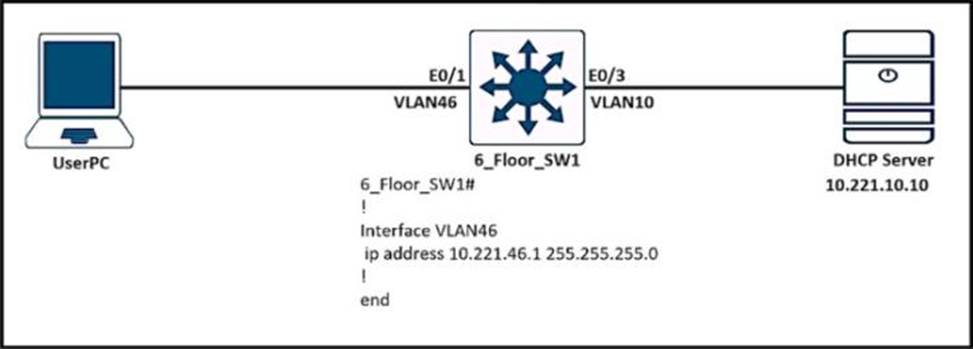
Users in VLAN46 cannot get the IP from the DHCP server. Assume that all the parameters are configured properly in VLAN 10 and on the DHCP server.
Which command on interlace VLAN46 allows users to receive IP from the DHCP server?
- A . ip dhcp-addreos 10.221.10.10
- B . ip dhcp server 10.221.10.10
- C . ip helper-addrets 10.221.10.10
- D . ip dhcp relay information trust-all
Refer to the exhibit.
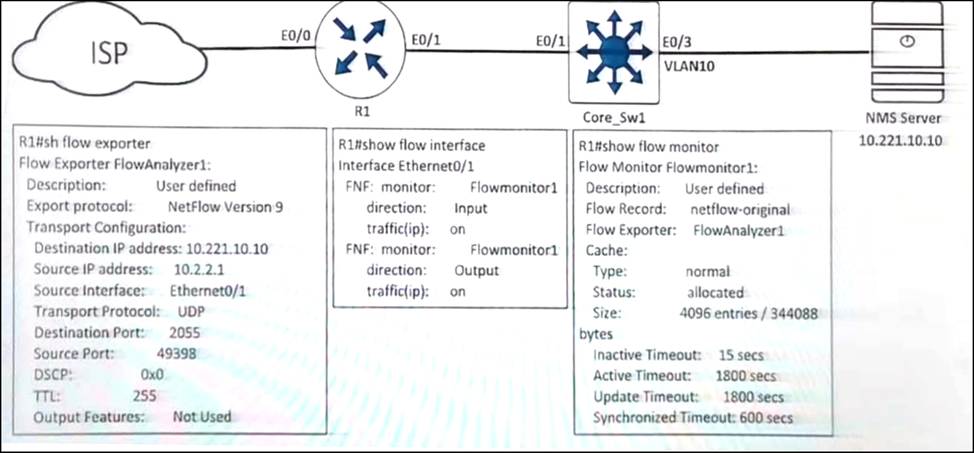
An engineer configured NetFlow on R1, but the NMS server cannot see the flow from ethernet 0/0 of R1.
Which configuration resolves the issue?
- A . flow monitor Flowmonitor1source Ethernet0/0
- B . interface Ethernet0/1ip flow monitor Flowmonitor1 inputip flow monitor Flowmonitor1 output
- C . interface Ethernet0/0ip flow monitor Flowmonitor1 inputip flow monitor Flowmonitor1 output
- D . flow exporter FlowAnalyzer1source Ethernet0/0
Refer to Exhibit.
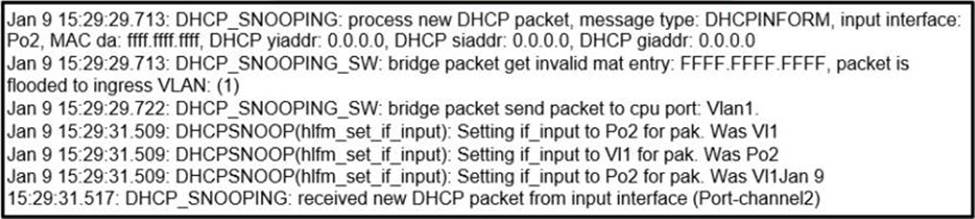
A network administrator enables DHCP snooping on the Cisco Catalyst 3750-X switch and configures the uplink port (Port-channel2) as a trusted port. Clients are not receiving an IP address, but when DHCP snooping is disabled, clients start receiving IP addresses.
Which global command resolves the issue?
- A . No ip dhcp snooping information option
- B . ip dhcp snooping
- C . ip dhcp relay information trust portchannel2
- D . ip dhcp snooping trust
DRAG DROP
Refer to the exhibit.
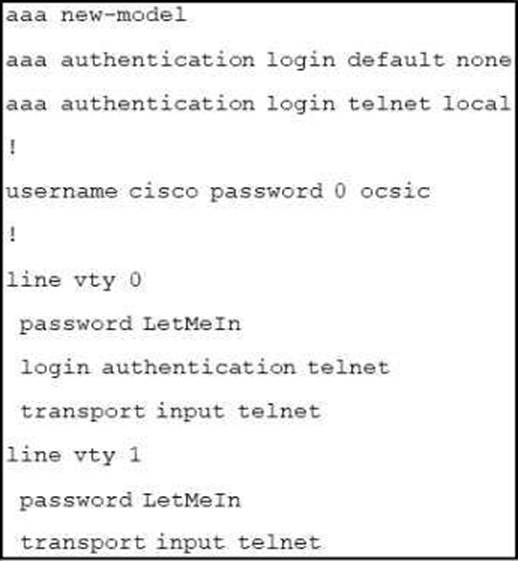
Drag and drop the credentials from the left onto the remote login information on the right to resolve a failed login attempt to vtys. Not all credentials are uf SLA by defining frequency and schedulingsed
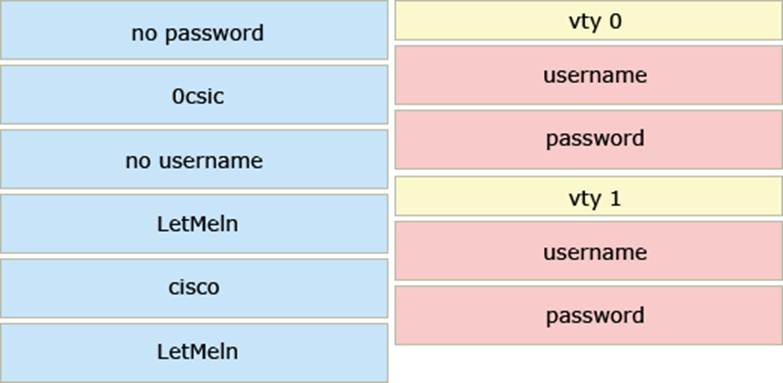
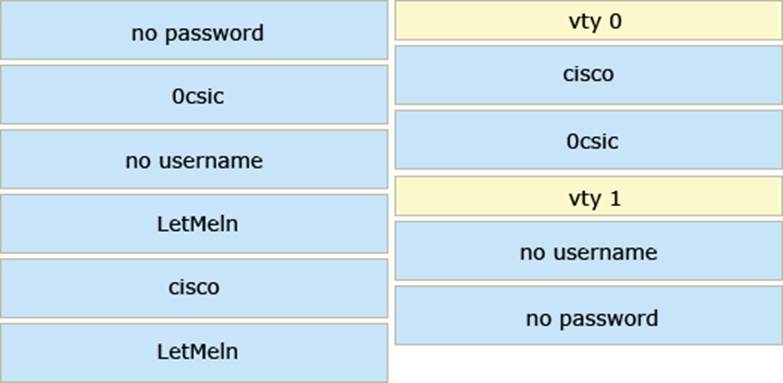
Explanation:
vty 0:
+ cisco
+ 0csic vty 1:
+ no username
+ no password
The command “aaa authentication login default none” means no authentication is required when access to the device via Console/VTY/AUX so if one interface does not specify another login authentication method (via the “login authentication …” command), it will allow to access without requiring username or password. In this case VTY 1 does not specify another authentication login method so it will use the default method (which is “none” in this case).
What is a function of BFD?
- A . peer recovery after a Layer 3 protocol adjacency failure
- B . peer recovery after a Layer 2 adjacency failure
- C . failure detection independent of routing protocols and media types
- D . failure detection dependent on routing protocols and media types
Refer to the exhibit.
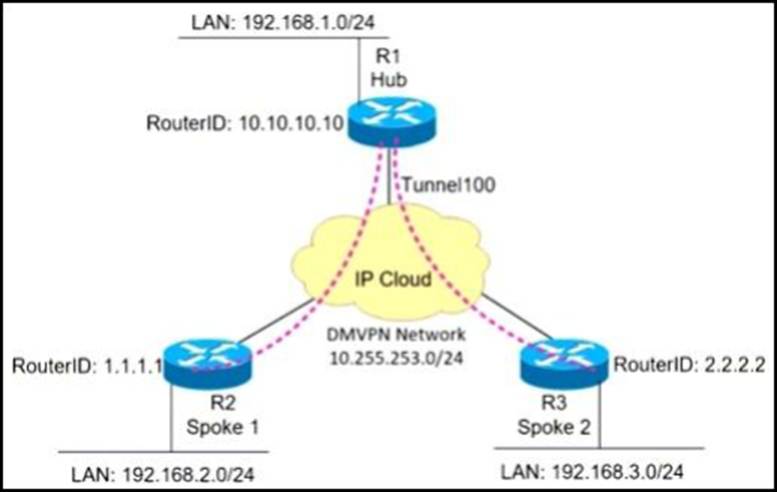
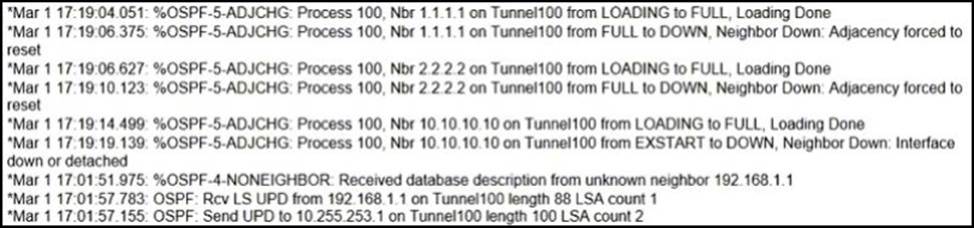
A network administrator sets up an OSPF routing protocol for a DMVPN network on the hub router.
Which configuration required to establish a DMVPN tunnel with multiple spokes?
- A . ip ospf network point-to-multipoint on both spoke routers
- B . ip ospf network point-to-point on the hub router
- C . ip ospf network point-to-multipoint on One spoke router
- D . ip ospf network point-to-point on both spoke routers
Refer to the exhibit.
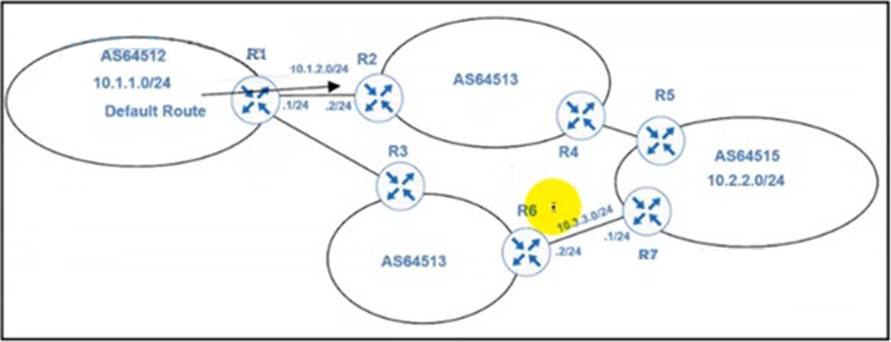
An engineer must configure PBR on R1 to reach to 10.2.2.0/24 via R3 AS64513 as the primary path and a backup route through default route via R2 AS64513. All BGP routes are in the routing table of R1. but a static default route overrides BGP routes.
Which PBR configuration achieves the objective?
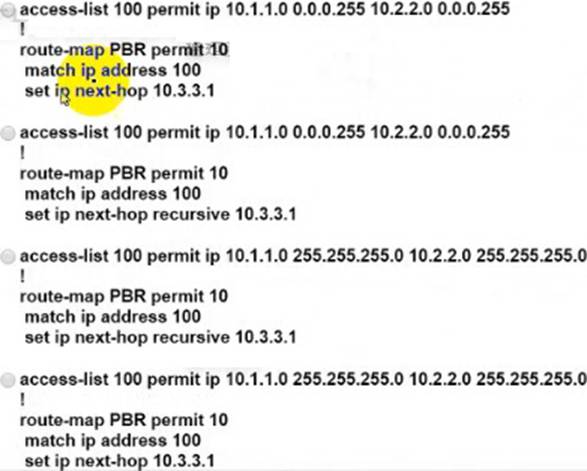
- A . Option A
- B . Option B
- C . Option C
- D . Option D