
Cisco 300-410 Practice Exams
Last updated on Nov 16,2026- Exam Code: 300-410
- Exam Name: Implementing Cisco Enterprise Advanced Routing and Services (ENARSI)
- Certification Provider: Cisco
- Latest update: Nov 16,2026
Refer to the exhibit.
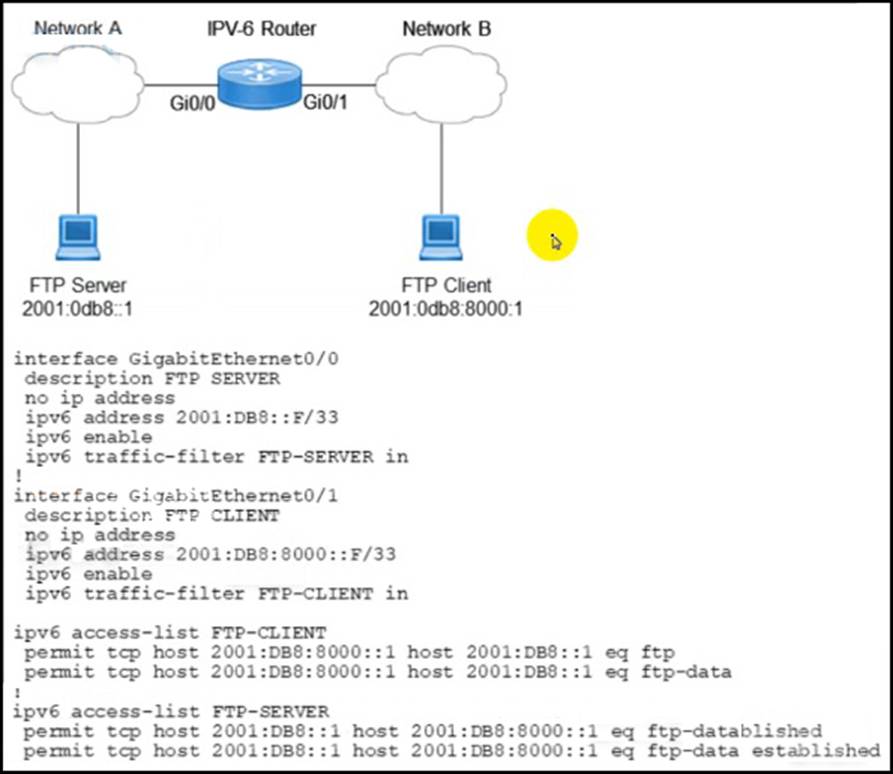
When an FTP client attempts to use passive FTP to connect to the FTP server, the file transfers fail.
Which action resolves the issue?
- A . Configure active FTP traffic.
- B . Modify FTP-SERVER access list to remove established at the end.
- C . Modify traffic filter FTP-SERVER in to the outbound direction.
- D . Configure to permit TCP ports higher than 1023.
Refer to the exhibit.

R2 can reach Loopback222, but R1 SW1 and PC1 cannot communicate with 172.16.222 254 R1 and R2 configurations are shown here
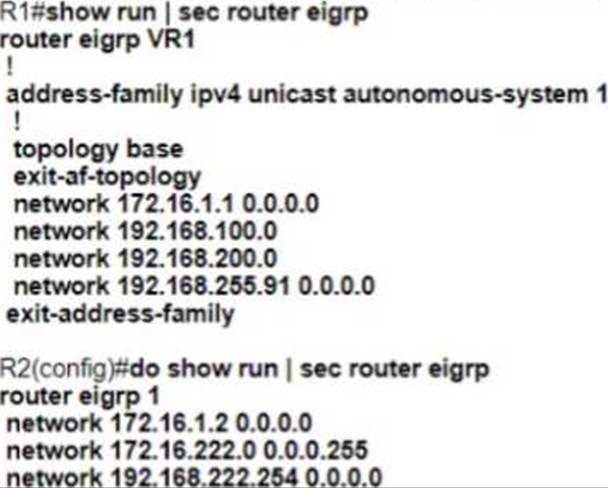
Which EIGRP configuration command resolves the issue?
- A . R2 (config-router) # redistribute static
- B . R1 (config-router)# network 172.16.222.254 0.0.0.0
- C . R1 (config-router)# network 172.16.222.264 255.255.255.255
- D . R1 (config-router)# redistribute static
Refer to the exhibit.
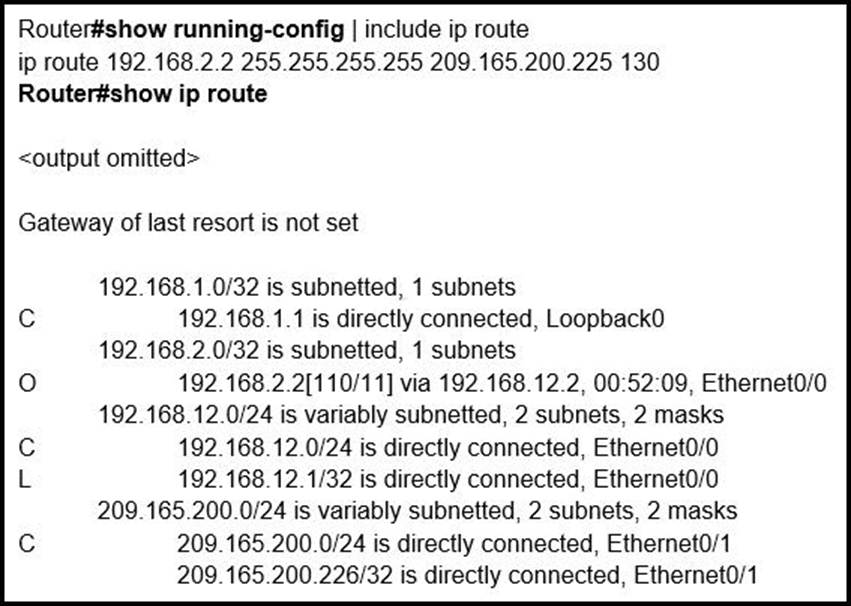
An engineer configures a static route on a router, but when the engineer checks the route to the destination, a different next hop is chosen.
What is the reason for this?
- A . Dynamic routing protocols always have priority over static routes.
- B . The metric of the OSPF route is lower than the metric of the static route.
- C . The configured AD for the static route is higher than the AD of OSPF.
- D . The syntax of the static route is not valid, so the route is not considered.
C
Explanation:
The AD of static route is manually configured to 130 which is higher than the AD of OSPF router which is 110.
Refer to the exhibit.
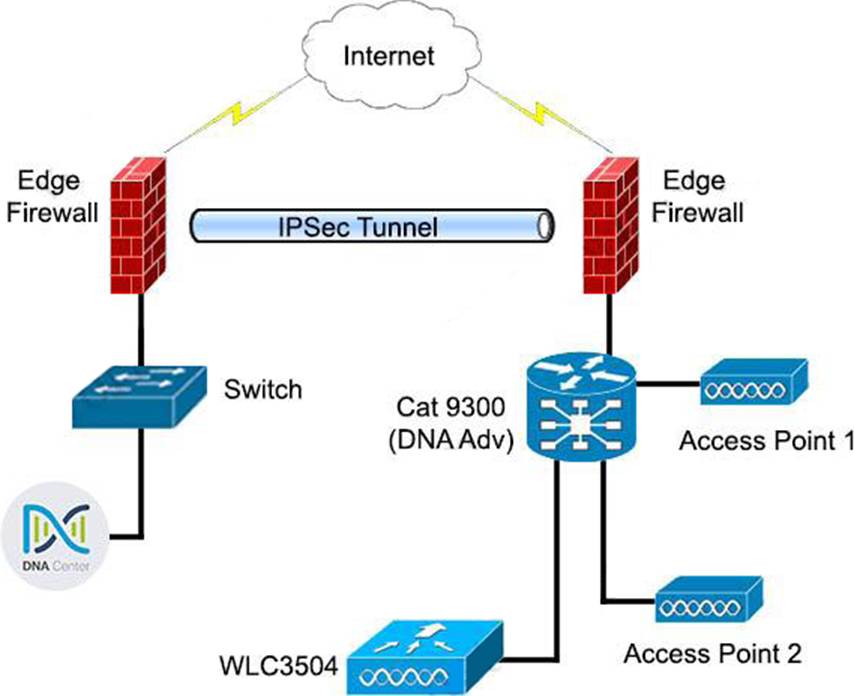
A network administrator is discovering a Cisco Catalyst 9300 and a Cisco WLC 3504 in Cisco DNA Center. The Catalyst 9300 is added successfully However the WLC is showing [ error "uncontactable" when the administrator tries to add it in Cisco DNA Center.
Which action discovers WLC in Cisco DNA Center successfully?
- A . Copy the .cert file from the Cisco DNA Center on the USB and upload it to the WLC 3504.
- B . Delete the WLC 3504 from Cisco DNA Center and add it to Cisco DNA Center again.
- C . Add the WLC 3504 under the hierarchy of the Catalyst 9300 connected devices.
- D . Copy the .pern file from the Cisco DNA Center on the USB and upload it to the WLC 3504.
D
Explanation:
https://www.cisco.com/c/en/us/support/docs/wireless/4400-series-wireless-lan-controllers/109597-csr-chained-certificates-wlc-00.html#anc12
Refer to the exhibit.
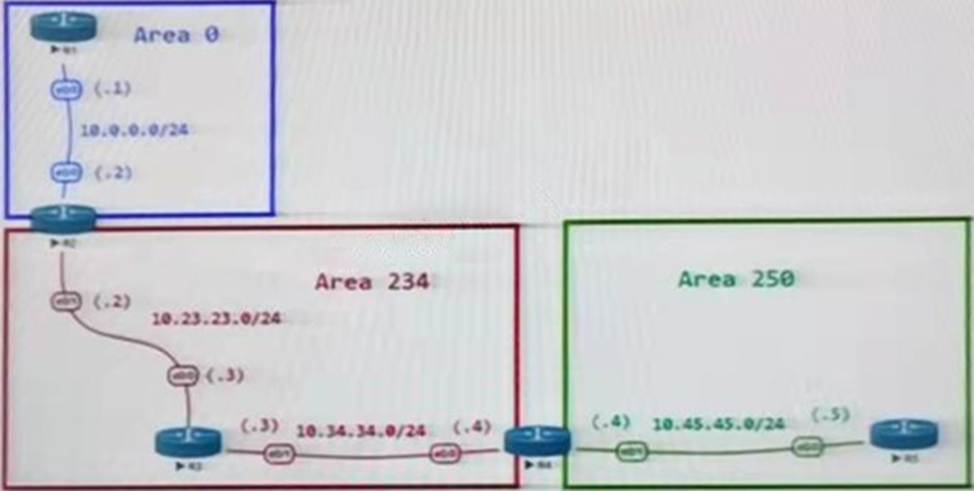
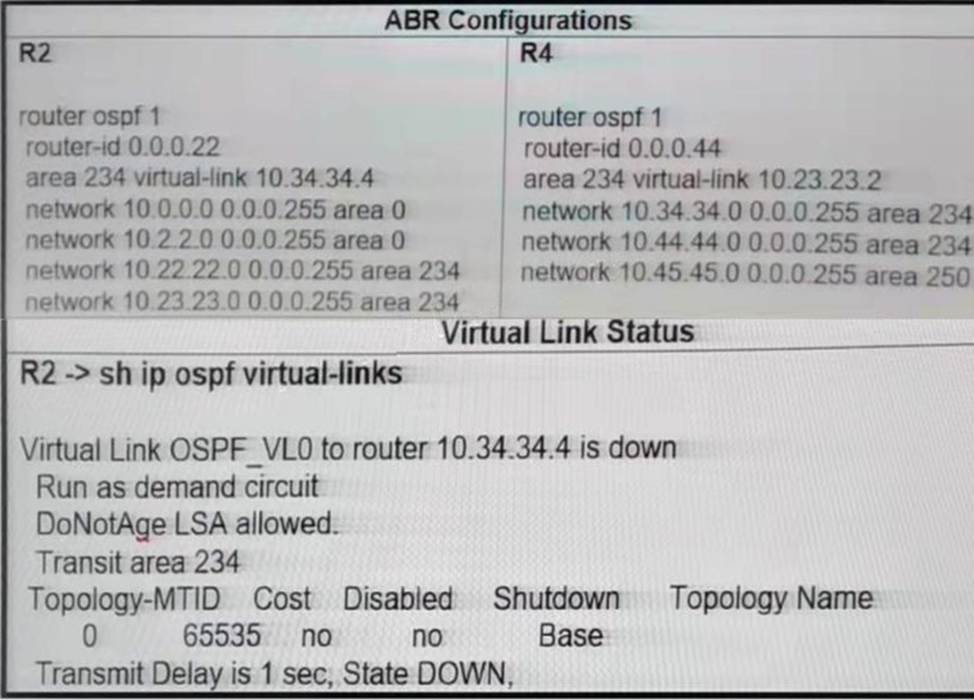
The network administrator configured the network to connect two disjointed networks and ail the connectivity is up except the virtual link which causes area 250 to be unreachable.
Which two configurations resolve this issue? (Choose two.)
- A . R2
router ospf 1
router-id 10.23.23.2 - B . R2
router ospf 1
no area area 234 virtual-link 10.34.34.4
area 0 virtual-link 0.0.0.44 - C . R4
router ospf 1
no area 234 virtual-link 10.23.23.2
area 234 virtual-link 0.0.0.22 - D . R2
router ospf 1
no area 234 virtual-link 10.34.34.4
area 234 virtual-link 0.0.0.44 - E . R4
router ospf 1
no area area 234 virtual-link 10.23.23.2
area 0 virtual-link 0.0.0.22
C,D
Explanation:
Reference: https://www.cisco.com/c/en/us/support/docs/ip/open-shortest-path-first-ospf/13703-8.html
An important thing to remember when configuring virtual-link is we need to configure the OSPF router
ID and NOT the IP address of the ABR. Therefore in this question we have to use the command “area 234 virtual-link 0.0.0.44” on R2 and “area 234 virtual-link 0.0.0.22” on R4.
Which method changes the forwarding decision that a router makes without first changing the routing table or influencing the IP data plane?
- A . nonbroadcast multiaccess
- B . packet switching
- C . policy-based routing
- D . forwarding information base
Refer to the exhibit.
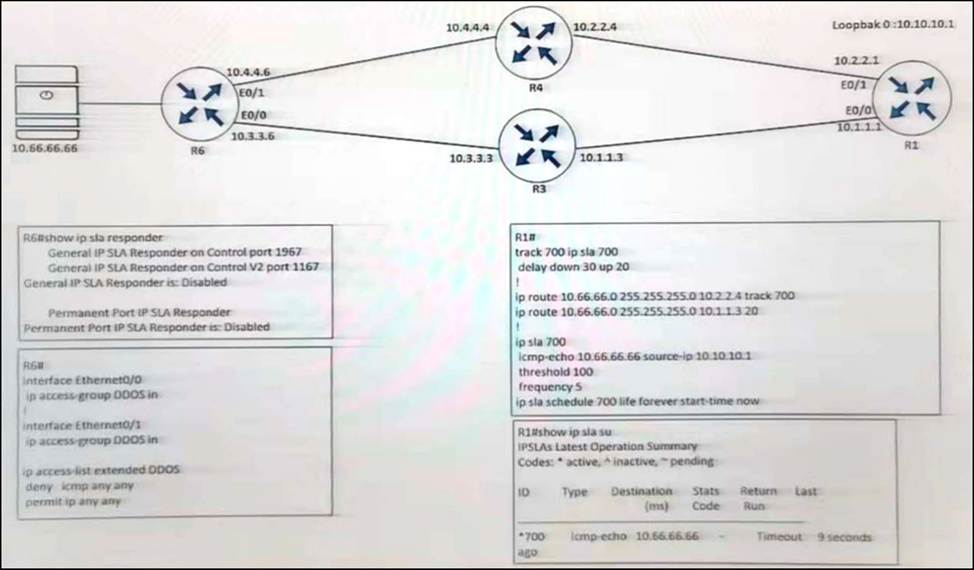
R1 is configured with IP SLA to check the availability of the server behind R6 but it kept failing.
Which configuration resolves the issue?
- A . R6(config)# ip sla responder
- B . R6(config)# ip sla responder udp-echo ip address 10.10.10.1 port 5000
- C . R6(config)# ip access-list extended DDOS
R6(config ext-nac)# 5 permit icmp host 10.66 66.66 host 10.10.10.1 - D . R6(config)# ip access-list extended DDOS
R6(confg ext-nac)# 5 permit icmp host 10.10.10.1 host 10.66.66.66
D
Explanation:
In this IP SLA tracking, we don’t need a IP SLA Responder so the command “ip sla responder” on R6 is not necessary.
We also notice that the ACL is blocking ICMP packets on both interfaces E0/0 & E0/1 of R6 so we need
to allow ICMP from source 10.10.10.1 to destination 10.66.66.66.
Refer to the exhibit.
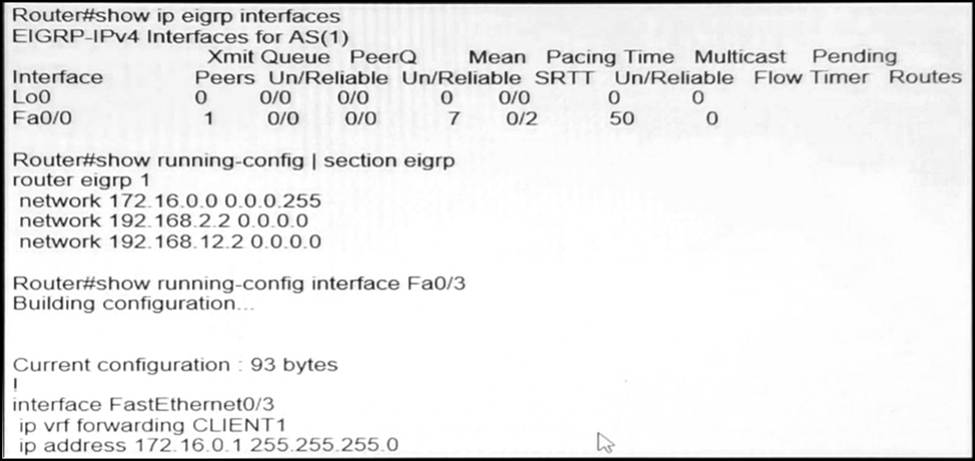
While troubleshooting an EIGRP neighbor adjacency problem, the network engineer notices that the interface connected to the neighboring router is not participating in the EIGRP process.
Which action resolves the issues?
- A . Configure the network command to network 172.16.0.1 0.0.0.0
- B . Configure the network command under EIGRP address family vrf CLIENT1
- C . Configure EIGRP metrics on interface FastEthernet0/3
- D . Configure the network command under EIGRP address family ipv4
B
Explanation:
router eigrp 1
!
address-family ipv4 vrf CLIENT1
network 172.16.0.0 0.0.0.255
no auto-summary
autonomous-system 1
exit-address-family
Refer to the exhibit.
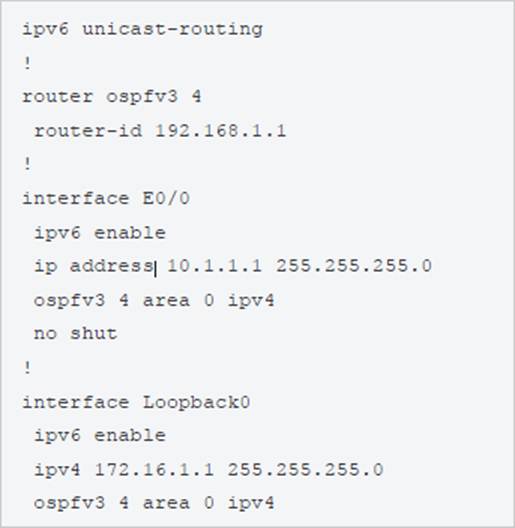
The network administrator configured the branch router for IPv6 on the E 0/0 interface The neighboring router is fully configured to meet requirements, but the neighbor relationship is not coming up.
Which action fixes the problem on the branch router to bring the IPv6 neighbors up?
- A . Enable the IPv4 address family under the E 0/0 interface by using the address-family Ipv4 unicast command
- B . Disable IPv6 on the E 0/0 interface using the no ipv6 enable command
- C . Enable the IPv4 address family under the router ospfv3 4 process by using the address-family ipv4 unicast command
- D . Disable OSPF for IPv4 using the no ospfv3 4 area 0 ipv4 command under the E 0/0 interface.
C
Explanation:
Once again, Cisco changed the IOS configuration commands required for OSPFv3 configuration. The new OSPFv3 configuration uses the “ospfv3” keyword instead ofthe earlier “ipv6 router ospf” routing process command and “ipv6 ospf” interface commands.
The Open Shortest Path First version 3 (OSPFv3) address families feature enables both IPv4 and IPv6 unicast traffic to be supported. With this feature, users may havetwo processes per interface, but only one process per address family (AF).