
Cisco 300-410 Practice Exams
Last updated on Nov 16,2026- Exam Code: 300-410
- Exam Name: Implementing Cisco Enterprise Advanced Routing and Services (ENARSI)
- Certification Provider: Cisco
- Latest update: Nov 16,2026
Refer to the exhibit.
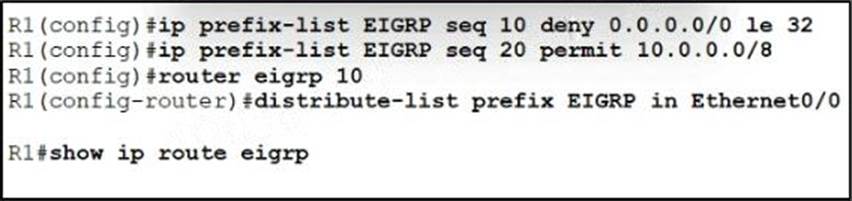
A prefix list is created to filter routes inbound to an EIGRP process except for network 10 prefixes After the prefix list is applied no network 10 prefixes are visible in the routing table from EIGRP.
Which configuration resolves the issue?
- A . ip prefix-list EIGRP seq 20 permit 10.0.0.0/8 ge 9.
- B . ip prefix-list EIGRP seq 10 permit 0.0.0.0/0 le 32
- C . ip prefix-list EIGRP seq 5 permit 10.0.0.0/8 ge 9 no
ip prefix-list EIGRP seq 20 permit 10.0.0.0/8 - D . ip prefix-list EIGRP seq 20 permit 10.0.0.0/8 ge 9
ip prefix-list EIGRP seq 10 permit 0.0.0.0/0 le 32
The network administrator deployed the Binding Table Recovery feature.
Which two devices recover the missing binding table entries? (Choose two.)
- A . DHCP client
- B . DHCP server
- C . destination host
- D . source host
- E . DHCP relay agent
SIMULATION
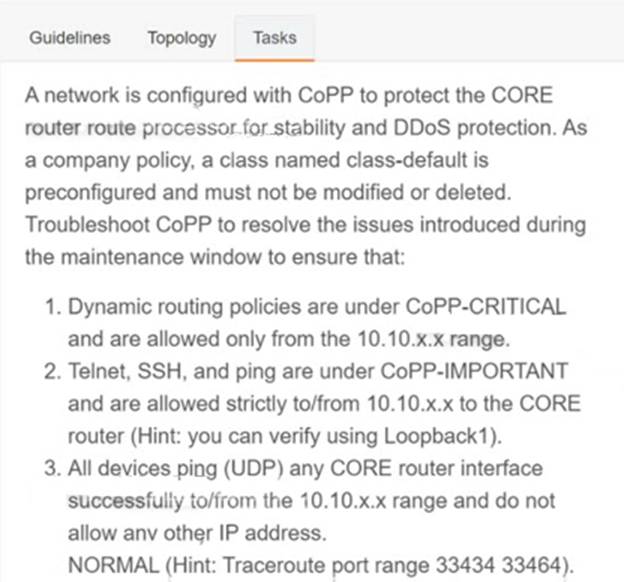
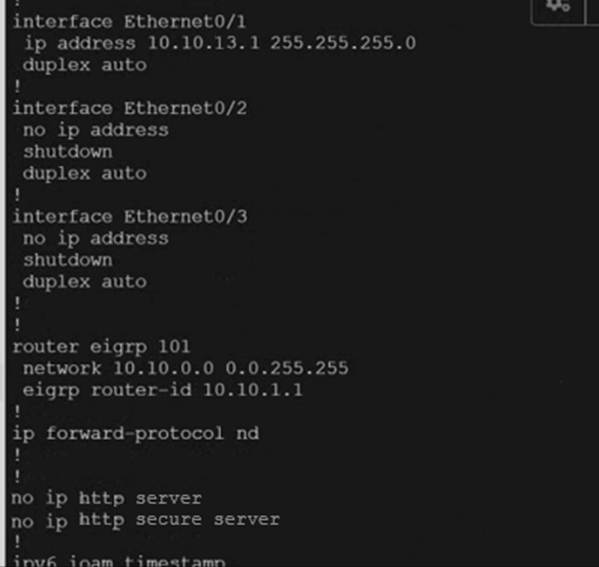
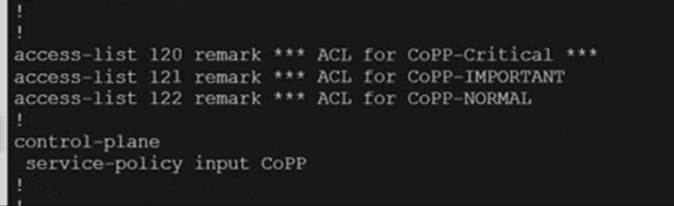
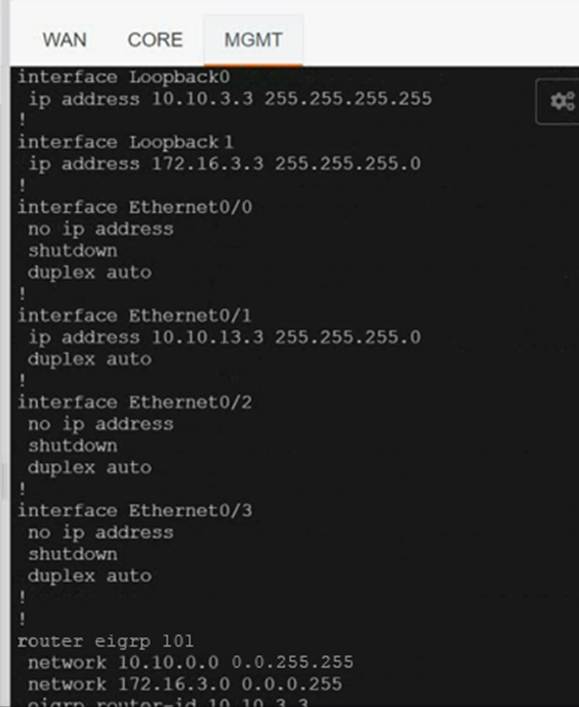
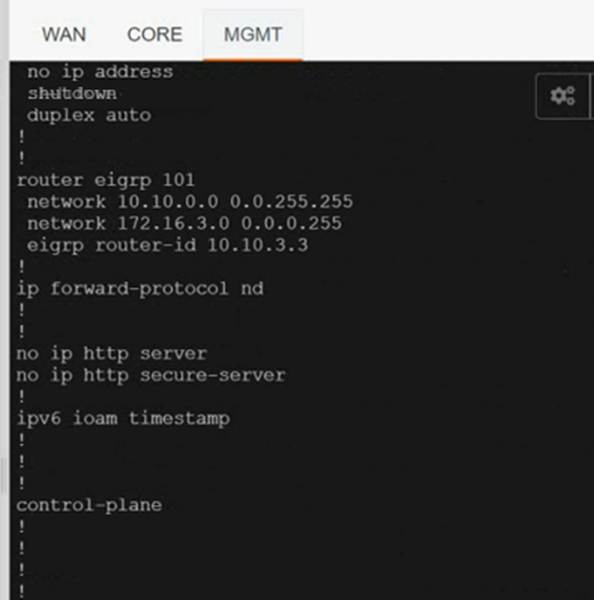
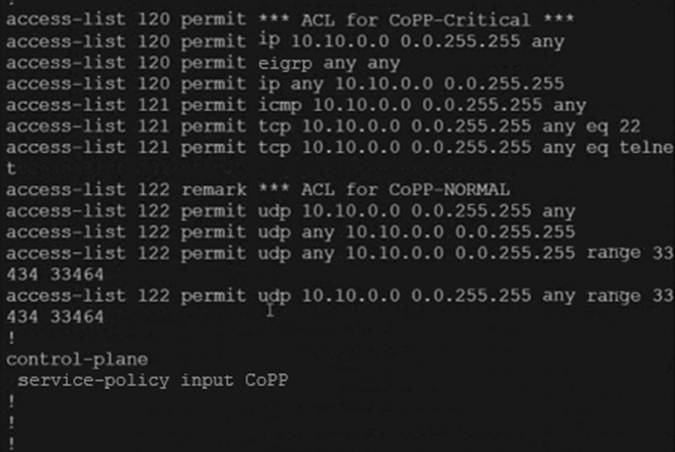
A network is configured with CoPP to protect the CORE router route processor for stability and DDoS protection. As a company policy, a class named class-default is preconfigured and must not be modified or deleted.
Troubleshoot CoPP to resolve the issues introduced during the maintenance window to ensure that:
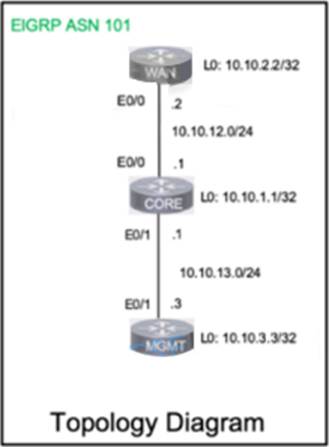
WAN
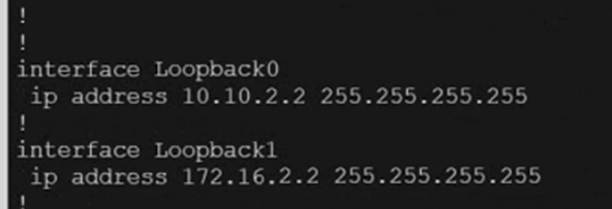
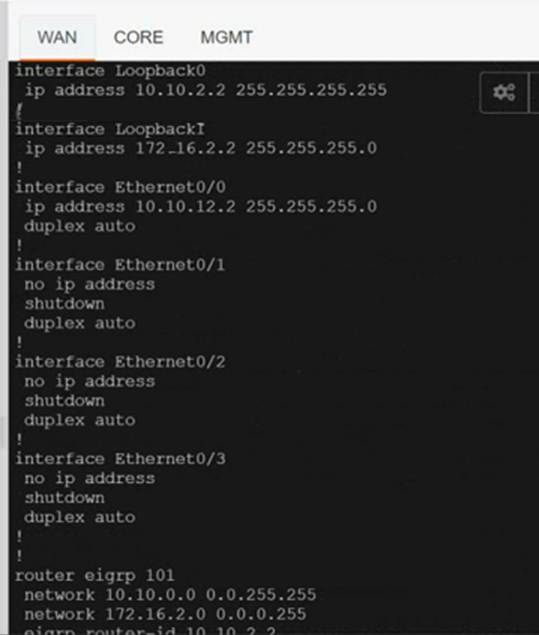
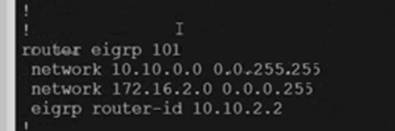
CORE
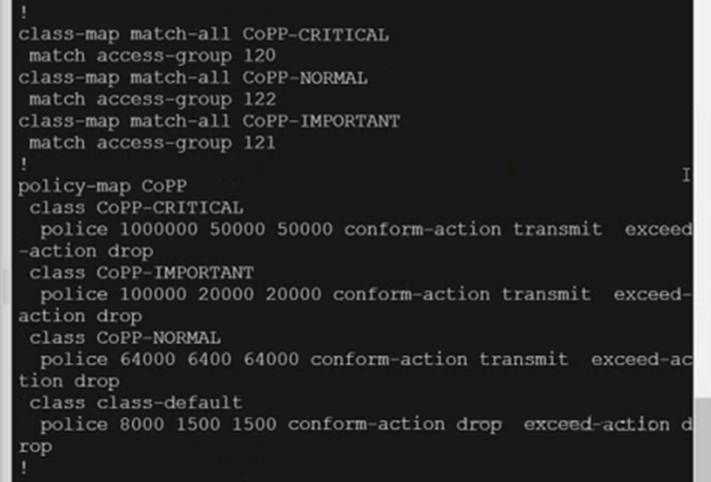
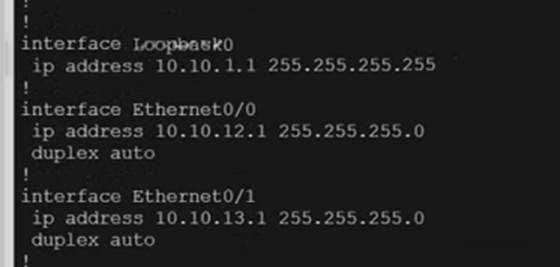
MGMT
policy-mao CoPP
class CoPP-CRITICAL
police 1000000 50000 50000 conform-action transmit exceed-action transmit
Text Description automatically generated with medium confidence
CORE# Copy run start
TESTING: –
CORE
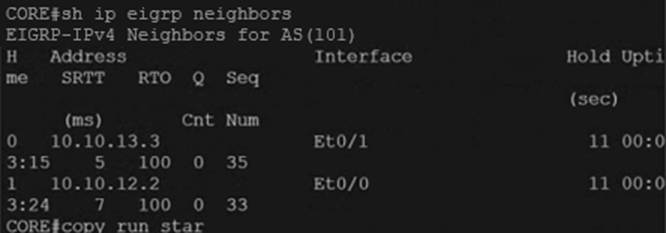
Graphical user interface Description automatically generated with medium confidence
MGMT
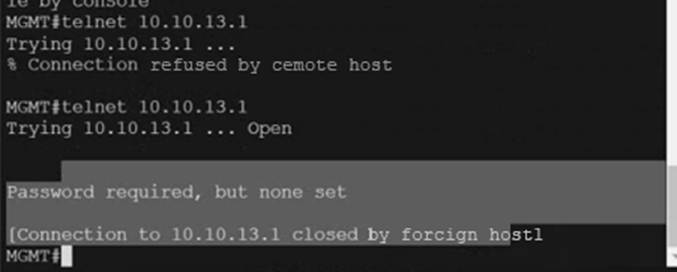
Graphical user interface, text Description automatically generated
What is an advantage of implementing BFD?
- A . BFD provides faster updates for any flapping route.
- B . BFD provides millisecond failure detection
- C . BFD is deployed without the need to run any routing protocol
- D . BFD provides better capabilities to maintain the routing table
Refer to the exhibit.
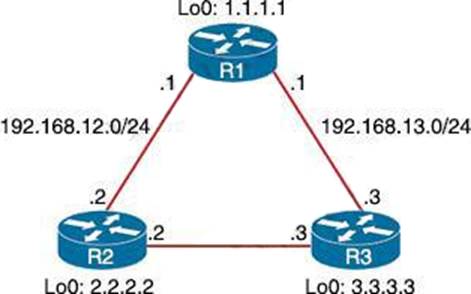
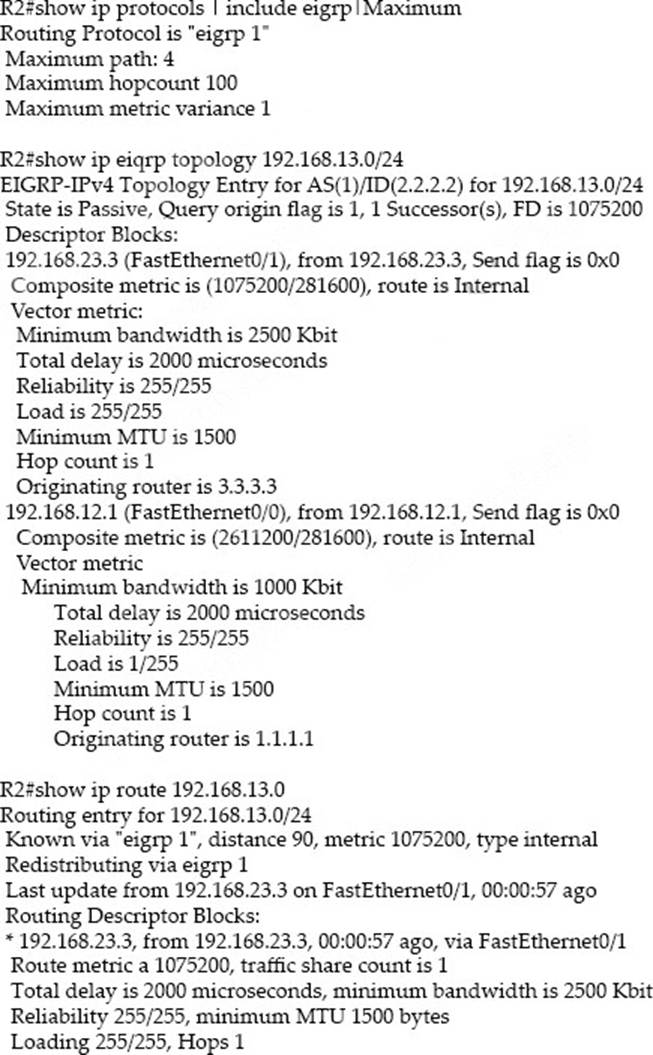
R2 has two paths to reach 192.168.13.0/24. but traffic is sent only through R3.
Which action allows traffic to use both paths?
- A . Configure the bandwidth 2000 command under interface FastEthernet0/0 on R2.
- B . Configure the variance 4 command under the EIGRP process on R2.
- C . Configure the delay 1 command under interface FastEthernet0/0 on R2.
- D . Configure the variance 2 command under the EIGRP process on R2
B
Explanation:
From the output of the “show ip eigrp topology …” command, we notice network 192.168.13.0/24 was learned via two routes:
+ From 192.168.23.3 (R3) with FD = 1075200 and AD = 281600
+ From 192.168.12.1 (R1) with FD = 2611200 and AD = 281600
From the output of the “show ip route …” command, we learned that the best (and chosen) path is via 192.168.23.3 (R3).
To use both paths (called unequal cost load balancing) with EIGRP, the second path via R1 must satisfy the feasibility condition. The feasibility condition states that, the Advertised Distance (AD) of a route must be lower than the feasible distance of the current successor route.
In this case, the second path satisfies the feasible condition as its AD (281600) is smaller than the FD (1075200) of the best path. Therefore we can configure loadbalancing with “variance” command.
In other words, EIGRP will install all paths with metric < variance * best_metric into the local routing table, provided that it meets the feasibility condition to preventrouting loop. Therefore we can calculate the variance > metric / best_metric = 2611200 / 1075200 =2.4.
So with a variance greater than 2 (and must be an integer), we can load balance traffic to network 192.168.13.0/24.
Refer to the exhibit.
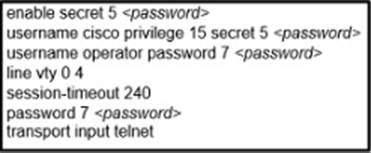
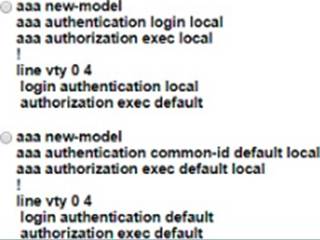
The authentication is not working as desired and the user drops into user-exec mode.
Which configuration resolves the issue?
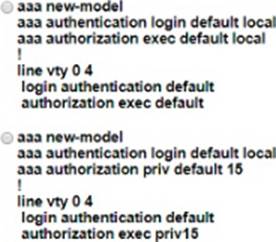
- A . Option A
- B . Option B
- C . Option C
- D . Option D
Refer to the exhibit.
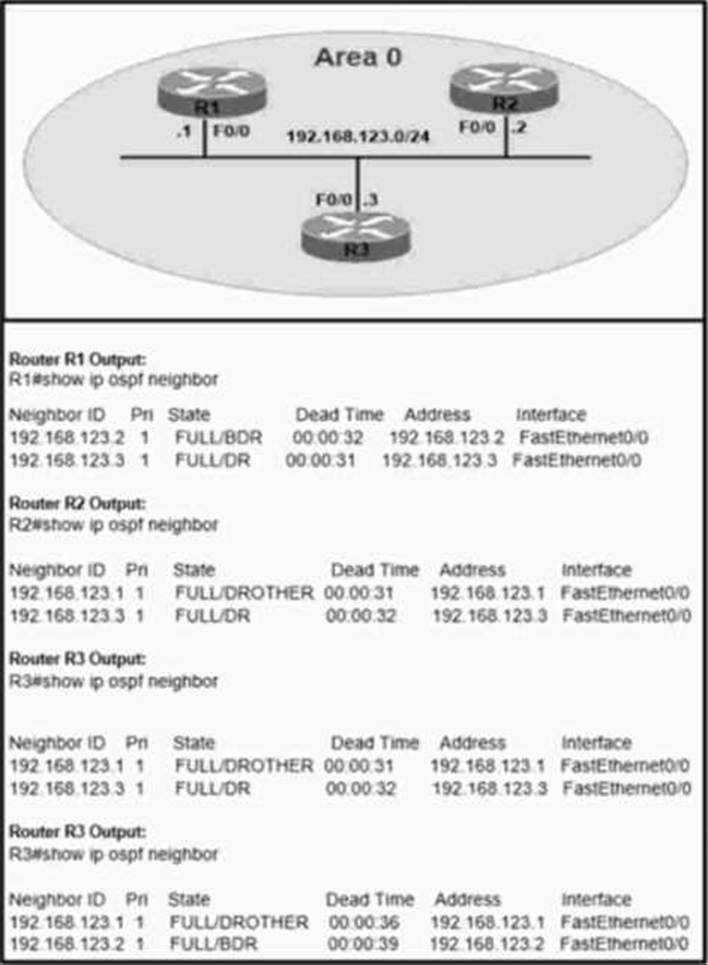
An administrator wanted to make R1 always elected as DR. R2 as BDR. and R3 as DROTHER but could not achieve the desired results.
Which two configurations resolve the issue? (Choose two.)
- A . On the R1 FO/0 interface, configure OSPF priority to 255.
- B . On the R2 FO/0 interface, configure OSPF priority to 201.
- C . On the R1 F0/0 interface, configure OSPF priority to 202.
- D . On the R3 FO’O interface, configure OSPF priority to 201.
- E . On the R2 FO/0 interface, configure OSPF priority to 200.
Refer to the exhibit.
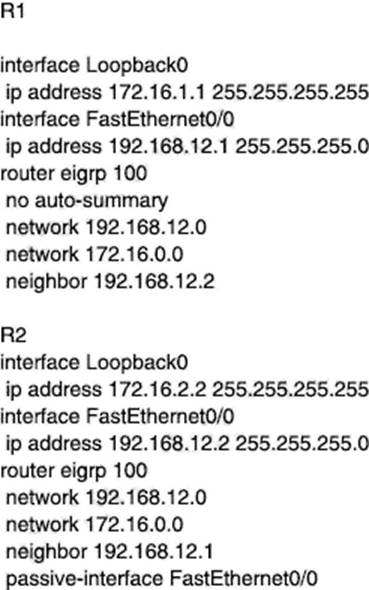
R1 and R2 cannot establish an EIGRP adjacency.
Which action establishes EIGRP adjacency?
- A . Remove the current autonomous system number on one of the routers and change to a different value.
- B . Remove the passive-interface command from the R2 configuration so that it matches the R1 configuration.
- C . Add the no auto-summary command to the R2 configuration so that it matches the R1 configuration.
- D . Add the passive-interface command to the R1 configuration so that it matches the R2 configuration.
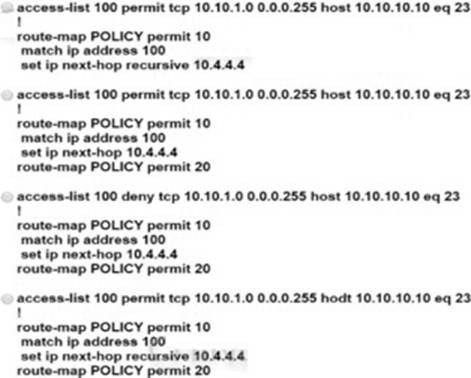
An engineer must override the normal routing behavior of a router for Telnet traffic that is destined to 10.10.10.10 from 10.10.1.0/24 via a next hop of 10.4.4.4. which is directly connected to the router that is connected to the 10.1.1.0/24 subnet.
Which configuration reroutes traffic according to this requirement?
- A . Option A
- B . Option B
- C . Option C
- D . Option D
Refer the exhibit.
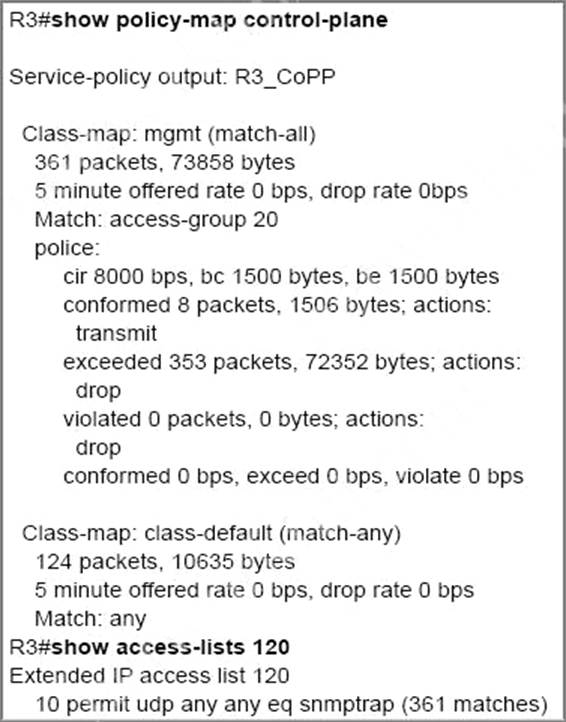
Which action resolves intermittent connectivity observed with the SNMP trap packets?
- A . Decrease the committed burst Size of the mgmt class map
- B . Increase the CIR of the mgmt class map
- C . Add a new class map to match TCP traffic
- D . Add one new entry in the ACL 120 to permit the UDP port 161