
CIPS L4M5 Practice Exams
Last updated on Oct 22,2026- Exam Code: L4M5
- Exam Name: Commercial Negotiation
- Certification Provider: CIPS
- Latest update: Oct 22,2026
Which of the following is the internal factor that is taken into price of a product?
- A . Risk management
- B . Customer tastes
- C . Elasticity
- D . Exchange rate
A
Explanation:
In order to answer this question, you should better consider each option:
‘Exchange rate’ is the value of one nation’s currency versus the currency of another nation or economic zone. This is a macroeconomic factor.
‘Elasticity’ refers to the degree to which individuals, consumers or producers change their demand or the amount supplied in response to price or income changes. This is a microeconomic factor Consumer tastes refer to the products and services that consumers consciously choose over others. Consumer tastes are so powerful that they can change how businesses conduct their activity. Like elasticity, this is also a microeconomic factor.
Among 4 options, only risk management is the internal factor. Risk pricing is a strategy applied by many companies in the world. To learn how to price the risk, you can read an article from McKinsey: https://www.mckinsey.com/business-functions/marketing-and-sales/our-insights/how-to-price-risk-to-win-and-profit
This is a question that a student met in her actual exam. The knowledge section is unknown. LO: Unknown, AC: Unknown
A procurement expert has been asked to ensure they consider emotional intelligence in their negotiation strategy. They have agreed to this and have started planning their approach.
Which of the following describes emotional intelligence?
- A . An individual’s ability to gain leverage by persuading the other party to agree to their terms
- B . An individual’s ability to fully understand another party’s cost drivers and profit margins
- C . An individual’s ability to understand their own feelings and those of other people
- D . An individual’s ability to place themselves in a position of authority during a negotiation
C
Explanation:
Emotional intelligence involves the ability to recognize and manage one’s emotions and empathize with others. This skill allows negotiators to respond appropriately to both their own feelings and the emotional cues of the other party, fostering a more constructive and adaptive negotiation environment. CIPS highlights emotional intelligence as a valuable asset in understanding and influencing negotiation dynamics.
Maria has adopted an adversarial style relationship with her stationery supplier. This relationship style can be characterised by which of the following? Select the TWO that apply.
- A . Minimal sharing of information
- B . Requirement to exceed expectations
- C . Degree of mutual commitment
- D . Use of power to seek the best possible deal
- E . Requirement to secure quality of supply
A, D
Explanation:
An adversarial relationship is characterized by a competitive, often zero-sum approach where:
Minimal sharing of information (A): In adversarial settings, there is limited transparency as each party prioritizes its interests.
Use of power to seek the best possible deal (D): Power dynamics are leveraged to gain favorable terms, often at the expense of the other party.
This style typically lacks collaboration and mutual commitment, focusing instead on short-term gains rather than building a partnership, as described in CIPS resources on adversarial relationships.
A procurement professional is sourcing low value items. He conducts market analysis and realise that these items can be provided by many suppliers and switching cost between suppliers is relatively low. He also assume that the relationship between buyer and supplier will be transactional rather than long-term.
According to Thomas-Kilmann conflict model instrument, which of the following is the most appropriate style that the procurement professional should adopt when negotiating with these suppliers?
- A . Avoiding
- B . Compromising
- C . Competing
- D . Collaborating
C
Explanation:
According to Thomas-Kilmann conflict model instrument, there are 5 conflict management styles:
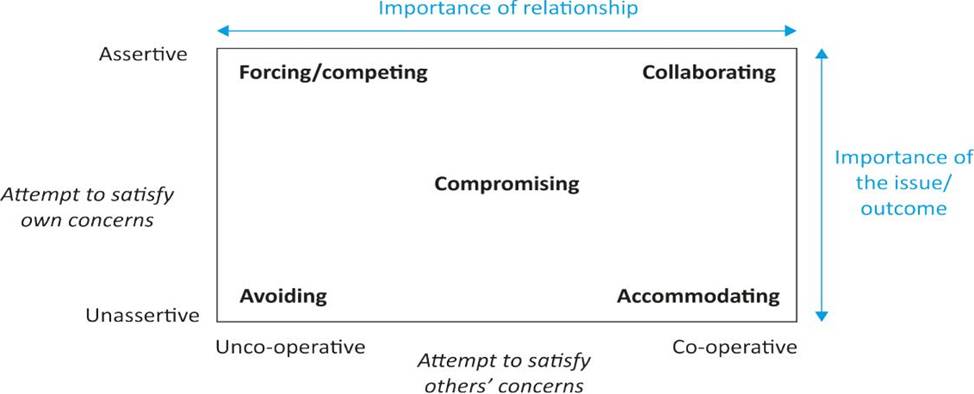
In this scenario, the buyer’s bargaining power is stronger than suppliers’, and the relationship is transactional. Therefore, to get the most preferable outcome, the procurement professional can take an assertive approach, while he doesn’t need to co-operate closely with these suppliers. Competing will be the most appropriate approach to negotiation in this scenario so that the buying organisation can get a better deal.
Where there are high levels of commitment to relationships between both the buyer and supplier, this is seen as collaborative and beneficial to negotiations. Is this statement correct?
- A . Yes, characteristics include risk management and strategic planning
- B . No, this can be classified as adversarial
- C . Yes, characteristics include arm’s length transactions and minimal communication
- D . No, collaboration does not require commitments from either side
A
Explanation:
A collaborative relationship is characterized by mutual commitment, which enhances risk management and strategic planning between buyer and supplier. High levels of trust and commitment enable both parties to work closely to achieve shared objectives, creating a beneficial negotiation environment. This approach aligns with CIPS’s principles of collaborative procurement relationships.
XYZ Ltd decides to go to market for a cleaning contract to service a number of offices. It knows that it will get a price which may, or may not, be better than the one it is currently paying.
To gain leverage in the marketplace, the organisation decides to add other related services to the scope, such as gardening, security and maintenance, which increase the value of the contract. This is an example of which forms of spend consolidation?
- A . Purchasing consortia
- B . Volume consolidation across categories
- C . Volume pooling
- D . Volume redistribution
B
Explanation:
Buying organisation may increase its leverage with suppliers by concentrating spend.
Supplier spend consolidation can take many forms as outlined below:
– Vendor base reduction: straightforward reduction of number of suppliers in any category
– Volume pooling: pooling cross organisational requirement until your order volume is high enough
to attract new bidders/additional discounts
– Volume redistribution: making recommendations following spend analysis to move from one supplier to another
– Volume consolidation across categories: certain purchase requirements may be common across a number of categories. In the scenario, XYZ has combined different categories but closely related to office services into a larger contract so that they can increase their leverage.
– Standardisation and harmonisation of specifications: analysis of specifications and standards for a high spend purchased input, may show that there is a little difference between them and that the specification can be standardised or at least harmonised across the group or across national, regional or global operations.
– Forming purchasing consortia: buyers may decide to come together and combine their purchase volumes to attract better deals.
LO 1, AC 1.3
A wide range of factors may be taken into account by suppliers when setting or negotiating prices.
Which of the following are external factors in pricing decisions? Select TWO that apply.
- A . Competition in the market
- B . Cost of production
- C . Where the product is in its lifecycle
- D . Customer perception of value
- E . Costs of sales
A, D
Explanation:
External factors in pricing decisions include Competition in the market (A) and Customer perception of value (D).
These factors are outside the supplier’s direct control but influence pricing strategies to remain competitive and meet customer expectations:
Competition in the market (A): Market competition dictates how much a supplier can charge without losing business to competitors.
Customer perception of value (D): How customers perceive the product’s worth affects its acceptable price range.
These factors are considered external as they relate to market dynamics rather than internal cost structures, according to CIPS’s guidance on pricing influences.